
Quick Answer
AI for manufacturing is a 5-phase deployment covering predictive maintenance ($630K/year savings), ai defect detection (97-99% accuracy), smart supply chain forecasting (91-94% demand accuracy), robotics integration, and IIoT/PLC modernization. A mid-size US plant doing $40M/year in production invests $550,000-$900,000 across all phases and generates $1.5M-$2.1M in annual savings within year two. Braincuber deploys this as a 27-week phased rollout using Agentic AI with LangChain and CrewAI frameworks.
The Real Cost of Running a "Traditional" Plant
Here's what running a US manufacturing plant without smart manufacturing looks like in 2026. Three hemorrhages happening simultaneously, and most plant managers can only see one of them.
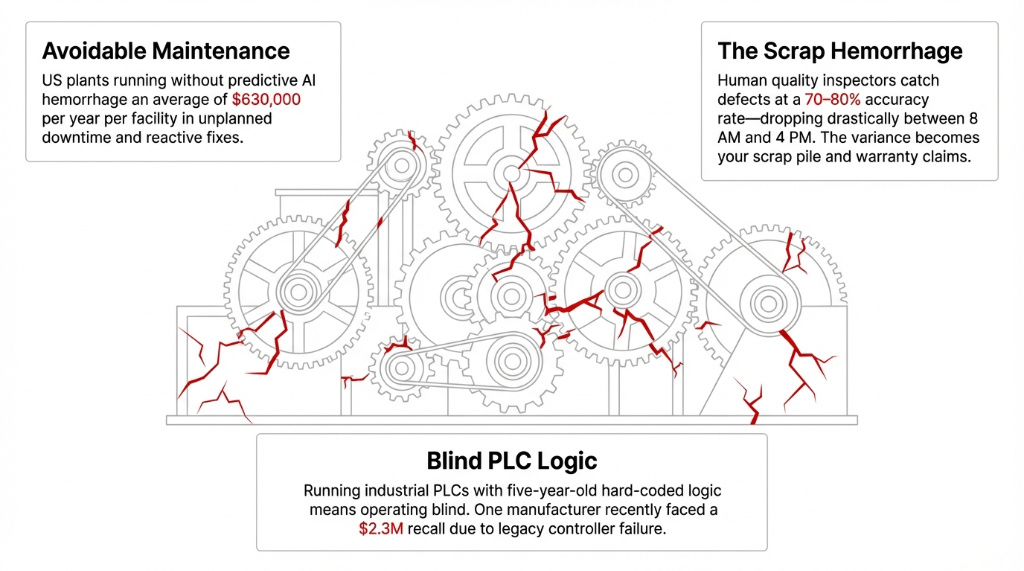
Avoidable Maintenance
Cost: $630,000 per year, per factory — the verified average savings predictive maintenance AI delivers when you finally deploy it.
That's not a projection. That's verified.
The Scrap Hemorrhage
Problem: Quality inspectors catch defects at 70-80% accuracy. Ai defect detection catches them at 97-99%. The gap is your scrap pile, warranty claims, and customer churn.
73% accuracy at 8 AM. 61% at 4 PM.
Blind PLC Logic
Running industrial plc logic hard-coded five years ago. Programmable logic controller manufacturers are shipping controllers with embedded AI. Plants on legacy plc and automation setups are calling us after a $2.3M recall.
Legacy plc automation = operating blind.
The problem is not that you don't know AI exists. The problem is that everyone keeps selling you concept instead of giving you a complete automation playbook. So here it is — through our AI solutions practice.
Phase 1 — Predictive Maintenance (The Fastest $630K You'll Ever Make)
A US automotive plant deployed AI on their robotic arms and conveyor belts. Sensors tracked vibration patterns, temperature deviations, and torque anomalies. The AI model predicted failures two weeks in advance.
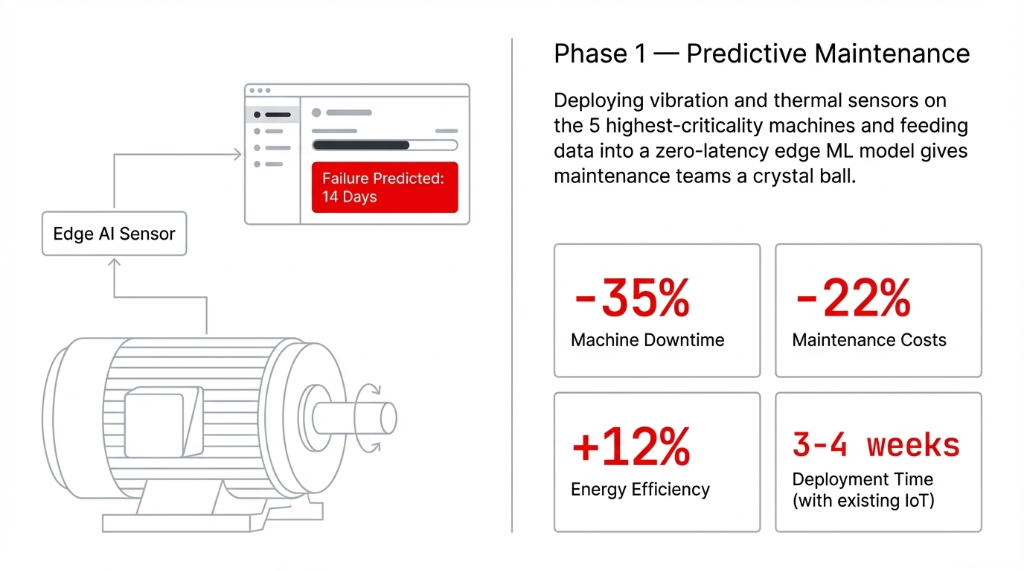
Phase 1 Results: Predictive Maintenance AI
-35%
Machine downtime reduction. Production automation at its most practical — giving your maintenance team a crystal ball.
-22%
Maintenance costs slashed. Not replacing your workforce — redirecting spend from reactive to preventive.
+12%
Energy efficiency improvement. Smart manufacturing that pays for itself in utility savings alone.
3-4 wks
Deployment time if you're running iot for industry infrastructure already. 8-11 weeks from zero for full industrial iot 4.0 deployment.
The Playbook Step
(Yes, that timeline feels long. But one avoided conveyor shutdown pays for the entire project.)
Phase 2 — AI Defect Detection (Stop the Scrap Hemorrhage)
Here's the ugly truth about inspection automation: human inspectors are inconsistent. They catch 73% of defects at 8 AM and 61% at 4 PM. That variance alone is costing you product quality, rework hours, and customer trust.
Ai defect detection using computer vision doesn't have off days. Foxconn deployed AI vision systems and pushed defect detection accuracy from 95% to 99%. They also cut inspection operating costs by 33%. Siemens ran a similar project on PCB inspection — the AI identified which boards needed X-ray testing, cutting unnecessary X-ray runs by 30% while increasing throughput.
ROI Reality: Full-fledged AI vision infrastructure delivers 200-300% ROI through defect reduction alone. We've seen clients hit breakeven in 4.5 months. This is where ai in smart factory setups pay back the fastest.
Phase 3 — Smart Supply Chain & Demand Forecasting
You're either over-ordering raw materials and sitting on $400K in idle inventory, or you're under-ordering and stopping the line because a $12 component didn't arrive on time. Smart manufacturing solutions with AI-powered demand forecasting end both scenarios.
Ai in automation for supply chains yields 150-250% ROI by preventing stockouts, optimizing procurement timing, and reducing holding costs. The AI models predict demand with 91-94% accuracy — versus the 67% accuracy most manual planners operate at.
Supply Chain Playbook Step
Export 24 months of production orders and material consumption data. Integrate with your automation system — Odoo ERP works perfectly here, we use it for most of our US manufacturing clients. Set up automated reorder triggers tied to your iot industry 4.0 sensor data. Connect supplier portals directly for autonomous PO generation.
This is autonomous manufacturing in practice — not science fiction, not a pilot program. Live, running today through our AI development services.
Phase 4 — Robotics Integration (The Part Everyone Gets Wrong)
Look, robotics in industry is not about replacing humans. It is about redirecting them. We constantly see US plants dropping $1.2-$3.5M on robotic manufacturing installations without answering one question first: Which tasks genuinely require a robot?
Robotics and automation delivers the highest returns in three specific scenarios: repetitive high-precision tasks where human fatigue causes error rates above 2.1%, hazardous environments where OSHA compliance costs exceed $140K/year per position, and 24/7 production targets where shift premiums make human labor cost-prohibitive.
The Playbook Step Nobody Tells You
Don't buy robots before you've mapped your process in digital twin software. We've walked into plants where a $780K robotic arm was installed on a process that needed a $45,000 programmable automation controller upgrade instead.
Automation equipment manufacturers will always sell you the bigger solution. Your job is to define the problem before you buy the fix.
Robotic automation manufacturers — ABB, FANUC, Kuka — now offer ai industrial automation layers baked into controllers. Your robot learns. It adjusts grip pressure based on component weight variance. It recalibrates after detecting tooling wear. That's robotik ai in production, not in a lab.
Phase 5 — IIoT + PLC Modernization (The Foundation Nobody Wants to Fund)
Here's where most manufacturing automation projects collapse. You invest in AI. You invest in robotics. But your industrial plc infrastructure is running firmware from 2014, communicating over protocols your new AI system can't even read.
Iot in smart manufacturing requires a unified data layer. Upgrading to modern industrial plc controller hardware with MQTT or OPC-UA communication. Installing edge gateways to bridge legacy equipment into your iiot 4.0 network. Standardizing data schema across all production lines. Connecting everything to a central smart manufacturing systems dashboard.
Warning: A rushed PLC migration caused one Ohio-based auto parts plant to lose $184,000 in production over a 17-day debugging period. Budget 12-18 weeks for full automation in industry 4.0 infrastructure modernization. Do it before you layer AI on top. Plc manufacturers like Siemens, Allen-Bradley, and Mitsubishi now ship programmable automation controller units with native cloud connectivity — but the migration needs careful planning.
What Real ROI Looks Like in the First 24 Months
We don't believe in promises. We believe in math. AI in manufacturing delivers an average ROI of 3.5x within 2 years. Here's the breakdown for a mid-size US plant doing $40M/year.
| Initiative | Implementation Cost | Annual Savings | Payback Period |
|---|---|---|---|
| Predictive Maintenance AI | $180,000 | $630,000 | 3.4 months |
| AI Defect Detection | $240,000 | $310,000 | 9.3 months |
| Smart Supply Chain | $120,000 | $195,000 | 7.4 months |
| IIoT/PLC Modernization | $350,000 | $420,000 | 10 months |
The Bottom Line for a $40M Plant
10-15%
Boost in overall production efficiency. Smart manufacturing and automation delivering measurable throughput gains across every production line.
4-5%
EBITDA increase. On a $40M plant, that's $1.6M/year hitting your bottom line. Technologies in manufacturing that pay for themselves.
40%
AI projected to boost manufacturing productivity by 40% by 2035. Plants that start now will hit it. Plants that start in 2029 will play catch-up forever.
Why "Just Buy More Software" Is the Wrong Move
Controversial opinion: most automation solutions vendors are selling you complexity you don't need.
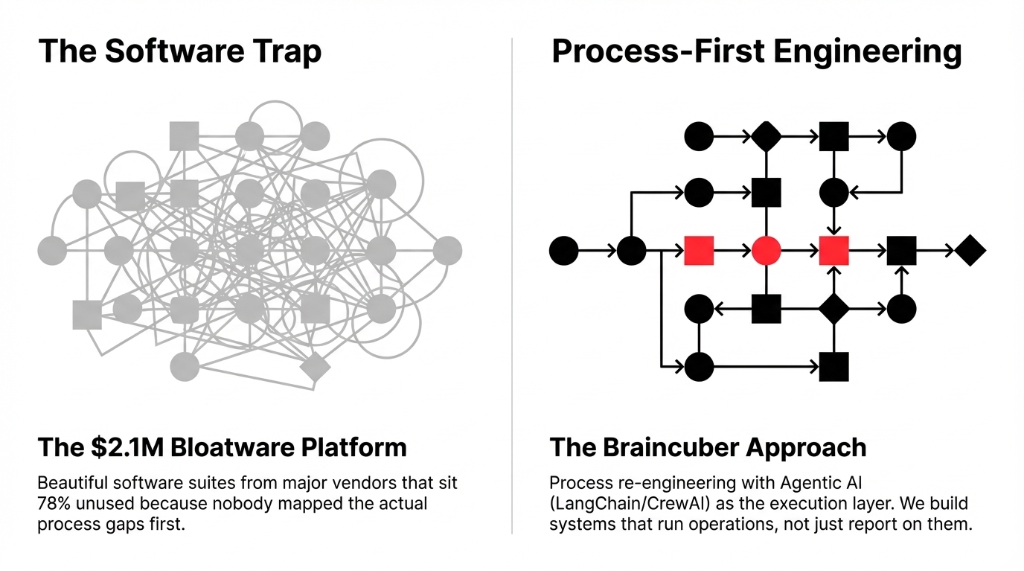
They'll pitch you a $2.1M smart manufacturing and automation platform when you actually need three focused AI modules and a proper automation in production workflow redesign. We've seen it with Rockwell, Siemens MindSphere, and SAP's manufacturing suite — beautiful platforms that sit 78% unused because nobody mapped the actual process gaps first.
Using ai in manufacturing is not a software purchase. It's a process re-engineering project with software as the execution layer. The future of smart manufacturing belongs to plants that solve specific operational problems — not plants that buy the biggest automation equipment catalog.
The Braincuber Implementation Approach
At Braincuber Technologies, we've run 500+ projects across manufacturing, D2C, and enterprise clients in the US, UK, UAE, and Singapore. Our ai for manufacturing industry playbook follows a fixed sequence — and we build Agentic AI systems using LangChain and CrewAI that actually run your operations, not just report on them. Explore our AI ecommerce solutions for cross-industry impact.
27-Week Phased Rollout
Week 1-2
Operational audit — map every process, quantify every leak. Role of ai in industry 4.0 starts here.
Week 3-6
IIoT and data infrastructure. No AI without clean data. Automation iot foundation built right.
Week 7-14
Phase 1 AI deployment — predictive maintenance first. Fastest ROI in the entire automation 4.0 stack.
Week 15-26
Quality AI + supply chain AI layered in. Smart production systems running autonomously.
Week 27+
Full autonomous manufacturing mode — AI agents making operational decisions 24/7. Innovation in manufacturing industry, realized.
If your plant is still paying $630K/year in avoidable maintenance costs, that's not a technology problem. It's a decision problem.
5 FAQs About AI for Manufacturing
How long does it take to see ROI from AI in manufacturing?
Predictive maintenance AI shows measurable ROI within 3-5 months. A mid-size US plant recovers its $180,000 investment in under 4 months through avoided downtime, with full-program ROI of 3.5x within 24 months across all automation initiatives.
Can AI work with existing PLC and legacy equipment?
Yes, but you need an edge gateway layer to bridge older industrial plc controllers to modern IIoT protocols like OPC-UA or MQTT. Braincuber handles this migration in 8-12 weeks — a non-negotiable foundation step before any AI layer functions accurately.
What's the difference between traditional industrial automation and AI automation?
Traditional automation executes fixed pre-programmed logic from 2018. AI automation learns from live production data, adapts to variance, predicts failures, and makes real-time decisions. Ai defect detection runs at 97-99% versus 70-80% for manual inspection.
How much does a full AI manufacturing deployment cost?
A phased deployment covering predictive maintenance, defect detection, and smart supply chain runs $550,000-$900,000 for a mid-size US plant doing $30-60M annually. That generates $1.5M-$2.1M in annual savings within year two.
Does AI in manufacturing replace workers?
No. AI reduces repetitive labor and error-prone manual inspection. Most plants redirect 60-70% of displaced labor hours into higher-value roles: process engineering, AI model oversight, and quality strategy. Headcount reductions happen through natural attrition, not layoffs.
Stop Bleeding Margin. Start the Playbook.
If your plant is still paying $630K/year in avoidable maintenance costs, still catching defects at 70% accuracy, still running industrial plc logic from 2014 — that's not a technology problem. It's a decision problem. We'll identify your single biggest automation leak in the first call.
No deck, no sales pitch. Just a direct answer on where your plant is leaking money and exactly how to stop it.