
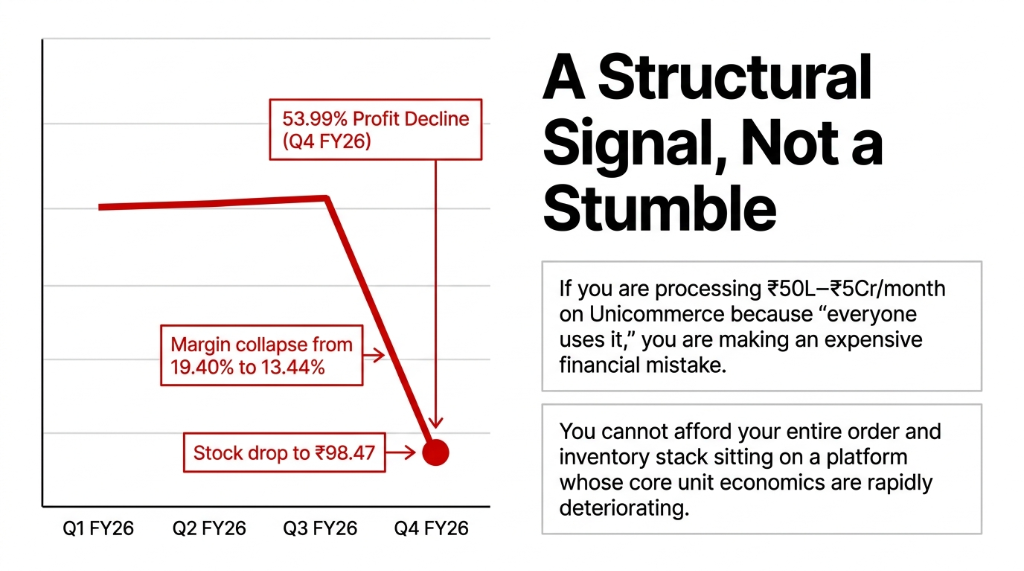
Why D2C Founders Are Switching Right Now
Let us get specific about what is actually breaking inside Unicommerce for fast-growing D2C brands — because vague "scalability issues" don't pay your team's salaries. Real problems do.
Problem #1: The Per-Transaction Pricing Trap
Unicommerce charges approximately ₹1.08 per transaction — which sounds tiny until you are processing 85,000 orders/month. That is ₹91,800/month just in base transaction fees, before the ₹5,000–₹20,000/month platform subscription. As your brand scales, your Unicommerce bill compounds with every order. You are essentially giving them an equity stake in your growth without getting equity-level value back.
Problem #2: Customisation Hits a Wall at ₹2Cr/month GMV
We constantly see clients hit a wall where Unicommerce's pre-set workflows simply cannot handle custom fulfillment logic — like split-warehouse dispatch, subscription box bundling, or B2B+D2C hybrid operations. The platform was built for marketplace sellers, not for operationally complex direct-to-consumer brands.
Problem #3: ERP Is an Afterthought, Not a Foundation
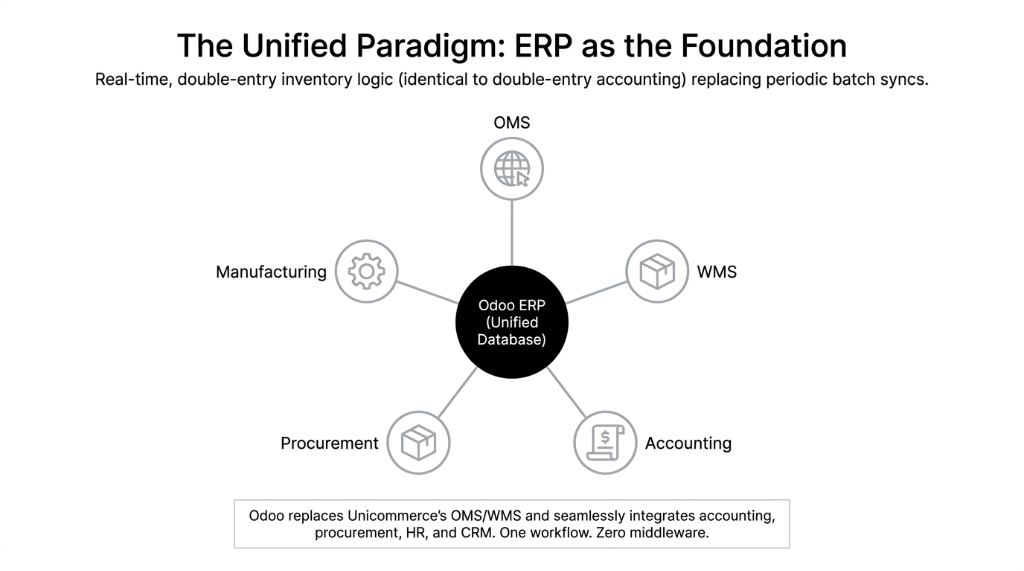
Unicommerce does OMS and WMS. It does not do accounting, procurement, manufacturing, HR, or CRM. So you end up with Unicommerce + Tally/Zoho Books + a separate CRM + manual Google Sheets for procurement = 4 different data sources, none of which talk to each other in real time. We audited a ₹3Cr/month skincare brand in Ahmedabad last quarter that was reconciling returns manually across 3 systems and leaking ₹14,200/month in untracked inventory adjustments.
The Honest Breakdown: Top Unicommerce Alternatives in 2026
Stop reading generic "Top 10" listicles that compare logos. Here is what these alternatives actually do — and where each one falls apart.
| Platform | Best For | Pricing (approx.) | Where It Breaks |
|---|---|---|---|
| Unicommerce | Marketplace-heavy D2C | ₹5K–₹20K/mo + per-txn | No ERP layer, rigid workflows |
| EasyEcom | Small D2C (<10K orders/mo) | ₹3K–₹12K/mo | Outgrown fast, limited WMS |
| Zoho Inventory | SMBs, simple SKU catalogs | ₹1,200–₹5,000/mo | Not built for high-volume D2C |
| Increff | Fashion & lifestyle brands | Custom/enterprise pricing | Niche-specific, not cross-vertical |
| WareIQ | Fulfillment-first D2C | Pay-per-use model | 3PL dependency, limited ERP |
| Odoo ERP (via Braincuber) | Scaling D2C ($1M–$10M ARR) | $15–$45/user/month | Needs proper implementation partner |
EasyEcom: Good Starter, Bad Scaler
EasyEcom works brilliantly when you are processing 2,000–8,000 orders/month on Amazon and Flipkart. It handles multi-channel order management and shipment tracking without making your warehouse team want to quit.
But here is the insider truth most EasyEcom sales decks will not tell you: the moment you need custom inventory allocation logic — say, reserving 30% of SKU stock for your own website while the rest goes to marketplace — EasyEcom's rule engine cannot handle it without a manual workaround. We have seen brands build a 7-step Zap just to handle a single warehouse priority rule. That is not a tech stack. That is a liability.
EasyEcom's Flash Sale Problem
At ₹80L/month GMV, EasyEcom's API rate limits cause sync delays of 8–14 minutes during peak traffic. During a flash sale, that is 500 orders that do not reflect in real-time inventory. You oversell. You cancel. You lose trust. (Yes, we know it happened to you last Diwali.)
Zoho Inventory: The Accountant's Favourite, The Operator's Nightmare
Zoho Inventory integrates cleanly with Zoho Books and is genuinely the best option if you are a ₹25L/month brand with 200 SKUs and no warehouse complexity.
But D2C brands at scale are not that brand.
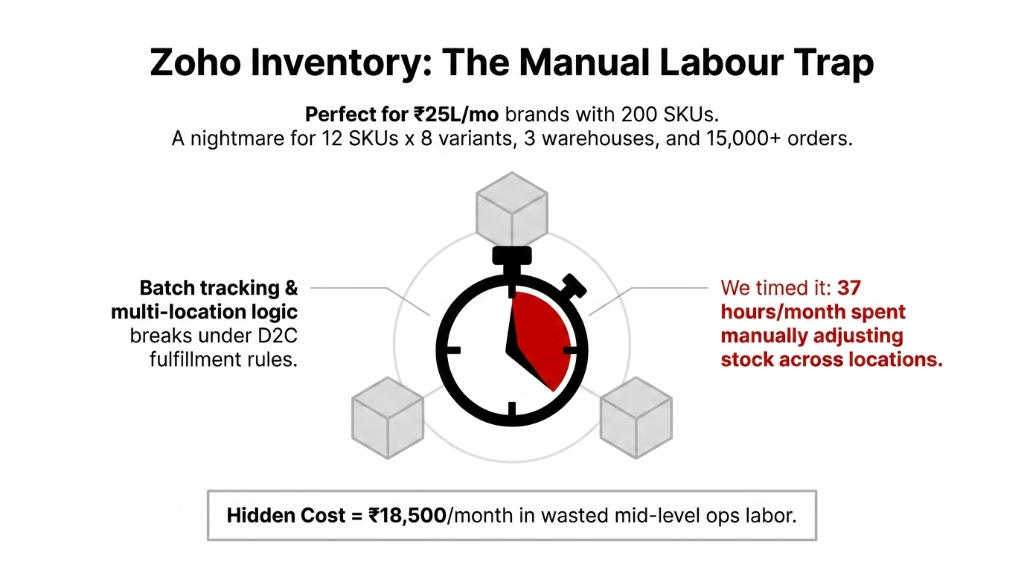
When you are running 12 SKUs per product with 8 variants each, managing 3 warehouse locations, processing 15,000+ orders/month, and tracking expiry-based FIFO for perishables — Zoho Inventory's batch tracking and multi-location logic becomes a manual nightmare. We timed it: one of our clients spent 37 hours/month manually adjusting stock across locations because Zoho's location transfer logic did not support their fulfillment rules. That is roughly ₹18,500/month in wasted labour cost at a mid-level ops manager's salary.
Why Odoo ERP Is the Right Unicommerce Alternative for Serious D2C Brands
Look, we are biased. We are Braincuber Technologies and we implement Odoo ERP for D2C brands. But we will tell you why the bias is earned, not just claimed.
What 50+ D2C Brands Saw Within 90 Days of Switching to Odoo
Order Processing Cost
Dropped from ₹12–₹18 per order to ₹3.40 per order — Odoo handles picking, packing, dispatch, and invoice generation in a single workflow, not four separate tools.
Inventory Accuracy
Went from 87% to 98.6% — Odoo uses real-time double-entry inventory (same logic as double-entry accounting) instead of periodic batch syncs.
Returns Reconciliation
From 4 staff members spending 3 days/month to 1 person spending 4 hours — Odoo's RMA module talks directly to financials without middleware.
What Unicommerce Cannot Do That Odoo Can, Out of the Box
1. Procurement Automation: Auto-generate purchase orders when stock hits reorder point, without a human touching it.
2. Manufacturing Orders: If you do any assembly, kitting, or private-label production, Unicommerce has zero manufacturing module. Odoo has a full MRP layer.
3. AI-Powered Demand Forecasting: With Braincuber's custom Odoo AI modules (built on LangChain), you get SKU-level demand predictions that cut overstock costs by 23–38% in the first season.
4. Full P&L Visibility Per Channel: Know exactly how much your Amazon channel costs you vs. your own website — including COGS, fulfilment, and returns — in one dashboard.
5. Shopify + Odoo Integration: We build this in 3–4 weeks; your Shopify orders, inventory, customer data, and returns sync to Odoo in under 90 seconds per batch.
The Case Study You Need to Read
A ₹4.2Cr/month D2C health and nutrition brand in Surat came to us in September 2024. They were on Unicommerce + Tally + three Google Sheets. Monthly reconciliation took 11 working days. They were carrying ₹67L in "buffer stock" because they had no confidence in their inventory numbers. And they were paying ₹22,000/month to Unicommerce for the privilege.
We implemented Odoo 17 with Shopify integration in 6 weeks. By week 10:
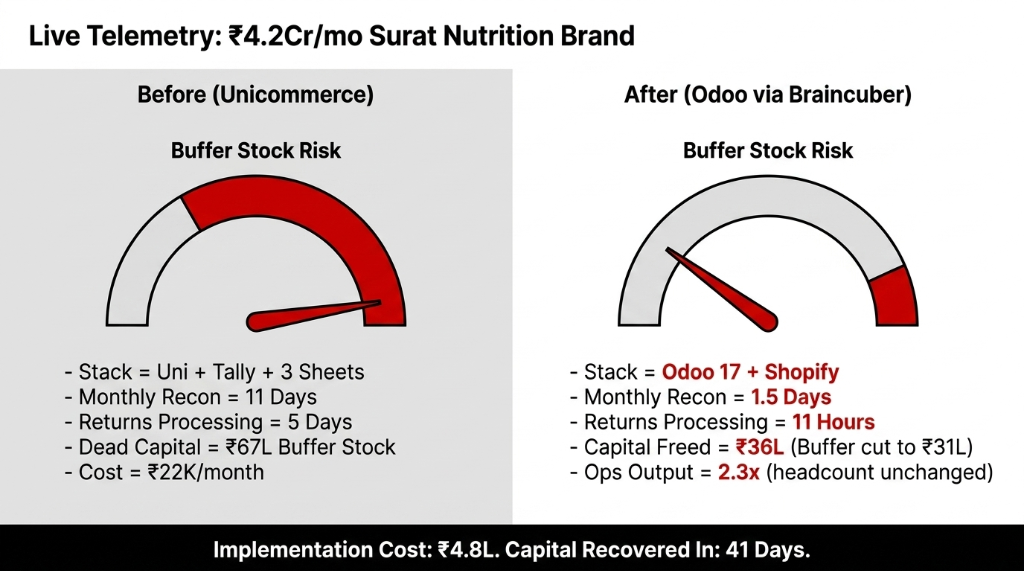
Before (Unicommerce)
Stack: Uni + Tally + 3 Sheets
Monthly Recon: 11 days
Returns Processing: 5 days
Dead Capital: ₹67L buffer stock
Monthly Cost: ₹22,000
After (Odoo via Braincuber)
Stack: Odoo 17 + Shopify
Monthly Recon: 1.5 days
Returns Processing: 11 hours
Capital Freed: ₹36L (buffer cut to ₹31L)
Ops Output: 2.3x (headcount unchanged)
The Odoo licence + Braincuber implementation cost ₹4.8L total. They recovered it in 41 days.
What the "Switch" Actually Looks Like
This is where most blog posts go vague. We will not.
The 8-Week Unicommerce-to-Odoo Migration
Week 1–2: Full Audit
We audit your current Unicommerce setup, map every integration (Shopify, Amazon, Flipkart, ShipRocket, Delhivery), and document your custom workflows. No assumptions. No surprises.
Week 3–6: Config + Parallel Run
Odoo configuration, Shopify–Odoo integration, and parallel-run testing. Your Unicommerce keeps running. Nothing breaks. We have done this 50+ times.
Week 7–8: Cutover
We move warehouse operations to Odoo WMS. Your team gets 2 days of hands-on training, not a PDF manual.
Week 9+: Live + Hypercare
You are live. We stay on call for 30 days post-go-live. Not a ticket system. A WhatsApp group with our ops consultant.
Total downtime: zero. Total data loss: zero. We migrate your historical order data, SKU catalog, and open POs from Unicommerce before we turn it off.
FAQs: Unicommerce Alternatives for D2C Brands
Is Odoo ERP really a direct Unicommerce alternative for D2C brands?
Yes — and it goes further. Unicommerce handles OMS and WMS only. Odoo replaces those plus handles accounting, procurement, CRM, and manufacturing in one system. For D2C brands doing ₹50L+/month, this eliminates 2–4 separate tools and the integration costs that come with them.
How long does switching from Unicommerce to Odoo take?
With Braincuber, the full migration — including Shopify integration, data migration, and team training — takes 6–8 weeks. We run Unicommerce in parallel during the transition so there is zero operational downtime. Brands processing 20,000+ orders/month have made this switch without missing a single dispatch SLA.
What does Odoo ERP cost compared to Unicommerce?
Odoo Community is free. Odoo Enterprise is $15–$45/user/month depending on modules. Braincuber's implementation starts at ₹2.5L for a standard D2C setup. Most brands recover the full implementation cost within 60–90 days through inventory savings alone.
Will our existing Shopify store still work after switching to Odoo?
Yes. Braincuber builds a real-time Shopify–Odoo integration that syncs orders, inventory, customers, and returns in under 90 seconds per batch. Your Shopify storefront is untouched. Customers see nothing different. Your ops team sees everything different — in one place.
What if Odoo is too complex for our ops team?
Frankly, every ops team says this before go-live and none of them say it 30 days after. Odoo's warehouse module is more intuitive than Unicommerce's dashboard when set up correctly. Braincuber provides 2 days of hands-on training plus 30 days of post-go-live WhatsApp support — not a PDF knowledge base.
If you are spending more than ₹8,000/month on Unicommerce and your inventory accuracy is below 96%, you have a leak. We will find it in the first call.
Stop paying Unicommerce an equity stake in your growth.
Book Braincuber's free 15-Minute Operations Audit — we audit your current stack, identify the #1 operational drain, and tell you whether Odoo makes financial sense for your brand. No pitch deck. No fluff. Just numbers.
Book Your Free 15-Min Audit