
Why E-Commerce GST Is Messy
E-commerce GST is not one report. It is several moving parts: operator mapping, invoice classification, tax breakup, reconciliation, and making sure the numbers that go to GSTN are the same numbers that came from your store, marketplace, and warehouse.
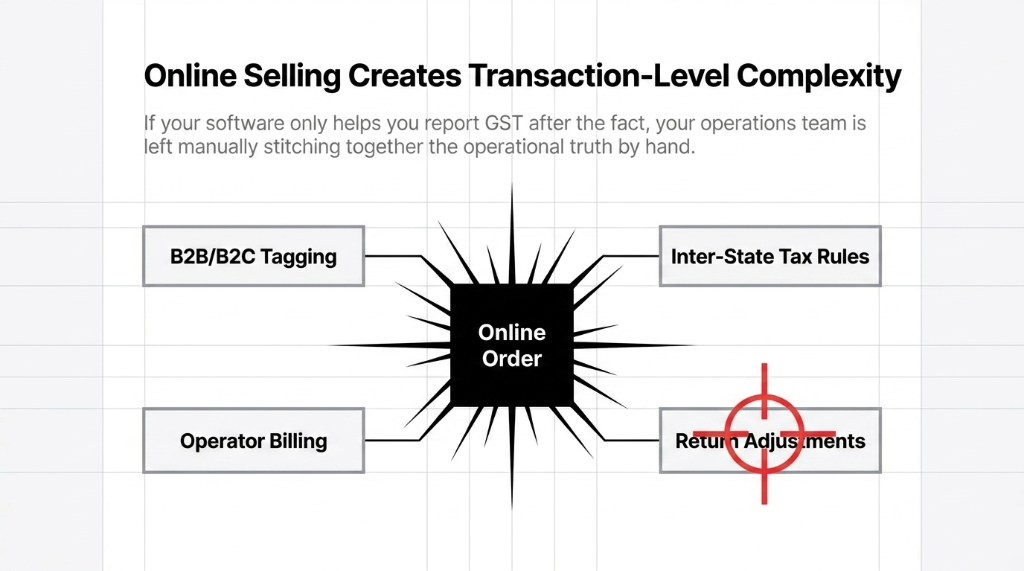
Online selling creates tax complexity at the transaction level. You have B2B and B2C orders, inter-state and local supplies, e-commerce operator billing, and returns that alter the tax base. If the software only helps you "report" GST after the fact, your operations team still has to stitch together the operational truth by hand.
That difference—between reporting GST and preventing the GST mess—is where this comparison actually matters. And it is where most "Tally vs Odoo" blog posts completely miss the point.
Tally Prime: Fast, Familiar, and Shallow
TallyPrime is strong when the business wants simple accounting plus GST reporting with minimal setup. Its e-commerce reporting can show operator-wise sales, break up tax amounts, and help users refer to the right figures before entering them into the GST portal. The workflow is practical for teams that already understand ledger-based accounting and want a familiar interface.
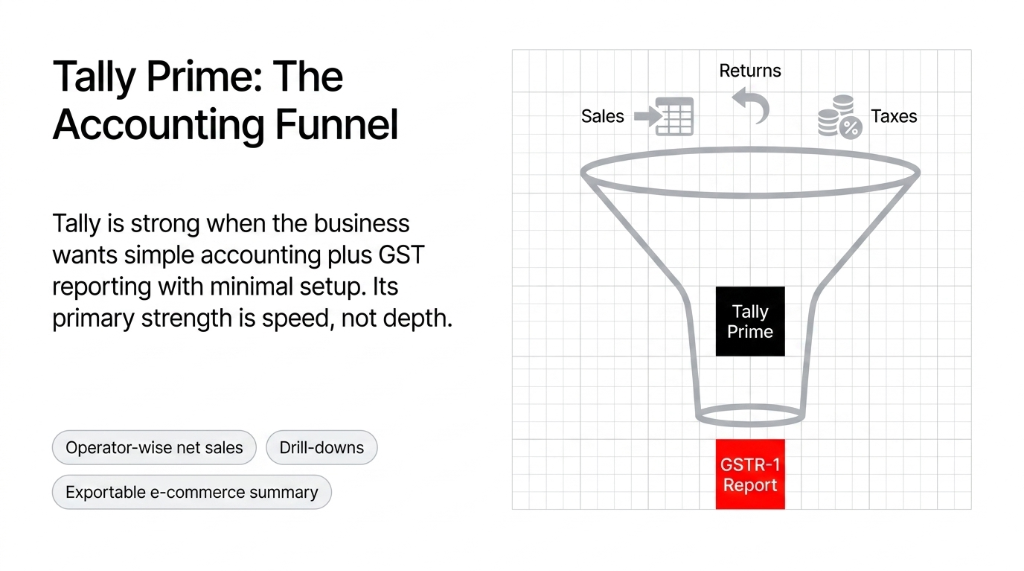
Its primary strength is speed, not depth. The Tally approach works well when the business mostly needs to capture e-commerce sales, classify them correctly, and move the summarized figures into GSTR-1 and related GST workflows. That is enough for many SMBs.
Where Tally Stops Working
But it is not the same thing as having e-commerce operations and GST tightly connected across sales, inventory, and finance. The moment your business has Shopify, Amazon, multiple warehouses, returns, and a finance team that keeps asking why sales, tax, and stock never match—Tally's reporting-first approach hits its ceiling.
Tally wins on familiarity. Many accountants already know it. The keyboard shortcuts are muscle memory.
But familiarity does not fix a broken reconciliation process. It just makes the broken process feel comfortable.
Odoo: The Operating System Approach
Odoo is more like an operating system for the business than a pure accounting tool. In India localization, Odoo supports GST reporting and return workflows, and its accounting stack connects invoices, taxes, and reconciliation with other modules such as inventory and eCommerce. That makes it more useful when GST cannot be separated from operations.
The practical upside: the same system holds the order, the invoice, the tax, the stock movement, and the reconciliation logic. Odoo also exposes a GST return filing workflow that depends on API access to the GST portal—designed to interact directly with compliance processes rather than only summarize them.
The Split-Brain Problem Odoo Solves
Finance sees one number
Ledger entries from manual Tally imports, often 14–48 hours stale
Operations sees another
Shopify dashboard, Amazon Seller Central, warehouse Excel—three versions of "truth"
Odoo sees one truth
Orders, invoices, taxes, stock, and reconciliation in a single flow—no manual stitching
Growing businesses get burned when the GST return gets built from a third version of the truth. Odoo eliminates that problem architecturally.
For e-commerce teams, that reduces the number of places where errors creep in. When you add marketplaces, discounts, returns, and interstate shipments, every gap between systems becomes a potential filing error. An Odoo ERP integration closes those gaps by design.
The Side-by-Side That Actually Matters
| Area | Tally Prime | Odoo |
|---|---|---|
| E-commerce GST reporting | Strong operator-wise reporting, GSTR-1 summary | GST tied to accounting and localization workflows |
| Filing workflow | Reporting-first, then portal entry | Integrated return workflow with portal/API steps |
| Inventory + GST connection | Limited—separate from ERP stack | Integrated with inventory and eCommerce modules |
| Multi-channel operations | Works, but requires manual stitching | Better fit for complex order flows |
| Reconciliation | Good for structured accounting users | Invoice, bill, and tax matching in one system |
| Accountant familiarity | High—most Indian accountants know Tally | 3–4 days training for accounting team |
The Story From the Floor
Picture a brand selling on Shopify, Amazon, and a few wholesale accounts. The accountant in Tally can pull e-commerce summaries and prepare GST figures. But every month the ops team still exports order data, checks returns, and manually validates which orders belong to which tax buckets. The finance team closes late because the numbers only become trustworthy after multiple rounds of checking.
Now picture the same company on Odoo. Orders hit the system, inventory moves, invoices are recorded, taxes follow the configured rules, and reconciliation happens inside the same business flow. The company still needs process discipline, but the software stops making the team rebuild the truth every month.
The Monthly Reconciliation Math
On Tally + manual workflow: 43 hours/month of reconciliation labor across ops + finance. Late filing 4–5 months/year. Average correction cost per quarter: $1,320.
On Odoo (post-migration): 7 hours/month reconciliation. Zero late filings in the last 14 months. Correction cost dropped to $180/quarter.
That is $30,960/year in reconciliation labor on Tally vs $5,040/year on Odoo. The software license difference is irrelevant next to that number.
Best Fit by Business Stage
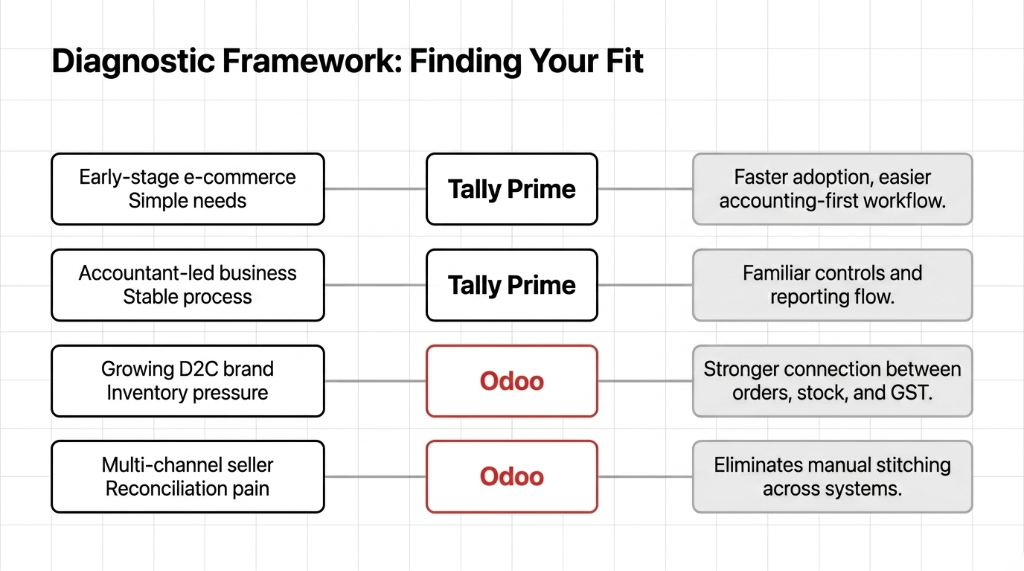
| Business Stage | Better Fit | Why |
|---|---|---|
| Early-stage e-commerce, simple GST | Tally Prime | Faster adoption, easier accounting-first workflow |
| Growing D2C brand with inventory pressure | Odoo | Stronger connection between orders, stock, and GST |
| Multi-channel seller with reconciliation pain | Odoo | Eliminates manual stitching across systems |
| Accountant-led business, stable process | Tally Prime | Familiar controls and reporting flow |
| Ops-led business with automation goals | Odoo | Better ERP structure for scaling |
The Hidden Trap
The biggest mistake is assuming GST compliance is the deciding factor by itself. It is not. Both tools can help with GST reporting. But e-commerce businesses usually fail because of broken process design, not because a tax form is missing.
The question is not "Which one files GST?" The question is "Which one prevents the monthly tax mess from starting in the first place?" On that question, Odoo has the edge because it brings sales, inventory, invoicing, and tax into one flow. A properly implemented Odoo setup reduces the number of places where the truth can fracture.
The real cost of picking wrong is not software licensing. It is the time your team spends reconciling mismatched reports, fixing filing errors, and cleaning up order data after the tax period closes. That waste grows fast when you add marketplaces, discounts, returns, and interstate shipments.
5 Questions Founders Ask About Tally Prime vs Odoo GST
Can Tally Prime handle e-commerce GST?
Yes. TallyPrime includes e-commerce reporting that helps users view operator-wise sales, tax breakup, and GST-ready summaries for filing. It works well for straightforward compliance reporting with minimal channels and returns.
Is Odoo good for Indian GST?
Yes. Odoo's India localization supports GST workflows, tax reporting, and portal-linked filing processes. It connects GST compliance directly with inventory, sales, and invoicing modules for end-to-end accuracy.
Which is better for Shopify sellers?
Odoo is usually better if Shopify sales must connect with inventory and accounting in one flow. Tally is fine if the seller mainly needs accounting and GST reporting without operational integration.
Which is easier for accountants?
Tally Prime is usually easier for accountants who already use ledger-based workflows. Most Indian CAs have Tally muscle memory. Budget 3 to 4 days of training if switching to Odoo.
Which scales better for e-commerce?
Odoo scales better because it connects e-commerce, inventory, accounting, and GST in one ERP stack. Tally remains an accounting tool; it does not grow into an operations platform as your channels multiply.
The Plain Language Answer
Tally Prime is the cleaner accounting answer. Odoo is the better business answer for serious e-commerce growth. Choose Tally if your e-commerce operation is small, your accounting team already lives in Tally, and your GST work is mostly reporting-led. Choose Odoo if you want one system that handles e-commerce operations and GST together—especially when scaling across channels, warehouses, or multiple inventory nodes.
Pull up your last GSTR-3B filing. Count the hours your team spent reconciling numbers before submission. If that number is above 8, your software is reporting the mess instead of preventing it.
We run Odoo implementations that connect GST compliance directly to your order, inventory, and invoicing flow. 15-minute call. No slide decks. Just the reconciliation math for your specific operation.
Book Your Free GST Operations Audit