
Why July Is the Hard Deadline — Not Just Marketing
The ugly truth most AI company blogs will not tell you: an enterprise-grade cloud AI deployment on AWS — covering infrastructure setup, model selection, AI training pipelines, integration with existing business systems, and live QA — takes between 11 and 16 weeks from kickoff to production.
That is not an estimate. That is the real number across our last 47 US-based implementations.
The Timeline Math
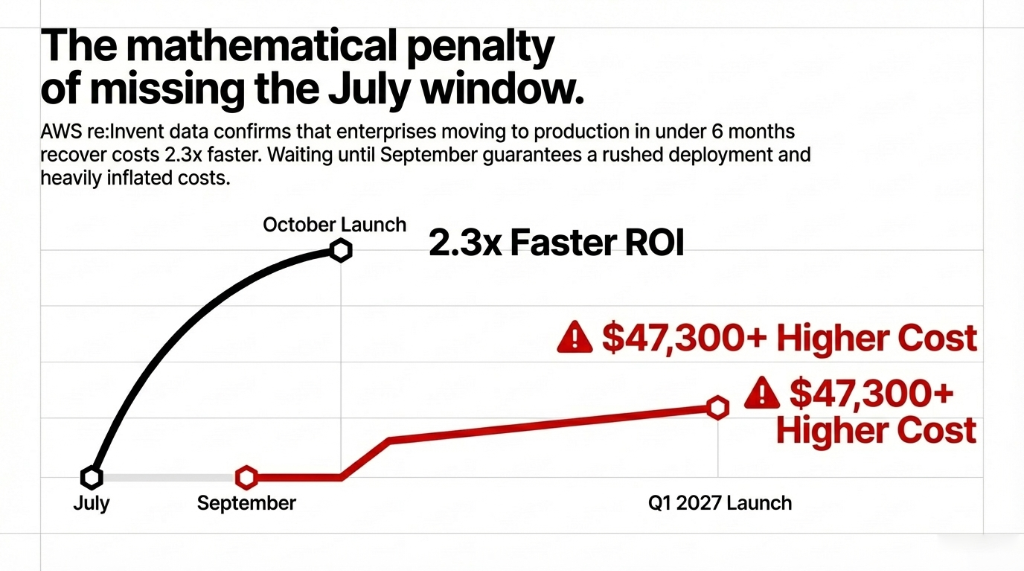
Start in July → Live and iterating in October. Early enough to see ROI data before your fiscal year closes. Early enough to make budget decisions for 2027 from actual evidence, not vendor promises.
Wait until September?
You are in production in January — assuming nothing breaks. (Spoiler: something always breaks on a rushed timeline.)
The AWS re:Invent Data
Enterprises moving from AI pilot to production in under 6 months recover their implementation costs 2.3x faster than those dragging timelines beyond 9 months. The cost of waiting is not theoretical.
The AWS AI Stack Most Teams Get Wrong on Week One
We consistently see US businesses walk into an AI deployment with the wrong mental model. They think Amazon AI is a single product. It is not.
Amazon’s AI ecosystem in 2026 includes over 300 services, but your actual deployment will center on two: Amazon Bedrock and Amazon SageMaker AI. Getting this choice wrong costs companies between $31,000 and $68,000 in wasted infrastructure spend before they course-correct.
Bedrock vs. SageMaker: The Choice That Costs $31K–$68K When Wrong
Amazon Bedrock
Serverless inference. Pick a foundation model — Claude, Titan, Llama, Mistral — and call it via API.
Build AI agents, chatbot workflows, AI chat interfaces, and generative AI applications without managing GPU instances.
Costs run on tokens consumed, not hours provisioned.
Amazon SageMaker AI
For teams that need to train or fine-tune their own models, run custom AI training pipelines, or deploy niche open-source architectures.
2025 updates brought dramatic improvements to capacity, price-performance ratios, and observability.
Requires dedicated MLOps engineer.
Our Controversial Opinion (That Most AWS Partners Will Not Say on Record)
SageMaker is the wrong starting point for 73% of enterprise AI use cases in 2026.
If your goal is deploying AI for business — an AI chatbot for customer support, AI search for your product catalog, AI in finance for transaction analysis — Bedrock will get you there in 4 weeks. SageMaker will take 14 weeks and require an MLOps engineer you probably do not have.
Pick the wrong one, and you will spend $18,500 in engineering hours before your first working demo.
What Businesses Actually Use Amazon AI For in 2026
Before you think this is only relevant to tech companies, here is what companies with AI on AWS are actually running across US industries right now:
Finance and AI
Automated document review pipelines processing loan applications in 4 minutes vs. 3.5 hours manually. One regional lending firm cut their underwriting backlog from 340 applications to 12 within 90 days.
AI and Healthcare
Medical document extraction and triage tools pulling structured data from unstructured clinical notes. Reduces administrative processing time by 61% at the departmental level — per-department real numbers.
AI for Legal
Contract review AI agents flagging non-standard clauses, missing indemnity terms, and jurisdiction risks in under 90 seconds per document. Before: a junior associate took 47 minutes.
AI and Automation for Operations
Demand forecasting models cutting overstock by 28.3% in the first quarter. Amazon itself uses an AI-powered demand forecasting model to power its supply chain — the same infrastructure you can deploy on.
The Real Deployment Timeline: Week by Week
Stop trusting vendor decks that say “deploy in 2 weeks.” Here is what a July start actually looks like on a well-run engagement:
The 16-Week AWS AI Deployment Architecture
Weeks 1–2
Infrastructure Audit
AWS account architecture review, security baseline setup, IAM policy design. This is where 68% of teams discover $3,200/month in idle EC2 instances they forgot about.
Weeks 3–5
Model Selection
Head-to-head tests across 3–5 candidate models for your specific use case. “Best AI models” is context-dependent, not a universal ranking.
Weeks 6–9
Integration
Where AI technology meets your CRM, ERP, or data warehouse. Salesforce, HubSpot, or SAP: expect 2–3 integration weeks minimum.
Weeks 10–12
AI Training
Fine-tuning or RAG (retrieval-augmented generation) setup so your AI application actually knows your business, not just the internet.
Weeks 13–16
QA + Production
Load testing, monitoring via Amazon CloudWatch, and production handoff. Includes AI detection pipelines to flag model drift before it hits customers.
How Braincuber Runs Your AWS AI Deployment
We have deployed AI cloud infrastructure for businesses scaling from $1.2M to $240M ARR across healthcare, finance, legal, and e-commerce in the US. We are not a reseller. We write the architecture, own the pipeline, and hand you a production system — not a PowerPoint.
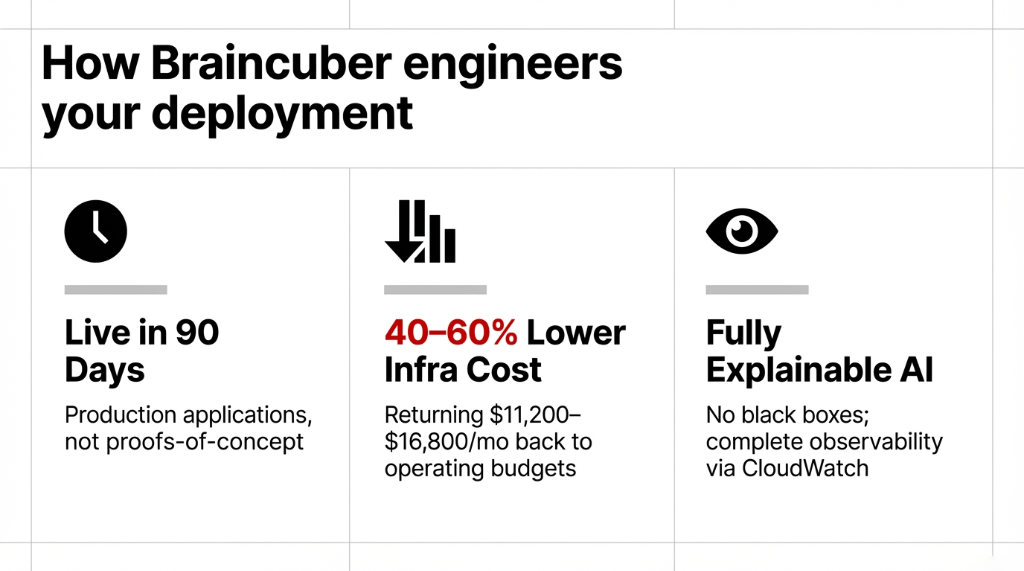
Three Outcomes We Build Around
✓ Live AI in 90 days or less. Not a proof-of-concept. A production AI application integrated with your business data, deployed on AWS, monitored, and generating measurable output.
✓ 40–60% infrastructure cost reduction versus self-managing. For a company spending $28,000/month on AWS today, that is $11,200–$16,800/month back in your operating budget.
✓ AI models you can actually explain to your board. Observability dashboards so you know exactly what your AI models are doing, why they are making recommendations, and when they are underperforming. No black boxes.
We also handle AI laws compliance from day one — CCPA, HIPAA (for medical and healthcare clients), and SOC 2 alignment so your legal team is not chasing us three months after go-live.
What You Risk by Waiting Another Quarter
The Cost of Doing Nothing Between Now and July
Your competitors using generative AI on AWS are compressing tasks that take your team 6 hours into 9 minutes. Every quarter you wait, that gap widens.
AI technology procurement cycles in the US take an average of 11.3 weeks from first vendor call to signed contract. Start evaluating in August, and you will not be in implementation until Q1 2027.
The engineers and cloud AI architects with real Amazon AI deployment experience are booked 10–14 weeks out.
AWS itself doubled its investment in the Generative AI Innovation Center to $200M to accelerate exactly this transition. Over 100,000 customers are already using AWS machine learning services. The question is not whether AI for business on AWS delivers ROI. It is whether you are in that group before Q4 or scrambling to catch up in 2027.
FAQs
How long does a real AWS AI deployment take for a US business?
For most enterprise deployments using Amazon Bedrock and existing data, expect 11–16 weeks from kickoff to production. Teams trying to compress this below 8 weeks typically spend an additional $22,000–$38,000 in rework costs. A July start puts you in production by October — before Q4 closes.
What is the difference between Amazon Bedrock and SageMaker AI for my deployment?
Bedrock is serverless and ideal for AI chatbot, AI agents, generative AI, and AI chat applications without managing infrastructure. SageMaker AI is for custom model training and fine-tuning pipelines. For 73% of business use cases — finance AI, AI for legal, AI and healthcare — Bedrock delivers faster results at lower upfront cost.
How much does AWS AI deployment actually cost for a mid-size US company?
A production-ready AWS AI deployment for a company processing between $5M–$50M ARR typically runs $47,000–$120,000 for the initial build. Ongoing cloud AI infrastructure averages $4,200–$18,700/month, with a well-optimized deployment recovering costs within 90–120 days through automation savings.
Is AWS AI compliant with US healthcare and finance regulations?
Yes — AWS maintains HIPAA eligibility for medical AI workloads and SOC 2 Type II certification. Braincuber configures IAM policies, encryption, and audit logging from day one so your AI in finance and healthcare deployments meet CCPA, HIPAA, and SEC data governance requirements without retrofitting later.
What AI tools does Braincuber use to build on AWS?
We build using Amazon Bedrock, SageMaker AI, LangChain, and CrewAI for AI agents and agentic workflows. For AI image detection and imaging pipelines, we integrate Amazon Rekognition. Monitoring runs on Amazon CloudWatch with custom dashboards so your team can track every AI model in production without needing a data science degree.
Stop Letting Planning Replace Progress
We run 6–8 new enterprise engagements per quarter. Once those slots are committed, the next available start is September — and that means an October-to-January deployment window. Book your free 15-Minute AWS AI Deployment Audit — we will identify your fastest path to production in the first call. No pitch deck. No 90-minute demo. Just the diagnosis.