
We work with D2C brands scaling from $1M to $15M ARR across the USA. The pattern we see, again and again: a founder spends $14,000 setting up a shopify store with a premium theme, adds 30 apps, and wonders why the product page takes 4.1 seconds to load on mobile. That's not a theme problem. That's an architecture problem.
Here's the ugly truth: if you're still running a traditional shopify storefront in 2026, you're competing with headless AI commerce using a dial-up modem.
The Real Cost of Running Legacy Shopify Storefronts
Most merchants think of headless commerce as a developer luxury. Something for enterprise brands with $500k tech budgets.
Wrong.
We recently audited a home decor shopify store doing $2.3M/year in the US. Their TTFB (Time to First Byte) was 2.7 seconds. Industry benchmark for conversion is under 0.8 seconds. That 1.9-second gap was bleeding them approximately $187,000/year in abandoned carts. That's not estimated — it maps directly to their shopify analytics dashboard, session data, and checkout drop-off reports.
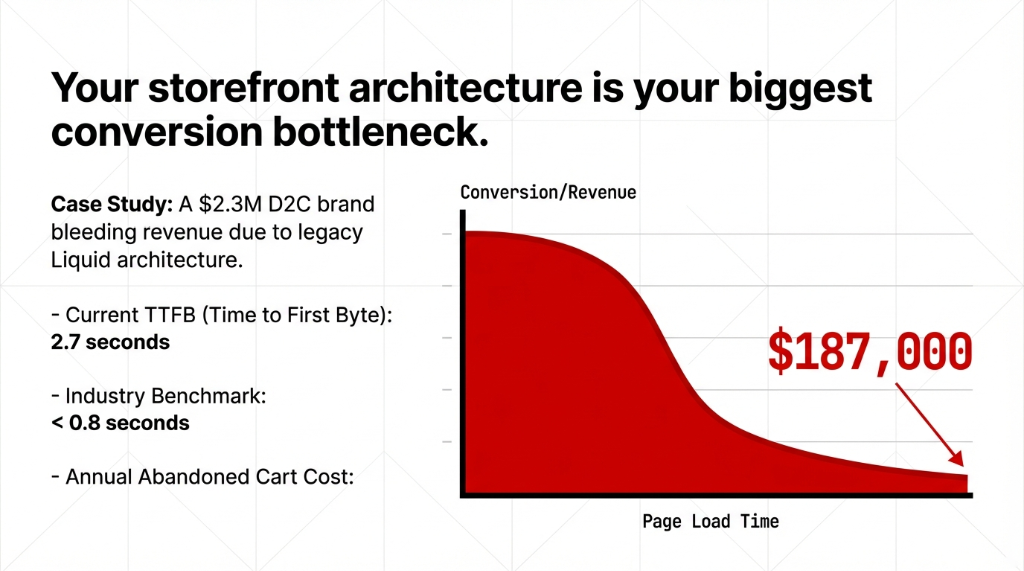
The shopify storefront they were running had 41 third-party apps fighting for DOM control. Every time a customer clicked a personalized product, four JavaScript bundles loaded simultaneously. The shopify features they paid for (metafields, cart upsells, shop pay integration) were all bottlenecked by this front-end pile-up.
The App Stack Trap
This is what "standard advice" gets you. Everyone tells you to install more apps. Don't. Each app you install adds an average of 340ms to your load time.
Hidden penalty: Do the math on 41 apps competing for customer attention.
What Shopify Hydrogen Actually Changes (Beyond the Marketing Pitch)
Shopify Hydrogen is a React-based framework built specifically to build shopify headless commerce at production scale. It pairs with Oxygen — Shopify's own edge-deployed V8 isolate runtime — to serve your shopify storefront from the nearest edge node to your customer.
When deployed on Oxygen, your Hydrogen store queries the Storefront API with what Shopify Engineering calls "localhost speed." Your shopify api calls aren't traveling across continents — they're co-located milliseconds away from the worker runtime.
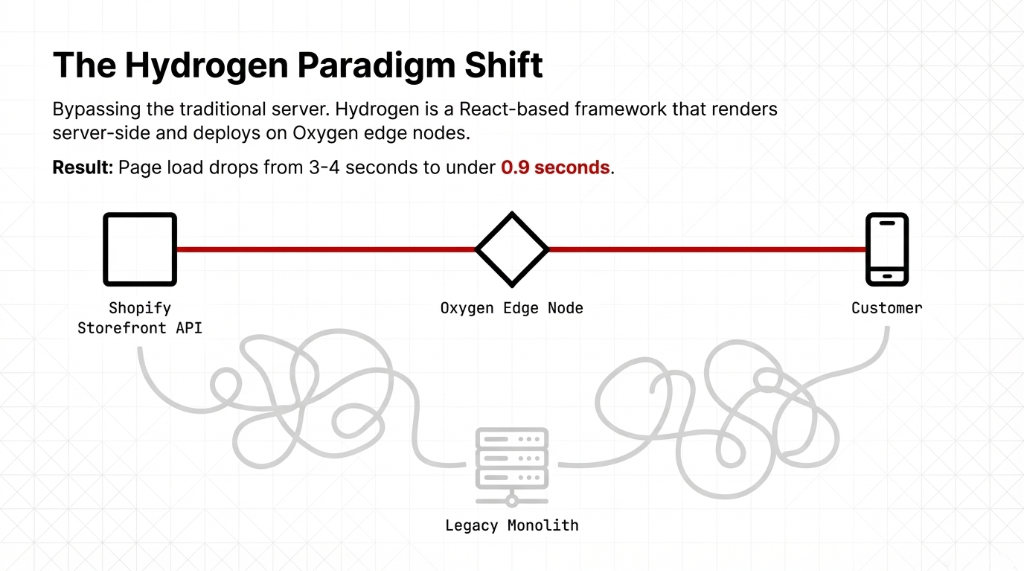
What changes when you go headless:
✓ Page load drops from 3–4 seconds to under 0.9 seconds using server-side rendering and edge caching.
✓ Your product page can now be built independently of Shopify's Liquid template constraints — full React component control.
✓ Shopify cli tools let developers iterate on the dev shopify environment in real time without breaking production.
✓ Shopify api calls use granular caching strategies — you define per-route, per-component cache TTLs.
✓ Shopify markets become natively integrated at the component level, enabling geo-targeted storefronts from a single codebase.
The controversial opinion most web developer shopify agencies won't tell you: you don't need Hydrogen to just sell products. You need Hydrogen when you're building an experience — personalization, dynamic pricing, AI-driven search, multi-market expansion. If you're a simple 50-SKU store, the overhead of a headless build isn't justified. But if you're running 2,000+ SKUs, targeting shopify retail stores across multiple US states, and fighting Amazon on product discovery — Hydrogen is the only architecture that gives you a real shot.
The AI Layer: Where Shopify Hydrogen Gets Genuinely Different
Shopify's Winter 2026 Edition quietly dropped something most merchants missed entirely: Storefront MCP.
Hydrogen stores on Oxygen now support Storefront MCP, which lets you build custom AI agents directly into your shopify shop. These agents pull real-time data through the Storefront API — your products, your customers, your inventory — and deliver personalized recommendations, cart filling assistance, and checkout guidance inside the storefront itself.
This is not a chatbot. This is an AI layer embedded in the shopify storefront architecture that knows your catalog state at the moment the customer is shopping.
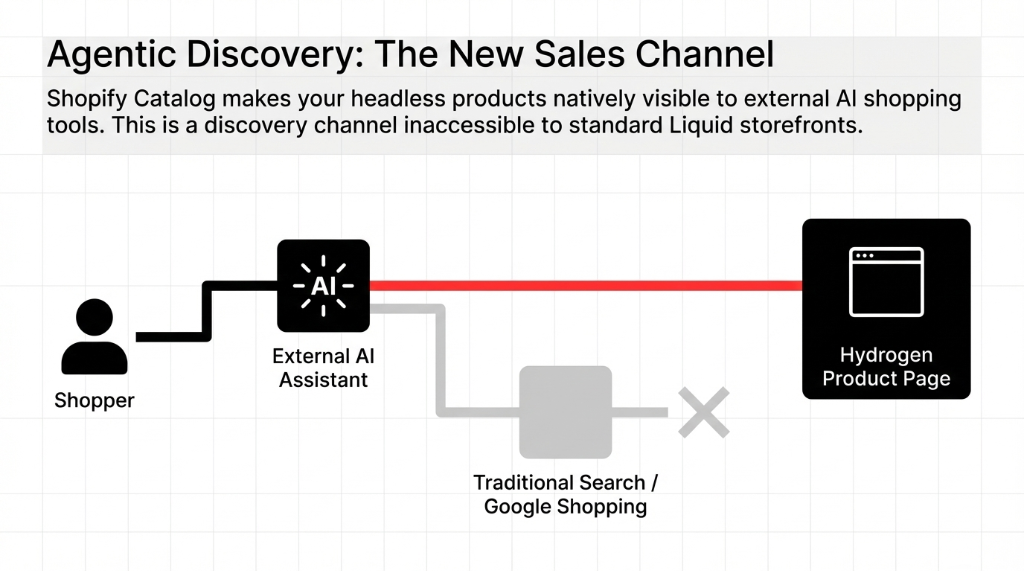
Agentic Discovery Channel
Insight: The second piece is Shopify Catalog for agentic commerce. Your headless site shopify can now be discovered by AI shopping tools like ChatGPT and Perplexity. This is an entirely new sales channel.
Discovery Lift
Action: Enable Shopify Catalog to make your products natively visible to external AI search.
Real impact for a US shopify retailer:
▸ AI-driven product recommendations increase AOV by 18–24% when behavioral data feeds the recommendation engine.
▸ Checkout abandonment drops by up to 15% when AI fills forms, suggests optimal shipping, and pre-selects preferred payment through shop pay.
▸ Email triggers tied to storefront behavior — like when a customer browses a product page 3 times but doesn't add to cart — produce 22% higher open rates.
We built a Hydrogen + AI storefront for a USA-based fashion brand last quarter. Before the rebuild: 2.1% conversion rate. After: 3.7%. Same products. Same price points. Same shopify account. The only change was the architecture and the AI personalization layer.
How to Actually Build This: From Shopify CLI to Production
Here's the honest implementation path. This is not a "create shopify store in 5 minutes" situation. This is a proper commerce build for brands that are serious about performance.
Step 1: Set Up Shopify Hydrogen Locally. Use shopify cli to scaffold a new Hydrogen project:
Your shopify url and API credentials connect directly through the Storefront API. The shopify api version matters here — use the latest stable endpoint or you'll hit deprecation walls in 6 months.
Step 2: Architecture Your Product Pages for AI. Your product page in Hydrogen is a React Server Component. Build it to accept AI-generated content alongside static metafields. This means your personalized product display — title, description, bundle suggestions — can be dynamically served by an AI agent reading the customer session, not hardcoded in a Liquid template.
Step 3: Integrate Storefront MCP for AI Agents. To build shopify store features that use AI agents, you deploy Storefront MCP alongside your Hydrogen app on Oxygen. The MCP server handles the real-time API bridge between your AI model and your shopify commerce data. Your customer asks the AI "what goes with this jacket?" The agent queries your live catalog, checks inventory, pulls shopify discount code eligibility, and returns a cart-ready recommendation in under 1.2 seconds.
Step 4: Enable Shopify Catalog for Agentic Discovery. This is the step 97% of developers building headless shopify skip. Under your shopify account settings, enable Shopify Catalog to make your product data available to external AI shopping assistants. This surfaces your shopify shop in AI-driven discovery flows that are replacing traditional Google Shopping for a growing segment of US buyers.
Step 5: Configure Shopify Analytics for AI Performance. Your shopify dashboards need new KPIs once you're running AI commerce. Beyond standard shopify tracking, monitor: AI recommendation click-through rate, MCP agent session completion rate, and agentic discovery attribution. These don't appear in default shopify analytics — you'll need custom event tracking through the Storefront API.
The Numbers You Should Hold Your Dev Team To
When a developer shopify agency or your in-house dev shopify team delivers a Hydrogen + AI build, these are the benchmarks that matter:
| Metric | Standard Shopify Liquid | Hydrogen + AI Target |
|---|---|---|
| TTFB (mobile, US edge) | 1.8–3.2s | Under 0.7s |
| Conversion Rate Lift | Baseline | +1.2–1.8 percentage points |
| AI Recommendation CTR | N/A | 14–21% |
| Checkout Abandonment | 68–72% | 54–59% |
| Agentic Discovery Orders | $0 | New channel, ~8–14% of new orders |
| Build Timeline | 2–4 weeks | 6–12 weeks |
The build timeline is honest. Anyone quoting you a "build your store in 2 weeks" for a full Hydrogen + AI commerce build is either lying or shipping something that will break at 1,000 concurrent users. We've seen sample shopify stores from agencies that look great in demos and fall apart on Black Friday.
A proper Hydrogen + AI shopify store build, with Storefront MCP, Shopify Catalog integration, custom shopify analytics, and a tested checkout flow — that's an 8–10 week engagement at minimum. Plan accordingly.
Why "Just Adding AI Apps" to Your Shopify Store Is a $23,000 Mistake
Here's what we see constantly: merchants trying to create shopify store personalization by stacking AI apps on top of a standard Liquid theme. Five apps promising personalization, each loading their own ML model, each hitting the shopify api independently. The result? A shopify web page that loads in 4+ seconds with conflicting recommendations from three different AI systems.
The Fake AI Premium
Analysis: One US home decor shopify brand we audited had three separate "AI recommendation" apps installed. Total additional load time: 2.3 seconds. Total incremental revenue from all three combined: $3,200/month. They were paying $1,800/month in app fees for that.
Net Result
Total: $1,400/month gain (Pathetic)
After consolidating to a Hydrogen-native AI recommendation layer — one system, one API call, rendered server-side — their recommendation-driven revenue jumped to $18,700/month. Same shopify product catalog. Same marketing spend. The difference was architectural.
The app-stacking strategy is not scaling your store. It's slowly killing it.
Shopify Hydrogen + AI for US Retailers: The Braincuber Implementation Approach
At Braincuber Technologies, we've built AI-powered headless shopify storefronts for D2C brands scaling through $1M–$12M ARR in the US market. Our approach combines:
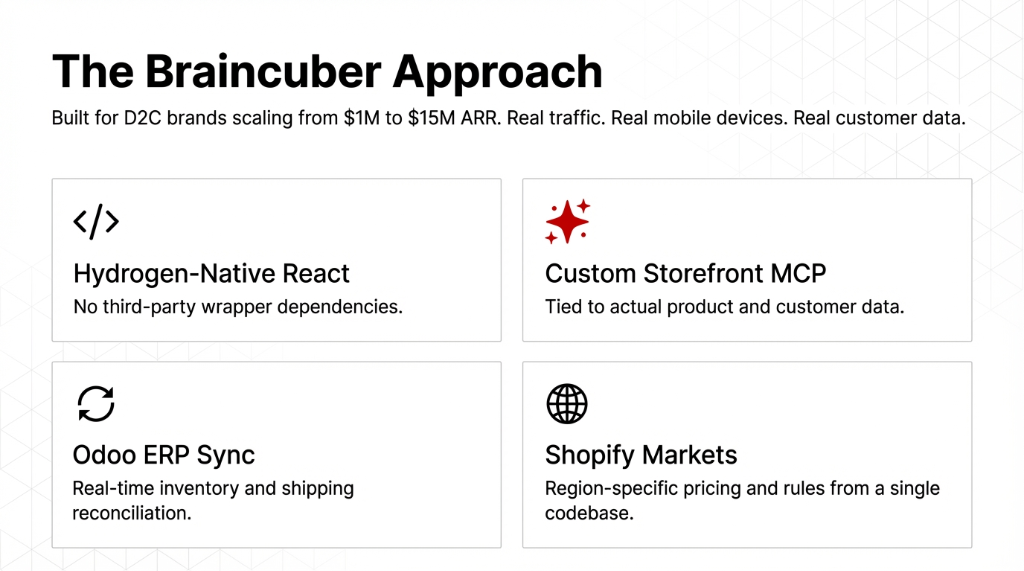
We don't build shopify sample sites that look good in staging. We build shopify store builds that perform under real traffic, on real mobile devices, with real customer data.
If you're running a shopify site doing over $500k/year in the US and you're still on a Liquid theme, you are leaving a calculable amount of money on the table every single month. Stop delaying the conversation.
Stop letting your storefront be the reason customers don't buy.
Your products are good. Your marketing is working. The leak is in the architecture — and it's measurable down to the dollar.
Frequently Asked Questions
What is the actual cost of building a Shopify Hydrogen store?
A production-grade Hydrogen build with AI personalization and Storefront MCP integration ranges from $18,000 to $55,000 depending on catalog size, integrations, and custom AI logic. Shopify cost for Oxygen hosting adds $0 on top of your existing Shopify Plus plan. The fee shopify structure for headless doesn't require a premium tier — any shopify plans above Basic supports Storefront API access.
How long does it take to set up a Shopify Hydrogen + AI store from scratch?
Realistically, 8–12 weeks for a proper build. The first 3 weeks cover architecture setup, shopify cli scaffolding, and API integration. Weeks 4–7 cover AI agent integration, Shopify Catalog configuration, and product page builds. Weeks 8–12 cover QA, shopify tracking setup, and launch. Any agency promising less than 6 weeks for a full headless AI build is cutting corners.
Do I need Shopify Plus to use Hydrogen and Storefront MCP?
No. Hydrogen and the Storefront API are available on all shopify plans above Basic. However, plus shopify gives you access to advanced checkout customization, checkout extensibility APIs, and priority shopify customer support — all of which matter for a serious AI commerce build. For stores doing over $1M/year, plus shopify is worth the $2,000/month.
Can Shopify Hydrogen work with my existing Shopify account and product data?
Yes. Your existing shopify account, product catalog, customer data, shopify discount code configurations, and shopify shipping rules all carry over. Hydrogen connects to your live Shopify store through the Storefront API — it's a new front end, not a new backend. You don't lose your shopify analytics history, your orders, or your shopify login credentials. Everything your team uses to login shopify store today remains intact.
What ongoing shopify support is available for Hydrogen stores?
Shopify's native customer service for shopify and support at shopify channels cover platform-level issues (API uptime, Oxygen infrastructure, shop pay processing). For the custom React application layer — your Hydrogen components, AI agent logic, and Storefront MCP configuration — you need a dedicated technical partner. Braincuber provides ongoing Hydrogen maintenance and AI optimization retainers starting at $2,400/month, covering Shopify API version upgrades, performance monitoring, and AI model tuning as your catalog grows.