
We work with D2C brands in the US scaling from $500K to $8M ARR, and across 130+ Shopify builds, we have seen the same pattern repeat itself: founders invest in paid ads, hire more staff, even redesign their theme — and still miss the $180,000-per-year gap sitting right inside their recommendation engine.
This blog breaks down exactly what intelligent ai recommendations look like when they're actually working, including what the video data reveals that your Google Analytics dashboard never will.
The Blind Spot Nobody Talks About
Most Shopify merchants think their recommendation widgets are "fine." They dropped in a "You might also like" section from a free app, watched it pull some related products, and moved on.
The Rule-Based Revenue Leak
Here is the ugly truth: generic recommendation apps built on rule-based logic are costing you an average of 22.66% in unconverted orders every month. They don't read behavioral signals. They don't connect ai data from your browsing sessions to your purchase history. They just guess.
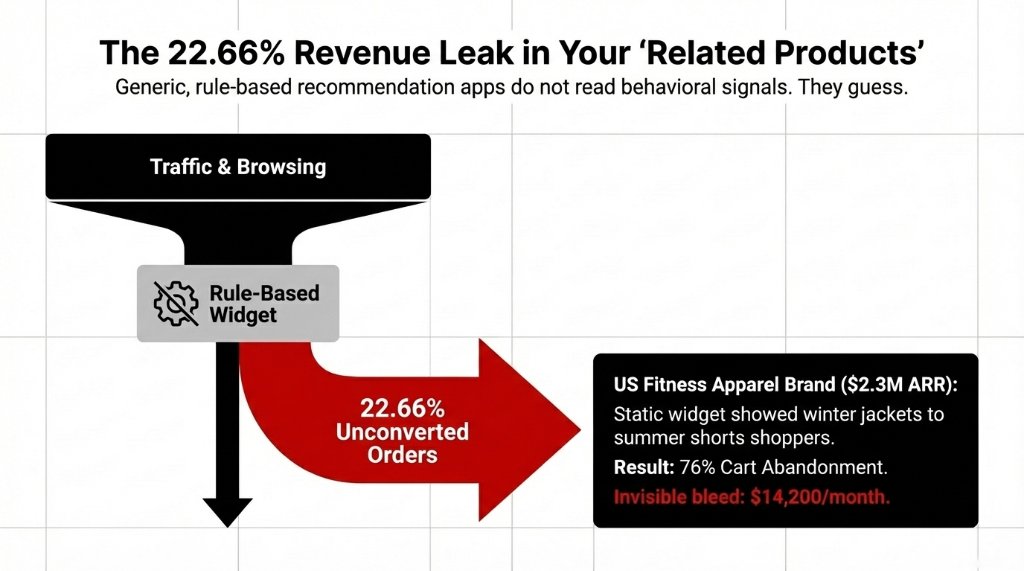
We had a client — a US-based fitness apparel brand doing $2.3M annually — whose "related products" section was pulling winter jackets for customers actively browsing summer shorts. The result? Their cart abandonment sat at 76% for eight straight months, and nobody tied it to the recommendation layer until we ran a video ai session recording audit.
Within the first 37 minutes of our data analytics review, we found $14,200/month in revenue bleeding out from mismatched suggestions alone. That's the difference between a widget and a real ai analytics engine.
What "Live" AI Recommendations Actually Look Like
When we say "see it live," we mean it literally. Video analysis of real user sessions — paired with ai video analytics — tells a story that heatmaps and bounce rate reports never can.
Intelligent AI in Real-Time
Micro-Signal Reading
A customer hovers on an image for 4.3s and scrolls back twice. AI for data analytics captures this intent. Static apps ignore it.
Mid-Session Adapting
Shopper adds a $79 item to cart then browses a $140 version. Intelligent automation shifts suggestions to premium accessories.
Modern ai video tools now generate ai videos from session recordings, flagging the exact moments where recommendations trigger engagement versus abandonment. This is your visual proof of what is working.
Gymshark deployed this exact approach on their Shopify Plus store in 2024 and saw a 35% increase in average order value by connecting fitness goals to past purchase data. That is not magic. That is data and analytics working.
Why Your Current Setup Is Failing the Data Governance Test
Let me be direct: most Shopify stores have zero data governance around their recommendation layer.
Your product data lives in Shopify. Your behavioral data sits in GA4. Your email engagement is locked in Klaviyo. Your ad performance is siloed in Meta. None of these talk to each other in real time, which means your recommendations are running on stale data integration.
The Cost of Disconnected Data
This is a data management failure. Brands that fix this data platform problem and connect data sources into a unified ai analytics layer see an average 38% revenue increase and 44% higher conversion rates.
The ROI Reality
For a $2M Shopify store, that is an additional $760,000 in annual revenue from a data governance fix.
Frankly, we see US brands spend $25,000 on a site redesign and $0 on fixing their data and ai infrastructure. That's backwards.
What Video Proof Actually Shows Investors and Teams
Here's something we don't hear discussed enough in the ai for enterprise space: the ability to generate ai video summaries of recommendation performance is now a boardroom-level tool.
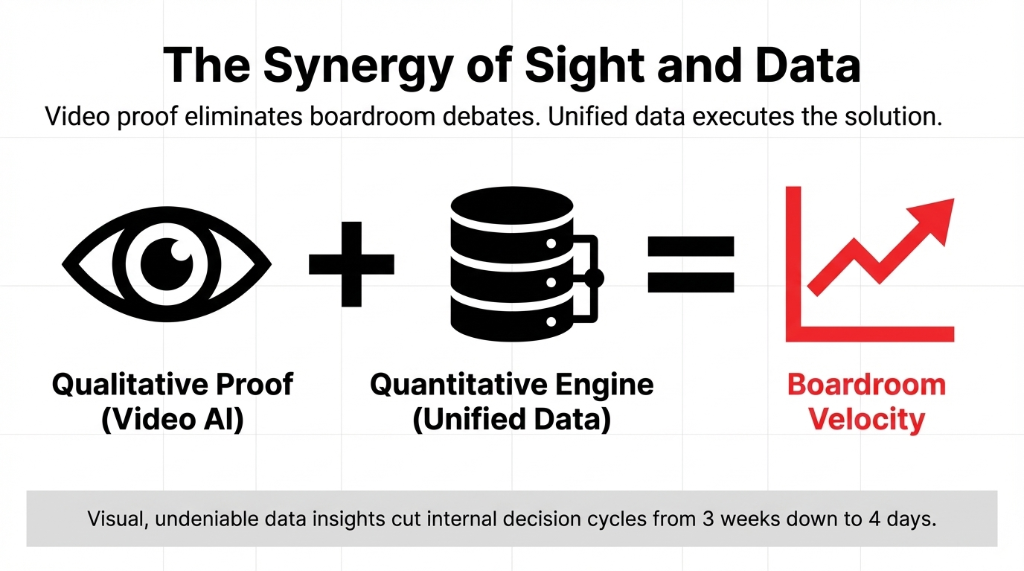
When you show a side-by-side video analysis ai comparison — a session where a shopper bounces due to a misfire versus one where intelligent ai suggestions led to a 3-item cart — you are no longer arguing about ROI in spreadsheets. You are showing it. Live.
US brands using video ai tools have cut internal debate cycles from 3 weeks to 4 days. Predictive analytics tied to visual proof eliminates the "let's wait" stall. The business of ai isn't abstract; it's a 47-second screen recording of a customer choosing you over a competitor.
The Numbers Don't Lie: What to Expect
Let's put specific outcomes on the table, because vague promises waste your time when measuring the impact of ai prediction:
| Metric | Before AI Recommendations | After Braincuber AI Layer | Timeline |
|---|---|---|---|
| Conversion Rate | 1.4% - 1.8% | 3.2% - 4.7% | 45-90 days |
| Average Order Value | Baseline | +22% - 35% uplift | 30-60 days |
| Cart Abandonment | 68% - 76% | 44% - 52% | 60 days |
| Revenue from Recs | 8% - 12% of total | Up to 35% of total | 90 days |
The Controversial Take Nobody Wants to Hear
Everyone in the Shopify ecosystem tells you to install more apps. More apps for reviews, more apps for upsells, more apps for loyalty programs.
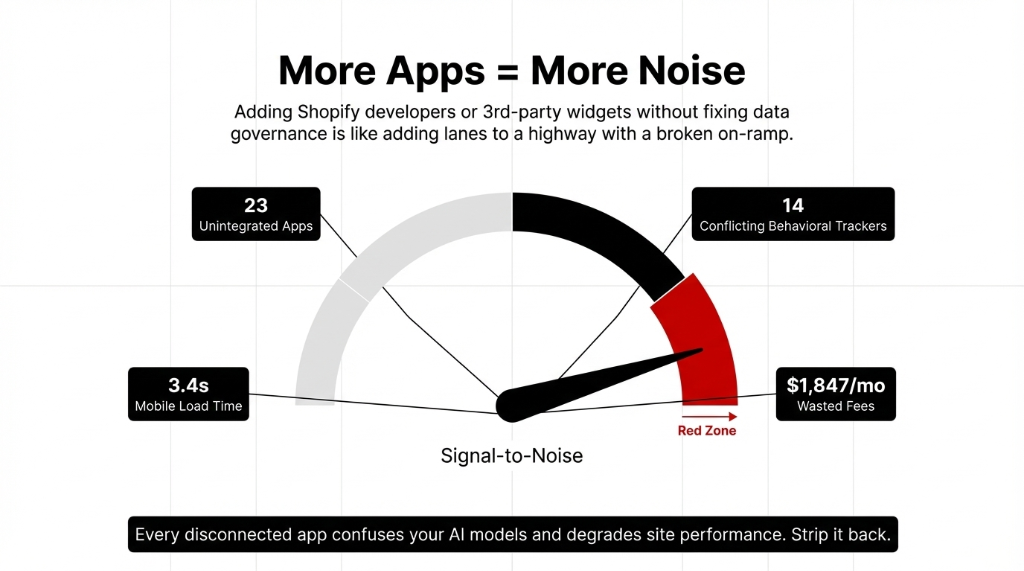
Don't. Every new app you install that isn't connected to your central data platform is adding noise to your ai analyze layer.
We had a US client running 23 Shopify apps simultaneously — 14 of them collecting behavioral data that never connected to anything. Their store was slower, their recommendation engine was receiving conflicting data signals, and they were paying $1,847/month in combined app fees just to confuse their own AI.
Hiring more Shopify developers without fixing your data governance first is like adding lanes to a highway with a broken on-ramp. Strip it back. Build a real data analytics and ai foundation.
5 FAQs
How quickly can AI recommendations go live on an existing Shopify store?
For most Shopify stores, a properly configured ai integration with behavioral data connectivity can go live in 14-21 days. Stores with messy product data take 28-35 days to prepare before the ai analytics layer can run accurately.
Do I need a large catalog for AI recommendations to work?
You need a minimum of 50 active SKUs and at least 50,000 monthly sessions for ai for data analytics to generate statistically meaningful patterns. Below that threshold, the models don't have enough data and ai signal to make smart predictions.
What's the difference between Braincuber's AI and a standard Shopify app?
Standard apps use rule-based logic. Braincuber's intelligent ai layer uses real-time behavioral data, ai data analysis from multiple connected sources, and adaptive ai for automation that retrains itself. The output is highly personalized.
Will AI video analysis work with my current store setup?
Yes. Our ai video tool audit works with any Shopify plan. We pull session recordings via your existing analytics setup and run ai video analytics on top of them. We identify recommendation failures within the first 5 business days.
How does Braincuber handle data governance and privacy compliance?
All data governance practices follow CCPA requirements for US brands. We don't store raw PII; we work with anonymized behavioral signals and aggregated data analytics. Every data integration is scoped before touching your store.
Stop Leaving $38,000+ a Month on the Table
Book a free 15-Minute AI Recommendations Audit with Braincuber. We'll pull your session data, review your current ai integration, and show you exactly where your store is losing money and what fixing it looks like in real numbers.