
The Real Problem with Separate Systems
Indian D2C brands do not fail because of basic accounting software. They fail because accounting is forced to live separately from orders, stock, shipping, cash collection, GST, and returns. QuickBooks can handle GST-oriented invoicing and reporting, but the moment your business needs deeper operational linkage, you are patching gaps with spreadsheets and manual exports.
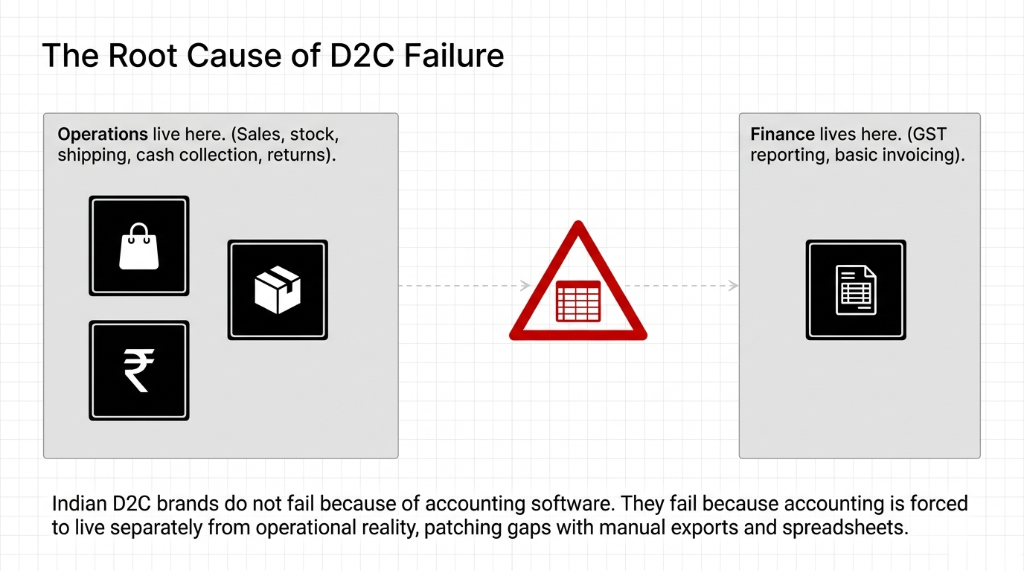
Odoo’s India GST modules are built to sit alongside sales, purchase, inventory, and invoicing. This is critical when you are dealing with B2B, B2C, exports, GSTIN handling, and e-commerce-specific tax treatment. That is the difference between recording the financial mess and controlling the operational mess.
QuickBooks in Indian D2C: The Bookkeeping Layer
QuickBooks supports GST workflows such as GSTIN capture, HSN/SAC codes, place of supply, and GST-ready reports. It is designed to help businesses create compliant invoices and generate return-ready outputs without heavy setup.
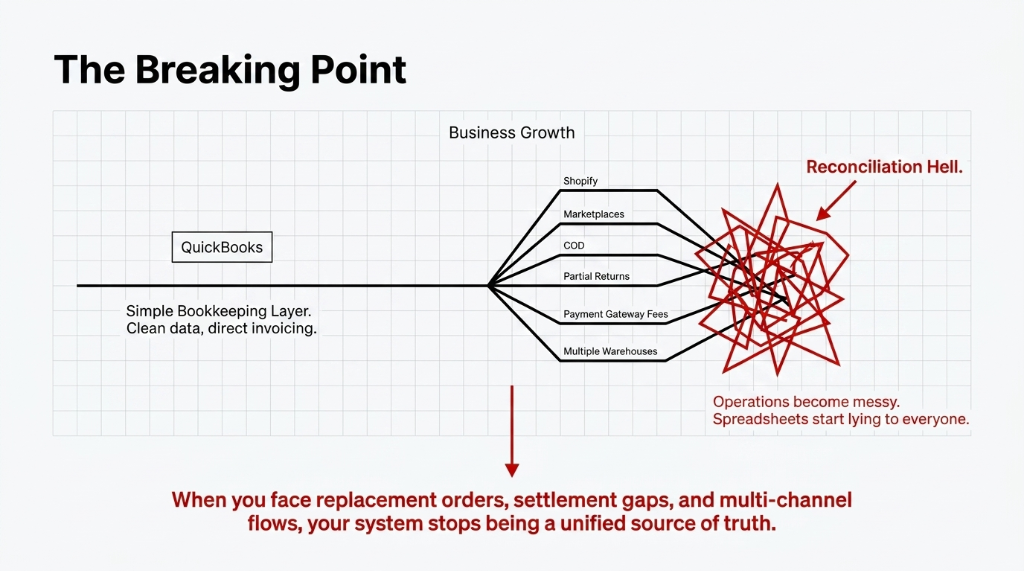
That sounds good until your D2C business becomes operationally messy. If you are selling across Shopify and marketplaces, handling COD, partial returns, replacement orders, payment gateway fees, and inventory movement across multiple warehouses, QuickBooks becomes a bookkeeping layer rather than an operating layer.
QuickBooks is strongest when you want:
- Simple ledger-based bookkeeping with minimal setup overhead.
- GST-friendly invoice tracking for clean, direct-to-consumer digital sales.
- Lightweight finance operations that do not require specialized training.
- A cleaner accounting interface for a small, accountant-led team.
Odoo for Indian D2C: The Operational Core
Odoo is a different animal because accounting is not isolated from the rest of the business. Its India GST apps and modules are tied to sales, purchase, inventory, invoicing, and reporting, with support for customer registration types, e-commerce operator logic, invoice types, and GSTR-1 style reporting fields.
That matters for D2C because the real pain is not just tax filing. It is keeping invoice data, shipping data, stock data, and finance data from drifting apart by the end of the month. Odoo gives you one operational record system, which is exactly what growing brands need once spreadsheets start lying to everyone.
D2C Accounting Pain Points
Indian D2C accounting has a few recurring nightmares. First, GST data has to be clean across invoices, returns, and customer types. Second, marketplaces and payment gateways create settlement gaps that do not line up neatly with sales. Third, returns and replacements distort revenue recognition unless the accounting system can absorb operational reality.
QuickBooks can capture tax and reporting data, but it is not built to be the command center for all those moving parts. Odoo is closer to that role because it connects finance to the actual business flow. This is what matters when your accountant and operations team keep arguing about which number is true.
Feature-by-Feature Comparison
| Operational Area | QuickBooks | Odoo |
|---|---|---|
| GST Setup | Basic GSTIN, HSN/SAC tracking and simple return-ready reports. | Advanced India localization covering GSTR-1, customer types, and portal integrations. |
| Inventory Control | Basic SKU tracking; lacks multi-warehouse and landed cost capabilities. | Fully integrated inventory, automated lot tracking, and warehouse routing. |
| Sales & Purchases | Bookkeeping workflows only; manual journal reconciliation required. | Directly linked to CRM, purchases, manufacturing, and general ledger. |
| D2C Operations | Requires third-party connectors for basic order routing. | Native Shopify and marketplace synchronization for real-time inventory adjustments. |
| Scale Readiness | Friction starts showing once order volume passes 310 orders per day. | Scalable to thousands of orders daily with automated payment gateway matching. |
GST and Indian Compliance
For Indian D2C, GST support is not a nice-to-have. QuickBooks includes GST-related invoice fields and return-ready reporting, including GSTIN and HSN/SAC handling. It also calculates tax based on customer status, ship-to location, and what you sell.
Odoo’s India GST modules go further into operational structure. The available modules cover customer registration type, invoice type, e-commerce operator handling, and GSTR-1 report categories like B2B, B2CS, B2CL, HSN, and export. That makes Odoo more practical when tax treatment depends on transaction context, not just a simple sales invoice. When setting up an Odoo implementation, this localization is configured directly into the core transactional engine.
One more point people ignore: e-commerce tax logic is not static. TCS under GST can matter in marketplace flows, and that creates another layer of reconciliation work for D2C brands selling through operators or multiple platforms.
Inventory and Returns: The Real Breaking Point
This is where the decision gets blunt. If your inventory is still manageable in a few SKUs and a single warehouse, QuickBooks may be enough. But the second you have multiple bundles, SKUs, replacement cycles, or warehouse-level stock movement, accounting software that ignores operations becomes a liability.
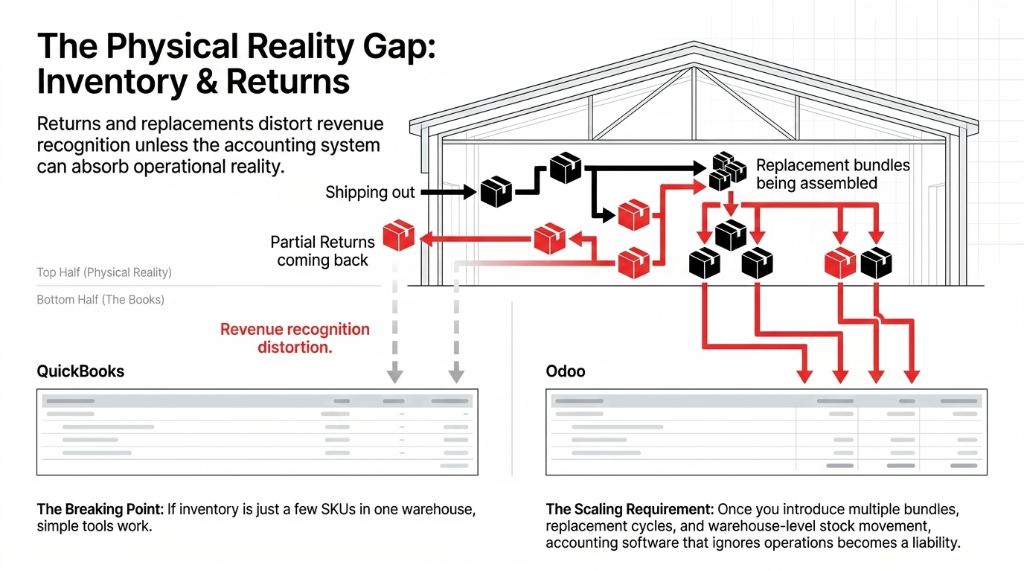
Odoo’s advantage is that inventory is not an afterthought. Its accounting, sales, purchase, and stock modules are designed to work together, so returns and stock adjustments are much easier to align with the books. This is why brands with serious fulfillment complexity choose to implement multi-channel inventory sync on an ERP instead of a standalone accounting tool.
Cost and Complexity
QuickBooks usually wins the "easy to start" argument. It is faster to adopt, simpler to train, and less intimidating for a lean finance team. For a small D2C brand with modest SKU complexity, that can be enough for a while.
Odoo usually wins the "expensive to ignore later" argument. It takes more setup, more process thinking, and better implementation discipline, but that extra work pays off when the business needs accounting that reflects the actual operation. In other words, QuickBooks is cheaper to begin with; Odoo is cheaper to live with when scale arrives.
Migration Reality: A Cleanup, Not a Swap
Migrating from QuickBooks to Odoo is not a software swap; it is a cleanup project. You have to map chart of accounts, customer and vendor records, item masters, GST fields, opening balances, and inventory valuation rules before the new system can behave properly.
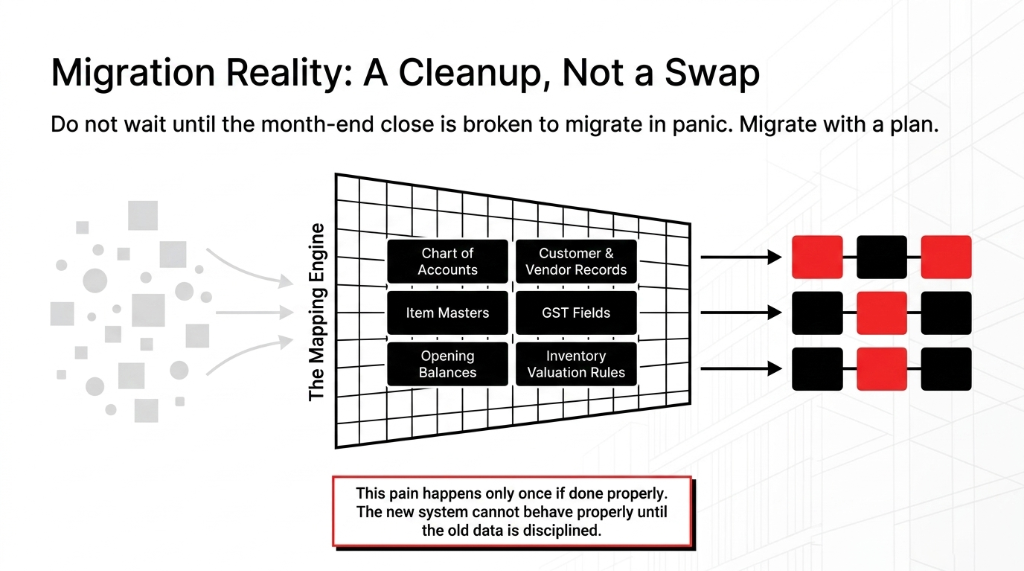
The good news is that this pain happens only once if the migration is done properly by an experienced Odoo integration partner. The bad news is that many D2C brands wait until the month-end close is already broken, which means they migrate in panic instead of with a plan.
Decision Framework: What to Choose
Choose QuickBooks if:
Single Sales Channel: You only sell on Shopify or one marketplace.
Low SKU Complexity: Your inventory is straightforward with no bundling.
Minimal Fulfillment Needs: You operate out of a single third-party warehouse.
Lean Team: You do not have dedicated operations or database resources.
Choose Odoo if:
Multi-Channel Growth: You sell on Shopify, Amazon, and offline B2B channels.
Complex Inventory: You handle bundles, expiration lots, or multiple warehouses.
High Return Rate: Returns and replacements make up more than 17.5% of your volume.
Automation Focused: You want order placement, stock allocation, and invoicing unified.
If your brand is still behaving like a startup with one accountant and a pile of Excel sheets, QuickBooks can carry you for now. If your business has already become a logistics problem disguised as a consumer brand, Odoo is the system you should be looking at.
Frequently Asked Questions
Is QuickBooks enough for Indian D2C?
Yes, for small and simple brands, QuickBooks can handle basic bookkeeping and standard GST invoicing. It stops working effectively once multi-warehouse inventory and complex return cycles are introduced.
Is Odoo better for GST compliance?
For operationally complex D2C brands, yes. Odoo's Indian localization connects GST calculations directly to sales invoices, inventory returns, and purchases, reducing manual adjustment errors.
Which system is better for inventory?
Odoo is much stronger because inventory is built as a core application, whereas QuickBooks requires third-party add-ons to handle multi-location warehouse routing and landed costs.
Can QuickBooks handle e-commerce tax needs?
It handles standard GST calculation well, but multi-operator TCS adjustments, cash-on-delivery reconciliation, and marketplace settlement matching require extensive offline spreadsheet work.
Which should a growing D2C brand pick?
If your growth plan involves expanding channels, managing warehouse operations, or handling higher volumes of returns, implementing Odoo early will save significant migration pains later.
Are you tired of spreadsheets lying to your operations and finance teams?
Let's audit your reconciliation workflows. We build integrated Odoo systems that keep inventory, sales, and GST aligned automatically. No consultants. Just operations experts.
Schedule a D2C Operations Audit