
The Real Cost Nobody Puts in a Slide Deck
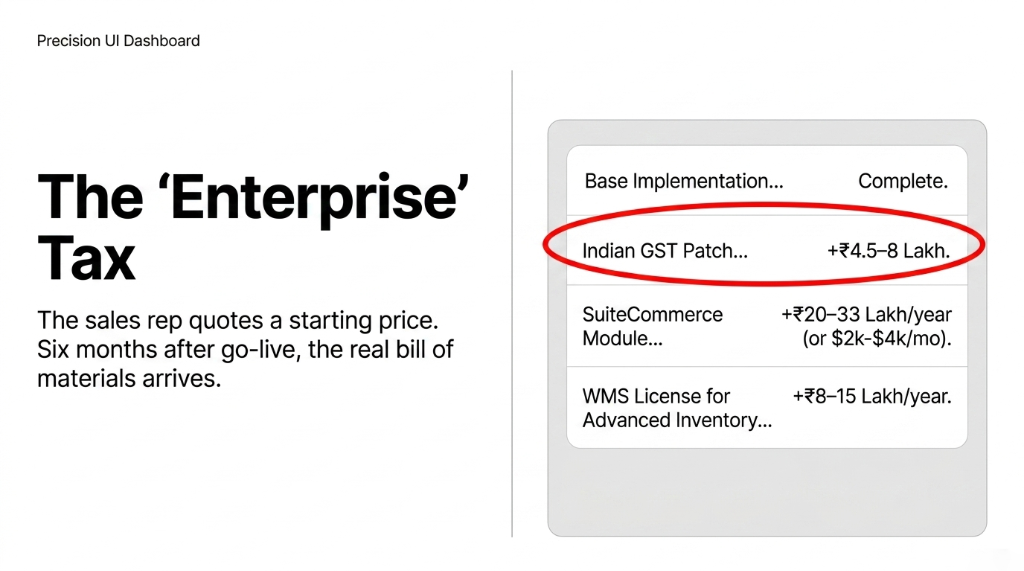
Every NetSuite sales rep quotes a "starting price." What they will not quote is the full bill of materials that lands in your inbox six months after go-live. The sales pitch is clean. The invoice is not.
Here is what a mid-market Indian e-commerce brand—say, $1.8M annual revenue, selling on Shopify and Amazon India simultaneously—realistically pays for NetSuite:
| Cost Component | NetSuite | Odoo |
|---|---|---|
| Annual License (20 users) | $19,200–$39,600/yr | $2,616/yr ($10.90/user/mo) |
| Implementation | $9,600–$96,000 one-time | $3,600–$18,000 one-time |
| India GST Customization | $5,400–$9,600 extra | $0 (Native) |
| E-Commerce Module | $24,000–$48,000/yr (SuiteCommerce) | Included |
| WMS License | $9,600–$18,000/yr extra | Included |
| Year 1 Total | $67,800–$211,200 | $6,216–$20,616 |
That is a 5x–10x cost difference before you touch a single line of customization. If you are a founder choosing NetSuite at $1.8M ARR, you are not scaling—you are cosplaying as an enterprise. (Your investors might love the logo on the deck. Your CFO will not love the wire transfer.)
Odoo's Custom plan—with Odoo Studio, multi-company support, and on-premise deployment—runs at $10.90/user/month annually. Implementation by a certified Odoo partner in India typically runs $3,600–$18,000 depending on complexity. That math is not even close.
Why GST Is the Real Battlefield
Here is the dirty truth that most ERP comparison blogs skip: NetSuite was built for US GAAP accounting. Its India localization is an afterthought bolted on by third-party consultants, and every bolt costs you money.
For Indian e-commerce, your ERP must handle automatic CGST/SGST/IGST split based on buyer-seller state, HSN/SAC code mapping at the product SKU level, e-invoicing with IRN and QR code generation for B2B transactions, e-way bill generation for logistics above $600 per consignment, GSTR-1 and GSTR-3B export in MCA-approved formats, and TCS deduction on marketplace payouts from Amazon and Flipkart. That is not a feature request. That is survival.
The GST Compliance Gap
Odoo: Native GST support embedded at the core. When a Shopify order lands, Odoo auto-applies the correct GST based on product type and customer state, generates an IRN from the government portal instantly, and populates the GSTR-1 report without manual intervention.
NetSuite: Getting to the same level of GST automation requires a customization project. We have seen clients spend $5,400–$9,600 extra just on India-specific tax patches after their base implementation was "complete."
(Yes, that is post-go-live. Yes, the sales rep knew.)
For the textile sector specifically, Odoo even automates GST slab switching—12% above $300 effective sale price, 5% below it—with no hacks required. Try getting NetSuite to do that without a SuiteScript developer billing you $150–$350/hour.
The Marketplace Mess Nobody Warns You About
Indian e-commerce is not just your Shopify store. You are selling on Amazon India, Flipkart, Meesho, and maybe Blinkit or Nykaa. Your ERP needs to consolidate orders, inventory, and payments from all of these simultaneously—without a 4-hour API sync lag that causes you to oversell during a flash sale.
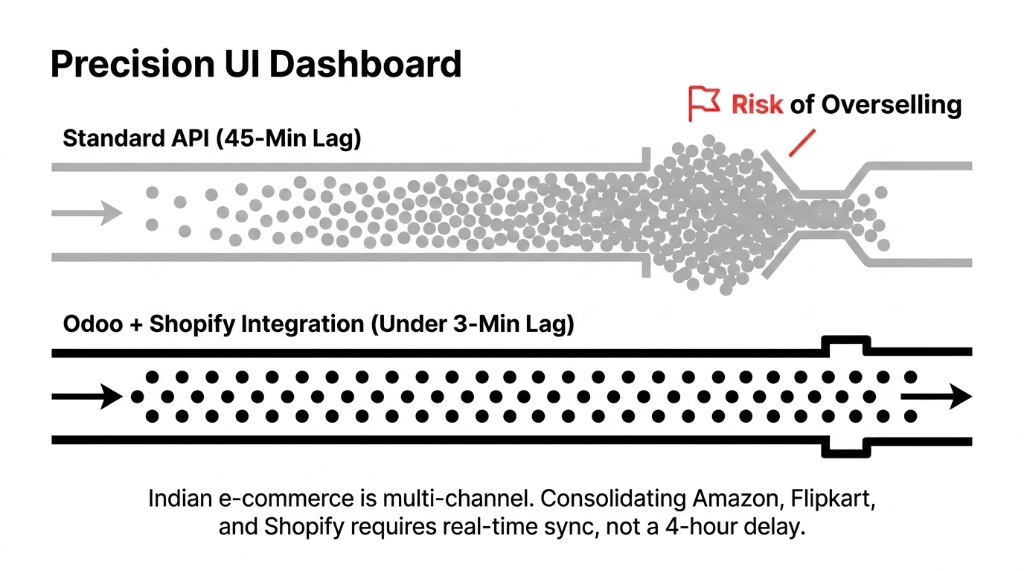
Odoo's native e-commerce module handles multi-channel inventory with real-time sync when properly implemented. The Odoo–Shopify integration we have built for clients cuts order sync delay from 45 minutes to under 3 minutes per batch. That matters enormously when you are running a flash sale at 6 PM and your stock is 800 units.
NetSuite's SuiteCommerce module is powerful—but it is priced for brands doing $10M+ USD in revenue. The SuiteCommerce Advanced plan alone adds $2,000–$4,000/month to your license. That is $24,000–$48,000 a year just for the e-commerce module. For an Indian brand at $1.8M ARR, that math kills your profitability before your marketing team has run a single campaign.
The Training Tax
What we see constantly: brands implement NetSuite for the brand equity (it sounds impressive in investor decks), then spend 18 months complaining that their warehouse team needs a 2-day training session just to process a return.
Odoo's UI is not pretty. But a warehouse executive in Surat or Bhiwandi with 6 months of experience can learn to process a return in Odoo in under 40 minutes of training.
That operational reality matters at scale.
Scalability: When Odoo Actually Loses
We are not here to paint Odoo as a perfect product. It has real limits, and if you are in one of these scenarios, NetSuite may be the right call—even with its pricing:
| Scenario | Odoo Verdict | NetSuite Verdict |
|---|---|---|
| $600K–$6M ARR, India-first D2C | Strong fit | Overpriced |
| Multi-country ops (India + UAE + US) | Needs customization | Native multi-currency |
| 200+ users, complex role access | Requires careful setup | Enterprise-grade controls |
| Financial consolidation (7+ entities) | Manageable with setup | Built for this |
| Seed/Series A startup (<$600K ARR) | Ideal fit | Financially irresponsible |
| Mid-market brand wanting 90-day go-live | Achievable | Typically 6–12 months |
The honest answer: NetSuite earns its price tag at $50M+ annual revenue with 5+ global subsidiaries. For 97% of Indian e-commerce brands reading this, that is not where you are today—and paying enterprise pricing for growth-stage problems destroys your cash position.
Implementation Reality in the Indian Market
Something the consultant in a Bangalore co-working space will not mention when pitching NetSuite: the Indian partner ecosystem for NetSuite is thin. Fewer than 40 certified NetSuite implementation partners exist in India as of 2026. The good ones have backlogs of 3–6 months. The bad ones will go live on time but leave you with a GST module that throws errors every quarter.
Odoo's partner network in India is significantly denser. In our own Odoo implementations across Surat, Mumbai, Delhi, and Bangalore, we have seen brands go from signed contract to live operations in 67–90 days for a mid-complexity Shopify + Amazon + accounting stack. That is not a claim—that is what the implementation calendar shows.
Real Client: Apparel Brand, $2.6M ARR, 3 Warehouses
NetSuite Quote
Implementation: $57,600
Timeline: 9 months
GST patches: Extra (TBD)
Odoo Result (Braincuber)
Implementation: $11,040 all-in
Timeline: 83 days
GST, e-way bills, Myntra connector: Included
They recovered the implementation cost in Q1 through reduced reconciliation errors alone.
The Inventory Accuracy Problem at Scale
If your e-commerce brand does over 500 orders a day across channels, your biggest silent killer is inventory discrepancy. One SKU miscount at a $14.40 average order value across 200 orders is $2,880 in either lost sales or customer cancellations—per incident.
Odoo's multi-warehouse inventory module handles bin-level stock tracking, FIFO/FEFO lot management, and automated reorder rules out of the box. For a brand with 2–5 warehouses and 3PL partners like Ecom Express or Delhivery, Odoo can sync stock positions every 8 minutes through a properly built API layer.
NetSuite does this too—but configuring its advanced inventory module requires a separate WMS license. Add another $9,600–$18,000 annually. (Your CFO is going to love that conversation.)
What Happens to Your Existing Stack
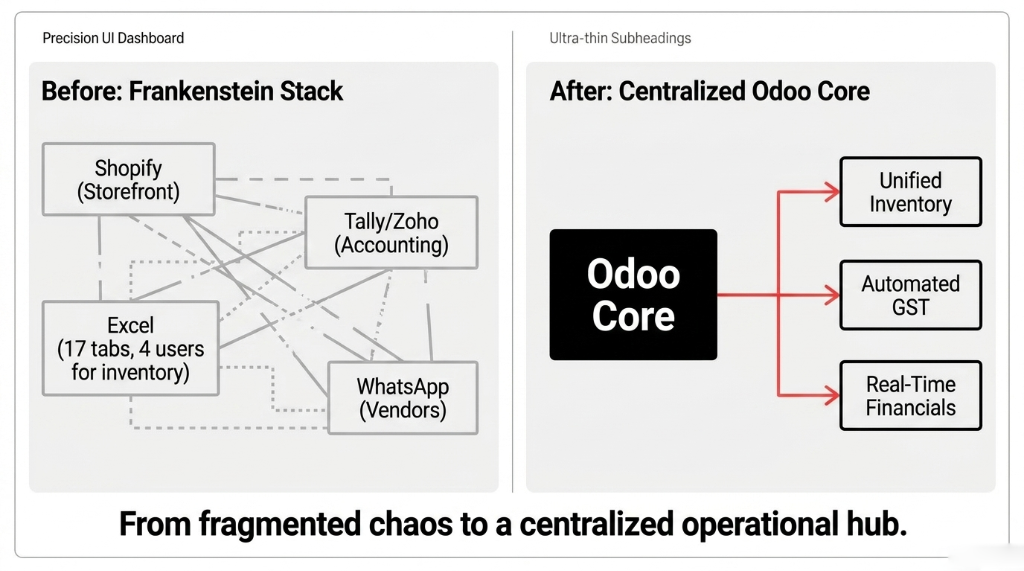
Most Indian e-commerce brands come to us running a Frankenstein stack: Shopify for the storefront, Tally or Zoho Books for accounting, an Excel sheet with 17 tabs and 4 people editing it simultaneously for inventory, and WhatsApp for vendor communication.
Migration Reality Check
Moving to Odoo: Shopify data, product catalogue, customer records, and order history migrate cleanly. GST history from Tally exports into Odoo's accounting module with a standard mapping file. We have done this migration for 11 Indian brands in the last 18 months without a single order going missing.
Moving to NetSuite: Your Tally data requires a middleware tool—typically $1,800–$3,600/year in licensing for something like MuleSoft or Celigo—just to translate the data formats. Every custom field in your Shopify store needs manual re-mapping in SuiteScript.
Timeline for NetSuite migration: 6–9 months. Budget overrun probability: 73% in our experience with clients who came to us after a failed NetSuite migration.
The Bottom Line Nobody Says Out Loud
Everyone tells you NetSuite is the "enterprise standard." That is true—for enterprises. An Indian e-commerce brand at $600K–$12M ARR is not an enterprise. It is a high-growth mid-market business that needs speed, GST compliance, multi-channel inventory sync, and a system its 6-person ops team can actually use without a consultant on speed dial.
Odoo, when implemented by the right partner with India-specific localization, does all of that at 1/5th the cost of NetSuite—and goes live 4x faster.
If you are raising your Series B and your investors are asking for NetSuite as a "scale signal"—push back. Show them the $45,600 you saved and the 83-day implementation. That is the real scale signal.
5 Questions Founders Ask About Odoo vs NetSuite
Can Odoo handle GST compliance fully for Indian e-commerce?
Yes. Odoo's India localization supports automatic CGST/SGST/IGST calculation, e-invoicing with IRN generation, e-way bill creation, GSTR-1 and GSTR-3B report export, and TCS tracking for marketplace sellers—all natively, without third-party plugins.
How much does Odoo implementation cost for an Indian e-commerce brand?
For a mid-complexity stack covering Shopify, 2 warehouses, GST, and accounting, a certified Odoo implementation in India typically costs $4,800–$18,000 one-time, plus $1,800–$3,000 per year in licensing for a 15–20 user team. Total Year 1 cost: $6,600–$21,000.
Is NetSuite better than Odoo for scaling beyond $12M ARR?
At $12M+ with multiple subsidiaries, global operations, and complex financial consolidation, NetSuite's multi-entity management and built-in multi-currency handling become genuinely valuable. Below that threshold, you are paying enterprise pricing for problems you do not yet have.
How long does Odoo implementation take for Indian e-commerce?
A well-scoped Odoo implementation covering inventory, GST, Shopify integration, and accounting takes 60–90 days with a certified partner. NetSuite equivalents typically run 6–9 months for the same scope.
Can Odoo integrate with Amazon India, Flipkart, and Meesho?
Yes. Through Odoo's connector ecosystem and custom API integrations, order, inventory, and payment data from Amazon India, Flipkart, and Meesho can be centralized in Odoo with sync intervals as low as every 5–10 minutes, eliminating manual reconciliation across platforms.
The $45,600 Question
Stop asking "Which ERP has more features?" Ask: "Which ERP gets my 6-person ops team live in 83 days, handles GST natively, syncs inventory across Amazon, Flipkart, and Shopify in under 3 minutes, and does not burn $187,000 before processing a single order?" The answer is not complicated. The ego around it is.
Check your last GSTR-3B filing. If your CA manually fixed even one mismatch, your ERP is not doing its job.
We run Odoo ERP integrations for Indian D2C brands doing $600K–$12M in revenue. 15-minute call. No slide decks. Just the numbers.
Book Your Free Operations Audit