
The Real E-Commerce Problem
The mistake most businesses make is picking software for today's billing pain instead of tomorrow's order chaos. That works for a while. Then orders start coming from Shopify, Amazon, WhatsApp, marketplaces, or a custom storefront—and the team ends up reconciling stock manually like it is 2009.
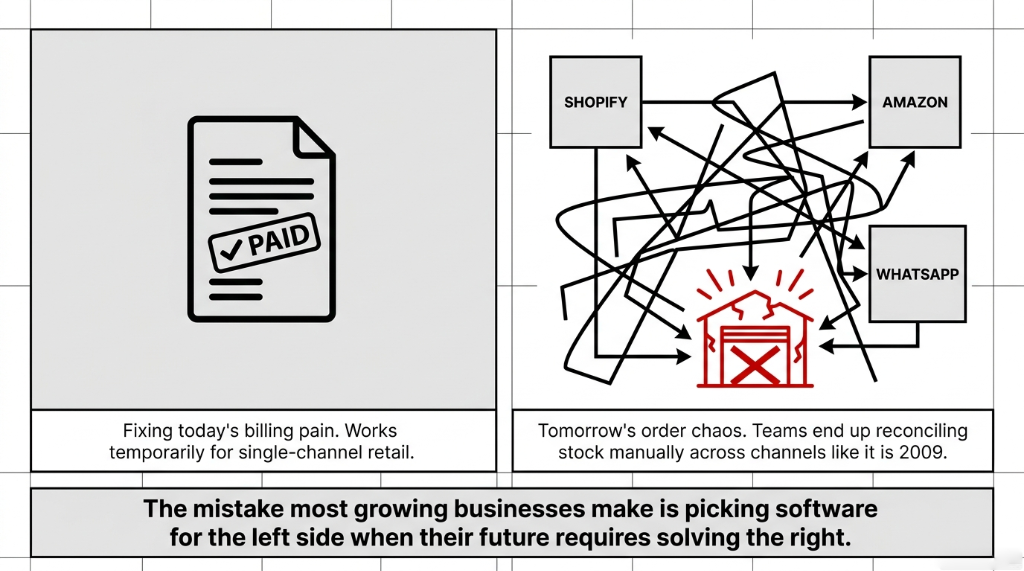
Marg ERP is not a bad product. Its public positioning is centered on GST-ready inventory, accounting, bank reconciliation, invoices, reports, and retail supply chain management. That makes it useful for businesses that care most about billing accuracy and inventory discipline. But it is not the same kind of commerce platform as Odoo.
Odoo is built around connected commerce. Its eCommerce feature set explicitly links website, sales, CRM, stock, and email marketing into one continuous flow. One action in one module reflects everywhere else. There is no CSV export. There is no 6-hour stale stock file. There is no manual reconciliation at 11 PM.
What Each One Is Actually Built For
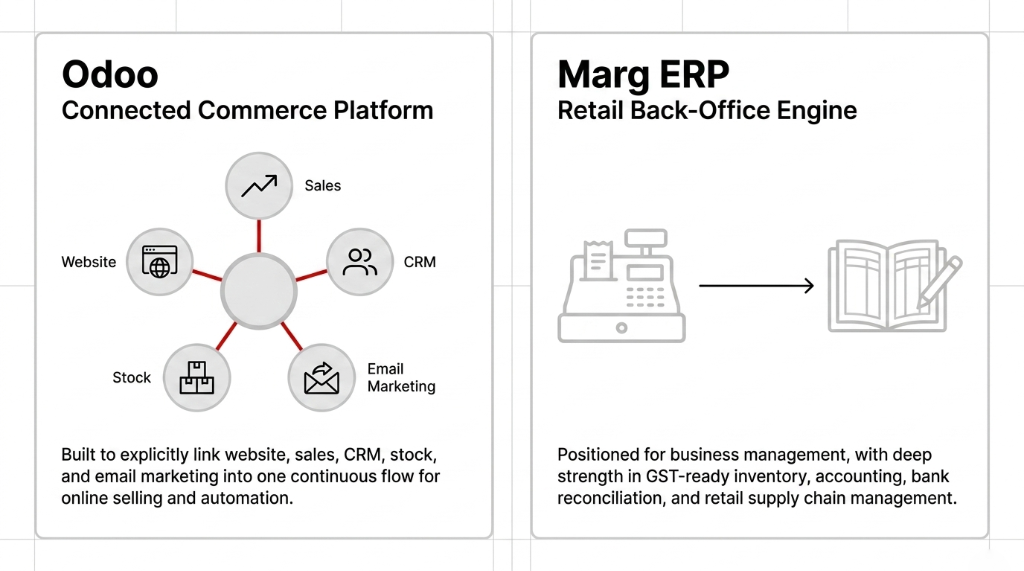
Odoo's pitch is broad: ERP, CRM, eCommerce, CMS, and a modular app suite with cloud and on-premise options. The Community edition is open source. The Enterprise offering adds extra apps, infrastructure, and services. For e-commerce teams, that means you can manage product pages, sales workflows, leads, stock updates, and marketing activities inside one system instead of stitching together five tools.
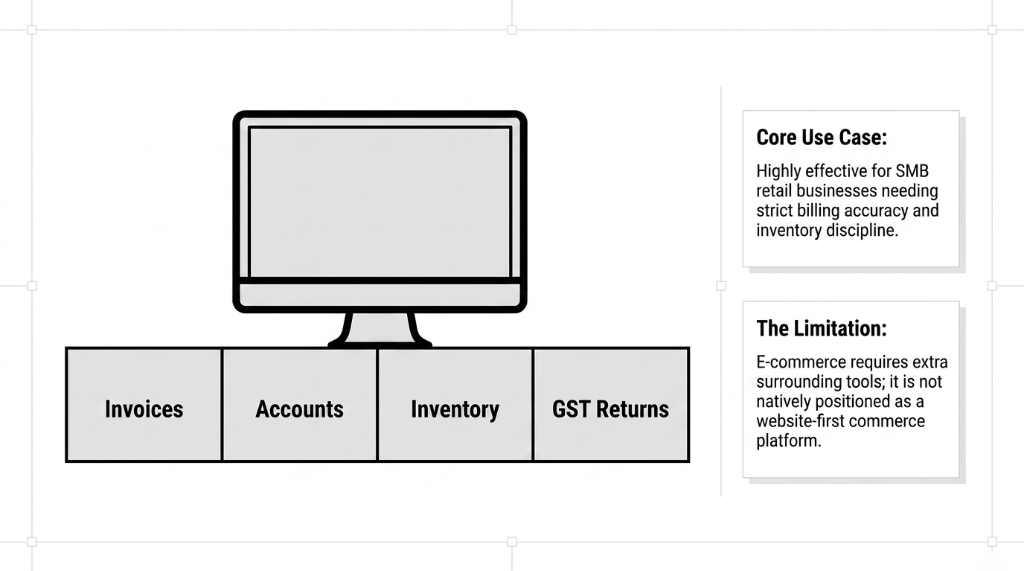
Marg ERP is a business management and retail operations tool, with strength in billing, stock, GST, and reporting. Its retail chain management focuses on invoices, accounts, inventory, reports, MIS, and GST returns—exactly why many small and mid-sized retail businesses use it. Its deployment is desktop-style, Windows-oriented, with short implementation durations for a basic retail use case.
The Core Difference Nobody States Clearly
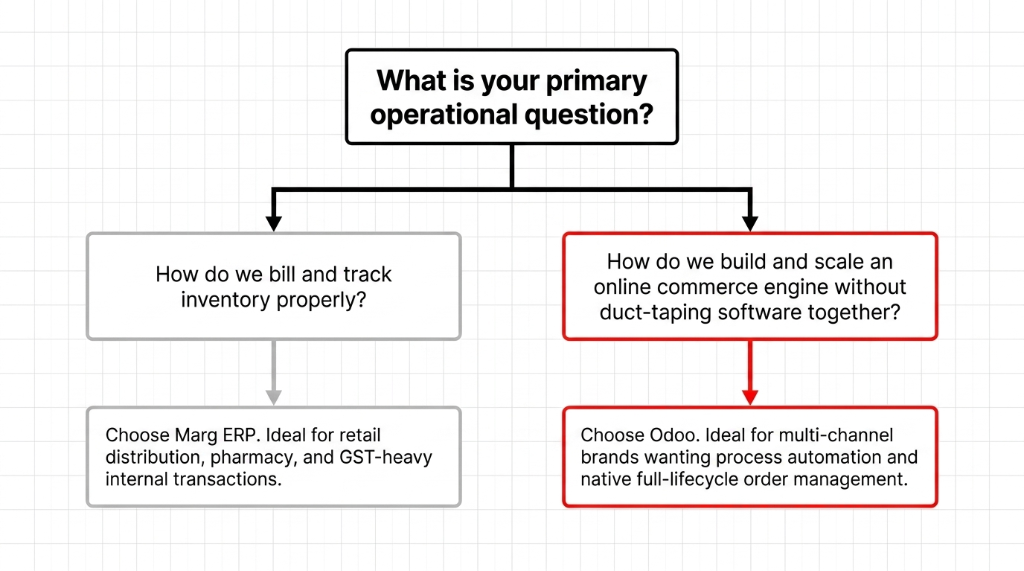
Marg ERP answers: "How do we bill and track inventory properly?"
Odoo answers: "How do we build and scale an online commerce engine without duct-taping software together?"
Those are fundamentally different questions. Pick the wrong one, and your ops team pays for it every month.
E-Commerce Capabilities: The Head-to-Head
Odoo has a clear advantage here because e-commerce is native to the platform. Its feature set shows integration points with Website, Sales, CRM, Stock, and Email Marketing—the backbone of online selling. You can create a website, send quotations, generate leads, and keep stock up to date without switching platforms.
Marg ERP can support retail operations and inventory-driven selling, but its publicly visible materials do not show the same depth of native storefront-first commerce. The system is strong for billing, accounting, product management, and retail chain processes. But e-commerce needs surrounding tools when the business model depends on online acquisition and digital customer journeys.
| Area | Odoo | Marg ERP |
|---|---|---|
| Core strength | ERP + eCommerce + CRM + automation | Billing + inventory + accounting + retail ops |
| E-commerce fit | Strong native fit for online selling | Retail back-office support only |
| Website tools | Native website and eCommerce stack | Not a website-first commerce platform |
| Integrations | Broad platform with apps and flexibility | Focused retail/business management stack |
| Deployment | Cloud or on-premise, open-source option | Desktop-oriented, Windows support |
| CRM and marketing | Native CRM, email marketing, lead capture | Not available—requires separate tools |
| Multi-channel order sync | Real-time across Shopify, Amazon, website | Manual CSV export/import workflow |
| Best for | Scaling brands, multi-channel, automation | SMB retail, billing, stock control |
Pricing: The Number That Misleads Everyone
Marg ERP's public listings show product pricing that varies by edition and vendor—examples range from $150 on IndiaMART to retail editions like Basic, Silver, and Gold on regional pages. That makes Marg ERP feel like a practical purchase for a local operations stack.
Odoo publishes $24.90/user/month for all apps, with Community offered as open source and free. That pricing structure is attractive if you want one platform to grow into instead of paying for separate systems as you add channels and workflows.
The Real Cost Comparison
Marg ERP + Patchwork Stack
Marg license: ~$150–$300/year
+ Separate CRM tool: $600–$1,200/year
+ Shopify connector or manual sync: $480/year
+ Email marketing platform: $360–$1,200/year
+ Ops labor for reconciliation: $2,400–$4,800/year
Odoo Enterprise (5 Users)
All apps included: $1,494/year
CRM: Included
eCommerce + website: Included
Email marketing: Included
Multi-channel sync: Native
Marg looks cheaper on paper. Add the surrounding tools, and the total cost of operations flips.
The Hidden Implementation Reality
E-commerce software rarely fails because of features on a brochure. It fails because order data, product variants, taxes, warehouse logic, and channel sync are handled badly. Odoo's integrated stack reduces the number of tools involved, which lowers the chance of data drift between website, sales, stock, and CRM.
Marg ERP works well when the workflow is mostly internal and transaction-driven. But if your business depends on the customer journey online—product discovery, lead capture, abandoned cart recovery, post-purchase email flows—you will still need extra tools for storefronts, lead capture, and marketing automation on top of Marg.
What We See in 47 E-Commerce Migrations
The pattern: Brand starts on Marg (or Tally or Busy) for billing. Adds Shopify. Adds Amazon. Online revenue crosses 30% of total. Suddenly the billing tool cannot keep up with the commerce engine.
The cost: By the time they call us, they have 3–5 disconnected tools, 23+ hours/month of manual reconciliation labor, and an average of $1,740/month in avoidable operational losses from oversells, stock mismatches, and delayed fulfillment.
That is why many businesses outgrow retail-first software once online revenue becomes more than a side channel.
Who Should Choose Which
Choose Odoo If:
Your business sells online and needs one connected system for storefront, CRM, orders, inventory, marketing, and reporting.
You are tired of moving data between Excel, Shopify, accounting software, and warehouse tools.
You want process automation and a platform that handles the full order lifecycle—not just the invoice. An Odoo implementation partner can get you live in 8–12 weeks.
Choose Marg ERP If:
Your operation is closer to retail distribution, pharmacy, or GST-heavy billing and your main pain is stock, invoices, accounts, and compliance.
You are not running a content-heavy, customer-facing commerce engine. If your online channel is less than 15% of revenue and you do not plan to scale it, Marg can be enough.
The Implementation Math
For e-commerce, the winner is usually the platform that can handle the full order lifecycle, not just the invoice. When we implement Odoo ERP integrations for brands migrating from Marg or similar retail-first tools, the average time to go-live is 67–90 days. The average reduction in manual reconciliation labor is 74%. The average recovery in operational losses within Q1 post-migration is $4,380.
Marg ERP has the narrower but still useful strength of retail operations and accounting. If your business model stays offline-first and transaction-driven, it does exactly what it says on the box. But the moment your e-commerce revenue crosses 30% of total sales, the box is not big enough.
5 Questions E-Commerce Founders Ask About Odoo vs Marg ERP
Is Odoo better than Marg ERP for e-commerce?
Yes. Odoo has native eCommerce, website, CRM, sales, stock, and email marketing integration, which makes it better for online selling workflows. Marg ERP is positioned more as retail and back-office software than a storefront-first commerce platform.
Is Marg ERP good for online businesses?
It can work for inventory, billing, and accounting, but it requires extra surrounding tools for storefronts, lead capture, and marketing automation. It is not natively positioned as a website-first commerce platform.
Which is cheaper, Odoo or Marg ERP?
Odoo publishes $24.90/user/month for all apps. Marg ERP pricing varies by edition and vendor, starting around $150. But when you add the CRM, email marketing, Shopify connector, and reconciliation labor that Marg requires separately, total cost of operations often exceeds Odoo.
Which one is easier for retail?
Marg ERP is usually easier for billing-heavy retail setups because its product pages focus on invoices, accounts, GST, and inventory. For pure offline retail with no e-commerce ambitions, Marg is the simpler choice.
Which one scales better for e-commerce?
Odoo scales better for e-commerce because it combines online store, CRM, sales, stock, and marketing in one platform. Marg ERP requires bolt-on tools as you add channels, which creates data drift and manual reconciliation overhead.
The Practical Decision Rule
If your main question is "How do we bill and track inventory properly?" Marg ERP deserves a look. If your main question is "How do we build and scale an online commerce engine without duct-taping software together?" Odoo is the stronger answer. For e-commerce, the winner is the platform that handles the full order lifecycle—not just the invoice.
Count the number of tools your ops team touches between order received and order shipped. If it is more than 2, your ERP is not doing its job.
We design Odoo implementations for e-commerce brands that have outgrown retail-first software. 15-minute call. No slide decks. Just the multi-channel sync math for your specific operation.
Book Your Free Operations Audit