
The Real Problem With How Indian D2C Founders Pick ERPs
Most founders pick an ERP based on a YouTube video or a Reddit thread from someone in Germany running a manufacturing plant. That has nothing to do with your Shopify store selling skincare to 40,000 customers in Tier 2 India.
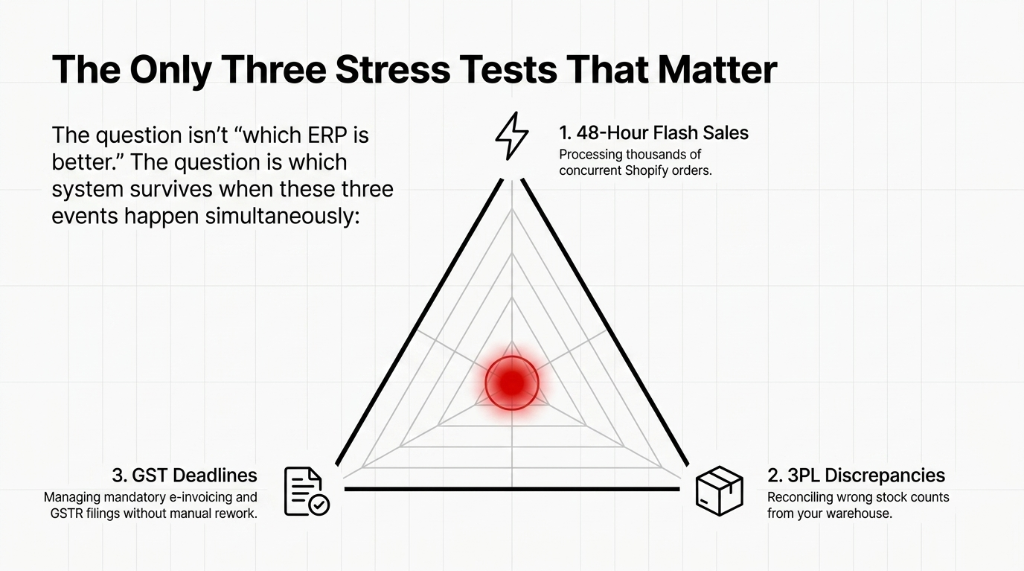
The real question isn't "which ERP is better." It's: which ERP won't collapse when your GST filing is due, your 3PL sends wrong stock counts, and you're running a 48-hour flash sale simultaneously?
That's the lens we use. Through that lens, Odoo and ERPNext look very different.
Where ERPNext Actually Wins (And Why It's Not Enough)
ERPNext is 100% open-source. No per-user licensing fees. If you're a bootstrapped D2C brand doing ₹30–80 lakh ARR with a 3-person ops team, that matters.
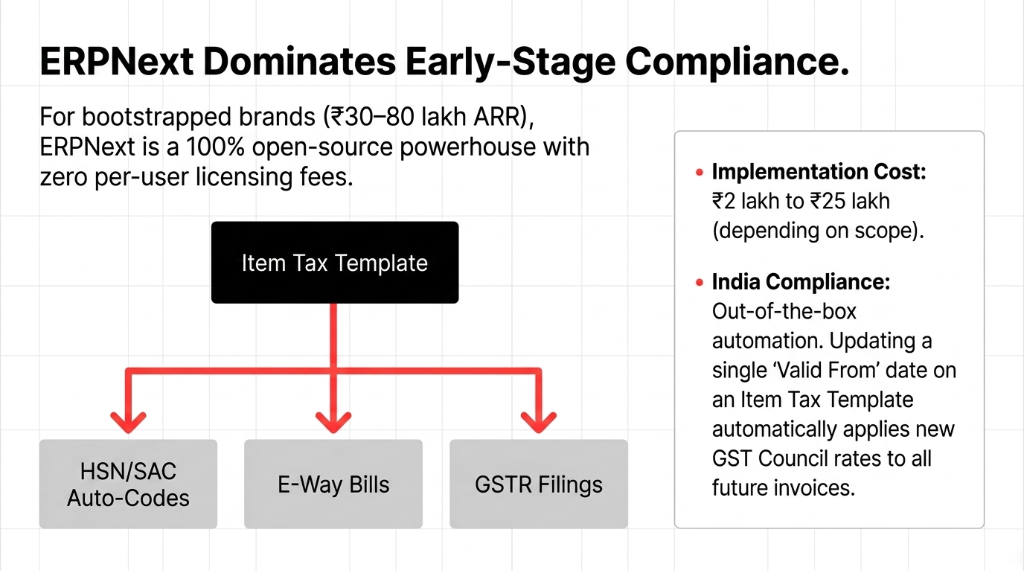
The ERPNext India Compliance app handles GST automatically — GSTIN validation, HSN/SAC codes, e-invoicing, e-way bills, and GSTR filings all pre-configured out of the box. When the GST Council revised rates in September 2025, ERPNext users could update a single Item Tax Template with a "Valid From" date and every future invoice automatically picked the new rate — zero manual rework. That's genuinely impressive for a free system.
ERPNext Cost Advantage
Total implementation cost in India: ₹2 lakh to ₹25 lakh, depending on scope. For a bootstrapped brand under ₹1 crore ARR, that's the entire argument for ERPNext. Closed.
But here's where it breaks down for growing D2C brands:
The ERPNext Breaking Points
1. MariaDB bottleneck: ERPNext runs on MariaDB, which starts creaking when you're processing 1,500+ orders a day during a sale.
2. Limited modules: ~20 core modules. The moment you want a native loyalty program, POS for your offline pop-up, or barcode picking — you're patching things together with third-party tools.
3. Shopify integration is community-maintained, not official. We've seen it silently fail during peak load — 300 orders didn't sync to the warehouse and nobody got a notification. That's not a bug. That's an operations disaster.
4. Cost creep past 30 users: ERPNext's annual cost approaches ₹9.6 lakhs due to data usage thresholds — suddenly it's not the budget option anymore.
ERPNext is a really strong SME ERP. It is not built for a D2C brand running flash sales, multi-warehouse ops, and a Shopify storefront simultaneously. Full stop.
Where Odoo Wins for Indian D2C (The Numbers Don't Lie)
Odoo is not cheap. Let's get that out of the way. Odoo licensing runs ₹800–₹2,000 per user per month. Implementation in India ranges from ₹4 lakh (starter) to ₹60 lakh (enterprise-grade). A professional package covering 20–50 users with Shopify integration, multi-warehouse, and custom workflows runs ₹15–20 lakh over 3–5 months.
That sounds like a lot. Here's what it buys you that ERPNext can't:
Native Shopify Integration That Holds During a Flash Sale
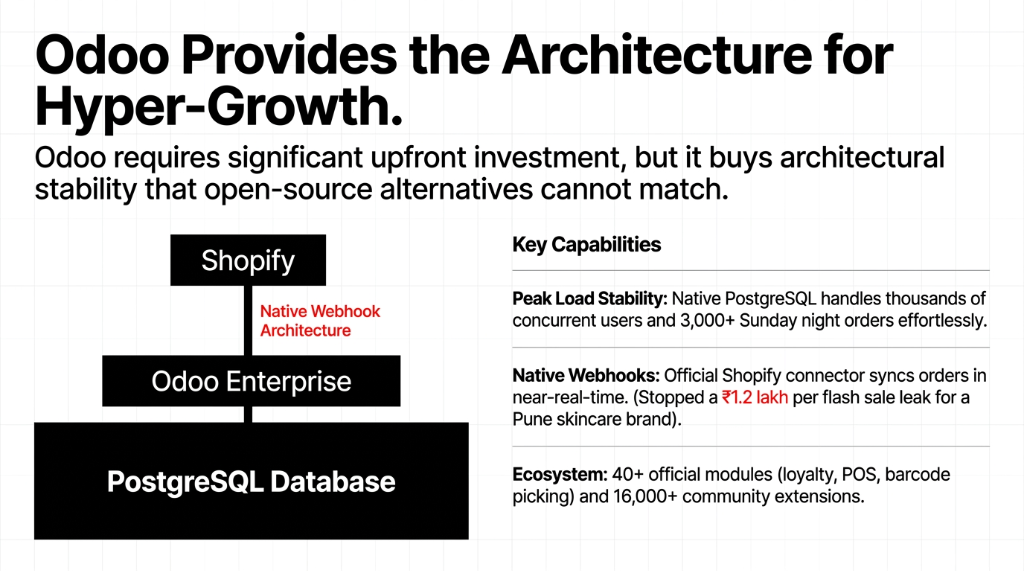
Odoo's official Shopify connector syncs orders in near-real-time using a webhook architecture. Compare that to a community plugin and you'll understand why one of our clients — a skincare brand in Pune doing ₹4.3 crore ARR — stopped losing ₹1.2 lakh per flash sale in unsynchronized orders after switching to Odoo.
40+ Official Modules, 16,000+ Community Extensions
Need a loyalty program? Native. Need WhatsApp order confirmation? App store. Need a barcode-based warehouse picking system? Built-in. ERPNext makes you build all of this from scratch.
PostgreSQL Under the Hood
Odoo runs on PostgreSQL and handles thousands of concurrent users without optimization gymnastics. When your D2C brand hits ₹20 crore ARR and you're processing 3,000 orders on a Sunday at 9 PM, this matters more than any feature comparison table.
Insider Truth: GST on Odoo
GST compliance in Odoo is handled — but you need a certified Odoo partner in India to configure it correctly from Day 1. We've onboarded clients who tried to DIY the Odoo GST setup and spent ₹3.4 lakh fixing incorrect e-invoice configurations 4 months post-go-live. Don't let that be you.
The Ugly Cost Comparison (With Real Indian Numbers)
Here's what nobody puts in their comparison blog — the 3-year total cost of ownership for an Indian D2C brand doing ₹5–15 crore ARR:
| Cost Component | ERPNext (Self-Hosted) | Odoo Enterprise |
|---|---|---|
| Year 1 Implementation | ₹5–15 lakh | ₹15–25 lakh |
| Annual License (25 users) | ₹0 (Open Source) | ₹4–6 lakh/year |
| D2C Customization | ₹3–8 lakh | ₹2–5 lakh |
| Shopify Integration Quality | Community / Unstable | Official / Stable |
| Peak Load Handling | Needs optimization | Native PostgreSQL scale |
| 3PL API Connectors | Build-it-yourself | 200+ ready integrations |
| 3-Year TCO Estimate | ₹12–28 lakh | ₹28–50 lakh |
The gap is real. But ask yourself: what does one bad flash sale cost you? A D2C brand doing ₹1.5 crore in a 48-hour campaign can lose ₹14–18 lakh in unshipped orders, wrong-SKU fulfillments, and customer refunds if the ops stack collapses. We've seen it happen — twice, with two different brands, both running patched ERPNext Shopify connectors.
The Braincuber Verdict: Which One Should You Pick?
We implement both. We're not here to sell you one over the other. We're here to stop you from making an ₹18 lakh mistake.
Pick ERPNext If:
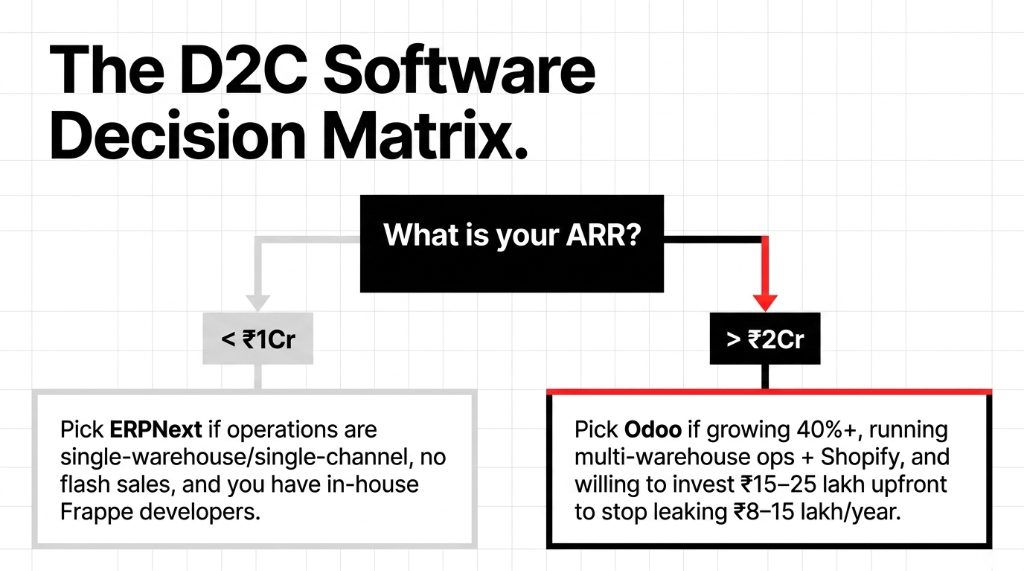
1. You're under ₹1 crore ARR and every rupee counts
2. You have an in-house dev who understands Frappe framework
3. Your ops are single-warehouse, single-channel, no flash sales
4. You want full code control and don't mind DIY overhead
Pick Odoo If:
1. You're at ₹2 crore+ ARR and growing 40%+ annually
2. Your ops span multiple warehouses + Shopify + offline touchpoints
3. You want CRM, inventory, accounts, and WhatsApp in one system
4. You'll invest ₹15–25 lakh upfront to stop leaking ₹8–15 lakh/year
Frankly, the "ERPNext is free" argument breaks the moment you hit ₹3 crore ARR. At that scale, your ops complexity outgrows what ERPNext can handle natively. You'll spend more on custom Frappe development than you would have on Odoo Enterprise licensing.
The Implementation Reality Nobody Tells You
Here's what the first 90 days actually look like with Odoo for an Indian D2C brand:
The 90-Day Indian D2C Go-Live Timeline
Days 1–15
GST configuration, chart of accounts, opening stock. If your partner doesn't have India-specific experience, you'll waste 3 weeks here.
Days 16–45
Shopify sync, warehouse workflows, barcode picking, 3PL API setup. This is where 68% of go-live delays happen — not in software, but in SKU master data quality.
Days 46–90
Live ops, user training, and the inevitable "why isn't this working" calls. Budget for 3–4 weeks of parallel running before full cutover.
In our last 23 Indian D2C implementations, brands that went live with clean data (SKU master, vendor master, opening stock verified) cut their go-live timeline from 90 days to 61 days. That's 29 days of reduced implementation cost and faster ROI.
(Yes, data cleaning is boring. No, you cannot skip it.)
Who Should You Trust to Implement This?
Not a freelancer who learned Odoo from a Udemy course in 2022. And not a generalist IT firm that also installs CCTV cameras.
You need a partner who has done D2C-specific Odoo implementations — someone who has connected Shopify to Odoo's inventory, configured India-specific GST e-invoicing, and built the multi-warehouse picking logic your 3PL demands.
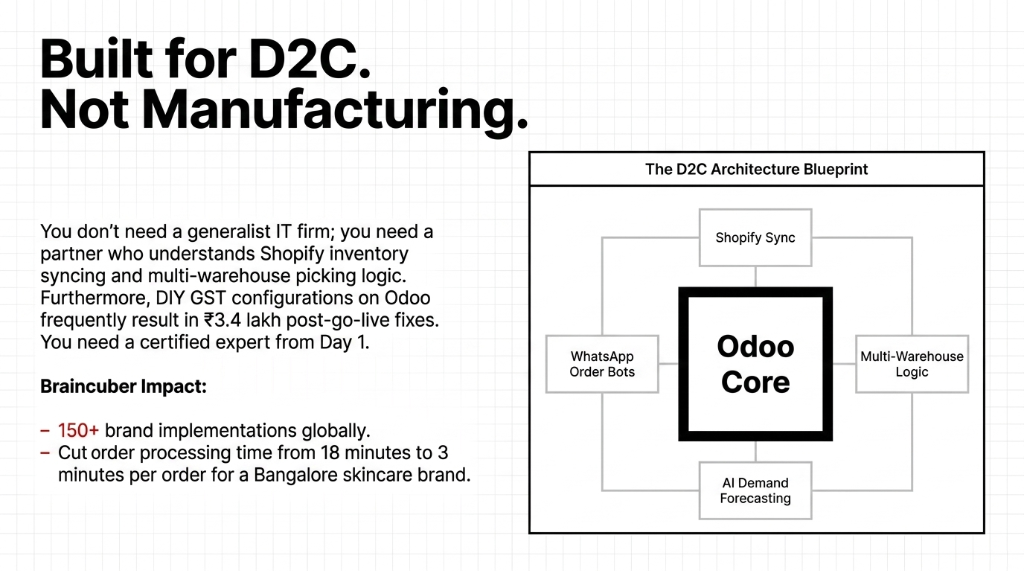
At Braincuber Technologies, we've done exactly this for brands across India, UAE, the US, and the UK. We don't just implement Odoo — we integrate it with AI-powered demand forecasting, automated Shopify sync, and custom WhatsApp order bots so your ops run 24/7 without a team standing by.
Braincuber Impact: Bangalore Skincare Brand
Before: 18 minutes per order processing. Manual Shopify-to-warehouse reconciliation. 3 Google Sheets holding ops together.
After: 3 minutes per order. Full Shopify–Odoo sync. Zero manual spreadsheets. 150+ brand implementations globally and counting.
FAQs: Odoo vs ERPNext for Indian D2C
Can ERPNext handle GST e-invoicing for Indian D2C brands?
Yes. ERPNext's India Compliance app auto-configures GSTIN validation, HSN/SAC codes, and e-way bill generation. It's one of ERPNext's strongest India-specific features. However, it requires developer-level setup — it's not plug-and-play for non-technical founders.
Is Odoo worth the cost for a D2C brand doing ₹2–5 crore ARR?
Yes, if your ops involve multi-warehouse, Shopify, and frequent promotions. Brands at this scale typically leak ₹10–18 lakh/year in operational errors. Odoo's ROI starts showing within 90 days of a clean go-live.
Which ERP is easier to customize for Indian D2C?
Odoo offers higher customization through Odoo Studio and 16,000+ community apps. ERPNext relies on the Frappe framework requiring Python skills. For non-technical founders, Odoo with a certified partner is significantly faster to customize.
How long does Odoo implementation take for an Indian D2C brand?
A professional Odoo implementation covering Shopify integration, multi-warehouse, and GST configuration takes 3–5 months. Brands with clean data and dedicated internal POCs can go live in as little as 61 days.
Can I migrate from ERPNext to Odoo without losing data?
Yes, but it's not trivial. Stock ledger, customer history, and open purchase orders require structured data mapping. Expect 3–5 weeks of migration work. The critical step is cleaning your SKU master before migration, not after — every wrong SKU carried forward multiplies post-go-live problems.
Open your Shopify admin right now. Check your last flash sale. Count the orders that hit "unfulfilled" for more than 48 hours. If that number is above 3% — your ERP is the problem, not your warehouse team.
Stop bleeding ₹8–15 lakh/year on a patchwork ops stack.
Book our free 15-Minute Operations Audit — we'll find your biggest leak in the first call. No sales pitch, just a diagnosis. We implement both ERPNext and Odoo. We'll tell you which one fits your numbers.
Book Your Free 15-Min Audit