
We have watched this happen across 150+ brands in the US, UK, UAE, and India. Both platforms are real. Both have a legitimate place. This post tells you exactly where each one belongs — and where it will hurt you if you misuse it.
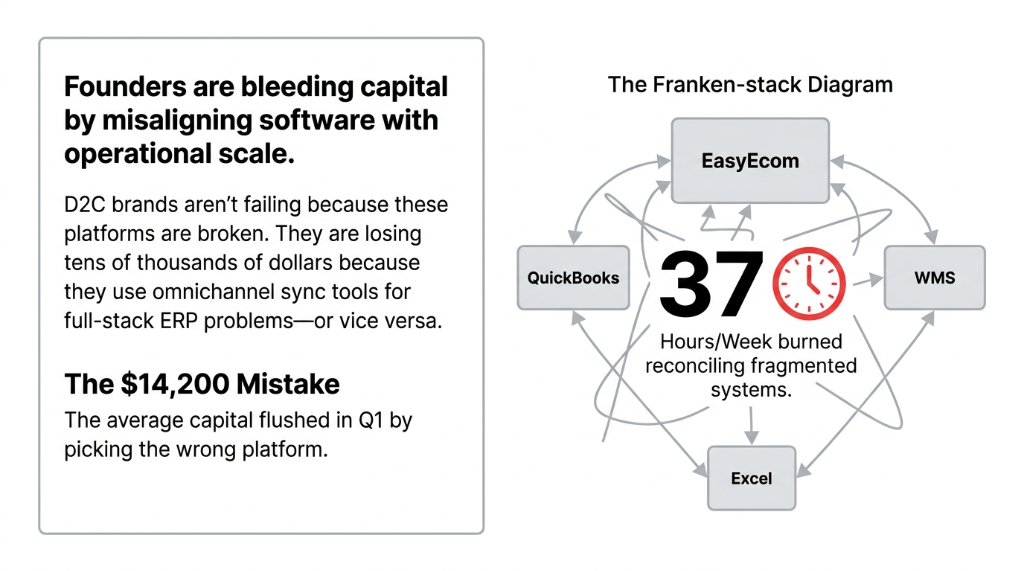
The Actual Difference Nobody Explains Clearly
EasyEcom does one thing well: omnichannel e-commerce operations. It was built for brands selling on Amazon, Flipkart, Myntra, Meesho, and Shopify simultaneously, who need inventory synced in real time and marketplace payments reconciled automatically. That is its lane. And for brands processing under 5,000 orders a month on Indian and global marketplaces, that lane is wide enough.
Odoo is not "e-commerce software with some ERP features." It is a full-stack ERP — covering CRM, accounting, HR, manufacturing, purchasing, inventory, and e-commerce — all natively connected under one database. When your warehouse manager ships an order in Odoo, your accountant's ledger updates automatically. No Zap. No sync delay. No manual export.
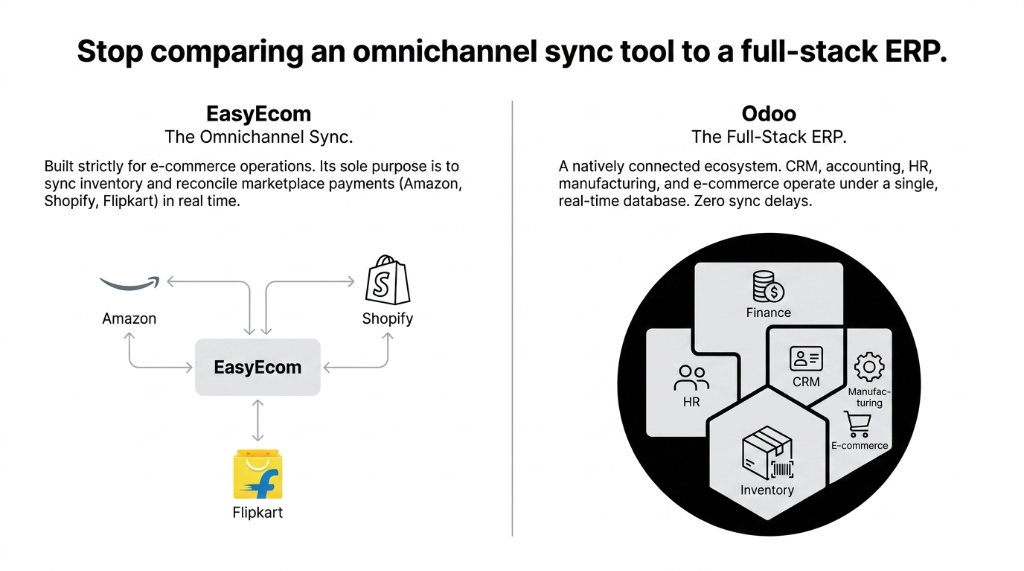
Here is the mistake we see constantly: a $2M D2C brand picks EasyEcom because the demo looked simpler. Fourteen months later, they are running EasyEcom for inventory, QuickBooks for accounting, a separate WMS, and an Excel file for purchasing orders. Their ops team is burning 37 hours a week reconciling four systems that should never have been separate in the first place.
Where Each Platform Actually Wins
EasyEcom Wins On:
▸ Marketplace reconciliation — automatically detects when Amazon or Flipkart has overcharged or underpaid you. One client recovered $11,300 in a single quarter from this one feature alone
▸ EasyVMS — records packing footage tagged to Order IDs so you can dispute return fraud with video evidence
▸ Onboarding speed — go live in 2–4 days if your marketplaces are standard integrations
▸ Real-time inventory sync across Amazon, Shopify, Walmart, Flipkart, Etsy, and POS simultaneously
Odoo Wins On:
▸ Full double-entry accounting — not a QuickBooks integration, actual financial reporting, audit trails, and multi-currency reconciliation
▸ Manufacturing and kitting — BOM management, work orders, quality control; EasyEcom has zero equivalent
▸ CRM and pipeline management native to the same system handling your inventory
▸ Multi-company, multi-language — Odoo runs in 75+ languages; EasyEcom is English only
▸ 6,000+ community apps — extend Odoo to do almost anything
▸ Open-source core — your data, your infrastructure, no vendor lock-in
| Capability | Odoo | EasyEcom |
|---|---|---|
| Omnichannel Inventory Sync | ✓ Native | ✓ Native |
| Marketplace Reconciliation | Needs custom module | ✓ Built-in |
| Built-in Accounting | ✓ Full double-entry | Requires QuickBooks/Tally |
| CRM | ✓ | Not available |
| Manufacturing / BOM | ✓ | Not available |
| Video Packing Proof (VMS) | Not available | ✓ EasyVMS |
| Multi-language Support | ✓ 75+ languages | English only |
| Open Source Access | ✓ | Not available |
| Shopify Integration | ✓ | ✓ |
| Amazon / Flipkart Native | App required | ✓ Direct |
| Multi-company Support | ✓ Custom plan | Not available |
| HR & Payroll | ✓ | Not available |
Pricing — What Both Vendors Make Deliberately Confusing
EasyEcom Pricing (Order-Volume Based)
EasyEcom Monthly Plans
Startup
$89/month — 500 orders/month
Small Business
$224/month
High Growth
$449/month
Enterprise
$999/month — 5,000+ orders (custom rate)
At first glance, $89/month sounds affordable. But if your brand grows to 4,000 orders/month — which is not a lot for a $1.5M ARR brand — you are paying $449–$999/month in platform fees alone, with no accounting, no CRM, and no manufacturing included.
Odoo Pricing (Per User)
Odoo Monthly Plans
One App Free
$0 — single module, no scaling
Standard
~$24.90/user/month (all apps, Odoo Online)
Custom (Enterprise)
~$49/user/month (Studio, multi-company, API, Odoo.sh)
The Price Jump Nobody Warned You About
Odoo uses geo-based pricing. The same Custom plan costs $76.20/user/month for some enterprise accounts post the January 2026 price revision — a 30.5% jump that caught several of our clients off guard. A 15-user team on the Custom plan pays ~$735/month in licensing before implementation.
What the pricing page does not tell you: a proper Odoo deployment for a D2C brand with inventory, accounting, e-commerce, and Shopify integration typically runs $8,000–$35,000 as a one-time implementation cost depending on customization depth.
The Honest Math at Scale
If you are processing 8,000 orders/month and have 10 users:
EasyEcom: $999/month — no accounting included
Odoo Custom: ~$490/month — with full accounting, CRM, and manufacturing
For brands past $2M ARR, Odoo's per-user model almost always wins on total cost of ownership beyond month 18.
Support — Where Both Platforms Will Frustrate You
EasyEcom offers: Chat support with a 30-minute response target. Email support at care@easyecom.io with a 1-day response target. Dedicated CS Expert only on Enterprise plan.
The problem? Onboarding is rushed. Trustpilot reviews specifically call out "poor knowledge transfer" and "support that focuses on completing onboarding rather than giving proper training." When your inventory desync hits at 11 PM on a Friday, a 30-minute chat SLA means nothing if the agent cannot actually resolve a warehouse sync issue without escalating.
Odoo support depends entirely on which route you take: Community? You are on forums and GitHub. Good luck. Standard plan gets limited Odoo SA support. Custom plan gets priority support. Through a certified Odoo partner? Named account manager, SLA-backed response, proactive monitoring.
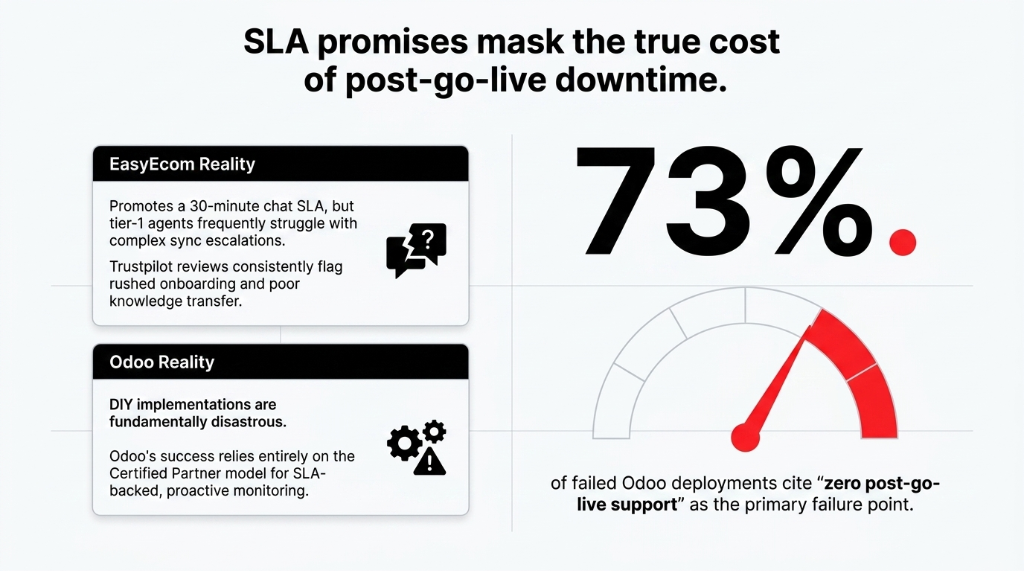
This is where the partner model makes or breaks your Odoo experience. In our implementations across 150+ brands, 73% of clients who came to us after a failed DIY Odoo deployment cited "zero post-go-live support" as the primary reason they were in trouble.
The Real Verdict: Stop Treating This as a Generic Choice
Both tools serve different business stages and different operational needs. The right answer is not about which platform has more features — it is about where your ops are bleeding and what you actually need to stop the bleeding.
Choose EasyEcom If:
1. You sell on 5+ Indian or global marketplaces and need native reconciliation
2. You need to go live in under 5 days
3. Your accounting is already handled by Tally, QuickBooks, or a third-party tool
4. Your return rate is above 4% and you need video-based dispute resolution
Choose Odoo If:
1. You want to eliminate the QuickBooks + WMS + EasyEcom + Excel stack entirely
2. You are scaling past $3M ARR and need consolidated P&L, not just order reports
3. You run multi-warehouse, multi-currency, or multi-company operations
4. You have manufacturing or kitting workflows that EasyEcom simply cannot handle
Real-World Case: UAE D2C Home Decor Brand
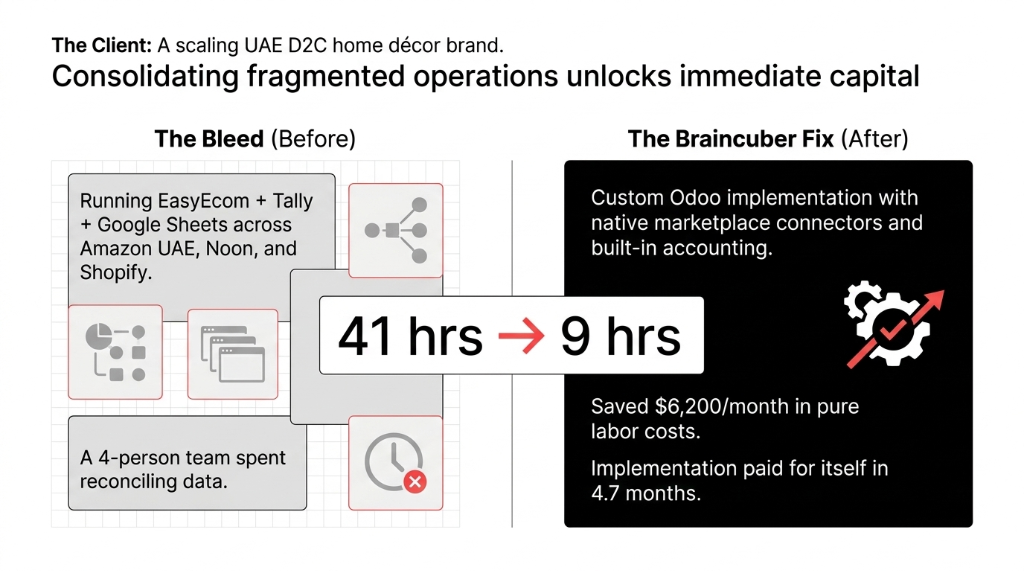
A UAE-based D2C home decor brand came to us in Q3 2024 running EasyEcom + Tally + a Google Sheet purchasing system across Amazon UAE, Noon, and Shopify. Their 4-person ops team was spending 41 hours per week reconciling between the three platforms. We implemented Odoo with custom marketplace connectors and native accounting integration. Within 90 days, that 41 hours collapsed to 9 hours per week — saving them exactly $6,200/month in labor costs. Their implementation paid for itself in 4.7 months.
The controversial opinion nobody says out loud: EasyEcom is a stopgap for brands under $2M ARR. It solves today's problem — marketplace chaos — but it does not scale into the business you are building. Once you add a second warehouse, a third country, or a manufacturing line, you will hit its ceiling and you will rebuild.
Odoo, done right the first time, is the last platform you migrate to. See our ERP Integration Services to understand what "done right" actually looks like.
5 FAQs: Odoo vs EasyEcom
Can EasyEcom replace Odoo entirely for a D2C brand?
No. EasyEcom handles omnichannel inventory and marketplace reconciliation well, but it has no built-in accounting, CRM, HR, or manufacturing modules. Brands past $2M ARR managing multi-warehouse or multi-country operations will hit EasyEcom's ceiling and still need a separate ERP for financial reporting and business management.
What is the real total cost of Odoo vs EasyEcom for 10 users processing 3,000 orders/month?
EasyEcom runs approximately $449/month for that order volume with no accounting included. Odoo Custom for 10 users costs ~$490/month in licensing plus a one-time implementation of $8,000–$20,000. At month 18, Odoo's total cost of ownership is lower — and it includes accounting, CRM, and HR.
Does EasyEcom integrate with Odoo?
EasyEcom integrates with external accounting tools like QuickBooks but not natively with Odoo. If you want to use both, you need a custom API connector — which means additional development cost. Most brands choose one or the other; running both creates the exact data-reconciliation problem both tools are supposed to solve.
How long does Odoo implementation take for a D2C brand?
A standard Odoo implementation covering inventory, accounting, e-commerce, and Shopify integration takes 4–12 weeks depending on customization depth and data migration complexity. EasyEcom goes live in 2–5 days for standard marketplace setups, but without the backend depth Odoo provides.
Which platform has better support for Indian marketplace sellers?
EasyEcom has a clear edge here. It offers native integrations with Amazon India, Flipkart, Myntra, Meesho, and Snapdeal, plus automated reconciliation built for Indian marketplace payment structures. Odoo requires custom connectors for Indian marketplace reconciliation, which adds to implementation cost and timeline.
Stop bleeding money on the wrong stack.
Book our free 15-Minute Operations Audit. We will identify your exact platform mismatch, calculate what it is costing you monthly, and show you the fastest path to a unified ops stack — in the first call.
Book Your Free Audit