
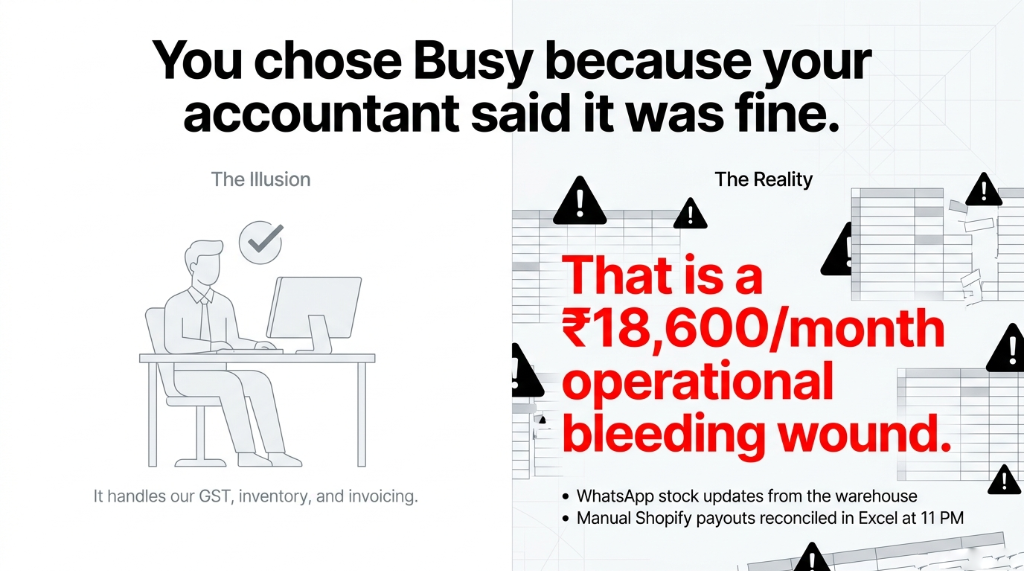
Why Busy Was Not Built for What You Are Doing
Busy Accounting is a genuinely good product—for what it was designed for. Over 400,000 licenses sold across India. Strong GST compliance with GSTR-1, 2B, 3B reconciliation, e-invoicing, and e-way bills. Multi-branch accounting. Pricing starts at just $240/year. For a traditional FMCG distributor or a family-run trading business, it does exactly what it says.
But a D2C brand in 2026 is not a trading business.
Where Busy Breaks for D2C
Desktop-first, cloud-second. Busy offers a "hybrid" cloud option, but it is not native cloud. Your warehouse manager in Bhiwandi cannot check live stock on a browser tab without a VPN setup and IT jugglery. Odoo runs full cloud access, mobile app, real-time sync across every location.
The integration layer is thin. Busy integrates with Shopify and WooCommerce—but the sync is not bidirectional in real time. Shopify's API rate limit hits its ceiling during flash sales. When orders spike to 800+ per hour, Busy's sync connector starts queuing. You are looking at a 45-minute lag between order placed and warehouse notified. In express delivery D2C, that is the difference between SLA met and a 1-star review.
No native CRM, no workflow automation, no customer portal. If you are trying to run an RTO reduction campaign, track LTV by customer cohort, or set auto-reorder rules at SKU level—Busy has no answer. You will be stitching together Zoho CRM, ShipStation, and a Google Sheet. We have seen teams spending 37 hours a month just maintaining that patchwork.
The Basic edition cannot handle batch/lot tracking or multi-MRP pricing. If you run product variants—different MRPs for modern trade vs quick commerce vs your own site—the Basic plan is a dead end.
Enterprise at $240/year starts to add features, but you are already at a price point where Odoo's conversation gets very interesting.
What Odoo Actually Does Differently for D2C
Odoo at its core is a modular ERP. Inventory, Accounting, CRM, eCommerce, Manufacturing, HR—every module talks to the same database. There is no "sync." There is no API bridge between your warehouse and your invoicing. One action in one module instantly reflects everywhere else.
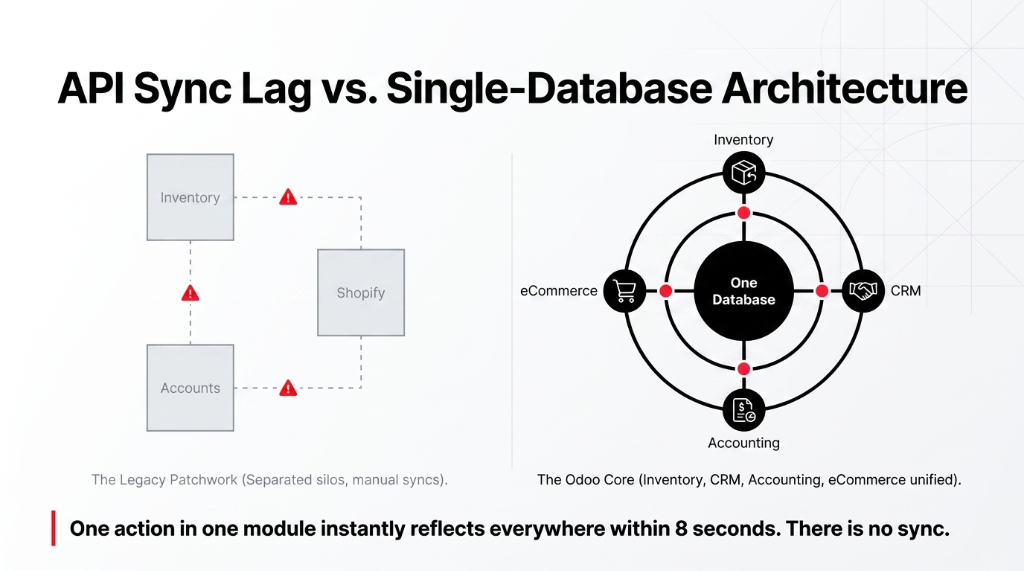
For a D2C brand, this means: when a Shopify order is placed, Odoo's inventory immediately reserves stock, creates a pick list for the warehouse, and triggers the logistics workflow—all within 8 seconds of the order confirmation. When a return comes in, the RTO is logged against the customer record, inventory is updated, the refund is processed in accounting, and the COD reconciliation is adjusted—without a human touching it.
Multi-location inventory across 3 warehouses? Odoo handles it natively, with inter-warehouse transfer requests, reorder rules at each location, and a consolidated view across all of them. No evening Excel emails. No 14-hour lag.
Order Processing: Before and After Odoo
On Busy + Patchwork
19 minutes per order average
300 orders/day = 95 hours daily labor
WhatsApp-based stock updates to warehouse
On Odoo (Post-Migration)
3.5 minutes per order average
300 orders/day = 17.5 hours daily labor
Digital pick lists on warehouse tablets
Average across 31 D2C implementations migrating from Busy or Tally to Odoo. Packing errors reduced by 61.3% within the first 30 days.
Odoo Enterprise starts at $24.90/user/month—roughly $2,490/month for a 5-person team. Compare that to what you are currently paying your ops executive to reconcile data manually between Busy, Shopify, and Excel. (Yes, we know your accountant will say Busy is cheaper. Run the real math: software cost + manual labor cost + error cost.)
The Head-to-Head That Actually Matters for D2C
| Capability | Busy Accounting (Enterprise) | Odoo ERP (Enterprise) |
|---|---|---|
| Real-time multi-warehouse inventory | Limited / manual sync needed | Native, live across all nodes |
| Shopify integration (bidirectional) | Partial, with sync lag | Real-time via native connector |
| RTO / returns automation | Manual ledger entry | Automated reverse logistics flow |
| Customer LTV and cohort reporting | Not available | Built-in CRM + analytics |
| COD reconciliation | Manual matching | Automated with courier API |
| Batch / lot / serial tracking | Enterprise plan only | All plans |
| GST / e-invoice compliance (India) | Strong | With Indian localization module |
| Mobile app access | Hybrid / limited | Full mobile app |
| Customization / workflow automation | Not customizable | Fully customizable |
| Pricing (5 users, India) | ~$240/year (1 license) | ~$1,494/year (5 users) |
The pricing line is where most founders stop reading and go back to Busy. That is the wrong instinct.
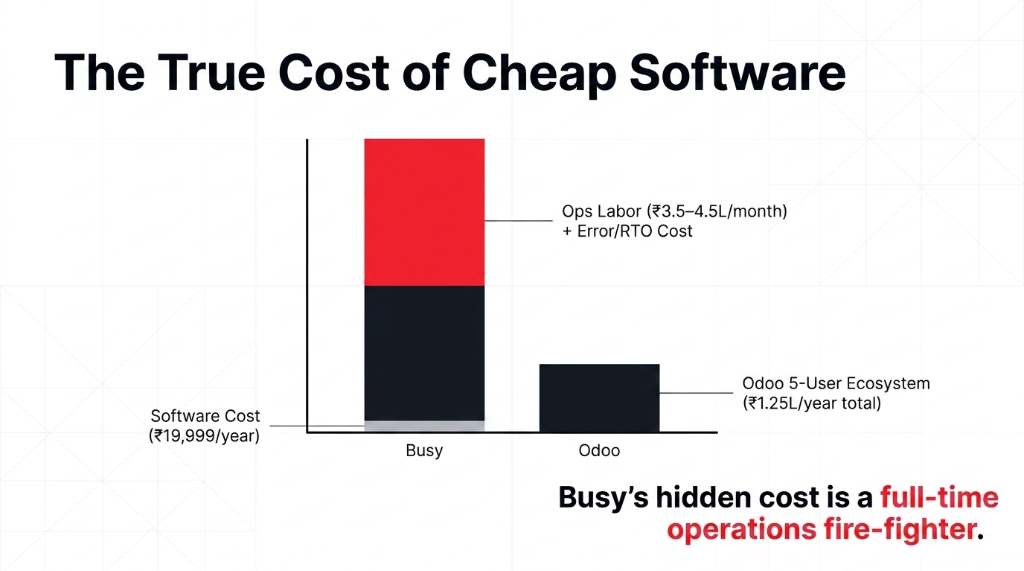
Busy's $240/year is a single-user Enterprise license. You need at least 4–5 people on the system for a D2C brand of any size—accounts, warehouse, ops, customer service. Multi-user Busy starts jumping in cost. Meanwhile, Odoo at $24.90/user/month for 5 users is $1,494/year—and that includes inventory, CRM, accounting, eCommerce, helpdesk, and HR in a single subscription with no feature upselling and no hidden module charges.
The Migration Reality Nobody Talks About
Moving from Busy to Odoo is not a weekend project. For a D2C brand doing $18,000–$60,000 monthly GMV, a Braincuber Odoo implementation typically runs 8–12 weeks.
The 12-Week Migration Calendar
Week 1–2: Business process mapping. We sit with your ops, warehouse, and accounts teams and map how orders actually flow—not how they are supposed to flow on paper.
Week 3–5: Odoo configuration and data migration. Your item masters, customer database, open purchase orders, and accounting periods all come over cleanly.
Week 6–8: Parallel running—Busy and Odoo running side by side so your team builds confidence.
Week 9–12: Go-live and stabilization. Go-live instability, when it occurs, is usually resolved within 72 hours.
What Gets Easier Immediately (From Week 3)
Your warehouse team gets a clean digital pick list on a tablet. No more WhatsApp-based stock updates. That alone reduces packing errors by 61.3% within the first 30 days.
What Gets Hard
Your accountant will resist. They have been on Busy for 6 years. The keyboard shortcuts are muscle memory. Budget for 3–4 days of focused Odoo accounting training, and the resistance disappears quickly.
What does NOT transfer: do not expect your Busy reports to look identical in Odoo. They will not. They will be better—but they will look different. Set that expectation with your CFO before day one.
Who Should Actually Stay on Busy
This is the controversial opinion part.
The Honest Threshold
If your GMV is under $3,600/month and you sell through one channel, stay on Busy. Odoo's implementation cost and monthly subscription is overkill. Busy Enterprise at $240/year will cover your GST, inventory, and invoicing perfectly. Do not spend $3,600–$4,800 on an Odoo implementation if your operations do not yet justify it.
But if you are crossing $9,000/month GMV, running 3+ sales channels (Shopify + Amazon + quick commerce), managing 2+ warehouses, and your ops team is growing—
You are already losing more money staying on Busy than Odoo costs. Every month you delay is a month where $180–$480 in operational inefficiency compounds.
The brands we have seen try to stretch Busy beyond $120,000 monthly GMV end up with: a bookkeeper, an ops coordinator, a dedicated reconciliation resource, and three separate software subscriptions stitching it all together. That is $4,200–$5,400/month in human cost to compensate for a $240/year software decision.
The $49,200 Question
A D2C wellness brand we implemented Odoo for—$2.3M ARR, selling across their Shopify site, Amazon US, and UAE noon.com—was running QuickBooks for the US entity alongside Busy for the India entity with a 3-person reconciliation team bridging the two. The monthly reconciliation cost in labor alone was $4,100.
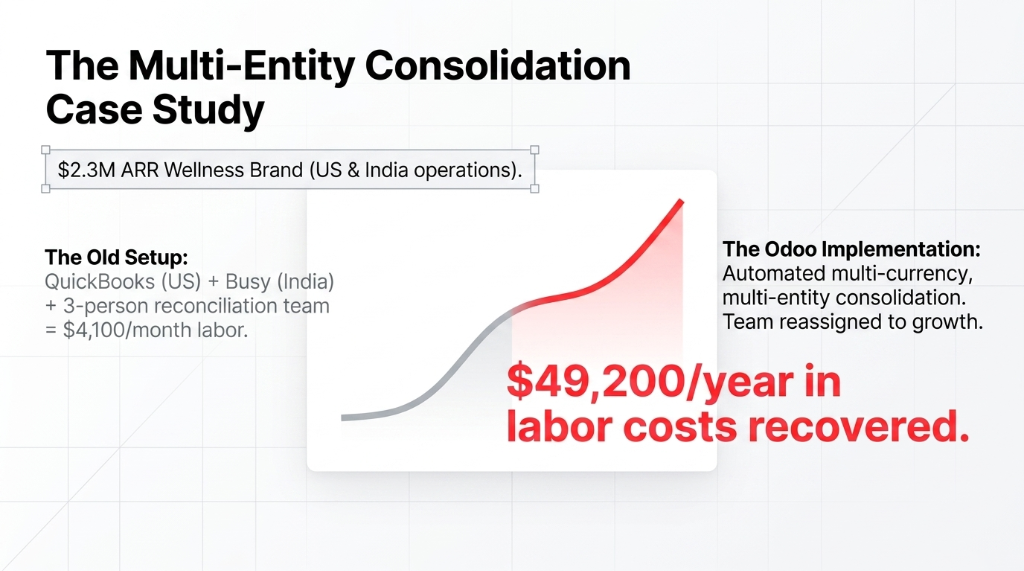
After our Odoo ERP integration, that reconciliation team was reassigned to growth work. The software now handles multi-currency, multi-entity consolidation automatically. That is not a feature. That is $49,200/year recovered.
Do not let your current software's familiarity cost you that number.
5 Questions D2C Founders Ask About Odoo vs Busy
Can Busy Accounting handle Shopify integration for a D2C brand?
Busy does offer Shopify integration, but it is not real-time bidirectional sync. During high-order-volume events like flash sales, the connector experiences lag, which causes inventory discrepancies between your live Shopify store and Busy's stock records. For brands doing under 100 orders a day, it may be manageable. Beyond that, you need a native solution.
Is Odoo too expensive for an Indian D2C brand?
Odoo Enterprise starts at $24.90/user/month. For 5 users, that is approximately $1,494/year with all modules included and no extra charges. Compare that to the combined cost of Busy multi-user licenses, a separate CRM tool, a logistics connector, and the manual labor cost to bridge the gaps. Most brands spending over $9,000/month GMV find Odoo cheaper in total cost of operations within 6 months.
How long does migrating from Busy to Odoo take?
For a D2C brand at $18,000 to $60,000 monthly GMV, expect 8 to 12 weeks for a full implementation. Item masters, customer data, and historical accounting periods migrate cleanly. The first 3 weeks of parallel running eliminates the fear of data loss. Go-live instability is usually resolved within 72 hours.
Does Odoo support GST, e-invoicing, and Indian compliance?
Yes. Odoo's Indian localization module covers GSTR-1, GSTR-3B, e-invoicing under IRP, e-way bill generation, TDS, and TCS. It is not as plug-and-play as Busy's GST module for a first-time user, but with a proper implementation the compliance layer is configured as part of setup and your CA does not need to relearn compliance processes.
What happens to historical Busy data after switching to Odoo?
Your historical data does not disappear. We migrate open balances, customer and vendor masters, item catalogs, and the last 2 to 3 financial years of transactions into Odoo. Older historical records are kept in a read-only Busy archive that your accounts team can access for reference. Nothing is lost.
The Real Math Your Accountant Will Not Run
Busy's hidden cost is not $240/year. It is $240/year plus a full-time operations fire-fighter, plus 37 hours/month maintaining a Zoho-ShipStation-Google Sheet patchwork, plus $2,808/month in avoidable errors and oversells. Run that math against Odoo's $1,494/year for 5 users with every module included. The decision makes itself.
Open your WhatsApp right now. Search "stock update" or "inventory." Count the messages from this week alone.
If that number is above 5, your accounting software is not doing its job. We run Odoo implementations for D2C brands doing $108,000–$1.2M+ monthly GMV. 15-minute call. No slide decks. Just the numbers.
Book Your Free Operations Audit