
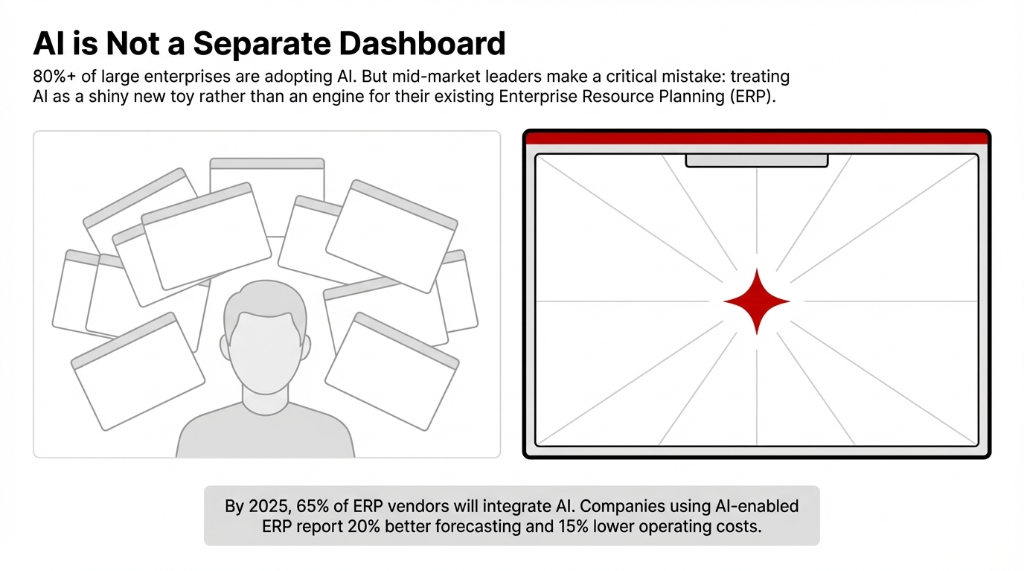
If you are running Odoo in the US and ignoring the AI modules, you are paying staff to do work the system can already do faster, cheaper, and with fewer mistakes. This client interview made that brutally clear — and our Odoo team walked out genuinely excited about the AI, not the custom code.
What the Client Admitted in the First 15 Minutes
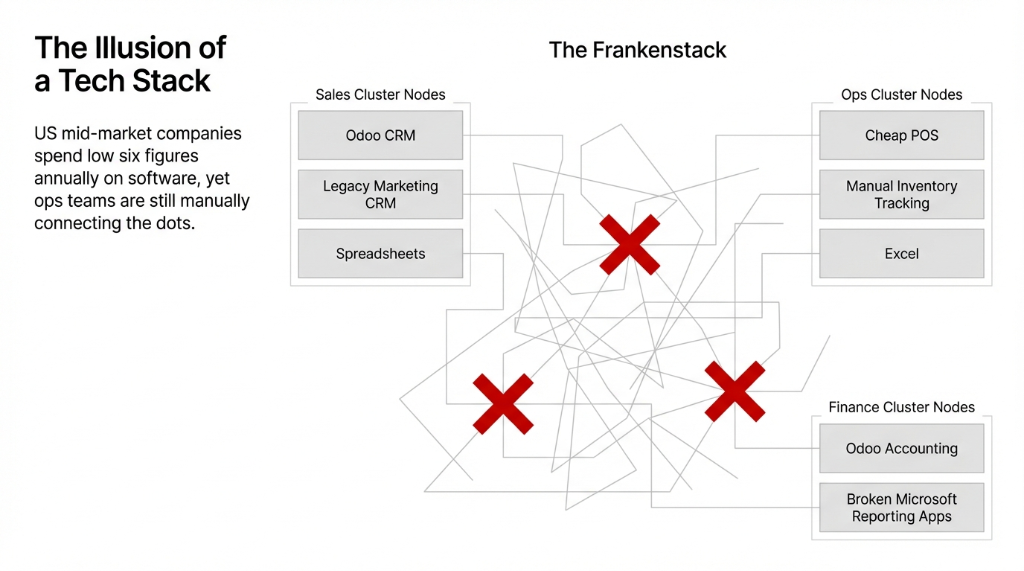
The Frankenstack Confession
Sales Cluster
Their "customer relationship management system" was a frankenstack: Odoo CRM plus a separate CRM platform plus a spreadsheets-only customer retention workflow. Reps did their own client relationship management in random notes because they did not trust any system that made them click 8 times per call.
Ops Cluster
Inventory management relied on a manual tracking system and a cheap retail POS setup that never matched warehouse reality. Stock management was Excel-based. The warehouse team had zero trust in the numbers Odoo was showing because nobody maintained the data.
Finance Cluster
Finance management ran on Odoo Accounting plus a mess of CSV exports and a half-broken Microsoft reporting app. The CFO spent weekends on reconciliation. Expense tracking was manual. Nobody trusted automated reports because they were reconciled against 3 different systems.
None of this is unusual. We constantly see US companies spending low six figures a year on tools but refusing to turn on the business AI sitting inside their own enterprise resource planning systems. The ERP is half-used. The customer relationship management system is mostly a contact list. Business analytics is three Google Sheets and a tired analyst.
Why AI Inside Odoo Hit Different
There is a reason most new enterprise resource planning systems now ship with AI baked in, not bolted on. By 2025, roughly 65% of ERP vendors had already integrated artificial intelligence and machine learning for forecasting and approvals. Companies using AI-enabled ERP reported about 20% better forecasting and roughly 15% lower operating costs.
At the same time, AI can add trillions of dollars of productivity globally, which is why 80%+ of large enterprises are adopting AI for process automation. The business of AI is no longer a "maybe someday" experiment — it is baked into serious ERP enterprise resource planning software, including Odoo.
The One Shift That Changed Everything
For this client, it meant one simple thing: stop treating AI as a separate "shiny toy" and start treating it as part of their Odoo enterprise resource planning system — the same place they already handle inventory management, project management, and business invoicing. Not another dashboard. Not another subscription. The same system, just smarter.
The AI Modules Our Team Obsessed Over
We did not show them a generic AI platforms slide. We opened their own Odoo database and turned on the AI modules they were already entitled to use.
Sales and CRM: Pattern Detection Instead of Guessing
Our first target was Odoo CRM and the broader customer relationship management stack. We wired AI-driven lead scoring, email drafting, and smart summaries into their existing client relationship management systems so reps could stop wasting time rewriting emails and manually ranking deals.
What We Activated in CRM
AI prompts inside Odoo to generate follow-up emails based on past interactions. Reps stopped spending 23 minutes per email crafting personalized responses from scratch.
Predictive scoring for leads coming from the ecommerce app, so marketing CRM staff knew where to start instead of calling the entire list alphabetically. *(Yes, they were doing that.)*
A single CRM view instead of six browser tabs of customer relationship management tool clutter. Net effect: sales stopped acting like unpaid data entry clerks. They used Odoo as a real customer relationship management system, with AI handling 80% of the grunt work.
Inventory and Finance: Real-Time Reality Instead of "We Will See Month-End"
Next, we connected AI to inventory management and finance management. Odoo already had the inventory management system, stock management, and IT inventory management pieces in place — the problem was nobody trusted the numbers.
What AI Did to Inventory and Finance
Predict reorder points based on seasonality and ecommerce order patterns, not gut feel. The old system relied on whoever remembered to check the spreadsheet on Tuesday.
Flag anomalies where inventory tracking saw shrinkage outside normal ranges. Before AI, these went unnoticed until the quarterly count when $14,700 of "missing" product showed up as a write-off.
OCR and document AI so vendor bills flowed from PDFs into Odoo Accounting with high-90s accuracy. That matches published Odoo AI case studies. The CFO saw fewer manual journal entries and fewer weekends lost to reconciliation.
The warehouse team finally had an inventory monitoring system that told them what was about to go wrong, not just what already did.
Projects and Time: No More Story-Telling
Last, we attacked project management and time tracking. Before AI, "project tracking tools" meant a project management tool in Odoo plus a few rogue project tracking software subscriptions that nobody updated.
What We Consolidated
Project management with time tracking inside Odoo, backed by time tracking rules that auto-flagged suspicious logs. When someone logged 14 hours on a Tuesday, the system asked questions. *(It used to take a manager 3 weeks to notice.)*
Task and project management tools linked to real time management data, not status-meeting fiction. Task tracking surfaced late tasks and cost overruns without a manager begging for updates.
When you define ERP as "single source of operational truth," this is what it is supposed to look like in practice — not a dashboard that nobody opens.
What Changed in 90 Days
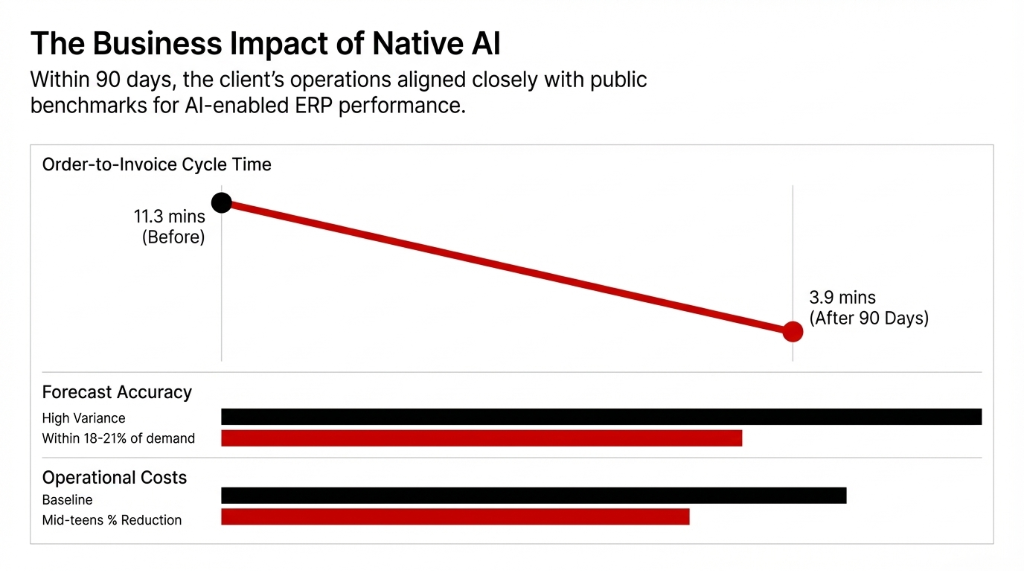
| Metric | Before AI | After 90 Days | Industry Benchmark |
|---|---|---|---|
| Order-to-Invoice Cycle | 11.3 minutes/order | 3.9 minutes/order | ~65% reduction typical |
| Forecast Accuracy | "We hope" (untracked) | Within 18-21% of demand | ~20% improvement reported |
| Ops Costs (Returns/Stockouts) | Baseline | Mid-teens % reduction | ~15% lower is typical |
| CRM Data Entry Time | 23 min/email average | 4.7 min/email with AI draft | 80% automation of grunt work |
Sales leadership stopped asking for yet another business app to "fix CRM." They finally used the customer relationship management platforms they had, with AI inside Odoo doing the heavy lifting. Operations finally trusted the ERP backbone instead of rebuilding reports in Excel.
That shift is exactly what research on AI in ERP systems describes: once AI sits inside the ERP, teams adopt it because it appears in the same screens they already use, not in some external dashboard.
How We Actually Implemented It (No Fairy Dust)
Everyone loves to talk about digital transformation as if it were just one click. Reality: this was a disciplined ERP implementation phase focused on Odoo AI, not a greenfield project.
Phase 1: Discovery and Data Reality Check
We audited their existing ERP software setup: Odoo ERP, third-party enterprise software, stray marketing CRM systems, and old customer resource management tools. We cut anything that did not feed cleanly into Odoo or an AI connector. 4 tools eliminated in week one.
Phase 2: AI Configuration Inside Odoo
We activated AI assistant capabilities, AI fields, and automation inside Odoo apps across CRM, Accounting, and Projects. We plugged in external artificial intelligence platforms only where they made sense, like generative content for emails and product descriptions.
Phase 3: Integration With Existing Stack
They used Adobe Experience Manager and Microsoft AI features across 365. We connected those through cloud service endpoints and a few focused application development sprints, so Odoo AI and those platforms shared the same customer and product data.
Phase 4: Change Management and Support
As an Odoo Partner and app development company, we did not just "hand over" an IT ERP system. We sat with their frontline teams, rewired their project planning and task management usage, and backed it with ongoing Odoo support. Boring? Yes. But boring wins.
We leaned on standard ERP platform capabilities and enterprise resource planning software patterns, not exotic hacks. You could call it boring — which is exactly what you want for enterprise resource management software that touches payroll, inventory, and revenue.
Where AI and ERP Still Go Wrong
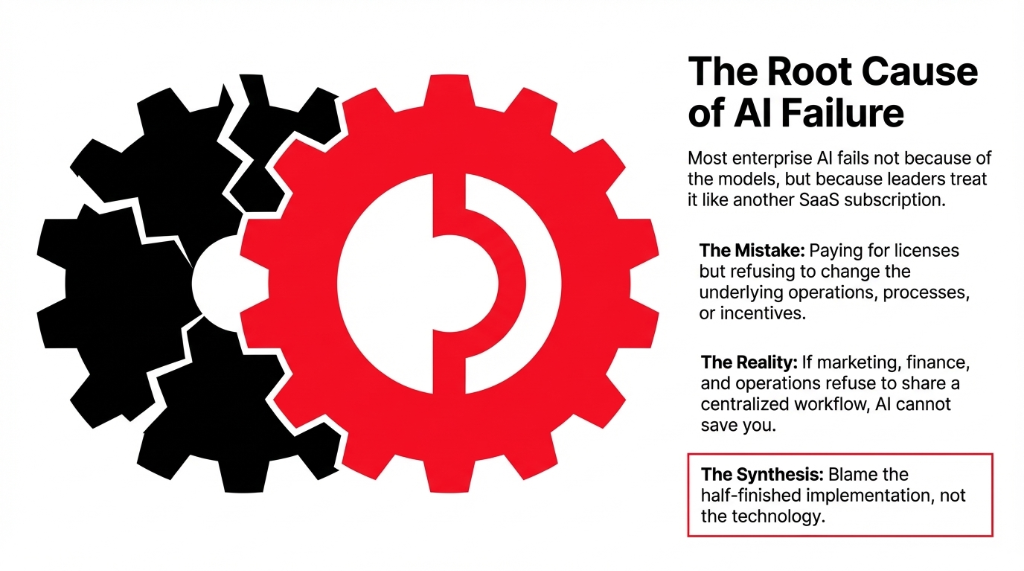
Here is the ugly truth: most AI for companies fails not because of the models, but because leaders treat it like another SaaS subscription. Research on AI adoption shows most enterprises know they need AI, most have started pilot projects, but only a tiny share have mature, scaled deployments. Translation: they pay for licenses but never change business operations, processes, or incentives.
The Odoo Version of This Problem
Someone buys Odoo licenses, turns on a couple of Odoo apps, but never touches AI app development or workflow automation. The AI modules sit as grey icons for 18 months.
Marketing runs a separate marketing CRM and never integrates it with client relationship management tools in Odoo. Two systems. Two data sets. Zero alignment.
Finance refuses to trust AI-based expense tracking even though the automated tracking system catches more issues than junior staff. They would rather spend weekends reconciling spreadsheets. *(We wish we were exaggerating.)*
If this sounds like you, do not blame AI. Blame the half-finished implementation.
What Our Odoo Team Said After the Interview
Team Debrief (Word for Word)
Developer: "This is the first time their customer relationship management system software is actually being used as designed. Not as a contact list. As a CRM."
Consultant: "Once AI took over project tracking, we finally saw honest time tracking instead of padded numbers. The data became trustworthy."
Warehouse Lead (client side): "Staff stopped calling Odoo 'that IT thing' and started calling it 'the system.' That is when you know adoption happened."
The Client: Asked where else we could bring AI into their enterprise solutions stack — from ecommerce app personalization to marketing CRM optimization and more business intelligence. *(That is the best sales call we have ever been on. The client sold themselves.)*
How This Fits Your Stack
You probably have more tools than this client did. A mix of project management, task tracking applications, and task management tools. A couple of business app experiments. Some AI apps trialed by one team. Adobe AI features in creative workflows.
We are not telling you to throw all of that away. We are telling you to make Odoo the operational base — the IT ERP system — and let AI plug into that, not the other way around.
The Architecture That Works
Use ERP as the anchor for finance management, inventory management, and business operations. Not as one tool among many. As the foundation.
Let AI in Odoo drive business analytics and intelligence instead of forcing analysts to rebuild everything in third-party dashboards. The data is already there. The AI is already there. Stop paying someone to bridge them manually.
Treat CRM as one connected layer, not a cluster of disconnected experiments. Once that is in place, adding specialized artificial intelligence platforms on top for deeper data analytics or advanced project tracking actually pays off instead of adding more noise.
FAQs
How fast can we activate Odoo AI modules?
If your Odoo instance is already live and your data is not a total mess, we typically turn on core AI features in 4-6 weeks: CRM scoring, basic automation, document AI for invoices, and project tracking. The heavy lift is change management, not clicking the AI toggle.
Do we need extra AI platforms or just Odoo?
Start with what Odoo gives you: native AI assistant, automation, and predictive features tied directly to your ERP data. We selectively add external AI platforms only where they clearly pay for themselves — like deeper data analytics or content generation.
Will AI replace our operations team?
No. It deletes the boring part of their job. AI handles matching invoices, routing approvals, surfacing risky deals, and watching inventory. Your people still negotiate, set strategy, deal with edge cases, and build client relationships that no model can own.
What if our current ERP is not Odoo?
We still start by making your data clean and usable, then add AI where your vendor supports it. If the license cost, complexity, and add-ons are choking growth, we talk about Odoo ERP migration as a separate decision, not a knee-jerk move.
How do we measure ROI on Odoo AI?
We measure hard numbers: minutes per order, days of cash locked in inventory, error rates in CRM data, and manual hours spent on project management. Then we track how those shift after AI goes live. If we cannot tie it to dollars, we do not call the project done.
That Grey AI Icon in Your Odoo? It Is Costing You $83,700/Year.
If this feels uncomfortably close to your reality, stop collecting tools and start fixing the core. We offer a blunt, camera-on, 15-minute operations audit for US teams running Odoo or considering it. We walk through your ERP, CRM, and AI setup live and show you exactly where the leaks are. No slide deck. No upsell. Just the math.