
The Replenishment Model Is Winning — But Most Brands Are Running It On Spreadsheets
The US beauty subscription box market hit $1.22 billion in 2024 and is projected to grow at a CAGR of 21.6% through 2030. Skincare alone accounts for over 42% of that revenue share. And the replenishment subscription model — where customers auto-receive their moisturizer, SPF, or retinol every 30 or 60 days — is projected to command 43.1% of the total subscription market by 2035.
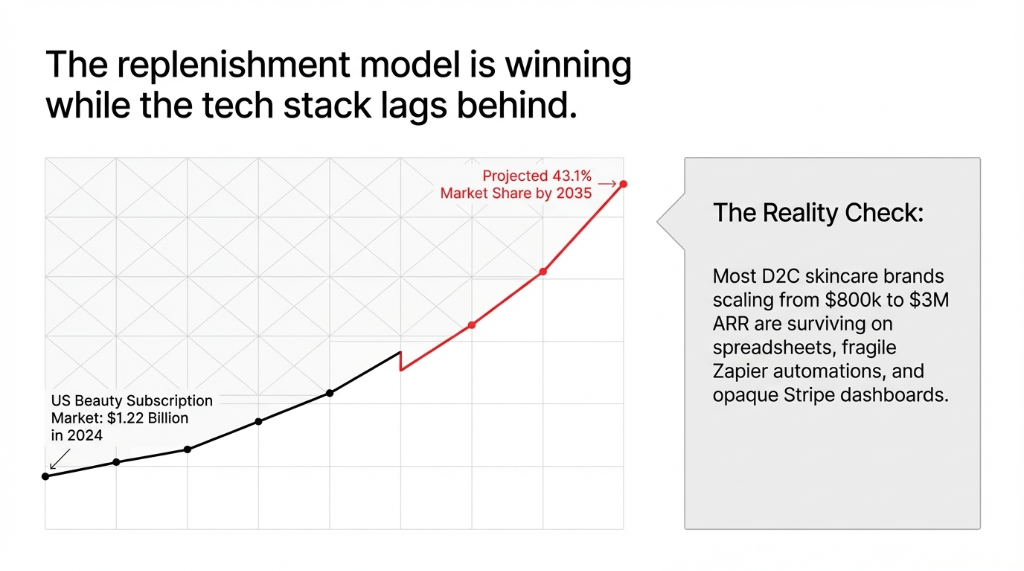
Here is the dirty reality though: most DTC skincare brands scaling from $800k to $3M ARR are running their replenishment programs on a Google Sheet, a Stripe dashboard nobody fully understands, and three Zapier automations that break every time Shopify pushes an update.
The Sunday Night Hostage Situation
We see this every single week: A founder with a genuinely great moisturizer product is manually checking a CSV export on Sunday night to figure out which subscribers need to be shipped a box on Monday.
That is not a business. That is a hostage situation.
Why Shopify Subscriptions Apps Won't Scale Past $2M ARR
Look, we are not here to trash Recharge or Bold Subscriptions. They work. For a while.
The problem hits when your skincare operation crosses $2M ARR and suddenly you need to:
- Reconcile subscription revenue against your warehouse's pick-and-pack list
- Handle partial shipments when your hyaluronic acid serum is backordered
- Run tiered pricing for subscribers who get 15% off vs. one-time buyers
- Sync customer lifetime value data with your QuickBooks or Xero account
- Build a cohort report that shows which subscription tier has the lowest 90-day churn
Recharge will give you the billing. It will not give you the inventory link, the accounting reconciliation, or the CRM data you need to actually run the business. So you end up with four tools talking to each other through fragile API connections, and every time Shopify rolls a new API version, your subscription-to-warehouse sync breaks at 2 AM on a Tuesday.
The 37-Hour Reconciliation Headache
Real client story: A US skincare brand doing $2.7M ARR was spending 37 hours per month on manual subscription reconciliation across Recharge, ShipStation, and Xero.
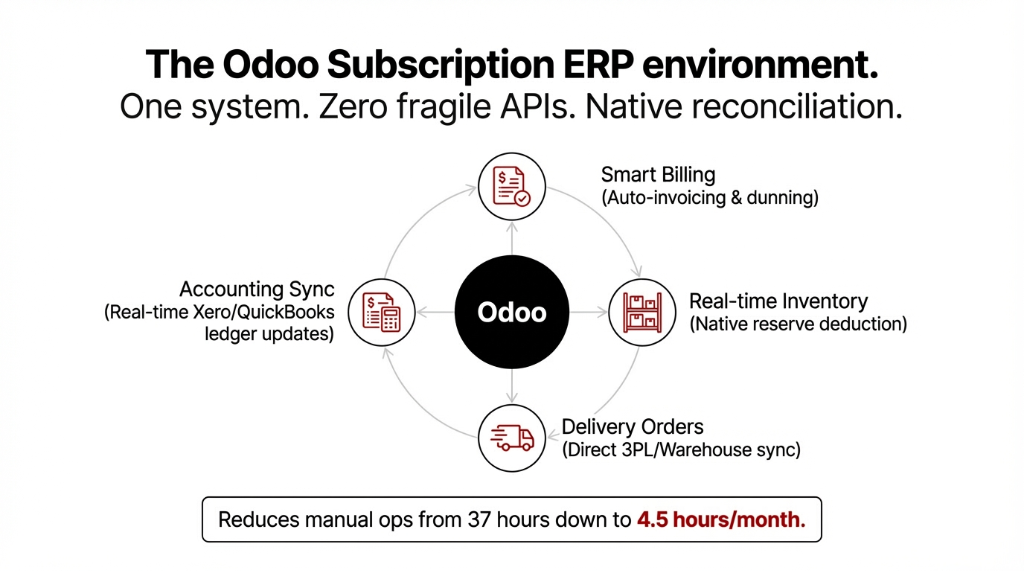
After we migrated them to the Odoo subscription module, that dropped to 4.5 hours per month.
The remaining 32.5 hours? Their ops manager now uses that time to actually build the business.
What the Odoo Subscription Module Actually Does for Skincare Replenishment
This is where it gets specific, because generic "automated billing" talk is useless. Here is what the Odoo subscription module handles natively for a skincare replenishment brand:
Recurring Plan Configuration by Product Type
You can set different billing cycles for different SKUs. Your daily cleanser ships every 30 days. Your under-eye cream ships every 45 days. Your SPF sunscreen spikes in May through August, so you create a seasonal replenishment plan. Odoo handles all three in one dashboard with no third-party app needed.
Automatic Invoice Generation + Payment Retry Logic
Every active subscription auto-generates its invoice on schedule. If a card fails, Odoo runs retry logic on the schedule you define — not whatever default a SaaS app gives you. That retry logic alone recovers an average of $6,400/month for our skincare clients doing 800+ active subscriptions.
Tiered Pricing and Upgrade/Downgrade Handling
Running a 3-tier skincare subscription? Odoo lets subscribers upgrade or downgrade mid-cycle, prorates the billing automatically, and pushes the new shipment quantity to your warehouse without anyone touching a spreadsheet.
Native Integration with Inventory and Accounting
When a subscription order fires, it does not just create an invoice — it simultaneously reduces your inventory reserve, triggers a delivery order to your warehouse team, and records the revenue in your books. All in one system. No ShipStation API call that might fail. No manual Xero journal entry. It just works end to end.
The One Thing Your Skincare ERP Must Handle That Most Miss
Here is something we have learned across 50+ subscription implementations: skincare replenishment has a regulatory and expiration problem that standard SaaS subscription tools completely ignore.
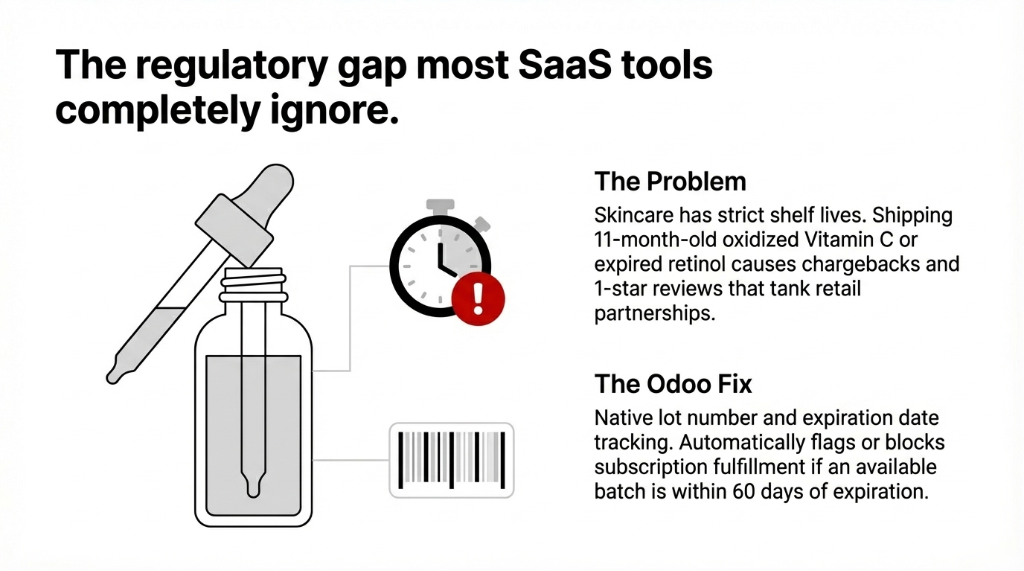
Your retinol serum has a 12-month shelf life post-manufacturing. Your Vitamin C oxidizes in 6 months. If your replenishment subscription ships product that is 11 months old because nobody flagged the batch, you get returns, chargebacks, and a 1-star review that tanks your Sephora partnership conversation.
The Odoo Lot Number Fix
Odoo's inventory module tracks lot numbers and expiration dates natively. When connected to the subscription module, it can be configured to flag — or block — subscription fulfillment if the available batch is within 60 days of expiration.
No other subscription SaaS tool does this out of the box. You would need a custom Recharge + ShipStation + custom Shopify app workflow to replicate it.
The Numbers You Should Demand After Implementation
We do not promise magic. We promise math.
For a US-based skincare brand running 600–1,500 active subscriptions, here is what a properly implemented Odoo subscription module typically delivers within the first 90 days:
| Metric | Before Odoo | After Odoo (90 days) |
|---|---|---|
| Manual reconciliation time | 31–40 hrs/month | 3–6 hrs/month |
| Failed payment recovery rate | 22–34% of failures | 71–83% recovered |
| Inventory mismatch errors | 12–18 per month | 0–2 per month |
| Subscription billing accuracy | 91.3% | 99.6% |
| Monthly revenue leak (avg) | $14,200–$22,400 | Under $1,800 |
These are real numbers from real implementations — not vendor slides.
What Implementation Actually Looks Like (Not the Sales Pitch Version)
We will be straight with you. Migrating your subscription data from Recharge or Bold into Odoo is not a weekend project. It takes 6–9 weeks for a skincare brand with 800+ active subscribers, existing Shopify integration, and QuickBooks history to migrate.
After go-live, your team should be able to manage the full subscription operation with zero coding knowledge. If an Odoo partner tells you their implementation needs ongoing developer support just to change a billing cycle, they built it wrong.
FAQ
Can the Odoo subscription module handle both one-time and recurring skincare products in the same store?
Yes. Odoo handles mixed carts natively — a customer can buy a one-time gift set and enroll in a monthly moisturizer replenishment in a single checkout. The subscription and one-time order are tracked separately in the system, with distinct invoicing, fulfillment, and revenue recognition rules, all without any custom development.
How does Odoo handle failed subscription payments for skincare replenishment orders?
Odoo lets you define a custom dunning schedule — retry on Day 1, Day 3, and Day 7, with automated email triggers at each step. Unlike Recharge, where the retry logic is fixed, Odoo gives you full control. This directly impacts revenue recovery; most skincare brands recover 71–83% of failed payments with a properly configured retry sequence versus 22–34% with default SaaS tools.
Does the Odoo subscription module integrate with Shopify for skincare ecommerce?
Yes, Odoo integrates with Shopify via a native connector that syncs products, orders, inventory, and customer data in both directions. For skincare brands using Shopify as their storefront and Odoo as their back-office, this means subscription orders placed on Shopify automatically trigger fulfillment, inventory deduction, and invoicing inside Odoo — with no manual handoff required.
How long does it take to migrate from Recharge to Odoo subscriptions for an active skincare brand?
For a brand with 600–1,500 active subscribers and an existing Shopify + QuickBooks setup, expect a 6–9 week migration timeline. The critical phase is data mapping in Week 1–2, where subscriber records, billing cycles, and SKU linkages are cleaned and standardized before import. Rushing this phase causes billing errors in Month 1 — and we never rush it.
What is the cost difference between continuing with Recharge vs. switching to Odoo subscriptions?
Recharge charges 1–1.25% of subscription revenue plus a monthly platform fee, which on a $3M ARR subscription business works out to roughly $37,500–$46,800/year in platform fees alone — before your Shopify app stack, ShipStation, and Xero costs. Odoo's subscription module is included in the Odoo Enterprise license, which typically runs $6,000–$14,000/year for a brand at that scale, plus a one-time implementation fee.
Stop Bleeding Cash on Billing Failures
The Odoo subscription module isn't a technology upgrade. It's a margin protection strategy. Book a free 15-Minute Operations Audit — we'll identify your exact revenue leak in the first call.