
Your Warehouse Is Lying to You
Here is what a typical beauty brand warehouse looks like before Odoo putaway rules are configured.
A shipment of 500 units of Vitamin C serums arrives. Your receiving team puts them in Bay 4 because Bay 4 had space. Three weeks later, your picker spends 11 minutes hunting for those serums because the system shows "Warehouse > Stock" and nothing more specific. The picker gives up, marks it as out of stock, and your Shopify store cancels 37 orders worth $4,100 in revenue — on a product that was physically sitting in your warehouse the whole time.
The Before-and-After at $2.3M UK Skincare Brand
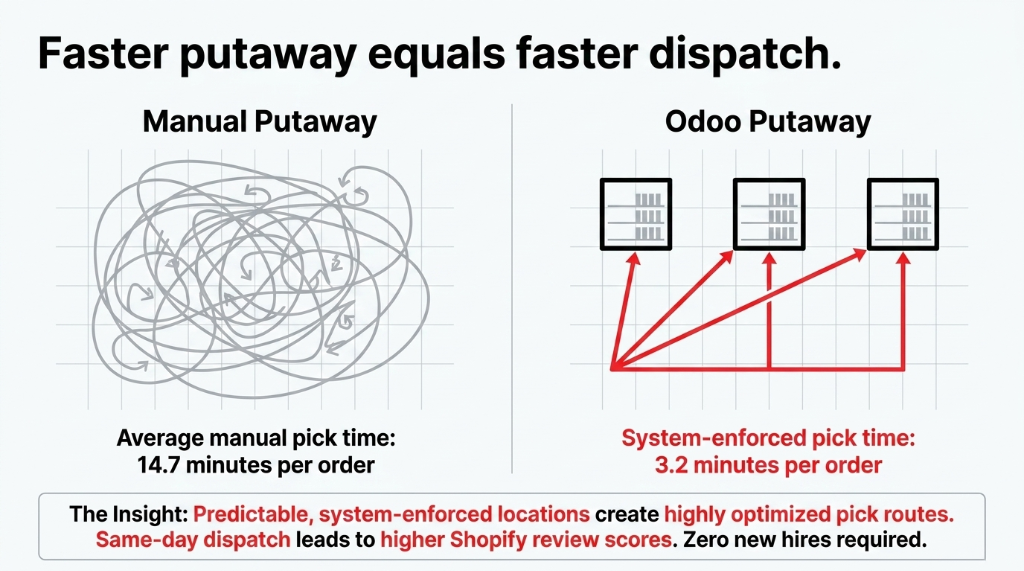
14.7 Minutes
Average pick time per order before putaway rules — pickers wandering the warehouse floor hunting for SKUs with zero location specificity
3.2 Minutes
Average pick time after Odoo putaway configuration — same team, same warehouse, zero new hires, system-enforced locations
$4,100 Recovered
Revenue from 37 cancelled Shopify orders that would have shipped if the picker could locate the serums sitting in Bay 4
Why "Just Organizing Your Warehouse" Does Not Work
Everyone tells beauty brand operators to "just organize your shelves better." That advice is wrong.
Manual organization fails because it scales with headcount, not with your catalog. When you go from 80 SKUs to 340 SKUs in one quarter — which happens to every D2C beauty brand that hits a viral TikTok moment — your manual organization collapses overnight. Your warehouse manager quits. Your new hire does not know the "system." And you are back to Bay 4.
The real fix is rule-based putaway at the system level, not the human level. Odoo's putaway rules sit inside the Inventory module and tell the system: when this product category or specific product arrives at this receiving location, automatically route it to this exact sub-location. No human decision required. No sticky notes. No "ask Jake where the SPF is."
Making sure your inventory management system routes products to the right bin automatically is the difference between a warehouse that scales and one that breaks every time your marketing team wins.
How Odoo Putaway Rules Actually Work for Beauty Warehouses
In Odoo 17, putaway rules live under Inventory → Configuration → Putaway Rules. Each rule has four fields:
The Four Putaway Rule Fields
From (Source Location): e.g., WH/Input or WH/Stock
Product Category or Product: e.g., "All / Cosmetics / Face Serums" or a specific SKU like SKU-VITC-30ML
To (Destination Location): e.g., WH/Stock/Zone-A/Shelf-2/Bin-14
Capacity (optional): Maximum units before overflow routing kicks in
| Product Type | Zone | Storage Condition | Putaway Rule Trigger |
|---|---|---|---|
| Face serums & actives | Zone A – Climate-controlled | 15-20°C, no direct light | Product Category: Actives |
| Fragrance & perfume | Zone B – Sealed cabinet | Flammable goods compliance | Product: Individual SKUs |
| SPF & suncare | Zone C – FIFO shelf | Expiry tracking required | Category: SPF, FEFO enabled |
| Lip & color cosmetics | Zone D – Standard shelving | Ambient, fast-pick zone | Category: Color Cosmetics |
| Hair care (bulk) | Zone E – Floor pallet | Heavy units, floor-level | Product weight > 2kg rule |
| Travel minis / gifting | Zone F – Kitting area | Pre-pack assembly zone | Product tag: "mini" or "gift" |
$4.7M UAE Beauty Distributor: 91.3% → 99.1% Order Accuracy
This is the exact zone structure we deployed. Their order accuracy went from 91.3% to 99.1% in 47 days. Same warehouse footprint. Same team headcount.
The FEFO Setup No One Tells You About
For beauty products — especially SPF, retinols, and vitamin-based actives — First Expired, First Out (FEFO) is non-negotiable.
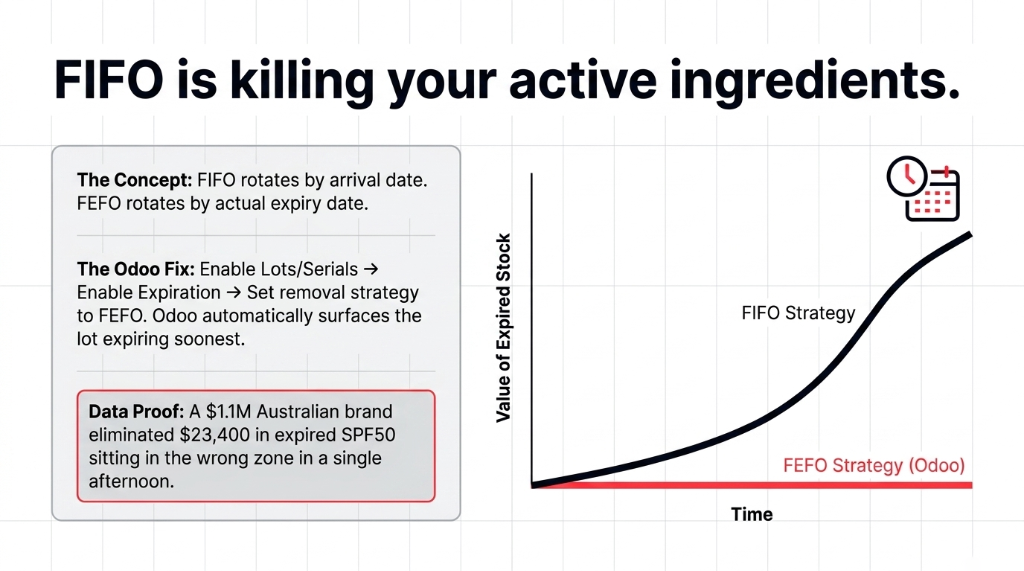
Here is the ugly truth: most brands configure FIFO and think they are covered. They are not. FIFO rotates by arrival date. FEFO rotates by actual expiry date. Those two are not the same thing when your supplier ships you a mixed batch with two different manufacture dates.
Activating FEFO in Odoo
1. Go to Inventory → Configuration → Settings
2. Enable Lots & Serial Numbers
3. Enable Expiration Dates
4. In your putaway rule for SPF or active-ingredient categories, pair it with a removal strategy set to FEFO
When a picker scans the SPF zone, Odoo automatically surfaces the lot expiring soonest, regardless of which bin it is sitting in physically.
$23,400 in Expired SPF50 — Sitting in the Wrong Zone
A $1.1M Australian clean beauty brand selling via Shopify had $23,400 worth of expired SPF50 sitting in Zone C while newer stock was being picked. One FEFO setup. Problem gone in one afternoon.
Capacity Rules: The Feature Nobody Configures (But Should)
This is an insider secret that even experienced Odoo partners skip: Putaway Capacity Rules.
Available from Odoo 16 onward, capacity rules let you set a maximum quantity per bin or shelf. When that threshold is hit, overflow automatically routes to a secondary location you define.
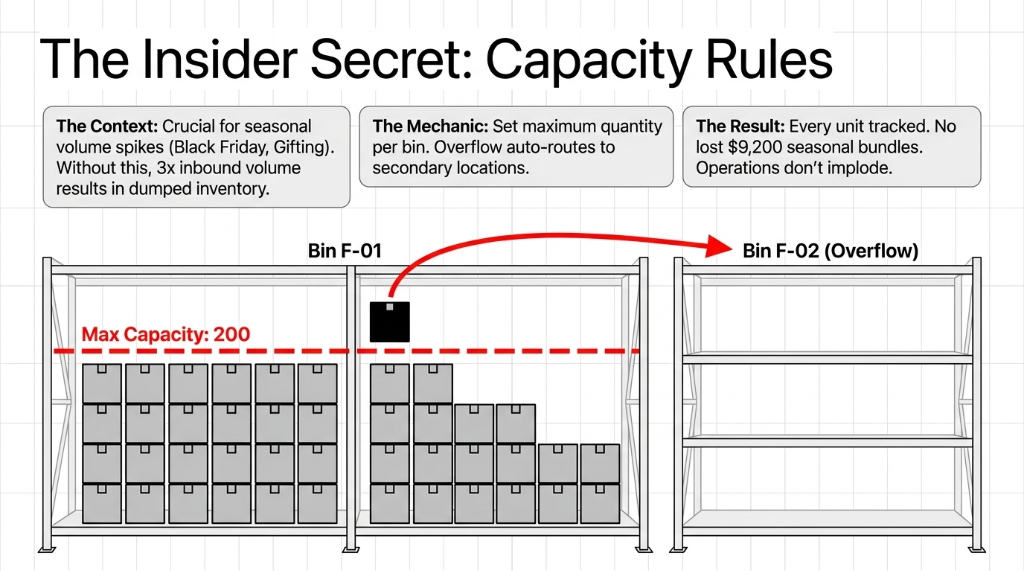
For beauty warehouses, this matters specifically for gift sets and seasonal bundles. During Ramadan, Diwali, Valentine's Day, or Black Friday, beauty brands receive 3x normal inbound volume in a single week. Without capacity rules, your receiving team dumps everything into the default bin, the bin overflows, and 2 weeks later you have $9,200 worth of gift sets sitting in the wrong zone that nobody can find.
With capacity rules, you set Bin F-01 (Gifting Zone) at max 200 units. Overflow routes to Bin F-02 automatically. Every unit is tracked. Every pick is accurate. Your seasonal ops do not implode.
The Multi-Step Receipt Setup That Makes Putaway Actually Trigger
Here is something 8 out of 10 new Odoo users get wrong.
Putaway rules only trigger on multi-step receiving operations. If your warehouse is set to 1-step receiving (receive directly into Stock), putaway logic is bypassed completely. You must configure 2-step or 3-step receiving for putaway rules to activate.
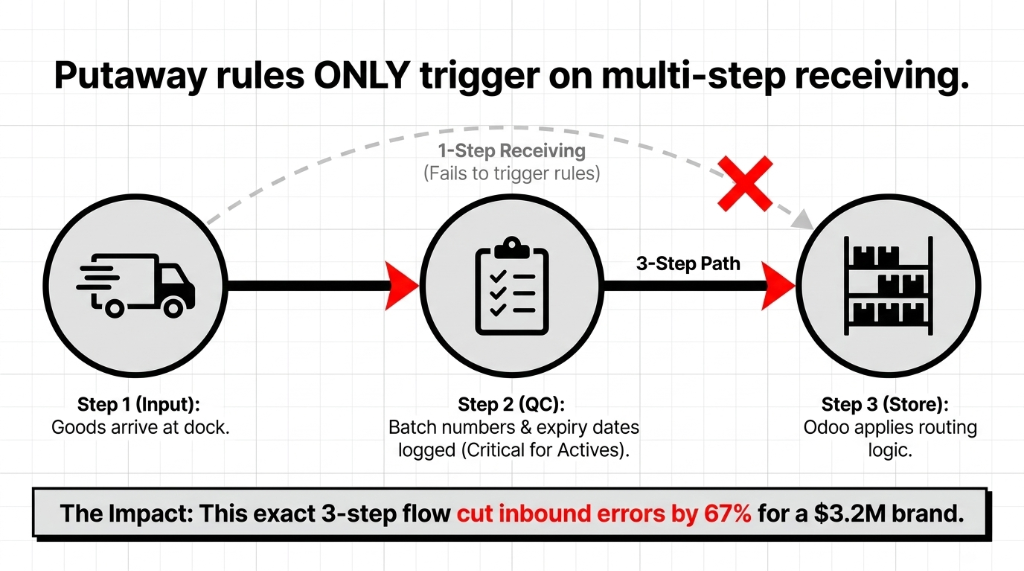
3-Step Receiving for Beauty Warehouses
Go to Inventory → Configuration → Warehouses → Your Warehouse → Incoming Shipments and set it to 3 steps (Unload + Quality Check + Store).
Step 1 (Input): Goods arrive and are staged at receiving dock
Step 2 (Quality Check): Batch numbers and expiry dates are logged (critical for actives and SPF)
Step 3 (Store): Odoo applies putaway rules and routes each product to the exact zone
67% Drop in Inbound Processing Errors
This 3-step flow cut inbound processing errors by 67% for a $3.2M Singapore beauty brand we worked with. They were previously logging expiry dates in a separate Google Sheet. (Yes, seriously. A $3.2M brand. A Google Sheet.)
Getting multi-step receiving and putaway rules configured correctly is a core part of our Odoo implementation services — because the single most common reason putaway rules "do not work" is that the warehouse is still on 1-step receiving.
What This Looks Like When It All Runs Together
Day 1: 1,200 Units — Dock to Shelf in 41 Minutes
Automated Routing
400 Vitamin C serums → Zone A, Shelf 2 with FEFO removal strategy. 300 SPF50 → Zone C, FEFO-enabled, checked against existing lots. 200 fragrances → Zone B sealed cabinet. 300 travel minis → Zone F Kitting area for gift set assembly.
Before vs After
Without putaway rules, the same 1,200-unit operation took 3.5 hours and generated 14 placement errors per shipment. With Odoo putaway: 41 minutes, zero errors. That is the difference.
The Odoo ERP integration work we do for beauty brands includes wiring putaway rules to the barcode scanning app, FEFO removal strategies, and capacity overflow — so that the entire inbound-to-shelf pipeline runs without a single human routing decision.
Frequently Asked Questions
Can I set putaway rules by product category instead of individual SKUs?
Yes, and for beauty brands with 200+ SKUs, category-level rules are the right approach. Set rules at the "Cosmetics > Serums" or "Haircare > Treatments" category level. Individual SKU rules override category rules when both exist, so you get full flexibility without building 300 separate rules.
Do putaway rules work with Odoo's barcode scanning app?
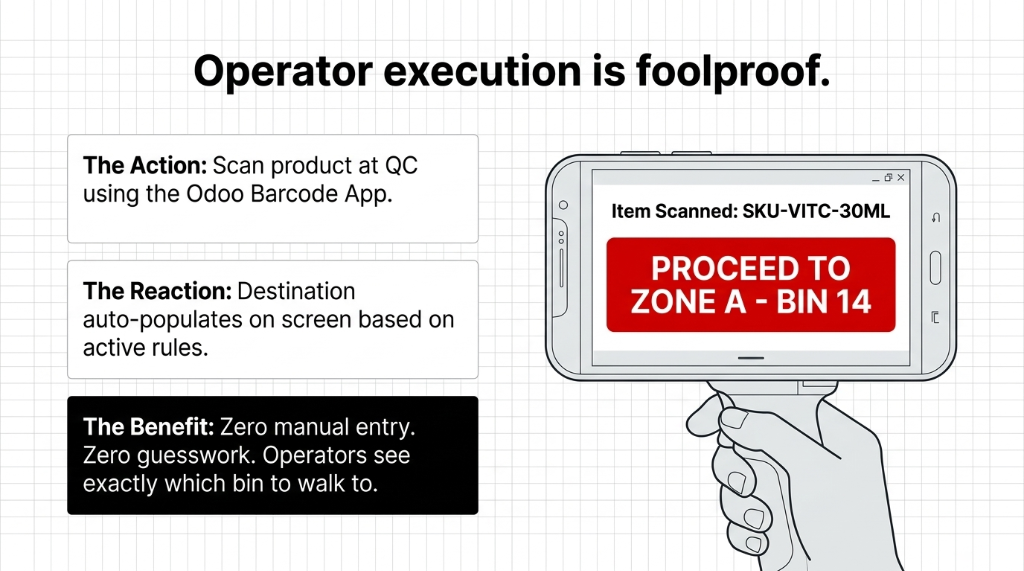
Absolutely. When a warehouse operator scans a product at the receiving or QC location using the Odoo Barcode app, the destination location auto-populates based on the active putaway rule. No manual entry, no guesswork. Operators see exactly which bin to walk to on their screen.
What happens when a destination bin is full?
If you have configured Capacity Rules (Odoo 16+), overflow automatically redirects to your secondary bin. If you have not configured capacity rules, Odoo will still complete the putaway to the primary location — which is why setting capacity rules is non-negotiable for seasonal beauty brands running high inbound volume.
Will putaway rules affect my Shopify order fulfillment speed?
Yes — positively. When every SKU has a fixed, system-enforced location, pick routes become predictable. Average pick time drops from 12-15 minutes to under 4 minutes per order for most beauty warehouses we configure. Faster picks mean same-day dispatch on more Shopify orders, which directly impacts your review scores.
How long does it take to configure putaway rules in Odoo for a beauty warehouse?
For a 150-400 SKU beauty brand with 5-8 warehouse zones, a proper putaway rule setup — including FEFO, capacity rules, and 3-step receiving — takes between 2 and 4 days. That includes zone mapping, rule creation, and team training. We have done it in as little as 1.5 days for brands with clean location master data already in place.
The Insider Takeaway
- Putaway rules only fire on multi-step receiving. If you are on 1-step, switch to 3-step immediately — Input → QC → Store
- FEFO is mandatory for SPF, retinols, and actives. FIFO rotates by arrival date. FEFO rotates by actual expiry. Those are not the same thing.
- Capacity rules prevent seasonal chaos. Set max units per bin and define overflow locations before Black Friday, not during it
- Category-level rules scale. Individual SKU rules do not. Configure at the category level and override only when a specific SKU needs special handling
- 2-4 days of configuration saves $18,300/month in mispicks, expired write-offs, and cancelled orders
Stop Letting Your Warehouse Lose the Game Your Marketing Team Won
You spent $47,000 on a TikTok influencer campaign. Orders spiked 340% in 72 hours. And your warehouse could not fulfill them because nobody knew where the serums were. That is not a demand problem. That is a putaway problem.
Book our free 15-Minute Operations Audit. We will find your biggest warehouse leak on the first call. No slides. No sales pitch. Just your numbers.
Book Your Free Warehouse Audit