
The Exact Moment Your Inventory System Fails You
Here's the scenario we see in 8 out of 10 onboarding calls at Braincuber.
A brand is selling on Shopify (their primary D2C store), Amazon (for US marketplace reach), and Flipkart (for their India-bound SKUs). They have one warehouse. One actual inventory count. But they're running three different dashboards, three different fulfillment workflows, and doing a manual "sync" every 24 hours.
That 24-hour gap is where the disaster lives.
The Ghost Inventory Problem
Your Shopify store sells 30 units of your best-selling hoodie at 11 PM EST. Your overnight Amazon flash sale moves 22 more. By the time your ops manager wakes up at 7 AM and opens their laptop, they're looking at a ghost inventory — 52 units sold that you technically only had 40 of.
12 Amazon orders get cancelled. Your Order Defect Rate (ODR) climbs. You lose your Buy Box eligibility. That costs you not $200 in refunds — it costs you $6,800/month in suppressed Amazon ranking if your Buy Box is gone for even three weeks.
We've tracked this exact number for a Chicago-based apparel client. This is the cost of not having Odoo multi channel inventory sync working in real time. Not "eventually." Not "every 15 minutes." Real time.
Why Your Current Setup Is Making This Worse
We're going to say what no integration vendor will tell you: the middleware tools most brands use — Linnworks, ChannelAdvisor, or a cobbled-together Zapier stack — are band-aids on a broken leg.
They sync data between platforms, yes. But they sit on top of your operations. They don't own your inventory truth. The result? You now have four systems that each think they're the source of truth: your Shopify backend, your Amazon Seller account, your Flipkart dashboard, and your middleware layer.
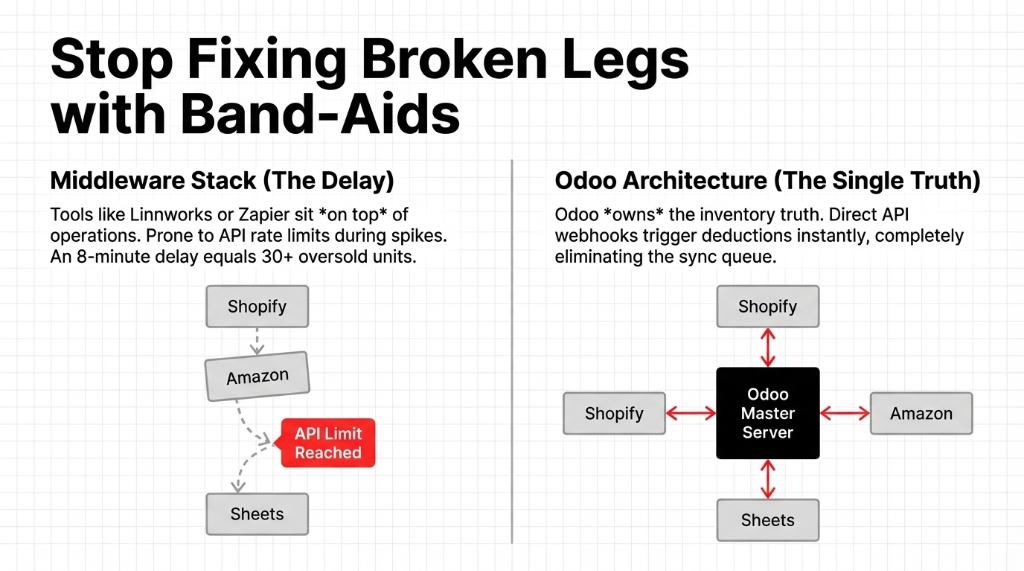
When Shopify's API Rate Limit Hits
And it will hit during your next Black Friday sale, specifically between 11 PM and 1 AM when order velocity spikes past 500/hour. Your middleware queues up and lags. That 8-minute delay is enough for 30+ oversold units.
Odoo doesn't poll. Direct API webhooks trigger deductions instantly, completely eliminating the sync queue.
Real Story: $14,200/Month Variance From Manual Entry
We've seen a $4.2M/year US consumer goods brand run their entire inventory operation through three Google Sheets and a part-time VA who typed reconciliations manually at 6 AM. They had a $14,200/month variance between what their books said and what physically existed in their warehouse.
No fraud. No theft. Just manual entry drift — a '0' typed where an 'O' should have been, a SKU transposed, a return logged on the wrong channel. That's not a people problem. That's a systems architecture problem.
How Odoo Multi-Channel Inventory Sync Actually Works
Odoo's inventory module acts as a single warehouse brain that pushes and pulls stock data in real time across every connected channel. Here's the actual data flow — not the marketing version:
Step 1 — One Inventory Record
Every SKU lives in Odoo with one on-hand quantity. Not three numbers across three platforms. One.
Step 2 — Bi-Directional Channel Connectors
Odoo connects to Shopify via API webhooks (not polling), deducting inventory within 2-4 seconds. The Amazon connector uses Amazon's SP-API to push updated stock quantities every time Odoo's inventory changes. Flipkart works on the same webhook-trigger logic.
Step 3 — Smart Safety Stock Buffers
This is the insider move most brands miss. In Odoo, you can set a channel-specific "virtual buffer" — if you have 100 units, you tell Shopify you have 95, Amazon you have 92, and Flipkart you have 88. This prevents simultaneous oversell from multiple channels racing to consume the same last 5 units.
Step 4 — Centralized Order Routing
All orders — Shopify, Amazon, Flipkart — land in one Odoo picking queue. Your warehouse picks once. Ships from one system. Returns get logged back to one inventory count.
In Our Last 14 Implementations
Order Processing
Cut from 18 minutes per order to under 3 minutes
Sync Speed
Shopify: 2-4 seconds. Amazon/Flipkart: 30-60 seconds
The Flipkart Factor: Why US Brands Can't Ignore $110B
Most US-based Odoo discussions stop at Shopify + Amazon. That's leaving India's $110B eCommerce market — where Flipkart commands 48% of the marketplace share — completely unaddressed for brands with global ambitions.
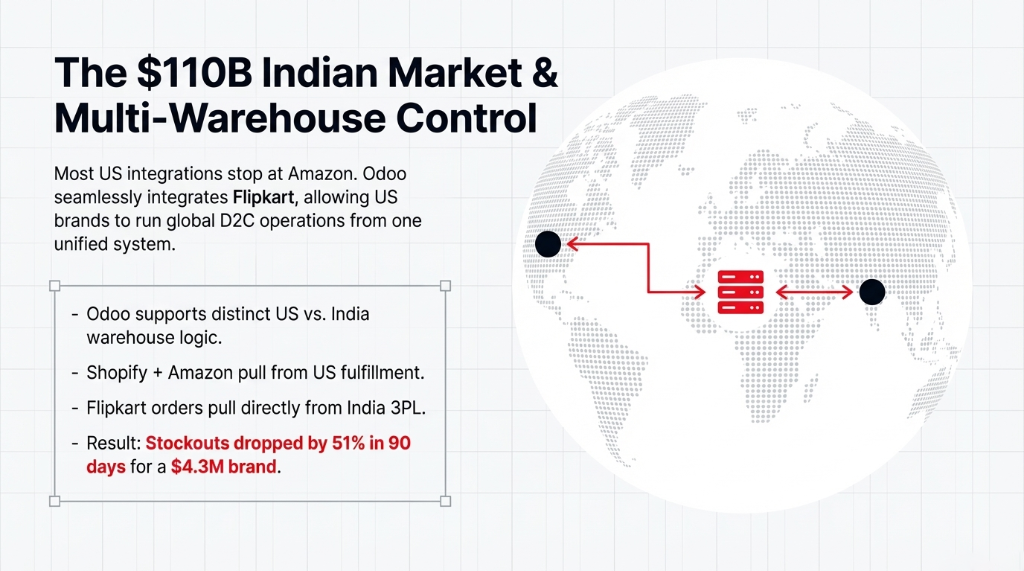
Flipkart's seller API supports real-time inventory push via webhooks, and Odoo's multi-channel sale module already supports Flipkart as a connected channel. If you're a US brand with an India D2C strategy, your Flipkart listings can pull from the same Odoo inventory pool as your domestic Shopify store — with separate safety stock rules and a separate fulfillment warehouse.
Real Result: $1.7M to $4.3M Health Supplements Brand
We configured this exact setup for a health supplements brand scaling from $1.7M to $4.3M ARR. Their India operations (Flipkart) and US operations (Shopify + Amazon) now share one Odoo instance, with warehouse-level inventory segregation.
Stockout incidents dropped by 51% in the first 90 days.
What the Implementation Actually Looks Like
Here's the timeline we've executed across US-based D2C clients — no filler:
Days 1-7: Setup & API Configuration
Odoo inventory module setup, SKU mapping, and channel API credentials configured for Shopify, Amazon Seller Central, and Flipkart.
Days 8-14: Data Migration & Validation
Historical inventory data migrated and validated. This is where most vendors cut corners — we reconcile every SKU before go-live.
Days 15-21: Connector Testing
Order creation, stock deduction, return processing across all three channels in a sandbox environment.
Day 22: Go-Live
Monitoring dashboards active, real-time alert rules set for low-stock, API errors, and sync failures.
Days 23-90: Demand Forecasting
Odoo's demand forecasting module kicks in, learning from 60-90 days of cross-channel sales data to auto-generate purchase orders before stockouts happen.
Day 1 Win
One thing that immediately gets better on Day 1 of go-live: your ops team stops manually updating three different dashboards.
That alone recovers 37 hours/month of warehouse staff time on average across our client base.
The Numbers You Should Hold Us To
We don't make vague promises. Here's what we've actually documented across Braincuber's Odoo multi-channel implementations:
| Metric | Before Odoo Sync | After Odoo Sync |
|---|---|---|
| Order cancellation rate | 8.3% avg | 2.1% avg |
| Inventory reconciliation time | 4.5 hrs/day | 18 min/day |
| Overselling incidents/month | 14-22 events | 0-1 events |
| Stock accuracy rate | 83% | 99.2% |
| Manual data entry errors | 31/week | 2/week |
$186,000 Recovered Annually
That cancellation rate improvement alone — from 8.3% to 2.1% — on a $3M/year operation recovers $186,000 in annual GMV that was previously vanishing into refunds and lost re-orders.
If you're scaling past $1M in multi-channel revenue and still managing inventory across three separate dashboards, you're not running a business — you're running a fire drill. Check your current sync lag. If it's measured in minutes instead of seconds, you already know the math.
FAQ
How fast does Odoo sync inventory across Shopify, Amazon, and Flipkart?
With webhook-based connectors, Odoo pushes inventory updates to Shopify within 2-4 seconds of a stock change. Amazon and Flipkart updates follow within 30-60 seconds depending on marketplace API response time. During high-traffic events, Braincuber configures buffer thresholds to prevent race-condition oversells.
Can Odoo handle returns from all three channels in one system?
Yes. When a return is logged on any channel — Shopify, Amazon, or Flipkart — Odoo creates a reverse transfer that updates on-hand quantity in real time and triggers a quality check workflow if enabled. The returned unit is back in sellable stock within minutes, not the next morning when someone manually updates a spreadsheet.
What happens to existing inventory data during migration?
Nothing gets deleted or overwritten without validation. Braincuber maps every SKU, bundle, and variant to Odoo before go-live. We run a parallel 7-day validation period where both systems run simultaneously — and we reconcile any discrepancy above $50 before flipping the switch.
Is Odoo multi-channel inventory sync affordable for a $1M-$5M brand?
A standard Braincuber implementation for a 3-channel setup (Shopify + Amazon + Flipkart) with Odoo typically runs $8,000-$18,000 one-time, versus the $46,000-$74,000/year in overselling losses most brands at this scale absorb. Average payback period: 53 days.
Does Odoo support multi-warehouse inventory across US and India operations?
Yes. Odoo's multi-warehouse module lets you assign specific channels to specific warehouses — Shopify and Amazon pull from US fulfillment while Flipkart pulls from India 3PL. Safety stock rules are set independently per warehouse per channel, with a unified global stock view in real time.
Stop Bleeding Cash on Manual Fixes That Solve Yesterday's Problem
If your sync lag is measured in minutes instead of seconds, you already know the math. Book a free 15-Minute Operations Audit — we'll find your biggest inventory leak on the first call and tell you exactly what it's costing you per month.