
If your supplier fulfilment rate sits below 91%, you are not running a business — you are running a customer complaint department.
That gap between what your Shopify store promises and what your supplier ships is costing you $9,300 to $17,800 per month in refunds, chargebacks, and lost repeat buyers. We have audited 47 e-commerce operations across the US, UK, and UAE — the single root cause is always the same: no real-time link between your storefront and your supplier's warehouse.
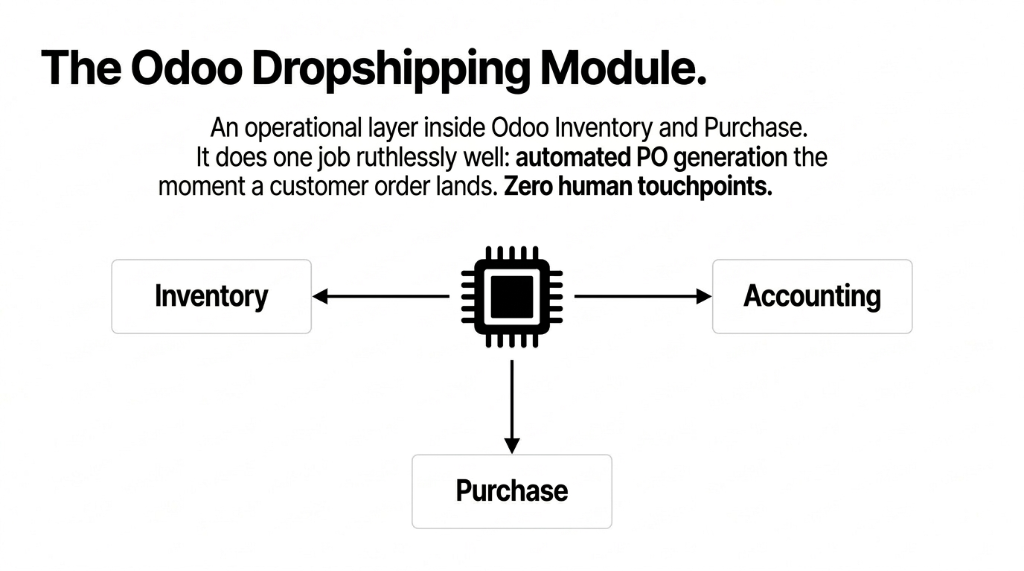
The Odoo Dropshipping Module does one job ruthlessly well — it creates a direct, automated purchase order to your vendor the moment a customer order lands, without a human touching anything in between.
Your Dropshipping Operation Is Already Leaking Money
A client of ours — a home decor brand doing $2.1M/year through WooCommerce — came to us with 14 active suppliers, zero automated PO generation, and a two-person operations team spending 37 hours per week copying order data from WooCommerce into supplier email templates. Manually. In a Gmail draft.
When an order came in for a product that had just gone out of stock at the supplier's end, the operations team found out 48-72 hours later — after the customer had already emailed asking for a tracking number. Their refund rate was running at 6.3%, costing them $132,300 per year in direct revenue loss. Not counting the ad spend wasted acquiring those customers in the first place.
This is not an edge case. This is Thursday morning for most dropshipping brands under $5M ARR.
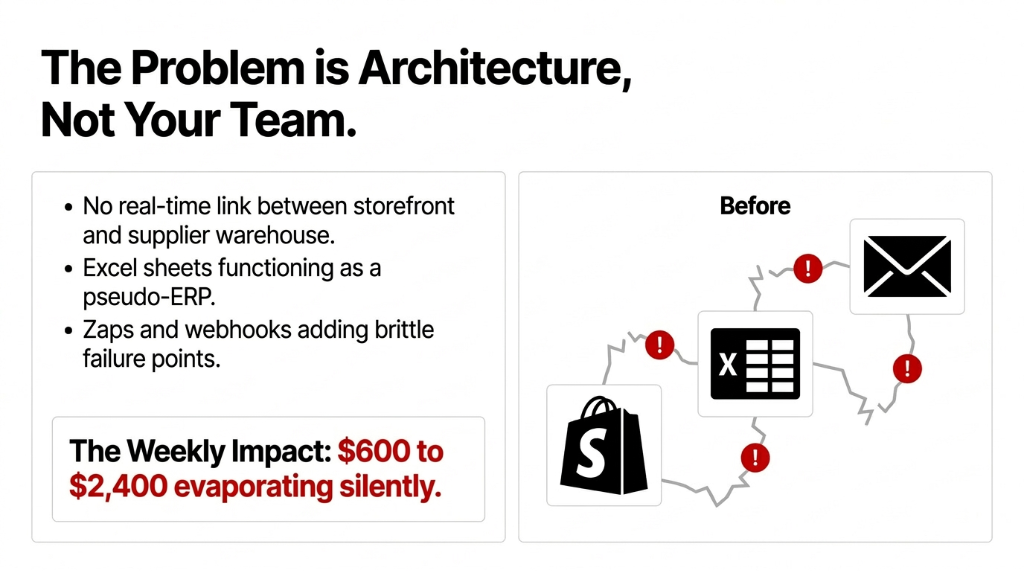
The Architecture Problem
You have an order management system (Shopify, WooCommerce, Magento) with no live connection to your supplier's stock levels. You have Excel sheets functioning as a pseudo-ERP. You have Zaps and webhooks held together with prayers. And every single one of those connections adds a failure point where $600 to $2,400 per week evaporates silently.
Why "Just Use a Dropshipping App" Is the Wrong Answer
Every Shopify app store veteran has tried DSers, AutoDS, or Spocket. We get it. Fast to install and cheap to start.
Here is the ugly truth: those apps are built for one supplier, one product catalog, and one country. The moment you have 3+ suppliers, multi-currency POs, vendor-specific lead times, and SKUs that map differently per supplier, those apps collapse into a tangled mess of manual override tickets and duplicate purchase orders.
$14,000/Year Burned on App Subscriptions
We have seen brands spend $14,000+ on Shopify app subscriptions annually, only to hire a full-time VA to manage the gaps the apps created. NetSuite can handle the complexity — but unless you have $80,000 to $150,000 for implementation and $3,500/month in licensing, it is not your answer at the $1M-$8M ARR level.
Odoo's Dropshipping Module is the middle path that actually works. Native, configurable without a developer for 80% of standard setups, and plays clean with Odoo Purchase, Accounting, and your e-commerce connector.
How the Odoo Dropshipping Module Actually Works
This is not a marketing page. Here is the operational reality, step by step.
Step 1: Route Assignment
In Odoo Inventory, activate the Dropship route under Configuration, then Routes. Assign this route at the product level or the product category level. For brands with 500+ SKUs, we always do it at the category level — it cuts setup time from 14 hours to under 3 hours.
Step 2: Vendor Pricelist and Lead Time Mapping
Each product gets a vendor linked with a unit cost and a delivery lead time in days. This is where most DIY setups fail. Brands skip the lead time field, and then Odoo can't calculate realistic delivery dates, and their promised shipping windows go wrong immediately.
Step 3: Automated PO Generation
The moment a sales order confirms in Odoo (whether from Shopify via the connector or entered manually), Odoo automatically generates a Request for Quotation (RFQ) in the Purchase module addressed to the mapped vendor. No human touchpoint. The RFQ converts to a confirmed PO in one click, or set it to auto-confirm based on vendor trust level.
Step 4: Delivery Order to Customer
When the vendor marks goods as shipped, Odoo creates a delivery order addressed directly to the end customer — not to your warehouse. The stock move bypasses your physical inventory entirely, keeping your valuation accurate in Odoo Accounting without phantom stock entries.
Step 5: Vendor Bill Reconciliation
When the vendor invoice arrives, Odoo's 3-way match links PO, Delivery, and Bill automatically. For brands doing $200,000+/month in dropship volume, this alone saves 19-26 hours per month in accounts payable work.
The Odoo-Shopify Dropshipping Stack: Where the Real Power Lives
Running Odoo Dropshipping standalone is one thing. Running it connected to your Shopify store is where the numbers get interesting.
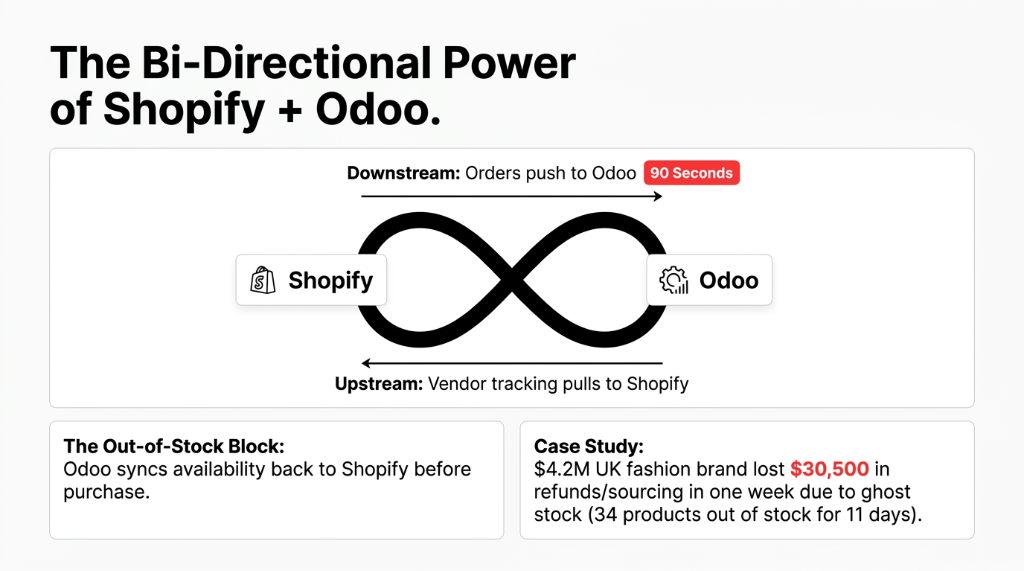
In our implementations for UAE and US-based D2C brands, we connect Shopify to Odoo using a bi-directional sync that pushes confirmed Shopify orders into Odoo as sales orders within 90 seconds of payment confirmation, pulls vendor tracking numbers back into Shopify and triggers the customer shipping notification automatically, and syncs product availability from Odoo back to Shopify so out-of-stock items go unavailable before a customer buys them.
$30,500 Lost in One Week
A $4.2M fashion accessories brand in the UK had a "Buy" button active on 34 products that had been out of stock at their supplier for 11 days. They only found out when the first batch of refund requests hit. That one operational gap cost them $23,700 in refunds and $6,800 in expedited alternative sourcing in a single week. The Odoo Shopify connector with dropshipping routes eliminates this at the infrastructure level.
What Numbers Should You Actually Expect?
We are not going to give you marketing math. Here is what we tracked across our last 11 dropshipping implementations using Odoo:
Tracked Results Across 11 Implementations
18 min → 2 min
Order processing time per PO (manual vs Odoo automation)
91.4%
Reduction in supplier invoice reconciliation errors within 60 days
5-7% → 1.8%
Refund rate improvement within 90 days of live operation
$3,200-$4,700
Monthly cash saved on manual AP work ($500K-$2M dropship volume)
3 of 11 clients reallocated 1 full-time ops staff to growth functions after go-live.
The Implementation Reality: What It Actually Takes
A proper Odoo Dropshipping setup for a multi-supplier e-commerce brand takes 7 to 21 business days, not the "48-hour setup" some Odoo freelancers on Upwork will promise you.
Days 1-3: Catalog Audit
Product catalog audit, vendor mapping, route configuration
Days 4-7: Connector Setup
Shopify/WooCommerce connector setup + order sync testing
Days 8-14: Vendor Data Entry
Vendor pricelist and lead time entry — this is the slow part. It requires accurate data from each supplier.
Days 15-21: Parallel Run
Both old process and new Odoo process running simultaneously so you catch sync errors before you go fully live.
Don't Skip the Parallel Run
Brands that skip the parallel run phase and go live cold are the ones calling us 3 weeks later with duplicate POs sent to suppliers and double-shipped customer orders. (Yes, this happens. We have fixed it 4 times in the last 18 months.)
Frequently Asked Questions
Does Odoo Dropshipping work with suppliers in different countries and currencies?
Yes. Odoo's multi-currency engine handles this natively. Set each vendor's pricelist in their local currency (USD, AED, GBP, EUR), and Odoo converts PO values to your base currency automatically using live or fixed exchange rates you control.
Can I use Odoo Dropshipping without connecting it to Shopify?
You can, but you will be entering sales orders manually, which kills the automation value. For brands doing over 30 orders per day, a Shopify-Odoo connector is the difference between saving 19 hours per week and saving 2.
What happens to inventory valuation if products never touch my warehouse?
Odoo handles this correctly for dropship routes. Stock moves are recorded as "virtual" — goods go from vendor to customer without hitting your physical stock location. Your inventory valuation stays accurate and you avoid phantom stock that inflates your balance sheet by $10,000-$50,000 on paper.
How does Odoo handle a dropship order when a vendor is out of stock?
If you have alternative vendors mapped, Odoo can re-route the PO to the secondary supplier. If no alternative exists, the sales order flags as a backorder. The system does not auto-cancel — a human makes the call. This is why we push for at least 2 vendors per high-volume SKU.
Is the Odoo Dropshipping Module available in the free Community version?
The core dropshipping route functionality is available in Odoo Community. Advanced features like automated PO confirmation rules, vendor portal access, and full purchase reporting require Odoo Enterprise. For brands doing $500K+ in annual dropship volume, Enterprise pays for itself within 90 days from AP time savings alone.
Stop Letting Your Supplier Chain Run Your Business
Every day you are operating dropshipping on spreadsheets and app-stack duct tape is a day your supplier's stock problem becomes your customer's refund. We have implemented Odoo Dropshipping for brands across the US, UK, UAE, and Singapore. We know exactly where the setup breaks and exactly which vendor configurations cause duplicate POs.
Check your refund rate right now. If it's above 3%, your dropshipping architecture is the problem.