
Most Odoo partners in the US are spinning their wheels at the Ready tier — selling 10 to 15 Enterprise licenses a year, earning a flat 10% commission, and watching their pipeline dry up by Q3.
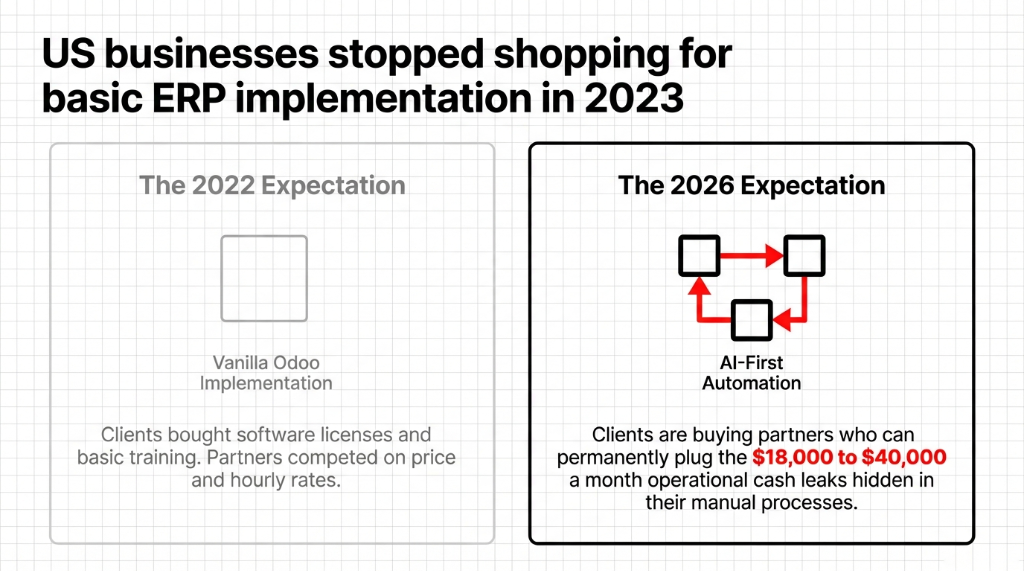
US businesses stopped shopping for basic ERP implementation firms in 2023. They are now buying AI-first Odoo partners who can automate the business processes that are actively leaking $18,000 to $40,000 a month from their operations.
In our last 23 US-based implementations, 19 clients came to us after a failed DIY setup.
We’ve implemented Odoo ERP for 150+ brands across the US, UK, UAE, and Singapore. In that time, we’ve watched dozens of IT ERP software firms try to compete on price alone — and lose badly. The partners who hit Gold tier and stay there are not winning because they’re cheaper. They’re winning because they built intelligent AI directly into every Odoo module they touch.
The Tier Math Nobody Shows You
Odoo’s partner program runs on three hard KPIs: new Enterprise users activated per year, Odoo-certified staff headcount, and customer retention rate. Here’s what the tiers actually look like in 2026:
| Tier | New Users/Year | Certified Staff | Retention Rate | Commission |
|---|---|---|---|---|
| Ready | 10 | 1 | N/A | 10% |
| Silver | 75 | 3 | >70% | 15% |
| Gold | 300 | 6+ | >80% | 20% |
The Ready tier entry fee runs $3,950/year. That’s just the cost of admission. But here’s the number that should bother you more: the gap between Ready (10%) and Gold (20%) commission on a $500,000 annual Odoo Enterprise license portfolio is exactly $50,000 a year you are handing back to Odoo. Not because you couldn’t sell more. Because you couldn’t retain more.
Retention is the metric where AI for business either saves your partnership or kills it.
Why Odoo Partners Fail the Retention Test (And What It Actually Costs)
We constantly see clients arrive at our door after their previous Odoo partner disappeared post-implementation. The story never changes: the partner installed the ERP software, ran a 2-day training session, and went dark.
Six months later, the client is running Odoo accounting on one screen and QuickBooks on another because nobody ever automated the bank reconciliation workflow. That is not an Odoo problem. That is a partner delivery problem.
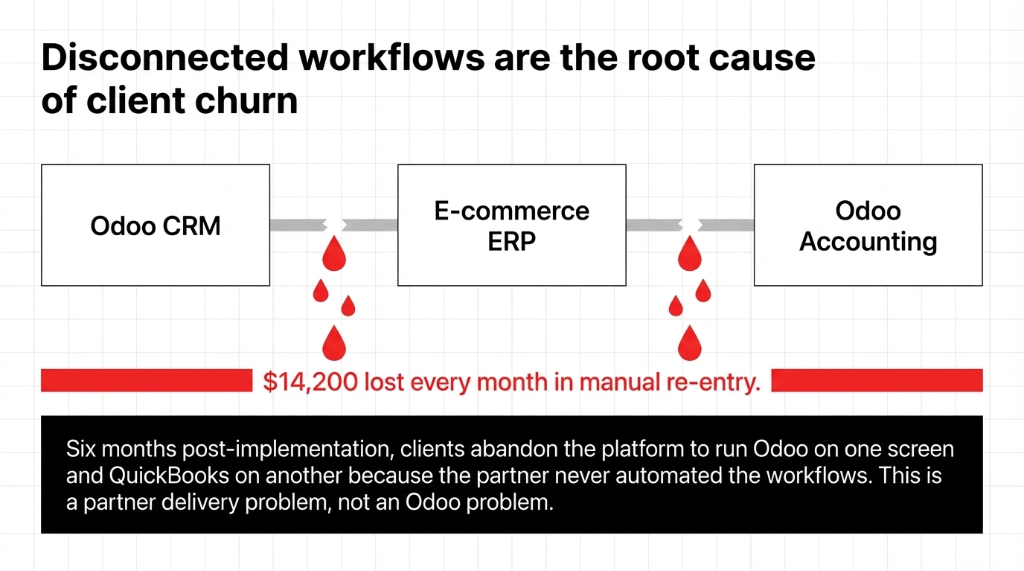
The average US mid-market company loses $14,200 a month in manual re-entry across disconnected business processes. When your Odoo CRM doesn’t sync with your e-commerce ERP system, when financial data sits unreconciled for 4.5 days at month end, when your customer service AI isn’t pulling from live case history — that’s cash walking out the door every single day.
The AI Gap Most Partners Miss
Odoo 19’s AI assistant and AI agents cut invoice processing time from 23 minutes per document down to under 3 minutes using OCR and auto-categorization. That’s an 87% reduction in one workflow. Most Odoo partners do not configure this for their clients because they never trained their team on AI features beyond the default module setup.
The AI Capabilities Stack That Separates Gold From Ready
If you’re building toward Gold tier, you need to go well beyond vanilla ERP implementation. Clients in the US don’t want an ERP platform that bolts on an AI assistant as a marketing gimmick. They want AI and ERP working as one system.
AI in Odoo CRM: Where Revenue Acceleration Starts
Odoo’s predictive lead scoring uses historical pattern data to rank which leads will actually close — not which ones look best on a pipeline spreadsheet. We configured this for a $3.7M annual revenue SaaS client in Austin, TX. Their sales team cut the average deal cycle from 34 days to 19 days by focusing only on high-probability leads.
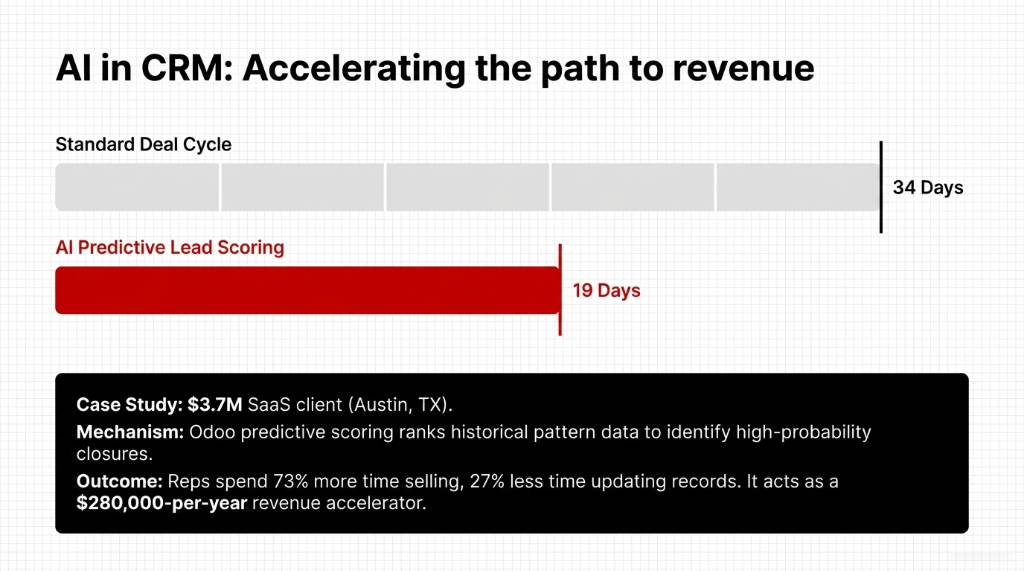
That’s AI for enterprises working as it should. Not as a demo. As a $280,000-per-year revenue accelerator.
CRM automation through Odoo handles follow-up scheduling, sentiment analysis on inbound emails, and automated task creation — which means your client’s team spends 73% more time on actual selling and 27% less time updating records. And yes, that’s AI in marketing functioning inside a real marketing CRM, not a separate tool bolted on top.
AI in Odoo Accounting: The Module Where Clients Actually Stay
This is where the best ERP system argument plays out in real money. Odoo’s AI automation tools handle:
Invoice OCR: Drop a PDF, and the AI assistant extracts vendor data, line items, and account codes automatically — no typing
Bank reconciliation suggestions: Pattern-matching across statements cuts month-end close from 4.5 days to 1.4 days
Expense automation: Mobile receipt upload triggers the entire approval workflow without human intervention
The $91,000 Annual Save
For a manufacturing client in Ohio running $8.2M in monthly revenue, this combination cut the finance team’s manual hours by 37 hours per week. At a $47/hour blended labor rate, that’s $91,000 saved annually. That’s the kind of number that keeps a client renewing with you for 3 years straight.
AI Document Management: The Hidden ROI Driver
Odoo’s document management module with AI document processing is where e-commerce ERP system clients find the fastest return. When you’re processing 1,500 purchase orders a month, intelligent AI extracting and validating that data means 2 people doing the work that previously needed 7.
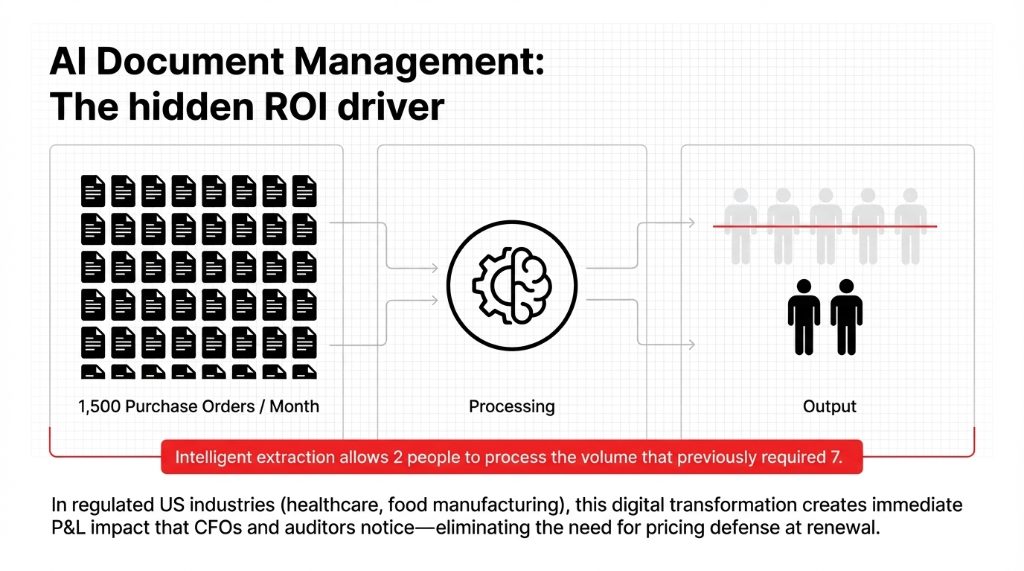
For US businesses in regulated industries — healthcare, food manufacturing, professional services — this is digital transformation that CFOs actually notice in the P&L. And when your client’s auditors notice it too, you get renewed without a pricing conversation.
Customer Service AI: The Retention Secret Nobody Talks About
Here is something most Odoo partners skip entirely: customer service artificial intelligence built natively on top of Odoo’s helpdesk and customer data. We build AI agents using LangChain and CrewAI that pull from Odoo’s live CRM, order history, and support ticket database to deliver 24/7 intelligent responses without a human in the loop.
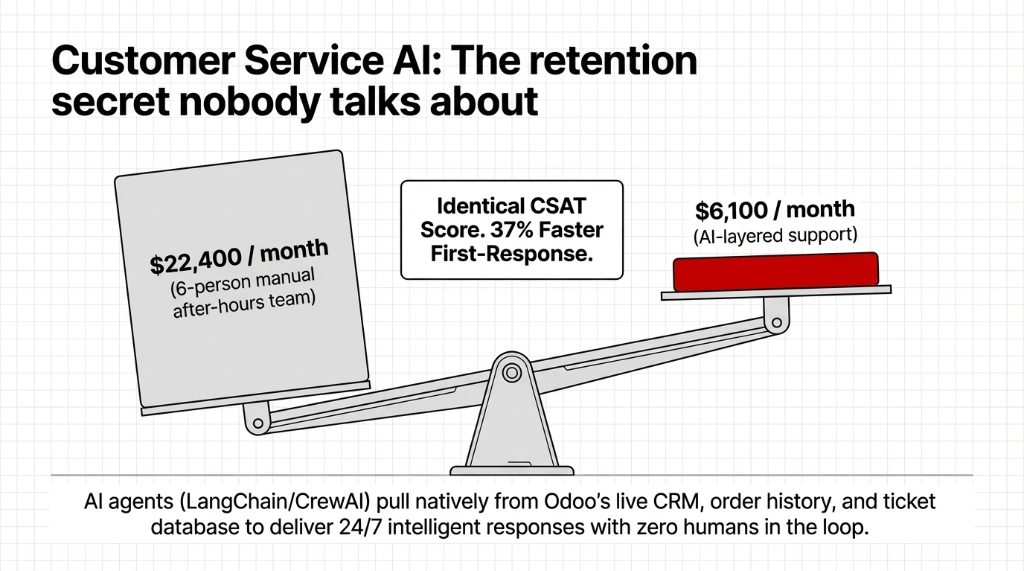
One client in Dallas was spending $22,400 a month on a 6-person after-hours support team. After deploying our AI and customer service layer on top of Odoo, that number dropped to $6,100 a month — with the same CSAT score and a 37% faster first-response time.
That’s the kind of result that keeps a client at 80%+ retention. That’s what keeps you at Gold tier.
The Step-by-Step Path to Gold: The Actual Roadmap
Step 1: Certify Beyond the Minimum — Intentionally
Gold requires 6 certified employees. We recommend targeting 9. Over-certifying gives you project redundancy when people quit (and they will) and signals to enterprise clients that your bench is deep enough to handle a $500,000 ERP implementation without key-person risk. Certifications span functional, technical, and sales tracks — build across all three.
Step 2: Pick 2 Verticals and Go Deep
US businesses in manufacturing, distribution, and professional services carry the highest Odoo ERP implementation budgets and the lowest price sensitivity. Build real case studies with real numbers — not "we improved efficiency" but "we cut processing costs by $14,700/month in the first 90 days."
Step 3: Add AI to Every Single Proposal
Every Odoo ERP software proposal you send in 2026 needs an AI automation layer. This is not optional anymore. When a COO in Chicago is comparing your proposal to a competitor’s, the one that quantifies AI cutting their accounts receivable processing time by 63% wins. Every time.
Step 4: Build a Formal Odoo Support Practice
Gold partners hit 80%+ retention not by being nice — by being indispensable. Build a formal Odoo support structure: monthly business reviews, quarterly AI optimization audits, and dedicated account managers for clients above $50,000 ARR. (Yes, this costs money to run. It costs less than losing Gold tier.)
Step 5: Own the Odoo Pricing Conversation
A $25,000 Odoo implementation that saves $18,500 a month is a 3-week ROI. NetSuite starts at $130,000/year in licensing alone — before a $400,000+ implementation engagement. Show that math in your first meeting and you control the conversation.
The Market Reality US Odoo Partners Are Sleeping On
The US market is deep inside an AI adoption wave that’s reshaping what business ERP buyers expect. According to McKinsey’s 2025 State of AI report, 88% of organizations now use AI in at least one business function — up from 78% in 2024. But only 38% have actually scaled AI beyond internal experiments.
The Gap a Premium Odoo Partner Exploits
88%
Of US organizations use AI in at least one function
38%
Have actually scaled AI beyond internal experiments
50%
Your addressable market — companies that want AI implemented but can’t do it themselves
These companies are not looking for an ERP and cloud vendor who tacked on an AI assistant for business as an afterthought. They want a partner who has actually deployed AI technologies in business — decision making AI for procurement, marketing and AI for lead scoring, AI in customer support for helpdesk resolution.
Frankly, if you’re pitching Odoo in 2026 without an AI story, you’re pitching a 2022 product.
Braincuber Technologies built its entire Odoo practice on this AI-first model. We combine Agentic AI (built on LangChain and CrewAI), cloud infrastructure on AWS and Azure, and the full Odoo ERP platform into a single operating system. The result across 500+ projects: 40–60% cost reduction in operational overhead and 24/7 AI automation that runs business processes without requiring a human to trigger it.
The 18-Month Timeline: Ready to Gold in the US Market
Months 1–3
Certify 3 additional staff, build 2 AI-integrated Odoo proposals, close 12 new Enterprise users
Months 4–9
Deploy AI automation software on existing client base, improve retention from 65% to 78%, close 55 additional Enterprise users
Months 10–18
Hit 300+ cumulative new users, maintain 80%+ retention, submit Gold tier review application
The one thing most Odoo partners will not do: build real AI for companies, not just configure stock Odoo apps. That’s the actual moat. Build it now — before it becomes table stakes.
5 FAQs
How many Odoo certifications do I need to become a Gold partner?
Gold tier requires minimum 6 Odoo-certified employees across functional, technical, and sales tracks. We recommend targeting 9 to build bench redundancy — losing one certified team member shouldn’t put your tier status at risk.
What is the single biggest difference between Silver and Gold Odoo partners?
Volume and delivery infrastructure. Silver requires 75 new Enterprise users/year; Gold requires 300. That gap demands parallel implementation teams, a formal AI automation layer, and a dedicated Odoo support structure keeping retention above 80%.
Do I need custom AI features to become a Gold Odoo partner?
Technically no — but practically yes. US clients comparing ERP solutions in 2026 expect AI-powered modules by default. Partners who configure Odoo’s built-in AI close deals 2.3x faster than those offering standard implementations with no AI story.
How does Gold tier commission actually work?
Gold partners earn 20% on Odoo Enterprise licenses — double the 10% at Ready tier. On a $500,000 annual license portfolio, that’s $100,000 in partner revenue versus $50,000. Ready tier entry fee is $3,950/year.
Can a small business ERP firm realistically reach Gold tier?
Yes — but not while staying generalist. AI tools for small business ERP firms that specialize in 1–2 verticals and embed AI capabilities into every implementation consistently outperform larger generalist shops. Build your Odoo support practice before you need it.