
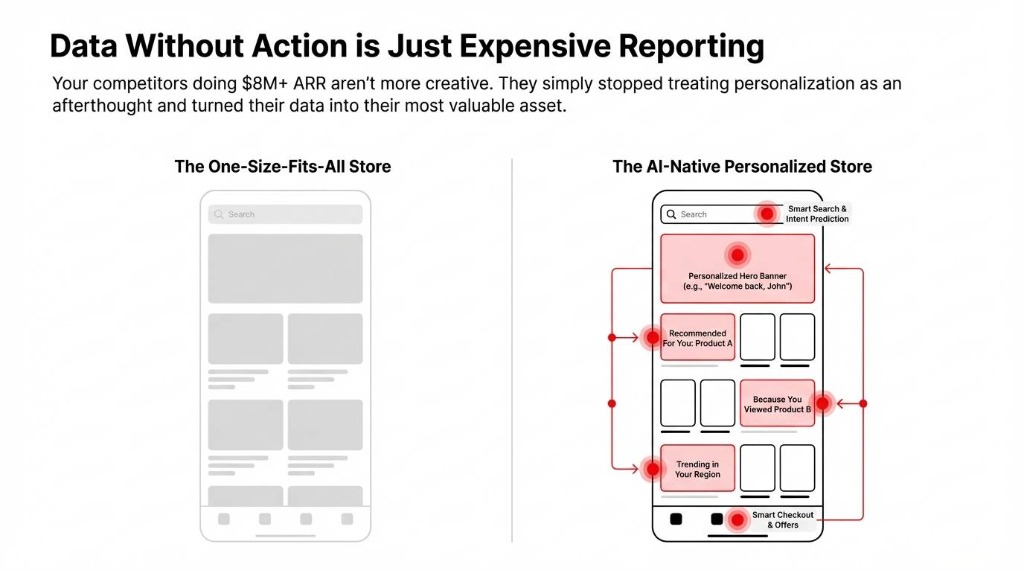
Your Shopify store is showing every visitor the same homepage. The same bestseller grid. The same generic "You might also like" row.
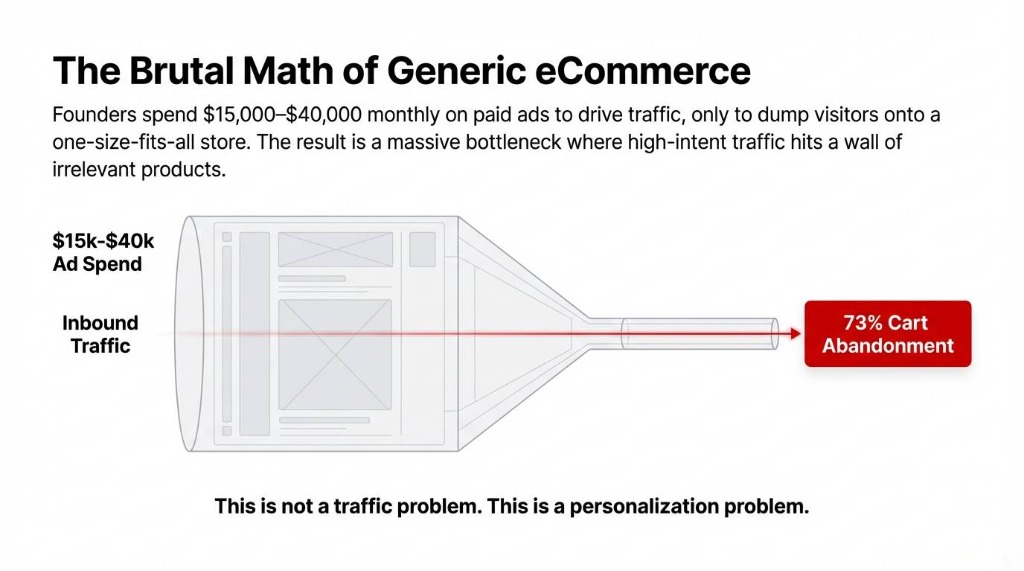
And you wonder why your cart abandonment rate sits at 73%. That's not a traffic problem. That's a personalization problem — and it's costing you somewhere between $8,000 and $22,000 every single month depending on your AOV.
We have audited 50+ D2C brands across the US in the past two years, and the pattern is identical every time: founders spend $15,000–$40,000 on paid ads to drive traffic, then dump those visitors onto a one-size-fits-all storefront. A skincare customer who bought a retinol serum last month gets shown the same acne cleanser as a first-time male visitor from Texas who Googled "face wash for dry skin." That is not a customer journey. That is a coin flip.
The D2C brands actually scaling from $1M to $10M ARR right now — the ones with repeat purchase rates above 38% — are not running better ads. They are running intelligent AI on top of their Shopify stores that reads every behavioral signal and rebuilds the shopping experience in real time, per customer, per session.
Here is exactly how they are doing it, and exactly what digital commerce winners are executing to capture ai transformation.
The Real Cost of Treating Every Shopper the Same
McKinsey's data is blunt: companies excelling at personalization generate 40% more revenue from those activities than average performers. Product recommendations alone now drive 31% of total eCommerce revenue across the industry.
Yet the majority of Shopify-based D2C brands in the US are still doing "personalization" the old way — a Klaviyo abandoned cart email and maybe a "Frequently Bought Together" widget that Shopify added three years ago.
That is not AI. That is a template with your customer's first name in the subject line.
Here is what the data actually says about customers: 76% of them walk away from a brand when the experience is not personalized, and 80% are more likely to purchase when it is. You are not losing those customers to a competitor with better products. You are losing them to a competitor with a smarter AI model reading their behavior.
The ugly truth? Your average Shopify store collects mountains of customer data — browse history, purchase frequency, average session depth, time-on-product, device type, referral source — and does almost nothing with it. It just sits in your Shopify company analytics dashboard while your team manually segments Klaviyo lists every two weeks based on last-purchase date.
That $12,000–$18,000 in monthly revenue you are missing? It is buried in that unprocessed data.
How AI Actually Reads the Customer Journey
The brands winning at ai and customer experience right now are not using AI as a gimmick. They are running it as a real-time data layer that sits between your Shopify storefront and your customer's browser.
Here is the mechanics of it, without the buzzwords.
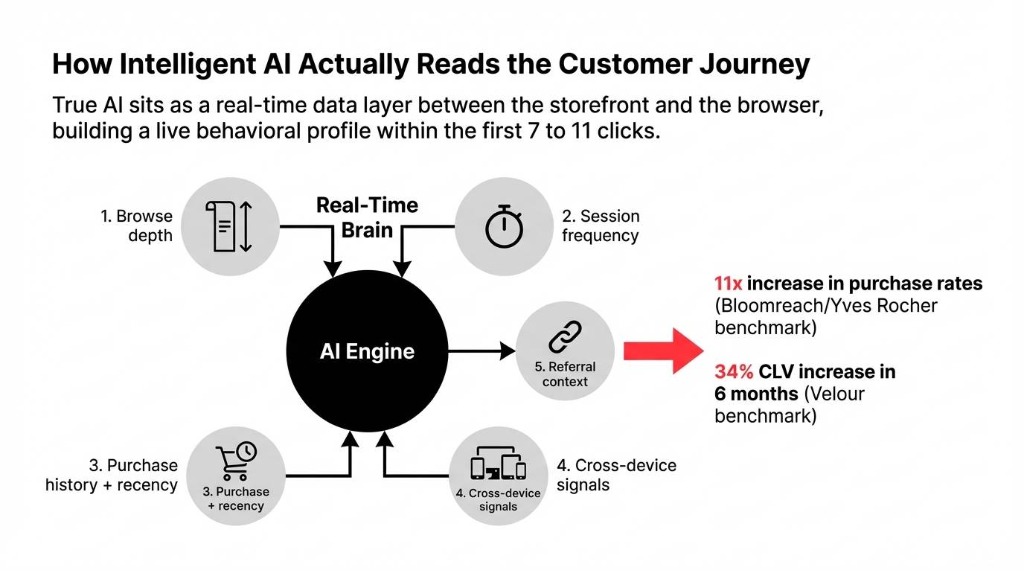
When a customer lands on your store, an ai module or engine begins building a live behavioral profile within the first 7–11 clicks. It is pulling from data analytics data:
- ▸Browse depth (how far they scroll on product pages)
- ▸Session frequency (first visit vs. 4th visit in 30 days)
- ▸Purchase history + recency (RFM scoring happening in milliseconds)
- ▸Cross-device signals from your data cloud or CDP
- ▸Referral context (did they come from a Meta retargeting ad or a Google Shopping listing?)
This is data science data science working at the front end of your store — not in a quarterly report. Platforms like Dynamic Yield, Bloomreach, and Nosto are doing exactly this on top of Shopify, and the results are not theoretical. Bloomreach customers like Yves Rocher saw an 11x increase in purchase rates and 17.5x increase in clicks on recommended items after turning on AI-native product discovery.
Fashion retailer Velour implemented AI-driven behavioral micro-segmentation in late 2024 and posted a 34% increase in customer lifetime value within six months. Not in three years. Six months.
That is what ai and data analytics working together on live customer behavior actually looks like — not a PowerPoint about digital transformation and theory.
The Shopify + AI Stack That Is Actually Working in 2025–2026
We are not going to recommend a single magic tool. That would be lazy advice. What we will tell you is the stack architecture that is producing results for D2C brands doing $2M–$12M on Shopify using advanced analytics.
Layer 1 — Customer Data Foundation
You need a real CDP or at minimum a clean data pipeline from Shopify into a data warehouse like BigQuery. This is the data transformation step that most brands skip because it is not glamorous. They pay for it later when their recommendation engine serves $200 handbags to customers who only buy discounts.
Layer 2 — Intelligent AI Personalization Engine
This is where tools like Dynamic Yield or a custom engine from an ai company lives. It consumes the clean customer data from Layer 1 and drives real-time decisions. Ai automation handles this 24/7 — no marketing manager waking up at 2am to update a homepage banner.
Layer 3 — Multichannel Execution
Personalization spans your website, email automation, SMS, and push notifications. Salesforce Marketing Cloud and Salesforce Service Cloud handle this at enterprise scale; Klaviyo handles it for brands under $20M ARR. The key is that every channel receives the same artificial intelligence solutions intelligence — not siloed lists.
Layer 4 — Predictive Analytics + BI Loop
Brands at $8M+ ARR are running predictive analytics models that forecast next-purchase probability, churn risk, and LTV segments. Advanced ai on customer cohorts, not just session-level data, is what separates a $3M brand from a $10M brand with the same product catalog.
Why "Just Using Salesforce" Is Not Enough
The Harsh Truth About Enterprise Pricing
Here is the controversial opinion nobody in the salesforce consulting world wants to say out loud: buying a Salesforce Sales Cloud or Salesforce Financial Services Cloud license does not make your brand smart. It makes your CRM expensive. Salesforce support tickets are answered in 48–72 hours. Your customers make decisions in 8 seconds.
We see this constantly. A $4M Shopify brand gets sold a Salesforce cloud implementation, spends $180,000 in year one between licensing and fees, and 14 months later their marketing team is still exporting CSVs to build email segments manually.
The real ai in marketing wins are coming from brands that combine lighter, faster marketing automation tools with purpose-built ai models trained on their specific product catalog — not from enterprise platforms that were designed for B2B sales pipelines. Salesforce partners can build excellent solutions, but only when the underlying data infrastructure is built correctly first. The platform is not the strategy.
For D2C brands, the better path is: clean your customer data → build a lean AI recommendation layer → connect it to Klaviyo for marketing metrics → run cloud artificial intelligence on your ad attribution. That stack costs 60–70% less and delivers faster results.
What Gen AI Is Actually Adding to D2C Shopping Right Now
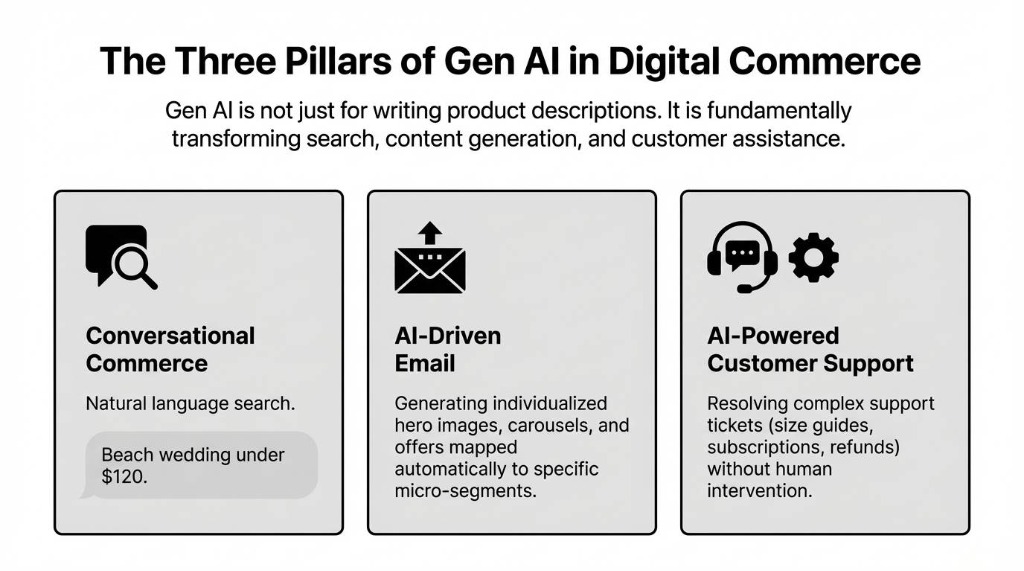
Gen ai is not just about writing product descriptions faster (though that is a legitimate use case for brands managing 500+ SKUs). The real ai transformation happening in digital commerce right now is in three places:
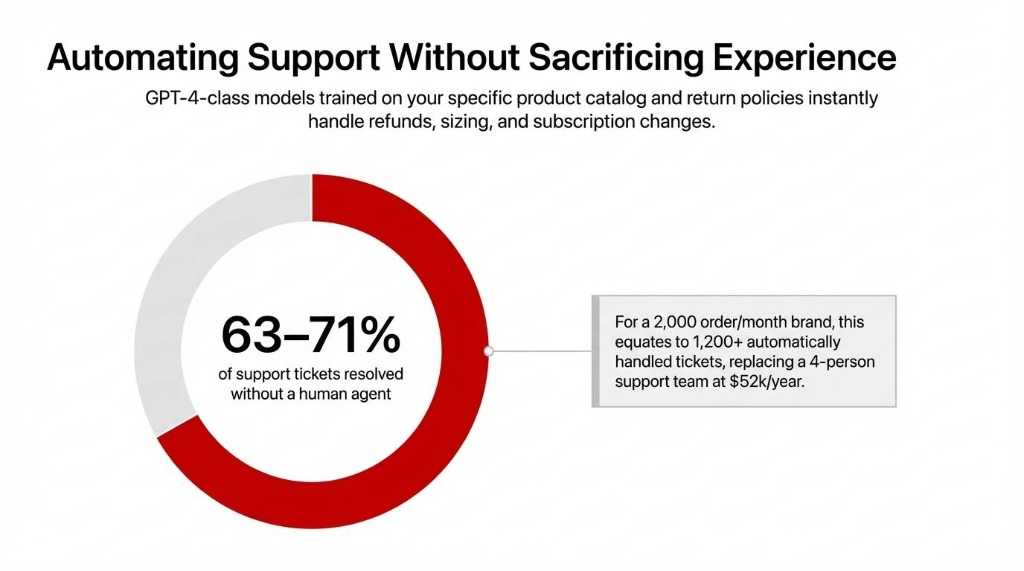
1. AI Customer Support
Brands running customer service AI chatbots trained on their product catalog are resolving 63–71% of support tickets without a human. Customer support ai handles size guides, subscription changes, and refunds, saving $52,000/year.
2. Conversational Commerce
Ai e commerce search tools let customers describe what they want in natural language — "something for a beach wedding under $120" — and the AI surfaces relevant products instantly. This is ai and customer service done right.
3. Content Personalization
Marketing AI tools generate individualized email content blocks — different heroes, carousels, offers — for each customer micro-segment automatically. Data analytics and ai working at the execution layer.
How Braincuber Builds This for D2C Brands on Shopify
We are not ai consultants who hand you a 60-slide deck and disappear.
In our ai implementation projects for D2C brands in the US, we build the full stack: Shopify store architecture with ai website features baked in, custom cloud ai pipelines on AWS or GCP for data processing, LangChain-based AI agents using business analytics, and Klaviyo integration for personalized marketing and ai execution.
Our typical engagement for a Shopify brand doing $2M–$8M ARR runs 8–12 weeks from kickoff to go-live. The brands we work with see conversion rate increases of 19–27% within 90 days and a measurable drop in support ticket volume of 40–60% within the first month of deploying customer service artificial intelligence.
Artificial intelligence in business is not a future investment. The business of ai is not about the technology. It is about the customer data, the data pipeline, and having the right ai and ml models in place to act on that data marketing faster than your competitors.
Business intelligence without action is just expensive reporting. Data analytics for marketing without personalization is just interesting charts nobody uses.
Frequently Asked Questions
How quickly can a Shopify D2C brand implement AI personalization?
For brands with clean customer data already in Shopify, a functional AI recommendation layer goes live in 3–5 weeks. Full-stack implementation typically runs 8–12 weeks. The bottleneck is messy customer data, not the AI models themselves.
Does AI personalization work for brands with less than 10,000 customers?
Yes. AI models trained on behavioral signals can deliver meaningful personalization with as few as 2,000–3,000 active customers. Micro-segmentation by browse behavior works at any catalog size with a clean data pipeline.
What is the difference between AI personalization and using Klaviyo?
Klaviyo flows react to discrete events (abandoned cart). AI personalization adapts the entire storefront experience in real time across the site, based on who is browsing right now. The tools are complementary.
How does AI personalization handle customer privacy and compliance?
Properly built systems use first-party data collected with explicit consent. GDPR/CCPA compliance is handled at the data pipeline layer. Any reputable AI partner builds consent management into the architecture from day one.
What ROI should a D2C brand expect from AI personalization?
Based on industry averages: 19–27% conversion rate improvement within 90 days, 15–30% increase in AOV, and 40–60% reduction in support costs from AI service. A $3M ARR brand can recover implementation costs in 4–6 months.
Stop Sending Every Customer the Same Store
Your competitors doing $8M+ ARR aren't more creative — they turned their data into their most valuable asset. Book our free 15-Minute AI Store Audit to find your biggest personalization gap.