
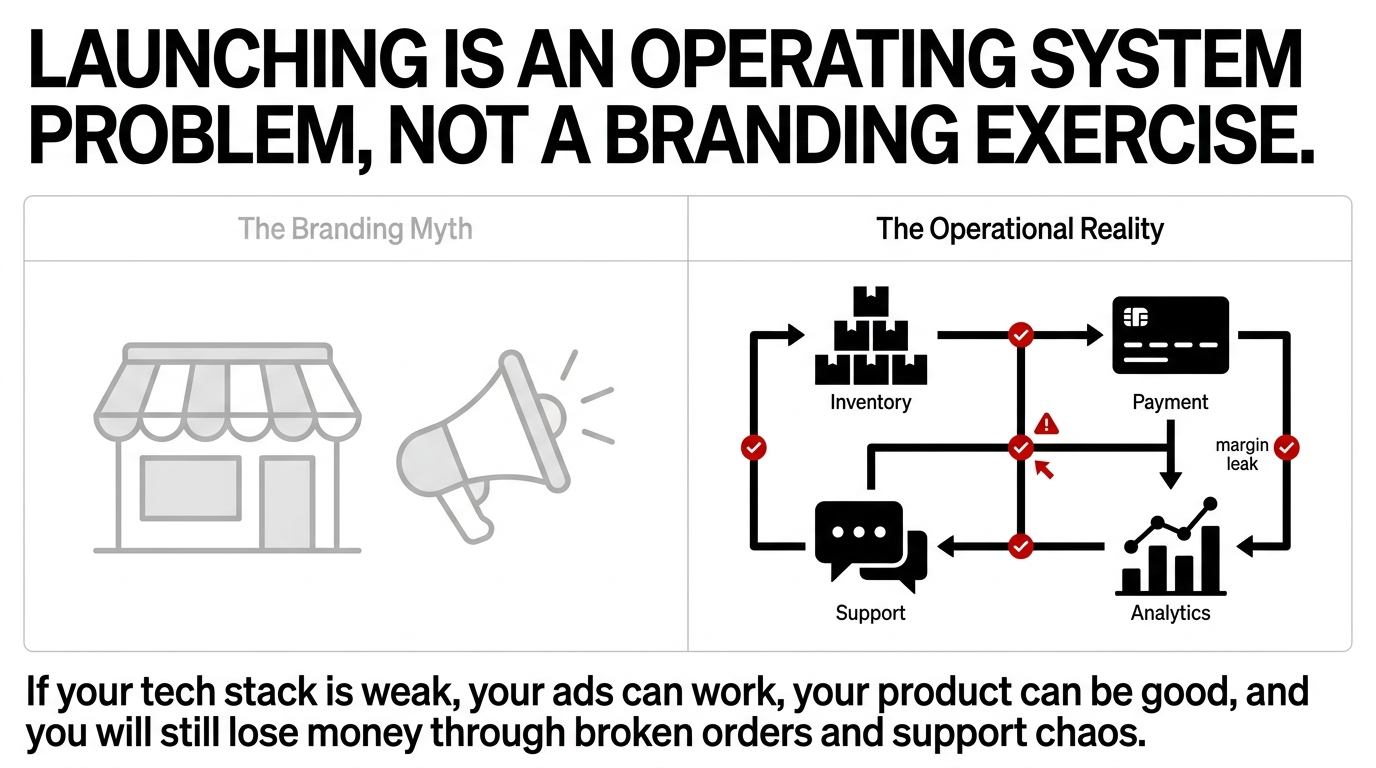
Launching is an operating system problem, not a branding exercise. Weak tech stacks create margin leaks through broken orders and support chaos.
Why Your Tech Stack Fails First
Your tech stack is not a "tech issue." It is a margin leak that shows up in refunds, chargebacks, delayed shipments, and support tickets. When one sales channel desynchronizes inventory, you get oversells. When subscriptions fail, you get churn. When attribution breaks, you get fake profitability.
For wellness brands, the stakes are higher. You are dealing with repeat purchase cycles, regulated claims, product education, and customer trust. The stack has to support clean recurring revenue, clear customer communication, and enough back-office control to keep fulfillment, finance, and marketing aligned.
The Core Problem
Wellness brands live or die on repeat orders. If your subscription engine is an afterthought, your LTV will be too.
Core Commerce Foundation
Your first layer is the storefront and checkout stack. For most D2C wellness brands, this means Shopify or a comparable commerce platform, a fast theme, mobile-first product pages, and a checkout that can handle upsells, bundles, subscriptions, and one-time purchases without friction.
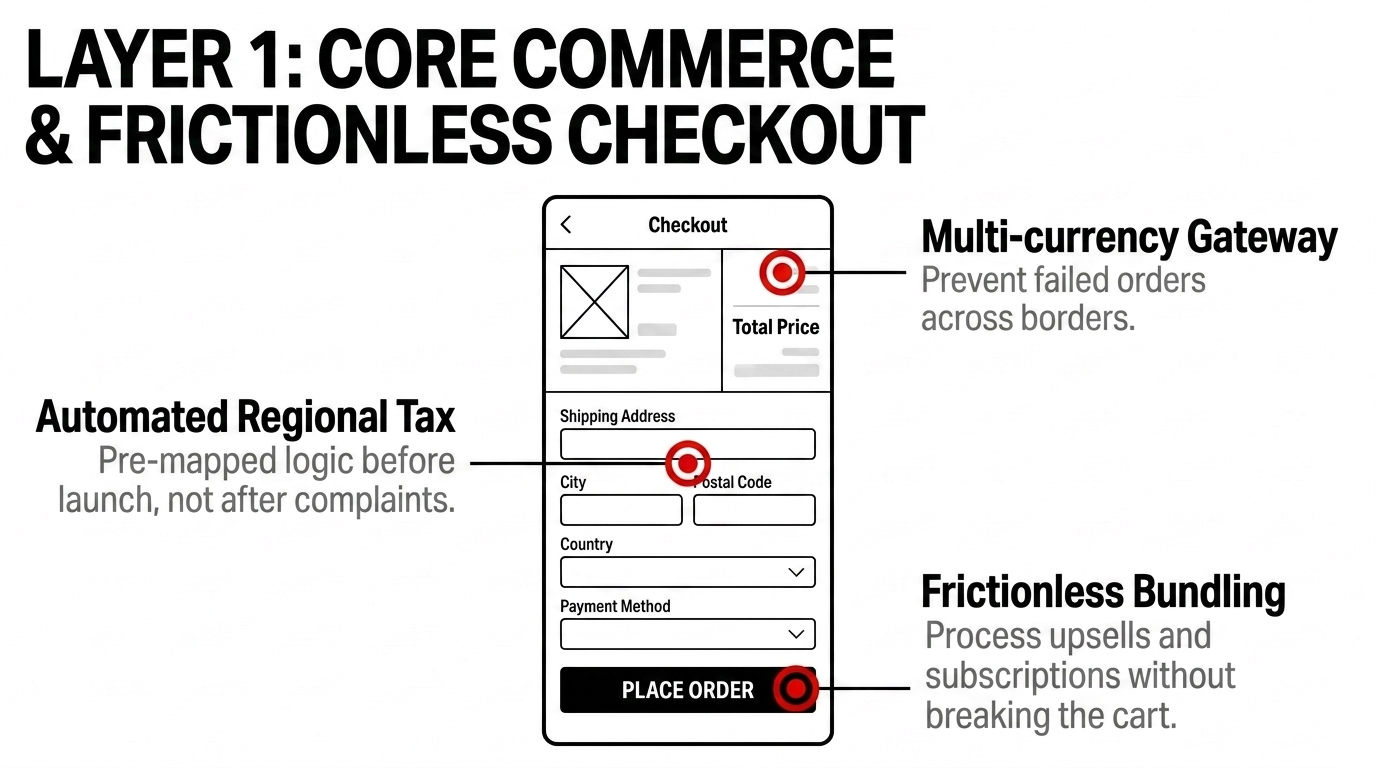
Layer 1: Core Commerce requires multi-currency gateway, automated regional tax, and frictionless bundling to prevent failed orders across borders.
You also need payments that support your target markets, fraud controls, tax handling, and failed-payment recovery. If you sell supplements, skincare, fitness products, or sleep aids across countries, your payment and tax setup should be mapped before launch, not after the first customer complaint.
Minimum Viable Stack at Launch
Storefront
Shopify or equivalent with mobile-first theme and CRO tools
Payments
Multi-currency gateway with fraud filters and tax logic
Subscriptions
Recurring billing with skip, pause, swap, and dunning
Inventory
Central inventory system to prevent overselling
CRM
Customer profile and segmentation for retention
Email/SMS
Lifecycle automation for abandoned cart and replenishment
The Subscription and Retention Layer
Wellness brands live or die on repeat orders. That means your subscription engine cannot be an afterthought. The platform should support skip, pause, swap, dunning, renewal reminders, and failed-payment recovery with minimal manual work.
You also need retention automation that matches product reality. A collagen brand should trigger replenishment reminders based on consumption cycles, not generic newsletters. A sleep supplement brand should segment by purchase behavior and product use case, then send tailored follow-ups instead of dumping everyone into the same email sequence.
The Retention Math
If your subscription churn is above 8% per month, your LTV calculations are lying to you. Most wellness brands hit 12-15% churn in year one.
Impact: $23,400 average annual loss per 100 subscribers
Data and Analytics Setup
If your reporting is weak, your growth decisions will be wrong. At minimum, you need GA4, ad platform pixels, server-side tracking where possible, a product-level dashboard, and a clean source of truth for revenue, CAC, AOV, LTV, refund rate, and subscription churn.
The mistake we see constantly is founders trusting platform dashboards without reconciling them against payment and fulfillment data. That creates fake confidence. A brand can look profitable in ads while quietly bleeding money through failed renewals, untracked discounts, and inventory shrinkage.
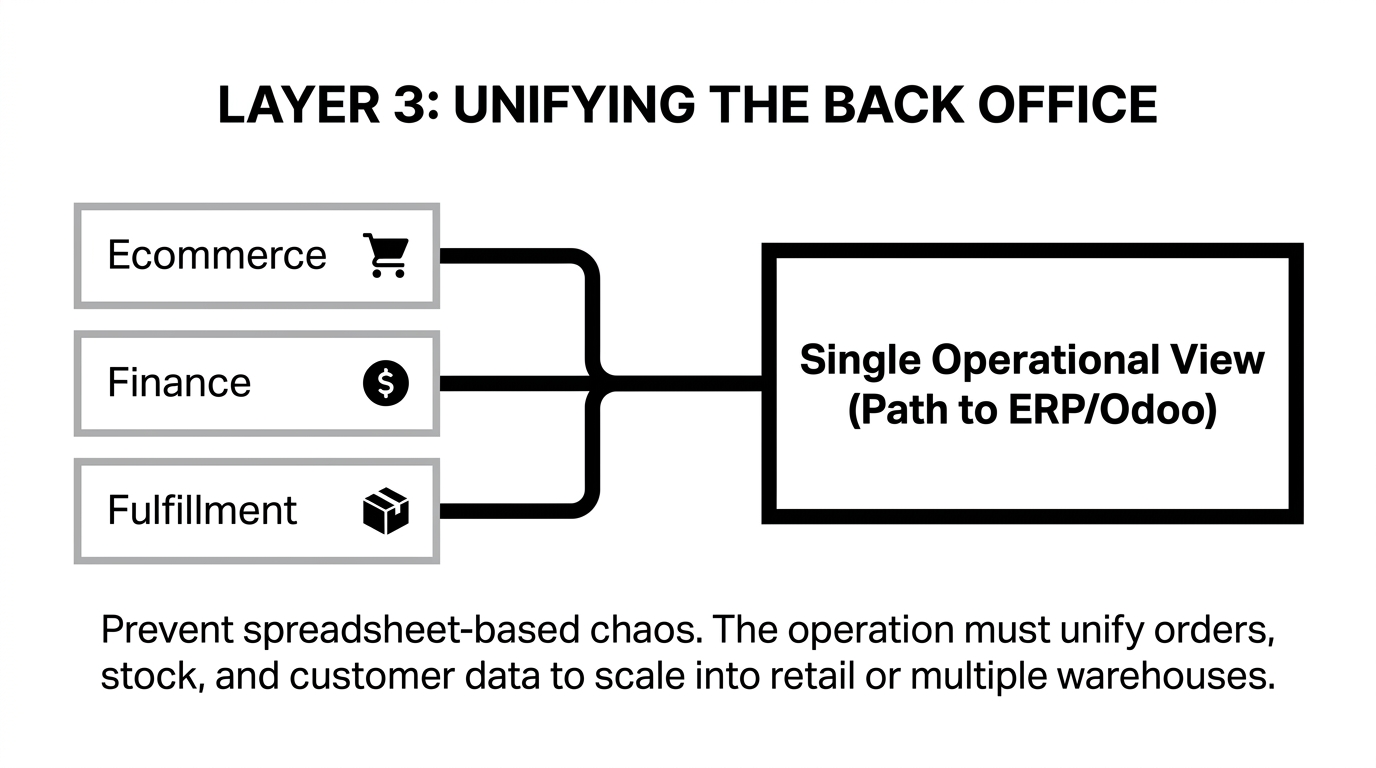
Layer 3: Unifying the Back Office prevents spreadsheet-based chaos. Operations must unify orders, stock, and customer data to scale into retail or multiple warehouses.
Operations and Back Office
The back office is where many wellness brands get messy. You need inventory control, order management, returns handling, accounting integration, and a single operational view across ecommerce, finance, and support. If you plan to scale into retail, marketplaces, or multiple warehouses, this becomes non-negotiable.
This is also where ERP starts to matter. You do not need a giant enterprise setup on day one, but you do need a path from startup stack to controlled operations. An Odoo-based workflow can unify orders, stock, invoicing, and customer data once the brand starts to outgrow spreadsheet-based operations.
Compliance and Trust
Wellness is not like selling T-shirts. You have to think about ingredient claims, disclaimers, privacy policy, consent management, secure payment handling, and region-specific rules for subscriptions and cancellations. Your website, email flows, checkout copy, and help center all need to support trust, not just conversion.
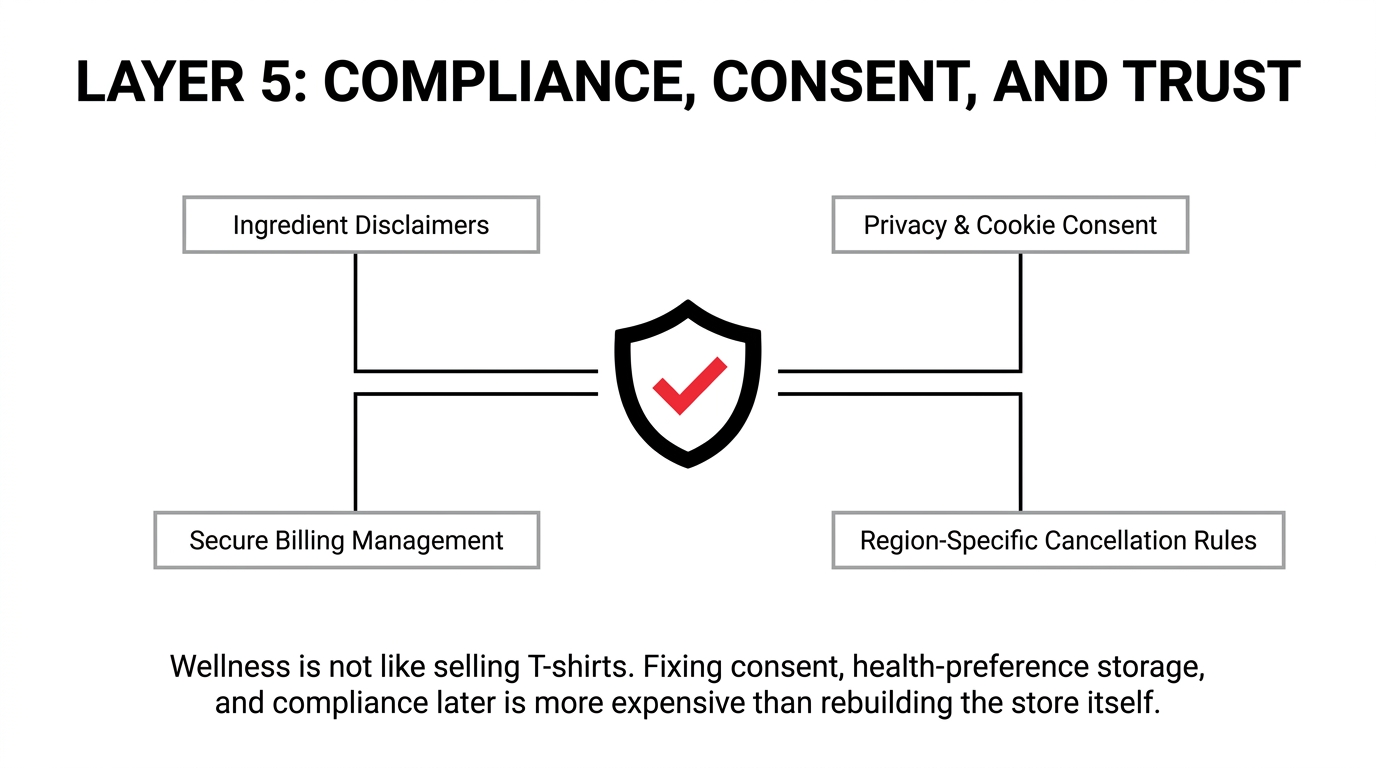
Layer 5: Compliance, Consent, and Trust. Wellness requires ingredient disclaimers, privacy consent, secure billing, and region-specific cancellation rules.
If you collect health-related preferences or behavior data, be careful with consent and storage. Build your forms, cookie tools, and CRM tagging with privacy in mind from the start. Fixing this later is more expensive, and in many cases it is harder than rebuilding the store itself.
The Launch Sequence That Works
Phase 1: Foundation
1. Set up commerce platform and theme
2. Connect payment, tax, and shipping rules
3. Configure subscription logic for repeat products
Phase 2: Automation
4. Build lifecycle email and SMS flows
5. Install analytics and conversion tracking
6. Connect support tools and order visibility
Phase 3: Validation
7. Test returns, refunds, failed payments, and stock sync
8. Run a soft launch before scaling ad spend
Critical Rule
Do not skip testing. A broken checkout or misconfigured subscription flow can burn through launch budgets faster than a bad ad campaign.
Common Mistakes That Kill Margins
The worst mistake is buying too many apps before you have a real process. App sprawl creates duplicate data, conflicting automations, and a support burden no small team can handle. Another common error is using disconnected tools for ecommerce, accounting, and fulfillment, then wondering why reporting never matches.
Founders also underinvest in analytics, which means they cannot answer basic questions about repeat rate, churn, or channel profitability. In wellness, where LTV is often the real growth engine, that is a costly blind spot.
The App Sprawl Tax
Average D2C wellness brand uses 23 apps by year two. Most are redundant. Your margin cannot support that.
Hidden cost: $3,200-$8,900 per month in unused app subscriptions
The Launch-Day Audit
Use this as your launch-day audit. If every box is not checked, you are not really ready to scale. You are just ready to spend money faster.
Commerce and Payments
✓ Commerce platform live
✓ Mobile checkout tested
✓ Payments and tax configured
✓ Subscription logic validated
Operations
✓ Inventory synced
✓ Email and SMS flows active
✓ Helpdesk connected
✓ Analytics verified
Final Checks
✓ Refunds and returns tested
✓ Compliance pages published
Internal Resources
- Odoo Implementation Services - Unify your operations with ERP
- Multi-Channel Inventory Sync - Prevent overselling across channels
- Shopify Development Services - Optimize your storefront
Ready to Fix Your Tech Stack?
Most wellness brands waste 18 months on a broken stack. We help you build the right one from day one.