
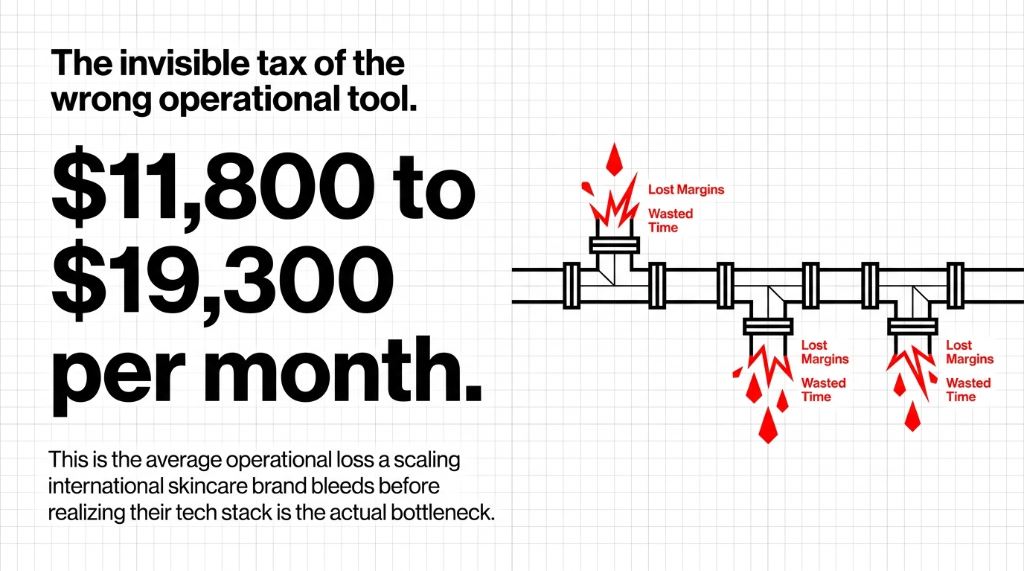
The Business You Are Actually Running
Let us be honest about what an international skincare brand actually looks like operationally. You are not just "selling moisturizer."
You are managing batch lot traceability with FEFO (First Expired, First Out) logic because your Vitamin C serum oxidizes in 18 months. You are tracking expiry dates across 3 warehouses — one in New Jersey, one in Dubai, one in Singapore — with SKUs that have 14 variants (fragrance-free, SPF 30, travel size). You are dealing with MoCRA compliance in the US, EU Cosmetics Regulation in Europe, and Gulf Standards Organization requirements in the UAE.
And you are doing all of this while your operations manager is still running a VLOOKUP in Excel to reconcile what actually shipped from your Korean contract manufacturer versus what was invoiced in QuickBooks.
That is the real problem. Neither Cin7 nor Odoo is a silver bullet — but one of them fits your situation far better depending on exactly where you are right now.
Where Cin7 Is Genuinely Good
Frankly, Cin7 does not get enough credit for what it actually does well.
Cin7 connects over 700 integrations — Shopify, Amazon, Sephora EDI, ShipStation, Xero, and third-party 3PLs — out of the box. If you are a skincare brand doing $500K to $2.5M annually, selling D2C on Shopify and wholesale to Target or Sephora, Cin7 is genuinely fast to deploy. We have seen brands go live in 23 days. Not 23 weeks. 23 days.
Cin7's Real Strengths for Skincare
Batch and expiry tracking: Real-time flags across all connected channels and warehouses when products approach expiry. Saves skincare brands approximately $3,200 to $6,500 per quarter in write-offs from expired stock being shipped out and returned.
B2B portal: Wholesale buyers — your spa distributors in the UAE, your salon chains in Australia — log in and place orders directly without your sales team being in the loop for every PO.
But Here Is Where Cin7 Hits a Wall
The moment you need multi-entity accounting across 3 countries with different tax jurisdictions, Cin7 cannot do it natively. You are back to Xero or QuickBooks running parallel. The moment you need manufacturing — even light assembly like kitting a gift set with a serum, toner, and eye cream — Cin7's production module is underwhelming. And the moment you want a CRM to track your B2B dermatology clinic accounts alongside your D2C customer cohorts? You are buying HubSpot on top of it, and Cin7's HubSpot integration syncs only basic contact and product data. (Yes, that is the official limitation.)
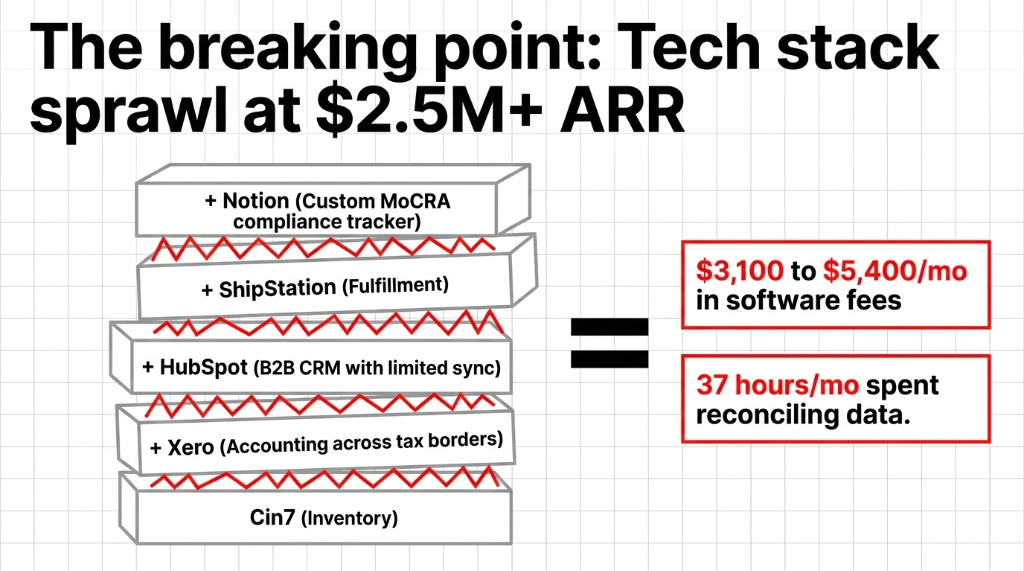
As your brand scales from $2.5M toward $8M ARR, your stack starts to look like this: Cin7 + Xero + HubSpot + a custom Shopify app + ShipStation + a compliance tracking spreadsheet. You are paying $3,100 to $5,400 per month across tools that do not talk to each other cleanly. And your ops manager is spending 37 hours a month reconciling data between them.
Where Odoo Wins — and Why It Is Not for Everyone
Odoo covers 7 operational layers that international skincare brands currently manage across 4 disconnected tools: formulation versioning, batch/lot traceability, FDA/MoCRA compliance reporting, quality control workflows, inventory and supply chain, multi-channel order management, and manufacturing COGS. All in one system. One database. One login.
That is not marketing. That is an architectural fact.
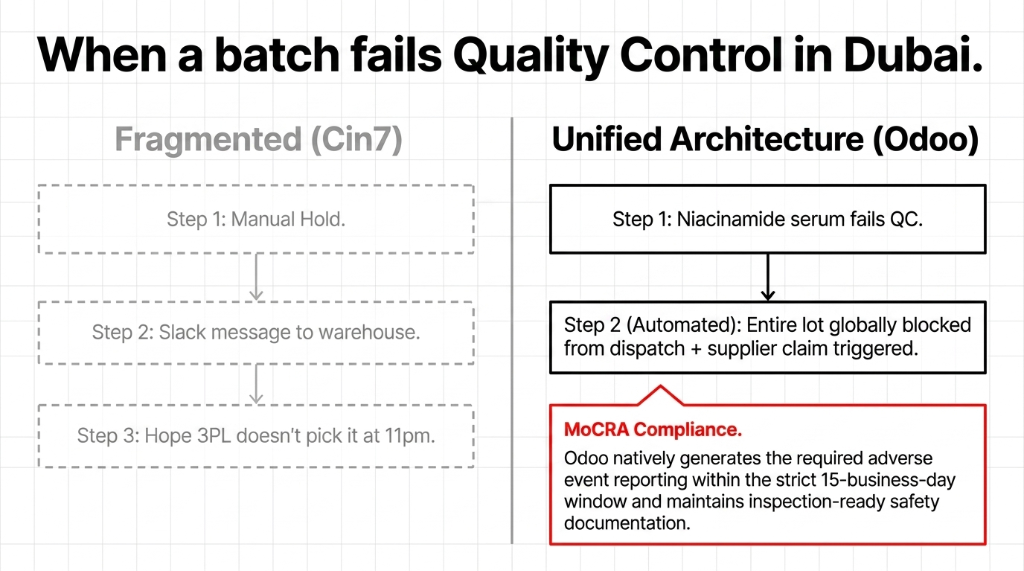
When a batch of your niacinamide serum fails QC at your UAE warehouse, Odoo blocks the entire lot from being dispatched — automatically — and triggers a supplier claim workflow. In Cin7, that same scenario requires a manual hold, an email to the warehouse team, a note in Slack, and a prayer that the 3PL does not pick it by accident at 11pm.
What Odoo Handles Natively That Cin7 Cannot
MoCRA Compliance
Adverse event reporting within the required 15 business days. Safety substantiation documentation. Facility inspection records — audit-ready. EU Cosmetics Regulation dossier mapping from the same module.
Multi-Entity Accounting
US, UK, UAE — different tax rules per country, intercompany transfers, consolidated P&L across entities. All inside the same system. No Xero running in parallel.
Manufacturing + COGS
Full MRP with formulation versioning. When your Korean contract manufacturer changes a niacinamide concentration, that change flows through to COGS, batch records, and compliance docs automatically.
The Honest Limitation of Odoo
It takes longer to implement. A properly configured Odoo implementation for a skincare brand takes 8 to 12 weeks. Not 23 days. You need a qualified implementation partner — and a bad Odoo implementation is worse than no Odoo at all. If your internal team does not have the bandwidth to define processes before go-live, Odoo will feel overwhelming.
The Real Cost Breakdown No One Shows You
Here is what both platforms actually cost for an international skincare brand doing $4M ARR, operating in 3 countries:
| Cost Factor | Cin7 Omni | Odoo Enterprise |
|---|---|---|
| Platform subscription (annual) | ~$7,200–$14,400/yr | ~$9,600–$18,000/yr |
| Required add-on tools (Xero, HubSpot, etc.) | +$24,000–$36,000/yr | $0 (native modules) |
| Implementation time | 3–5 weeks | 8–12 weeks |
| Compliance module (MoCRA/EU) | Not native — custom dev needed | Native, configurable |
| Multi-entity accounting | Not native — requires Xero | Native |
| Manufacturing/kitting | Basic only | Full MRP available |
| 3-Year TCO ($4M ARR scale) | $93,600–$151,200 | $72,000–$96,000 |
The total cost of ownership for Cin7 at $4M ARR scale, once you add Xero, HubSpot, and custom compliance tooling, typically runs $31,200 to $50,400 per year. Odoo at the same scale, with an implementation partner, typically runs $24,000 to $32,000 per year all-in, including the implementation cost amortized over 3 years.
That is a $19,200 annual difference in favor of Odoo once you are past the $3M ARR mark.
The Case Study You Need to Read
We worked with a UAE-based skincare brand — $3.2M ARR, selling across the Gulf, UK, and Australia — that came to us after 18 months on Cin7.
Their problem was not Cin7's fault, exactly. They had simply outgrown it. They were running Cin7 for inventory, Xero for accounting, a custom-built compliance tracker in Notion, and a separate CRM for their B2B dermatology clinic accounts. Every month-end close took their finance team 41 hours to reconcile across tools. They were leaking $14,200 per month in un-reconciled supplier deductions that fell through the cracks between Cin7 and Xero.
After Migration to Odoo (11-Week Implementation)
Month-end close: Down from 41 hours to 9 hours.
Supplier deduction leakage: Dropped from $14,200/month to $1,100/month — a $13,100 monthly recovery.
Adverse event reporting: 7 business days instead of scrambling at the 15-day MoCRA deadline.
Year 1 recovery: $157,200. Not a projection. Actual numbers.
Who Should Pick Cin7 Right Now
Stop Reading and Go With Cin7 If:
1. Your revenue is between $300K and $2M ARR and growing fast
2. You sell primarily on Shopify and/or Amazon with limited multi-country complexity
3. You need to go live in under 30 days and do not have time for a structured ERP implementation
4. Your accounting is handled by Xero or QuickBooks and you are happy keeping it that way
5. You do not do any in-house manufacturing — you buy finished goods from a contract manufacturer and ship them out
Who Should Pick Odoo Right Now
Stop Reading and Go With Odoo If:
1. Your revenue is $2.5M+ ARR and you are selling in 2+ countries with different tax and compliance requirements
2. You manufacture, formulate, or kit products and need real production order tracking
3. You need MoCRA or EU Cosmetics Regulation compliance documentation built into your operations
4. You are paying for 3+ disconnected tools and reconciliation alone costs more than 20 hours a month
5. You are planning a Series A or institutional raise and investors will want a single, auditable ERP as part of due diligence
The Worst Decision You Can Make
Here is our controversial opinion, and we stand behind it completely:
The $55,000 Penalty of Migrating Too Late
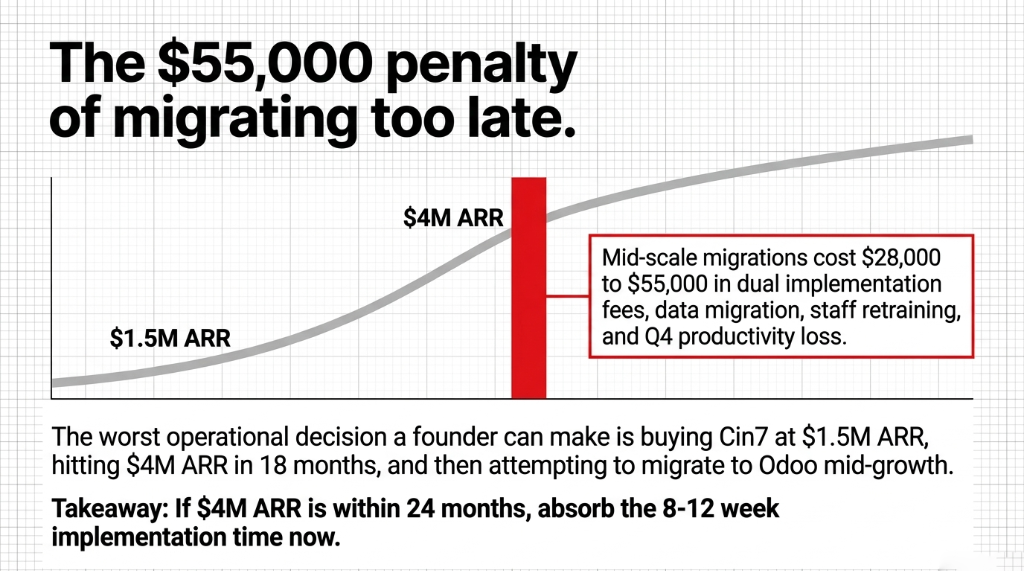
The worst decision is buying Cin7 at $1.5M ARR, hitting $4M ARR in 18 months, and then migrating to Odoo mid-growth. A mid-scale migration costs between $28,000 and $55,000 in implementation, data migration, staff retraining, and productivity loss during the transition window.
If you can see $4M ARR on the horizon in the next 24 months, start on Odoo now. Pay the extra 8 weeks of implementation time on the front end. You will save $40,000+ on the back end.
Everyone tells you to "start simple." That is advice built for software generalists, not international skincare founders who know they are going to need batch traceability, multi-country compliance, and real manufacturing cost tracking within 24 months anyway.
5 FAQs: Cin7 vs Odoo for International Skincare
Can Cin7 handle batch and expiry tracking for skincare products sold internationally?
Yes, Cin7 tracks batch numbers and expiry dates across multiple warehouses and channels in real time. It is effective for brands doing primarily finished-goods trading. However, it does not natively handle MoCRA adverse event reporting or EU Cosmetics Regulation dossier management — you will need separate tools for regulatory compliance at scale.
Does Odoo support multi-currency and multi-country tax management for skincare brands?
Yes. Odoo's accounting module handles multi-entity operations, country-specific tax rules (VAT in the UK, GST in Australia, VAT in UAE), intercompany transfers, and consolidated reporting natively. For a skincare brand operating across 3 countries, this eliminates the need for a parallel Xero or NetSuite instance entirely.
How long does an Odoo implementation take for a skincare brand?
For an international skincare brand with inventory, manufacturing, compliance, and multi-channel sales requirements, a proper Odoo implementation takes 8 to 12 weeks with a qualified partner. Rushing this to 4 weeks almost always produces a broken go-live that costs more to fix than the time saved. Budget 10 weeks as your working estimate.
Is Cin7 cheaper than Odoo for a brand under $2M ARR?
At face value, yes — Cin7's subscription is comparable to Odoo's. But once you add Xero, HubSpot, and any compliance tooling, the total cost of the Cin7 stack typically runs $31,200 to $50,400 per year for a brand at $4M ARR. Odoo consolidates those costs. Under $2M ARR with simple operations, Cin7 is the more cost-effective choice.
Can Odoo integrate with Shopify for D2C skincare brands?
Yes. Odoo integrates with Shopify to unify inventory, orders, and back-office processes in real time. When a Shopify order is placed, Odoo updates inventory across all warehouses, triggers the fulfillment workflow, and posts the revenue entry to the correct entity's books — without a middleware tool like Zapier sitting in between.
Do not let a mid-scale ERP migration kill your Q4. Pull up your current software invoices right now. Add up Cin7 + Xero + HubSpot + ShipStation + whatever compliance tracker you cobbled together. If that number is north of $3,100/month and your ops manager is spending 20+ hours reconciling — you already know the answer.
See exactly how we recovered $157,200 for a $3.2M UAE skincare brand in Year 1. Read the full methodology.
Stop letting the wrong tool eat your margins.
Book our free 15-Minute Operations Audit — we will identify your single biggest operational leak in the first call, whether you are on Cin7 today or still deciding. Braincuber has implemented Odoo for 150+ brands globally across the US, UK, UAE, and Singapore.
Book Your Free 15-Minute Audit