
You are paying $7,800 every single day to do something a machine learning model handles in under 14 minutes.
500 invoices x $15.60 average manual processing cost = $7,800/day. Multiply by 22 working days and you’re burning $171,600/month on a task that Odoo’s AI invoice automation handles for roughly $1,180/day.
The gap: $170,420 every single month — sitting there, bleeding out, while your AP clerks wrestle with a 14-tab Excel reconciliation sheet.
We’ve implemented AI-powered invoice processing for manufacturers, distributors, and enterprise D2C brands across the US and UK. In every single one of those implementations, the client said the same thing: "We didn’t realize how broken our process actually was."
That’s not a projection. That’s arithmetic. And here’s the full case study — with the numbers your CFO actually needs to see.
Your AP Team Is Not the Problem — Your Process Is
A mid-size US distributor came to us processing 480–520 vendor invoices every day. Three full-time AP clerks. An Excel reconciliation file that had grown into a monster with 14 tabs. A "three-way match" routine that took between 12 and 19 minutes per invoice — per person.
Do the math: 18,500 staff-hours per year spent manually touching invoices.
Their error rate? 6.3%. On 500 invoices a day, that’s 31 invoices daily generating exceptions — duplicate payments, miskeyed line items, wrong PO matches. One quarter, they paid a vendor $23,400 twice because two clerks processed the same PDF that arrived simultaneously via email and fax.
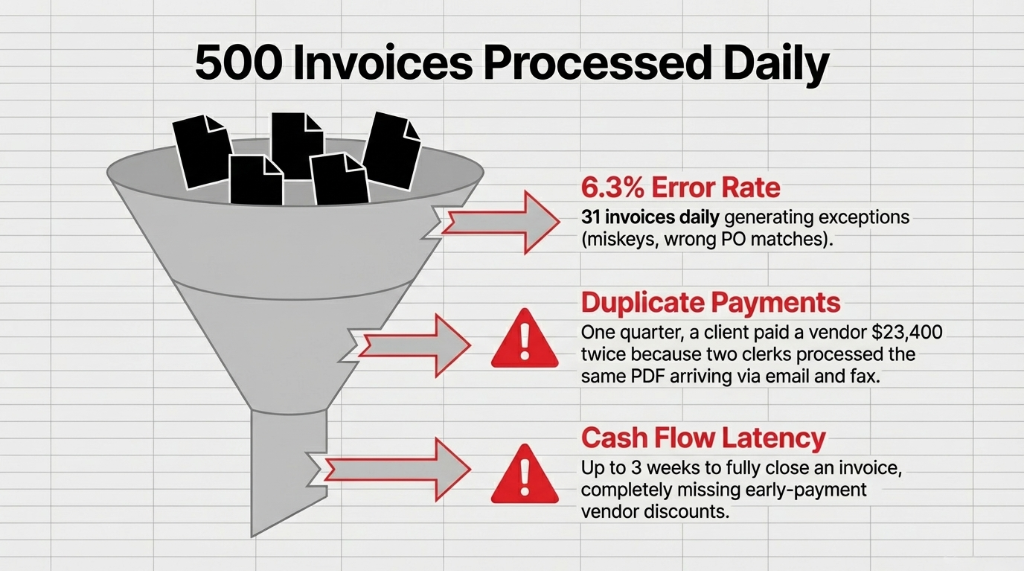
This is not an edge case. Ardent Partners reports manual invoice processing costs over $13 per invoice and takes up to three weeks to fully close. When you’re running 500 invoices/day, three weeks of AP latency is a cash flow disaster — especially for manufacturing businesses trying to capture early-payment vendor discounts.
Artificial intelligence in accounting doesn’t just speed this up. It restructures how the entire process works.
What Odoo’s AI Actually Does (The Non-Brochure Version)
Here’s the insider truth most Odoo partners won’t tell you: Odoo’s AI invoice digitization is not a magic button. It is a trained machine learning model that gets smarter with every invoice it processes from a specific vendor.
At go-live, Odoo uses OCR to extract vendor names, invoice numbers, line items, tax codes, and payment amounts. The system then creates a custom template based on that vendor’s specific invoice layout. Every subsequent invoice from that vendor gets processed faster and with higher confidence because the AI model has already learned the pattern.
AI Accuracy Trajectory
Go-Live (Day 1)
OCR extraction accuracy on clean dataset: 91–94%. System learning vendor-specific invoice layouts for the first time.
Day 90
Accuracy stabilizes at 97.6%. That’s the number we consistently see across implementations.
Auto-Matching
95% of transaction matching automated — pairing invoices against POs and goods receipts. The remaining 5% flagged for human review.
Your AP clerk is no longer a data entry robot. They’re a judgment-call handler. That’s what artificial intelligence in business actually looks like in a live production environment — not in a demo, not in a slide deck.
The 500 Invoices/Day Numbers (Real Client, Anonymized)
Baseline: Manual Process (Month 0)
| Metric | Manual Workflow |
|---|---|
| Average invoices/day | 487 |
| AP staff required | 3 FTE + 1 part-time |
| Cost per invoice | $16.20 |
| Daily processing cost | $7,889 |
| Monthly cost (22 working days) | $173,558 |
| Error rate | 6.3% |
| Avg. processing time per invoice | 14.7 minutes |
| Daily exception queue | 31 invoices |
| Duplicate payments (Q1) | $47,200 |
After 90 Days of Odoo AI Invoice Automation
| Metric | AI-Automated Workflow |
|---|---|
| Average invoices/day | 503 |
| AP staff required | 1 FTE (exceptions only) |
| Cost per invoice | $2.36 |
| Daily processing cost | $1,187 |
| Monthly cost (22 working days) | $26,114 |
| Error rate | 0.7% |
| Avg. processing time per invoice | 1.3 seconds |
| Daily exception queue | 4–6 invoices |
| Duplicate payments (Q2) | $0 |
The Bottom Line
$147,444
Monthly savings in AP processing costs
$1,769,328
Annualized savings from AI invoice automation
$8,340/mo
Early-payment vendor discounts now captured — previously left on the table because manual processing was too slow
The AI transformation also freed up 2.6 FTE staff who were redeployed into vendor relationship management and cash flow analysis. The company began capturing early-payment discounts averaging $8,340/month — discounts they’d been leaving on the table because the manual process was too slow to approve invoices before the discount window closed.
Why "Hire More AP Staff" Is the Most Expensive Advice You’ll Follow
This is where most US CFOs make a $200,000 mistake.
The instinct when invoice volume grows is to hire. At $55,000–$65,000/year fully-loaded for an AP clerk in the US, adding a fourth person costs you $62,400/year. And you’ve added exactly zero scalability — because next quarter, when volume hits 700 invoices/day, you’re hiring again.
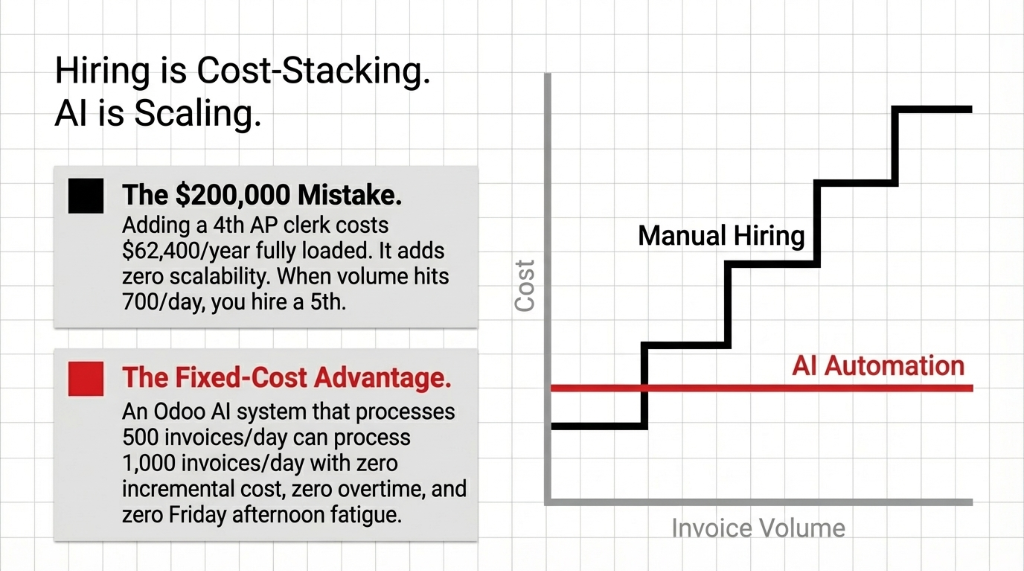
Using AI for enterprise doesn’t work that way. The Odoo AI system that processes 500 invoices/day processes 1,000 invoices/day with zero incremental cost. There is no overtime. No sick days. No variance in output quality because someone is tired on a Friday afternoon.
Hiring is not scaling. It’s cost-stacking.
Every AP clerk you hire to handle repetitive data entry instead of implementing AI automation is a sunk cost with a negative trajectory. The companies building durable competitive advantage in accounting and AI are treating invoice processing as an engineering problem, not a headcount problem.
Intelligent automation in accounts payable is not a future of AI conversation anymore. It’s a right-now operational decision with a 67-day payback window.
How We Implement This — The Actual 90-Day Roadmap
We’ve done this enough times to know exactly where implementations fall apart. The #1 failure mode? Going live on AI automation before your vendor master data is clean. If your Odoo vendor list has 14 duplicate entries for "ABC Logistics" with three different tax IDs, the machine learning model will learn wrong patterns. Garbage in, garbage out — one of the real limitations of AI that no one mentions in the sales demo.
Weeks 1–3 — Data Audit & Cleanup
Pull all vendor records. Deduplicate. Standardize tax IDs, payment terms, and GL codes. On a 500-invoice/day operation, this typically surfaces 340–600 vendor data errors. (Yes, your data is messier than you think.)
Weeks 4–6 — Odoo AI Configuration
Enable invoice digitization module. Configure OCR extraction rules. Set three-way match parameters against your PO workflow. Connect bank feeds for automatic reconciliation. Map exceptions to the right approval queues.
Weeks 7–9 — Parallel Run
Run AI and manual processes simultaneously. Track every exception. The AI model actively learns from each correction your AP team makes — that’s how machine learning examples get baked into the model’s understanding of your vendor mix.
Weeks 10–12 — Full Handoff
By week 10–12, the model has processed 9,000–12,000 invoices. Accuracy is stable above 97%. Decommission manual entry. Redeploy staff.
Average time to ROI: 67 days post go-live.
Where AI Invoice Processing Breaks (And How to Not Be That Client)
Using AI and automation without proper configuration creates different — sometimes worse — problems.
The Upstream Data Disaster
We had a client in US manufacturing who enabled Odoo’s AI invoice features without first fixing their purchase order workflow. The AI tried to match invoices to POs that had already been closed in the system. Result: 22% exception rate in the first two weeks. The team thought the AI system was broken. It wasn’t. The upstream data was broken.
Artificial intelligence in manufacturing and distribution environments is only as intelligent as the data ecosystem it operates inside. The AI applications are powerful — the machine learning models Odoo uses for invoice recognition are among the best available in any mid-market ERP — but they cannot compensate for a vendor master with 40% duplicate records.
The Scope Creep Tax
Every AP manager wants to add one more approval workflow, one more GL coding rule. Lock the scope. Build phase 2 separately. Every mid-project change to Odoo’s workflow adds $3,200–$6,800 in rework costs and delays your ROI by 3–5 weeks.
The Real Cost of Waiting Another Quarter
At 500 invoices/day and $16.20 manual cost, you’re spending $173,558/month on AP operations that a properly configured Odoo AI system handles for $26,114/month.
Every quarter you delay costs you $441,264 in unnecessary processing spend — before counting duplicate payments, missed early-pay discounts, and the salary of the fourth AP clerk you’re about to post a job requisition for.
The benefits of artificial intelligence in accounting are not theoretical. They’re measurable, replicable, and already live inside the Odoo instances of your competitors in distribution and manufacturing. The companies using AI for automation in their AP departments today are compounding a structural cost advantage that manual shops cannot close by hiring.
The AI and machine learning capabilities built into Odoo right now — OCR extraction, vendor template learning, automatic PO matching, anomaly flagging — represent the most accessible entry point into AI automation for mid-market US businesses. You don’t need a data science team. You need a proper implementation partner and clean vendor data.
That’s it. That’s the whole thing.
5 FAQs
How accurate is Odoo’s AI invoice processing for high-volume operations like 500/day?
Accuracy stabilizes at 97–98% within 90 days. Exception rates drop below 0.9%, down from the 5–8% typical in manual workflows. The machine learning model improves with every invoice processed.
How long does implementing Odoo AI invoice automation actually take?
10–12 weeks: 3 weeks of vendor data cleanup, 3 weeks of Odoo AI configuration, and a 4-week parallel run before full handoff. Compressing into 4 weeks is the most common reason implementations fail.
What ROI can a US business processing 500 invoices/day realistically expect?
At $16.20 manual vs $2.36 AI cost per invoice, savings are $147,444/month — roughly $1.77M annually. Average payback period: 67 days post go-live.
Can Odoo’s AI handle invoices from vendors with non-standard or variable layouts?
Yes. Odoo creates a custom template for each vendor and refines it with every processed document. Unusual formats become learning opportunities, though heavily damaged scans or handwritten invoices still require human review.
Do we need to replace existing accounting staff to implement AI invoice automation?
No. In every Braincuber implementation, 2–3 FTE AP staff are redeployed to exception management, vendor negotiation, and financial analysis. AI handles volume and speed; your team handles judgment calls.