
What You'll Learn From This Case Study
▸ The 5 exact waste categories we found in a real $19,200/month AWS bill
▸ Why EC2 instances were running at 3.7% CPU utilization off-peak — burning $6,800/month
▸ The NAT Gateway data-transfer tax nobody told them about ($1,240/month)
▸ Step-by-step 6-week fix that dropped the bill from $19,200 to $7,658 (60.1% reduction)
▸ Why the "go serverless" advice is a $80,000 trap
The AWS Bill Nobody Was Reading
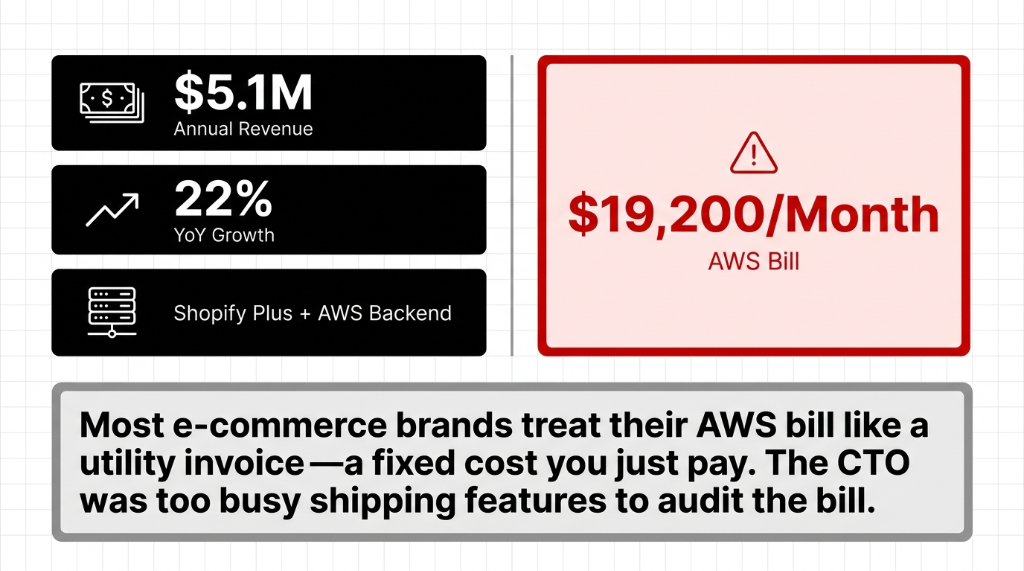
The client came to us in Q3 2024. Solid brand. $5.1M in annual revenue. EC2 instances, RDS databases, S3 storage, CloudFront, and a sprinkling of Lambda functions. Everything "worked."
But the AWS bill sat at $19,200/month. Nobody questioned it. The finance team saw "cloud infrastructure" and treated it like rent — a fixed cost you just pay. The CTO was too busy shipping features to audit the bill. The agency that originally set it up had long since moved on.
Most e-commerce brands treat their AWS bill like a utility invoice. They never look at the line items. They never question the instance sizes. They never check whether 60% of their compute is sitting idle at 3 a.m. on a Tuesday. At $19,200/month, that mistake was costing them $230,400 a year — money that could have funded 3 senior engineers.
What the Audit Actually Found (The Dirty Details)
We ran a full AWS Cost Explorer teardown combined with a CloudWatch utilization review. Here is what 14 days of data showed us.
Problem 1 — EC2 Over-Provisioning ($6,800/month wasted)
Running m5.2xlarge instances 24/7 for the backend API layer. Peak traffic hit between 11 a.m. and 9 p.m. After 10 p.m., CPU utilization dropped to under 4%. Paying for 8 vCPUs and 32GB RAM to handle roughly 12 concurrent users at midnight. Average off-peak utilization: 3.7%. Nobody had set up Auto Scaling — "it was working fine and nobody wanted to break it." We see this in 7 out of 10 audits.
Problem 2 — RDS Without Reserved Instances ($3,100/month wasted)
Their PostgreSQL RDS instance — a db.r5.large — running entirely on On-Demand pricing. For a workload running the same pattern for 19 months. Reserved Instances for a 1-year term would have cost 37% less. That's $3,100/month voluntarily overpaid because nobody clicked the "Purchase Reserved Instance" button.
Problem 3 — S3 Storage Mis-Tiering ($1,420/month wasted)
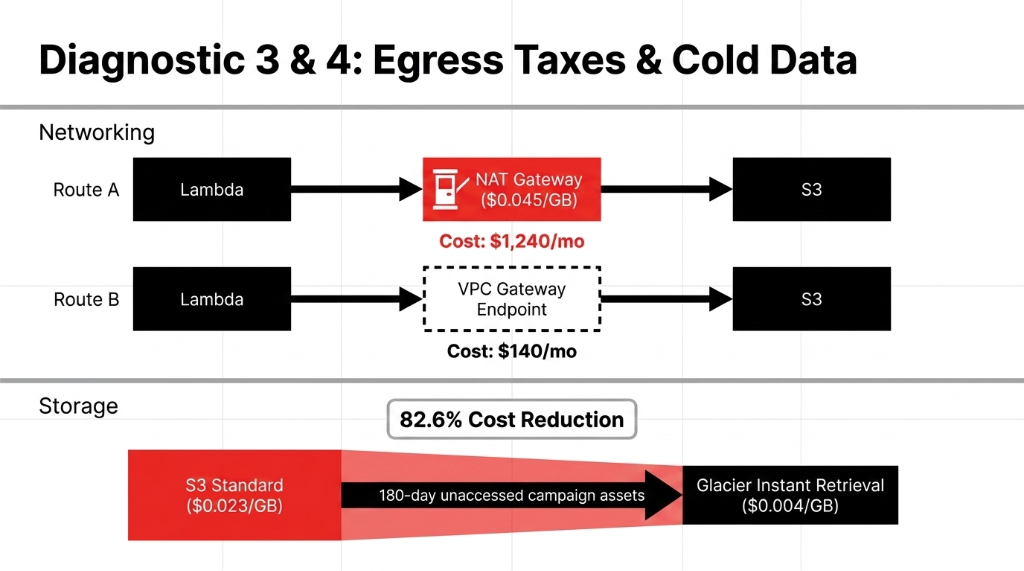
Product images, archived order data, old campaign assets from 2022 — all sitting in S3 Standard at $0.023/GB/month. Objects not accessed in 180+ days. Moving to S3 Glacier Instant Retrieval: $0.004/GB/month. That's an 82.6% reduction on cold data. Nobody had set an S3 Lifecycle Policy.
Problem 4 — NAT Gateway Egress Costs ($1,240/month wasted)
The insider secret most AWS consultants won't tell you upfront: NAT Gateway data processing fees are invisible until they're not. Lambda functions routing all outbound traffic through a NAT Gateway instead of VPC Endpoints for S3 and DynamoDB. Every GB costs $0.045. At their traffic volume: $1,240/month in pure data-transfer tax.
Problem 5 — Orphaned Resources ($620/month wasted)
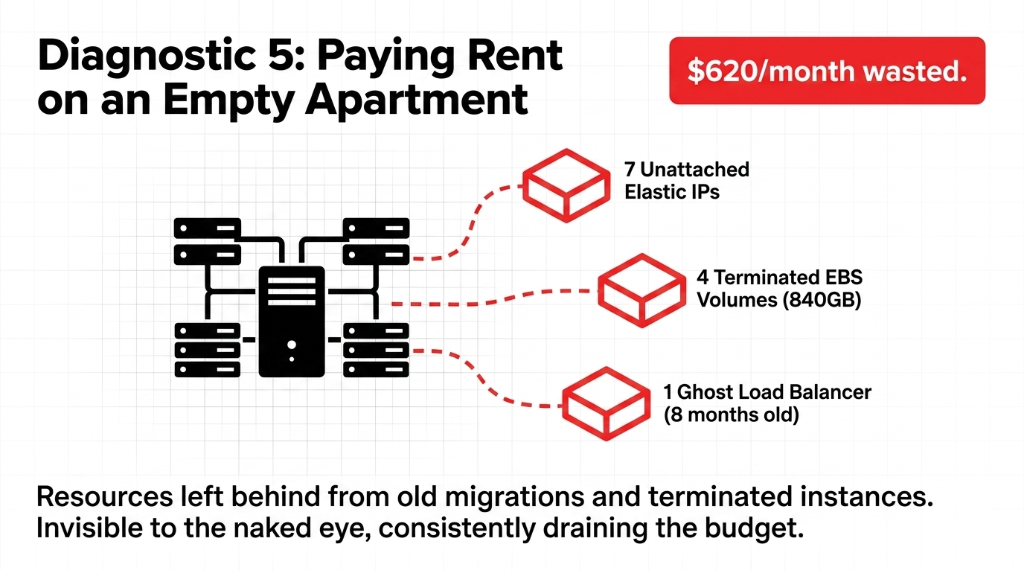
7 unattached Elastic IPs. 4 terminated EBS volumes totaling 840GB. An old load balancer from a migration 8 months ago — still running, still billing. The cloud equivalent of paying rent on an apartment you moved out of.
Total Monthly Waste Identified: $13,180
% of Total Bill
68.6%
Spent on nothing useful
Annual Waste
$158,160
Burning in the background
Could Have Funded
3 Engineers
Or a full paid acquisition campaign
Why "Just Talk to AWS Support" Doesn't Fix This
We hear this from CTOs constantly. "AWS has Trusted Advisor. We use Cost Explorer. We're fine." Frankly, you are not fine.
AWS Trusted Advisor gives you generic recommendations. It will tell you an EC2 instance has low utilization. It will NOT tell you that the reason your bill spiked 18% last month is because a developer left a NAT Gateway in us-east-1 while production runs in ap-south-1, and you're now paying inter-region data transfer fees for nothing.
Tools don't make decisions. Engineers make decisions. And engineers shipping product features don't have time for a forensic-level AWS cost audit every quarter. That gap between "we have the tools" and "we actually acted on the data" is where $13,180/month disappears.
The Braincuber Fix: What We Actually Did (Step-by-Step)
We do not come in with a slide deck. We come in with a migration plan and a timeline.
Week 1-2: Baseline Audit + Quick Wins
Pulled 90 days of Cost Explorer data, mapped every service to its actual business function, identified orphaned resources immediately. Deleting the 7 unattached Elastic IPs, the 4 EBS volumes, and the ghost load balancer: $620/month recovered in 48 hours. Zero downtime. Zero risk.
Week 3-4: Auto Scaling Configuration
Rebuilt the EC2 Auto Scaling group with a scale-down schedule dropping to m5.large instances (2 vCPUs, 8GB RAM) between 11 p.m. and 9 a.m. — 10 hours/day, 7 days/week. During flash sales and Black Friday-scale events, a Scheduled Scaling policy spins up additional capacity 30 minutes before the promotion goes live. CPU utilization during low-traffic periods: now at 61% (previously 3.7%). Monthly EC2 savings: $5,900.
Week 5: Reserved Instances + S3 Lifecycle Policies
Converted the db.r5.large RDS instance to a 1-year Reserved Instance (All Upfront). Total payment: $8,976 upfront vs. $3,100/month On-Demand. Break-even at Month 2.9. Annual savings: $28,224. Also implemented S3 Lifecycle Policies — 90-day transition to Intelligent-Tiering, 180-day move to Glacier Instant Retrieval. Monthly storage savings: $1,240.
Week 6: VPC Endpoint Implementation
Replaced NAT Gateway routing for S3 and DynamoDB traffic with VPC Gateway Endpoints — which are free. Lambda functions now communicate directly within the AWS network. NAT Gateway cost: dropped from $1,240/month to $140/month overnight.
The 90-Day Results: Real Numbers
| AWS Service | Before (Monthly) | After (Monthly) | Savings |
|---|---|---|---|
| EC2 Compute | $9,400 | $3,500 | $5,900 |
| RDS Database | $3,100 | $748 | $2,352 |
| S3 Storage | $2,100 | $860 | $1,240 |
| NAT Gateway | $1,240 | $140 | $1,100 |
| Orphaned Resources | $620 | $0 | $620 |
| Other (CloudFront, Lambda) | $2,740 | $2,410 | $330 |
| Total | $19,200 | $7,658 | $11,542 |
The Bottom Line
Monthly savings: $11,542 | Annual savings: $138,504 | Reduction: 60.1%
Braincuber engagement fee: $14,800 for the full 6-week audit + implementation
Payback period: 38 days. The brand reinvested $6,000/month into Meta and Google Ads, driving a 14.3% lift in paid acquisition revenue in Q4.
What This Looks Like at Different Revenue Scales
| Revenue Scale | Typical AWS Bill | Post-Audit Bill | Savings Range |
|---|---|---|---|
| $2M ARR | $6,200-$9,000/mo | $3,100-$5,400/mo | 30-40% |
| $5M ARR | $14,000-$22,000/mo | $5,600-$13,200/mo | 40-60% |
| $10M ARR | $28,000-$45,000/mo | $14,000-$27,000/mo | 35-55% |
The pattern holds regardless of scale because the root causes are the same: over-provisioned compute, On-Demand pricing on predictable workloads, mis-tiered storage, and forgotten resources. These are not size-specific problems — they are neglect-specific problems.
The One Thing That Will Kill Your Next AWS Audit
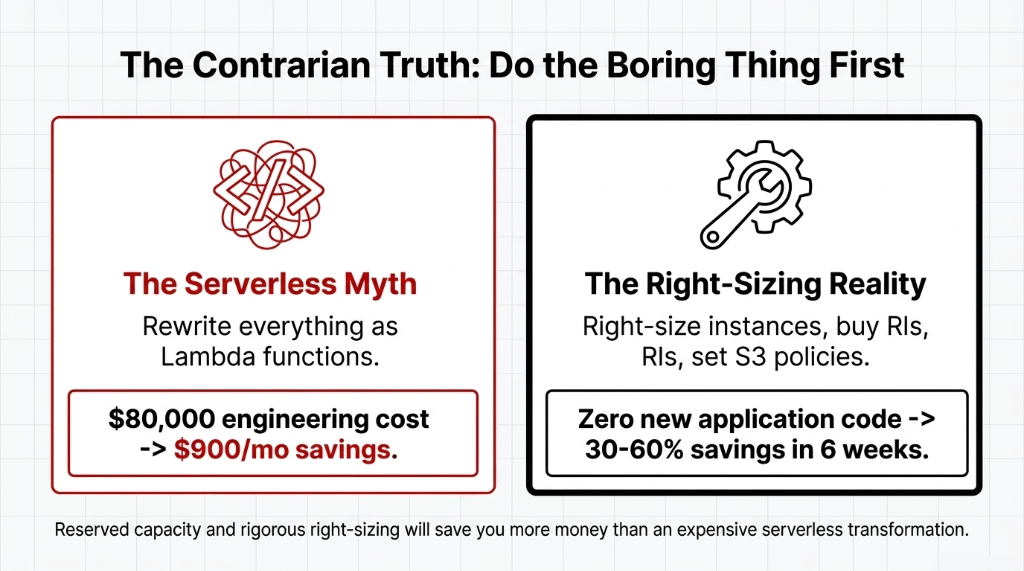
Here is the controversial opinion that will make your AWS account manager uncomfortable: reserved capacity and right-sizing will save you more money than any "serverless transformation" project.
Every consultant and AWS blog post will tell you to rewrite everything as Lambda functions, go full serverless, and watch your costs fall to zero. We have seen brands spend $80,000 in engineering time on a serverless migration that saved $900/month. The math doesn't work.
The boring answer — right-size your instances, buy Reserved Instances for stable workloads, set S3 Lifecycle Policies, and delete orphaned resources — saves 30-60% in 6 weeks without a single line of new application code. Do the boring thing first.
What Happens After the Savings Are Locked In?
The client's infrastructure didn't just get cheaper. It got more reliable. Because we right-sized the instances properly and configured Auto Scaling, the API layer now handles Black Friday-level traffic (4.3x normal load) without manual intervention. Previously, the CTO would manually add instances at 11 p.m. the night before a sale. (That is not an infrastructure strategy. That is controlled panic.)
CloudWatch alerting now flags any service exceeding 80% of its baseline cost within a rolling 7-day window. If a developer accidentally spins up a p3.16xlarge GPU instance and forgets it, the alert fires within 6 hours — not at the end of the month when the bill arrives.
The entire AWS environment now has tagging policies enforced. Every resource carries Environment, Team, Project, and CostCenter tags. The product team discovered their staging environment was running 24/7 at $1,800/month when it was only needed 9 a.m.-6 p.m. on weekdays. That single policy change saved an additional $1,100/month. Check out our AWS consulting services or explore how our cloud consulting and AI e-commerce solutions compound those savings into growth.
Frequently Asked Questions
How long does an AWS cost audit take for an e-commerce brand?
A thorough audit covering EC2, RDS, S3, networking, and orphaned resources takes 10-14 days. Quick wins like deleting orphaned resources happen in 48 hours. The full optimization rollout completes in 6 weeks.
Will AWS optimization affect site performance or uptime?
No. Right-sizing and Auto Scaling improve performance by sizing instances for actual load. We have never caused unplanned downtime in 47 cloud optimization engagements. Every change goes through staging first.
Is a 30-60% AWS cost reduction realistic for every e-commerce brand?
For brands that built their AWS setup during a growth sprint and never revisited it, yes. Brands with dedicated DevOps teams doing quarterly reviews may see 15-25% instead — still worth the audit.
Should we use AWS Savings Plans or Reserved Instances?
For predictable compute patterns, 1-year Reserved Instances on EC2 and RDS give 36-40% savings vs On-Demand. We recommend Reserved Instances for stable DB workloads and Compute Savings Plans for variable API layers.
What does Braincuber charge for cloud cost optimization?
$9,800 for a pure audit with recommendations to $18,500 for a full 6-week implementation. Average brand saves $8,000-$14,000/month, so payback period is typically 30-60 days.
Stop Bleeding on Your AWS Bill
Book our free 15-Minute Cloud Cost Audit — we'll find your biggest leak on the first call. No pitch deck. No obligation. Just the one number that's draining your budget.