
Your beauty brand is bleeding ₹56.67 crore while chasing revenue growth nobody can afford.
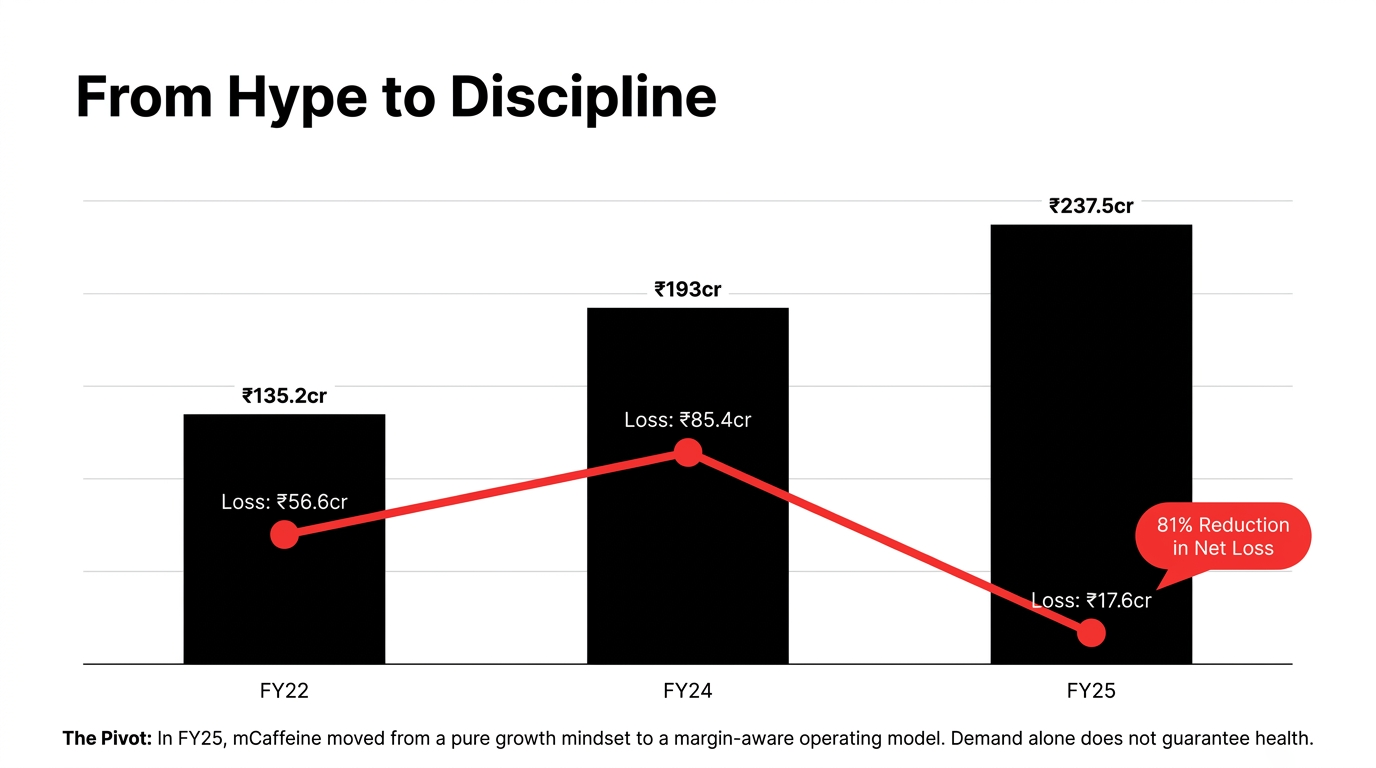
mCaffeine's FY22 numbers tell the brutal truth: revenue doubled to INR 135.23 crore, but expenses rose faster, and net loss widened. That is the classic D2C trap. Growth in beauty comes from tightening supply chain, marketing efficiency, and unit economics at the same time, not from chasing vanity metrics.
Impact: INR 85.41 crore loss in FY24 before the pivot.
The Scaling Problem Nobody Talks About
Beauty brands usually scale in the worst possible way: they spend too much on ads, carry too much inventory, and discover too late that returns, working capital, and channel complexity are eating the business alive.
In FY24, mCaffeine's operating revenue fell to INR 193 crore, yet losses were still INR 85.41 crore, showing that brand demand alone does not guarantee a healthy business.
The Category Complexity
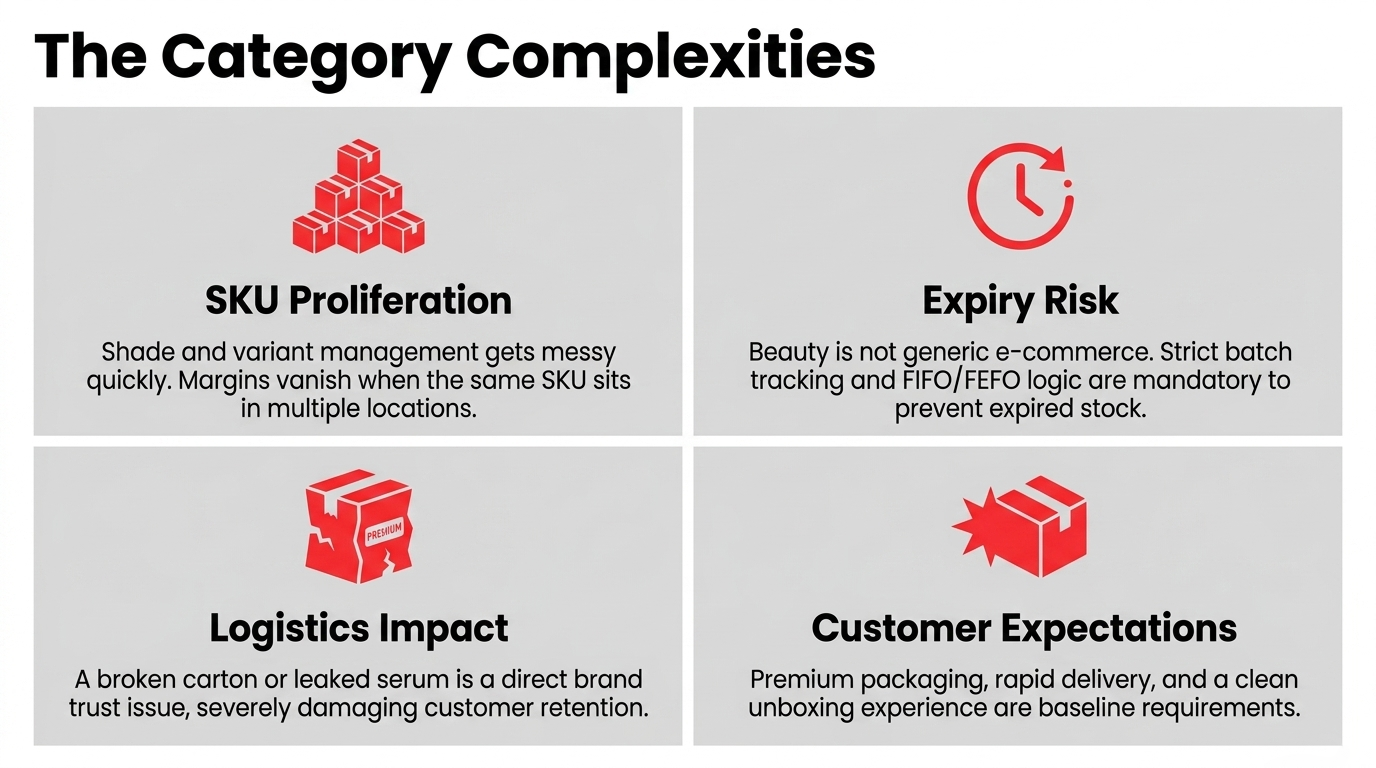
Products expire, SKUs multiply quickly, shade and variant management gets messy, and customers expect fast delivery plus a clean unboxing experience.
Industry reports on beauty fulfillment and cosmetics warehousing keep pointing to batch-level accuracy, structured inventory management, and flexible storage as essential to scale. Beauty is not generic e-commerce; a broken carton or expired serum is a customer trust problem, not just a logistics problem.
What mCaffeine Got Right
The smartest thing mCaffeine appears to have done is move from a pure growth mindset to a margin-aware operating model. In FY25, its parent PEP Brands reported revenue of INR 237.5 crore, total income of INR 239.2 crore, and an 81% reduction in net loss to INR 17.6 crore.
Even more important, expenses were pulled back. Employee benefit expense fell 31% to INR 26.6 crore, marketing expense dropped 14% to INR 95.8 crore, and total expenses declined 13% to INR 251.7 crore. That is not cosmetic efficiency; that is a business finally putting a leash on spend.
The Unit Economics Turnaround
FY24 Reality
INR 1.50 spent to earn every rupee of revenue
FY25 Improvement
INR 1.06 spent to earn every rupee of revenue
That is the difference between a brand that is buying growth and a brand that is learning how to keep it.
Why Omnichannel Changes the Math
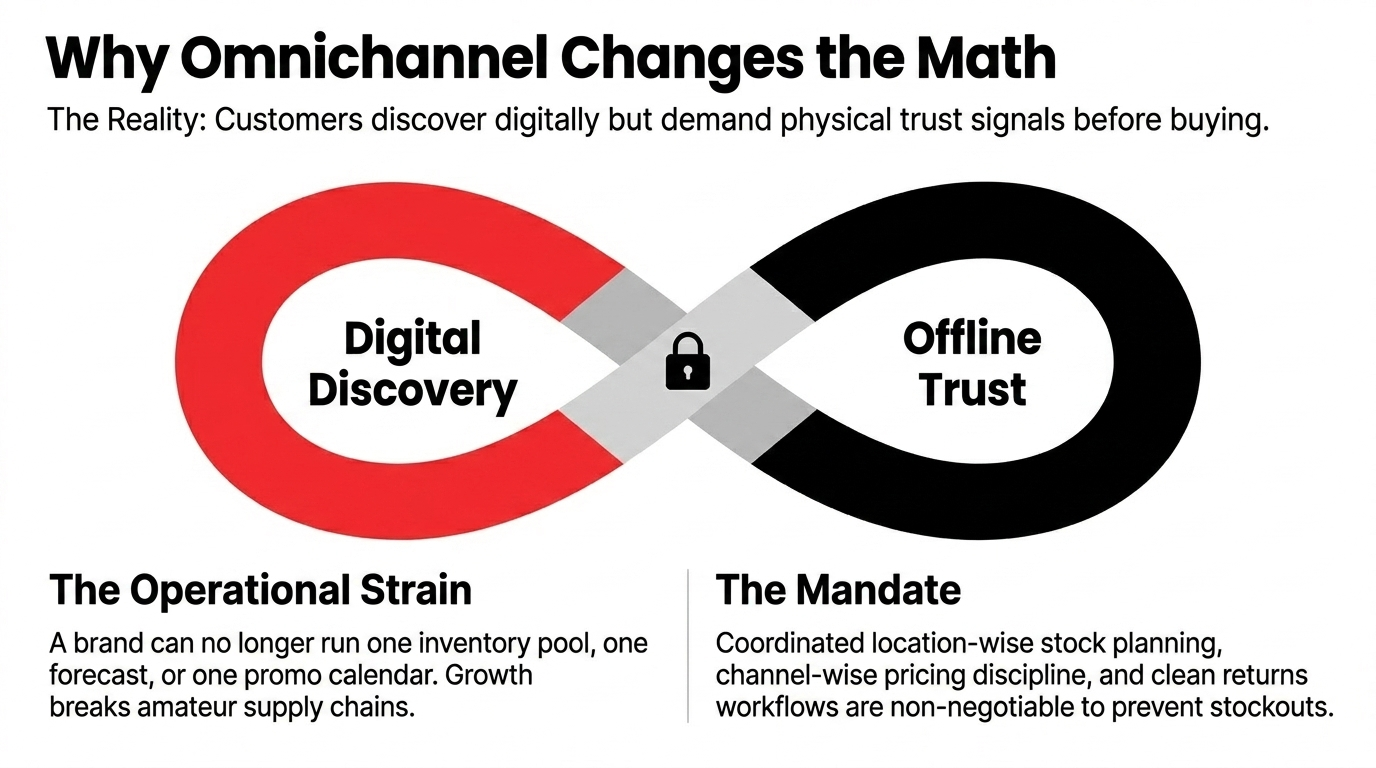
Beauty is one of the few categories where online discovery and offline trial both matter. Indian market coverage shows the beauty and personal care sector is large and still growing, with omnichannel becoming a central strategy because customers discover digitally but often want physical touchpoints before they buy.
That matters for scaling because omnichannel changes the operational math. A brand can no longer run one inventory pool, one forecast, and one promo calendar; it needs location-wise stock planning, channel-wise pricing discipline, and a clean returns workflow. If that sounds expensive, it is cheaper than the alternative, which is overselling, stockouts, and dead inventory.
The Operational Strain
A brand can no longer run one inventory pool, one forecast, or one promo calendar. Growth breaks amateur supply chains.
The Mandate: Coordinated location-wise stock planning, channel-wise pricing discipline, and clean returns workflows are non-negotiable to prevent stockouts.
The Operational Engine
Scaling beauty is mostly an operations problem wearing a marketing costume. The winners build a system where demand planning, production, warehousing, order routing, returns, and customer engagement all talk to each other instead of living in isolated tools like Excel, Shopify, QuickBooks, ShipStation, and a pile of Slack messages.
Here is the ugly truth: once a beauty brand sells across its own website, marketplaces, and retail partners, the same SKU can sit in multiple locations and the margin can disappear if inventory sync is late by even a few hours.
The brands that scale well do five things consistently:
- They keep SKU proliferation under control.
- They forecast demand by channel, not by gut feel.
- They use batch and expiry tracking.
- They place inventory closer to demand.
- They connect sales, warehousing, and finance in one system.
That is why fulfillment specialists for beauty emphasize batch accuracy, premium packaging, reduced returns, and multi-channel inventory management.
The Working Model
A beauty brand scaling well usually follows a sequence, even if the founders never write it down that way. First comes product-market fit, then channel expansion, then supply chain discipline, then margin correction, and finally operating use. Skip the middle steps and the brand becomes dependent on ad spend and fundraising.
In practical terms, the sequence looks like this:
- Launch a focused assortment.
- Validate repeat purchase on a small number of hero SKUs.
- Add marketplace and D2C channels carefully.
- Introduce warehouse and fulfillment controls.
- Tighten marketing spend only after fulfillment is stable.
- Use ERP-level visibility to stop leakage in stock, cash, and returns.
The Fatal Mistake
More heads do not solve inventory drift, delayed reconciliations, or forecasting errors. Better systems do.
What Scaling Actually Requires
The operational stack behind a scaling beauty brand usually includes demand forecasting, batch traceability, warehouse management, channel integration, and finance reconciliation. For beauty specifically, batch management and FIFO or FEFO logic matter because product freshness and expiry directly affect salability.
There is also a packaging layer that outsiders underestimate. Beauty customers judge quality from box condition, leakage prevention, inserts, and the speed of delivery, which means logistics has a brand effect, not just a cost effect.
If you compare this with mCaffeine's financial arc, the pattern is obvious. The company did not just need more revenue; it needed lower employee drag, lower marketing burn, better revenue quality, and better control over the cost of every rupee earned.
The Real Lesson
Brand love is not a business model. A beauty brand can win attention, distribute through multiple channels, and still bleed money if operations do not catch up fast enough. What changes the game is when the company starts behaving like an operating system instead of a campaign engine.
Frequently Asked Questions
How do beauty brands scale operations?
They scale by controlling inventory, forecasting demand by channel, tightening fulfillment, and reducing marketing waste while keeping customer experience consistent across D2C, marketplaces, and offline.
Why is beauty harder to scale than other categories?
Beauty has more SKUs, expiry risk, batch tracking needs, returns, and packaging sensitivity, so operational mistakes show up faster in margins and customer trust.
What made mCaffeine's scaling story notable?
mCaffeine grew revenue sharply, then later improved efficiency by reducing expenses and narrowing losses, showing that scale only works when the cost structure improves too.
Why does omnichannel matter for beauty brands?
Because customers often discover beauty products online but want physical trust signals before buying, so brands need coordinated stock, pricing, and fulfillment across channels.
What is the biggest mistake beauty founders make?
They scale marketing before operations, which creates stockouts, returns, delayed reconciliations, and margin leakage that no ad campaign can fix.
Talk to a practice lead
D2C operations stack feeling stretched?
We have shipped operations stacks for 30+ US D2C brands — inventory across Shopify + Amazon, 3PL routing, Avalara sales tax, returns automation. Free 30-min audit call.
Combined output from Braincuber's practice leads — Odoo, AI agents, AWS — drawing on the team's own delivery work.