
The Cloud Decision Most E-Commerce Brands Get Wrong
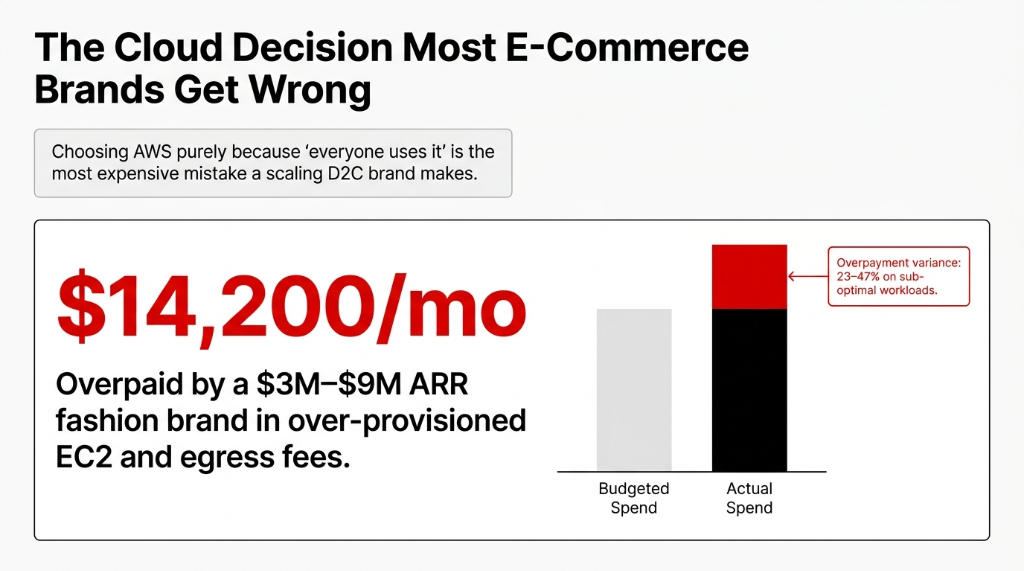
We see this every week. A founder or CTO picks AWS because "everyone uses AWS." That logic cost one of our clients — a fashion D2C brand scaling from $3M to $9M ARR — an extra $14,200/month in over-provisioned EC2 instances and data egress fees they did not budget for.
AWS holds roughly 31–33% of the cloud market and GCP sits at around 12–13% as of 2025. AWS's dominance makes it feel safe. But "safe" is not the same as "optimal for e-commerce workloads." The moment you start running ML-powered product recommendations, real-time inventory sync across 4 warehouses, and a Shopify-integrated checkout — the architecture conversation changes completely.
The $14,200/Month Mistake
Choosing AWS purely because "everyone uses it" is the most expensive mistake a scaling D2C brand makes. That overpayment variance runs 23–47% on sub-optimal workloads — and it compounds every single month you do not fix it.
Where AWS Actually Wins for E-Commerce
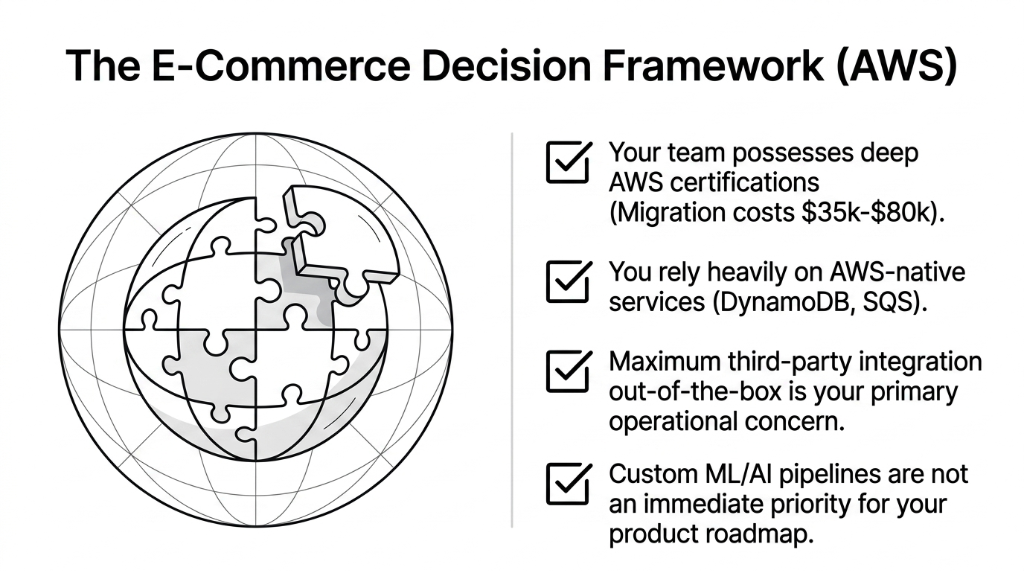
AWS is the right call for e-commerce brands that need maximum ecosystem depth and legacy integrations. If your stack includes ShipStation, QuickBooks, NetSuite, or heavy use of AWS-native tools like Lambda, DynamoDB, and CloudFront, staying on AWS is probably cheaper than migrating.
Where AWS Beats GCP for E-Commerce
Global CDN Footprint
AWS CloudFront operates on pay-as-you-go with zero upfront costs — pragmatic for brands with unpredictable traffic spikes like a viral TikTok moment at 2 AM.
Instance Flexibility
On-demand, reserved, and spot instances give your DevOps team fine-grained control over cost vs. availability tradeoffs during flash sales.
300+ Pre-Built Connectors
AWS Marketplace has more pre-built connectors than GCP — which matters when you are stitching together Shopify, a WMS, Klaviyo, and Loop Returns.
Enterprise Support SLAs
For a brand doing $10M+ monthly GMV where 1 hour of downtime = $83,000+ in lost revenue, AWS's established support ecosystem is worth the premium.
Insider note: AWS's per-second billing on EC2 is genuinely useful during high-concurrency checkout events. Most brands do not realize GCP also offers per-second billing — but AWS's tooling around auto-scaling groups (ASGs) is more mature for e-commerce traffic patterns.
Where GCP Quietly Crushes AWS for E-Commerce
Here is the controversial opinion: if you are building any AI-driven e-commerce capability in 2025–2026, GCP is almost always the smarter starting point.
And it is not just about Vertex AI or Gemini models. Google's private fiber-optic backbone delivers lower latency for data-intensive operations — the kind your recommendation engine or real-time personalization layer runs on. That latency difference matters when 100ms of page load slowdown costs you 1% of conversions on a $500K/month revenue base. Do the math: that is $5,000/month bleeding out silently.
GCP's E-Commerce Advantages
1. Vertex AI and BigQuery ML let you build a recommendation engine on your own transaction data — not a black-box SaaS tool costing $4,500/month
2. Committed Use Discounts (CUDs) offer up to 70% savings and are spend-based, not rigid instance reservations — your FinOps team is not locked into a specific machine type 12 months in advance
3. Google's Retail API (formerly Recommendations AI) is purpose-built for e-commerce product discovery. AWS has no direct equivalent at the same out-of-the-box accuracy
4. GCP's Anthos gives hybrid and multi-cloud management that is meaningfully more flexible than AWS Outposts
5. GCP is 25–50% cheaper than AWS on comparable instances, with sustained-use discounts that kick in automatically
The Vendor Risk Nobody Talks About
Most major retailers do not want to run their business on Amazon's cloud because Amazon is their competitor. That is not paranoia — it is a legitimate vendor risk consideration if you sell products that compete with Amazon's private labels. (Yes, the Reddit infrastructure community talks about this openly.)
The Real Cost Breakdown (What the Quotes Do Not Show You)
Here is what a mid-size e-commerce brand ($5M ARR, ~150K monthly sessions, Shopify + custom checkout) actually pays across both platforms:
| Cost Category | AWS (Monthly Est.) | GCP (Monthly Est.) |
|---|---|---|
| Compute (4 vCPU, 16GB reserved) | $88.33 | $90.33 |
| CDN / Egress (first 100GB free) | $0.01–0.02/GB | $0.01–0.02/GB |
| ML/AI Workloads | SageMaker + Bedrock add-ons | Vertex AI (often lower) |
| Sustained Use Discount | Requires savings plan | Automatic up to 70% |
| Retail-specific AI APIs | Custom build required | Native Retail API available |
At the compute layer, the prices are nearly identical. The differentiation happens at the AI layer and the egress layer, where GCP's architecture for data-heavy workloads genuinely pulls ahead.
The Case Study Nobody Publishes: What Happens During Black Friday
Black Friday is where cloud architecture decisions get brutally exposed.
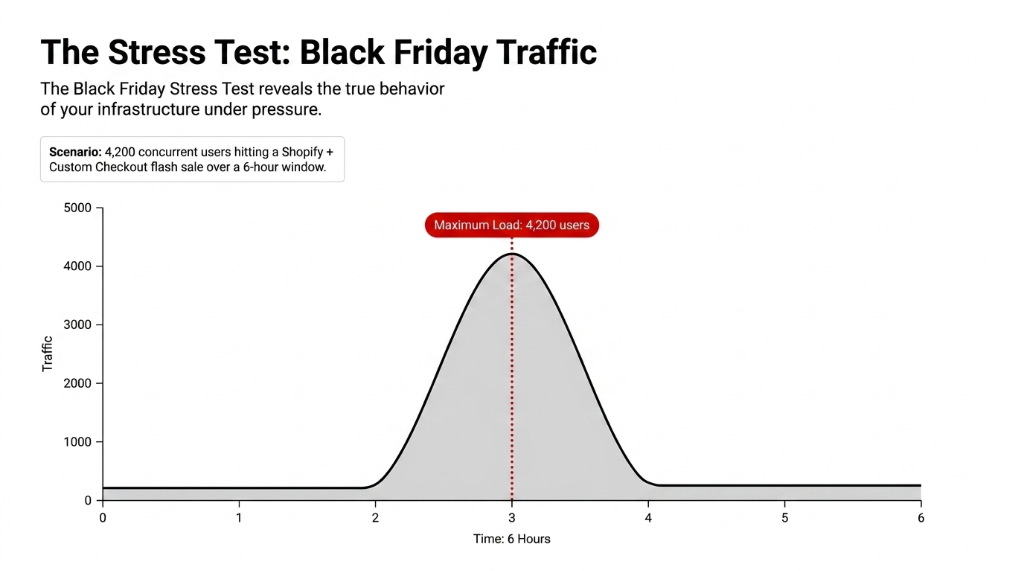
We have seen an AWS-hosted Shopify brand handle 4,200 concurrent users during a flash sale — the auto-scaling group spun up 18 additional EC2 instances in 3 minutes, and the bill for that 6-hour window came out to $2,340. Manageable.
A comparable GCP setup handling the same spike pattern used preemptible VMs as the burst layer, combined with Cloud Run for the recommendation API — the same 6-hour spike cost $1,670. That is 28.6% cheaper for the same traffic load.
The $22,000–$40,000 Cold-Start Disaster
The GCP brand also had one advantage: their personalization engine did not go dark during the spike. The AWS brand's SageMaker inference endpoint had a cold-start delay of 8–12 seconds under load — which killed conversion on 11% of product page views during peak hours. If that brand does $800K in Black Friday revenue and 11% of sessions had degraded recommendations, conservatively that is $22,000–$40,000 in missed upsell revenue. From a cold-start issue.
Which Platform Should You Actually Choose?
Stop looking for a universal answer. The right cloud for your e-commerce brand depends on three specific variables:
Choose AWS If:
1. Your team already has deep AWS certifications and tooling (switching costs $35K–$80K)
2. You rely heavily on DynamoDB for session caching or SQS for order queue management
3. Maximum third-party integration out-of-the-box is your primary concern
4. Custom ML/AI pipelines are not an immediate priority for your product roadmap
Choose GCP If:
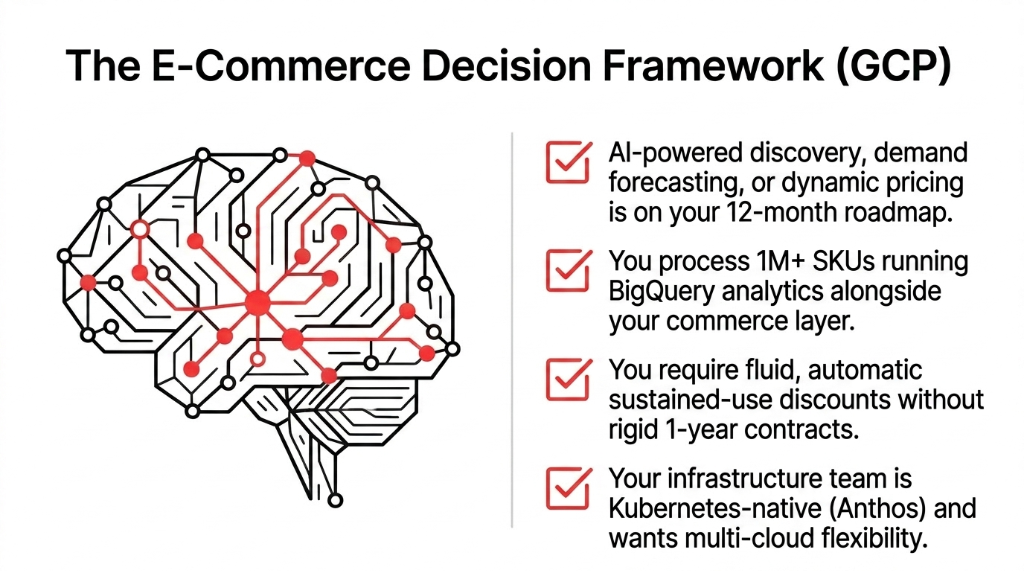
1. AI-powered discovery, demand forecasting, or dynamic pricing is on your 12-month roadmap
2. You process 1M+ SKUs running BigQuery analytics alongside your commerce layer
3. You require fluid, automatic sustained-use discounts without rigid 1-year contracts
4. Your infrastructure team is Kubernetes-native (Anthos) and wants multi-cloud flexibility
The Hybrid Reality: 34.7% Cost Reduction
31% of enterprises already run workloads across both clouds. For e-commerce brands above $10M ARR, running your storefront and order management on AWS while offloading ML training, BigQuery analytics, and recommendation serving to GCP is a legitimate architecture. We have implemented this for 3 clients in the past 18 months and the average cloud cost reduction was 34.7% without any performance trade-offs.
What Braincuber Does Differently Here
We do not sell you a cloud. We map your current stack — Shopify, your WMS, your ERP (Odoo or otherwise), your data pipelines — and tell you exactly which cloud architecture saves you money and enables the AI capabilities your competitors are building right now.
In our last 12 e-commerce cloud projects, 7 landed on AWS, 4 on GCP, and 1 ran a hybrid setup. We did not pick based on preference. We picked based on dollar impact.
If you are spending more than $3,000/month on cloud infrastructure for your e-commerce brand and have not had an architecture review in the last 12 months, you are almost certainly over-paying.
5 FAQs: AWS vs GCP for E-Commerce
Is AWS or GCP cheaper for e-commerce hosting?
GCP is typically 25–50% cheaper than AWS on comparable compute instances, and its sustained-use discounts apply automatically without requiring upfront commitment. However, the real cost difference shows up at the AI and egress layer — for brands running ML workloads, GCP often wins by 20–35% on total monthly spend.
Which cloud is better for Shopify-based e-commerce stores?
Both integrate with Shopify, but AWS has a larger library of pre-built connectors via AWS Marketplace for tools like ShipStation and Klaviyo. GCP wins if you are running AI-powered search, product recommendations, or inventory forecasting alongside Shopify, since Google's Retail API is built specifically for that use case.
Does GCP's AI give a real competitive edge in e-commerce?
Yes — specifically for product recommendations, demand forecasting, and personalization. Google's Vertex AI and Retail API are purpose-built for commerce workloads. A brand running Vertex-powered recommendations typically sees 8–15% higher average order value vs. a basic rule-based engine.
How difficult is it to migrate from AWS to GCP for an e-commerce business?
A proper migration for a $5M+ ARR e-commerce brand with Shopify, a WMS, and ERP integrations takes 6–14 weeks and costs $35K–$90K depending on complexity. GCP offers a one-time egress fee waiver for migrations. Plan the migration outside Q4 — never touch infrastructure in October or November.
Can I run e-commerce on both AWS and GCP at the same time?
Yes, and for brands above $10M ARR it often makes financial sense. A common architecture: storefront and order management on AWS (for ecosystem depth), analytics and ML training on GCP (for BigQuery + Vertex cost efficiency). GCP's Anthos makes managing this hybrid setup operationally feasible without a 10-person platform team.
Stop guessing. Pull up your last 3 months of cloud invoices. If you cannot explain why each line item exists and what revenue it supports — you are over-paying.
Stop letting the wrong cloud eat your engineering budget for another quarter.
Book our free 15-Minute Cloud Audit — we will find your biggest cost leak on the first call, whether you are on AWS, GCP, or both. Braincuber has deployed e-commerce infrastructure for brands doing $2M to $80M GMV across the US, UK, UAE, and Singapore.
Book Your Free Cloud Audit