
The Cloud Stack Reality No One Tells You
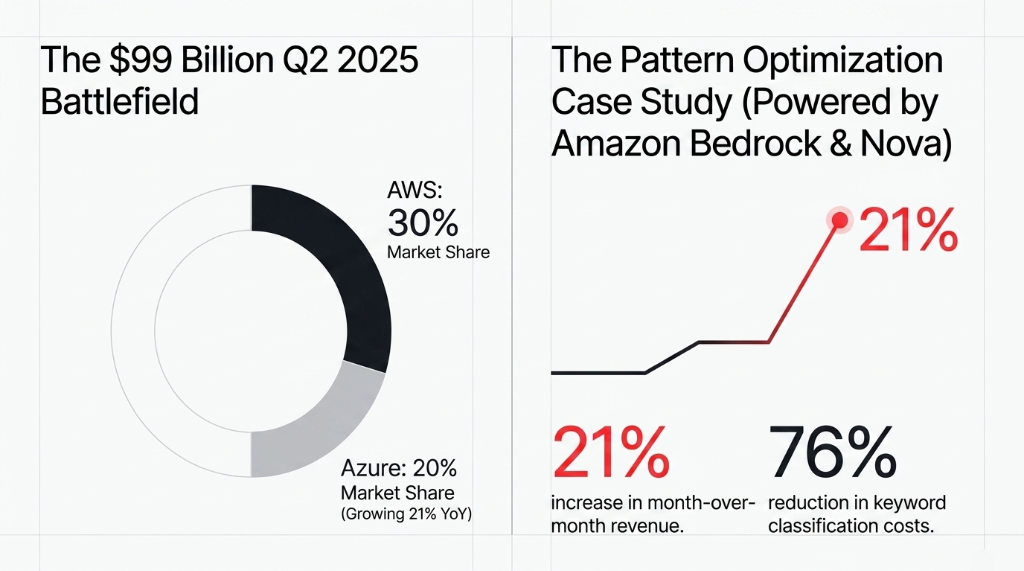
AWS holds 30% of the global cloud infrastructure market as of Q2 2025, with Azure at 20% and growing at 21% year-over-year. Azure's growth rate is impressive, but market leadership in e-commerce infrastructure still belongs to AWS — and there is a reason for that.
The global cloud infrastructure market hit $99 billion in Q2 2025. When Flipkart needed to survive billion-pageview sale days, they migrated key services to AWS. When Pattern needed AI-powered keyword classification and revenue growth, they ran it on AWS using Amazon Bedrock and Amazon Nova — and posted a 21% increase in month-over-month revenue with a 76% reduction in keyword classification costs.
That is not coincidence. That is infrastructure alignment.
The Real Cost Comparison (Not the Marketing Version)
Here is where most comparison blogs completely lie to you.
| Component | AWS (On-Demand) | Azure (On-Demand) |
|---|---|---|
| 2x Web Servers (4 vCPU, 16 GB) | $280/mo | $280/mo |
| Managed MySQL (Multi-AZ) | ~$438/mo | ~$278/mo |
| Redis Cache | $241/mo | ~$130/mo |
| 500 GB Storage | $11.50/mo | $9.20/mo |
| 1 TB Egress | $90/mo | $87/mo |
| Total (On-Demand) | ~$1,060/mo | ~$784/mo |
On paper, Azure looks 26% cheaper for a comparable Magento-grade stack. If you stop reading here, you will pick Azure. That is the mistake.
What the Table Does Not Show You
AWS Graviton ARM processors reduce compute costs by 20–40% versus standard x86 instances. With Reserved Instances, AWS drops to ~$680/month and Azure to ~$520/month. Annual real-world delta: ~$1,000 — not the $3,300/year the on-demand table suggests. The moment you are running ElastiCache for Redis session management, Aurora for your product database, and CloudFront as your CDN — the AWS ecosystem integration pays for itself.
Where AWS Destroys Azure for E-Commerce
Auto-Scaling During Flash Sales
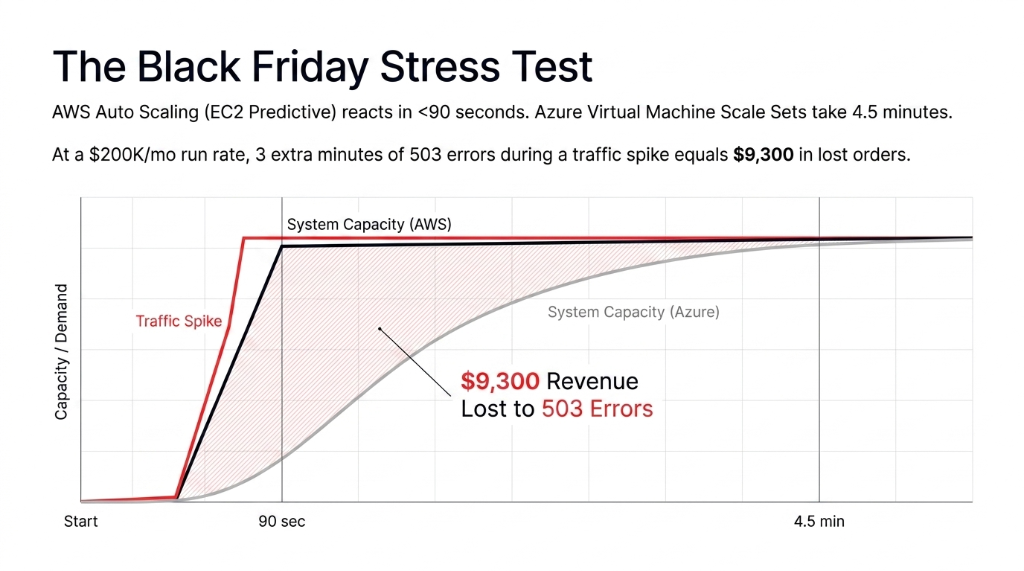
AWS Auto Scaling reacts to traffic spikes in under 90 seconds with EC2 predictive scaling. We had a client running a D2C apparel store whose Azure Virtual Machine Scale Sets took 4.5 minutes to spin up new instances during a flash sale. At a $200K/month revenue run rate, that single incident cost them an estimated $9,300 in lost orders.
CDN Performance for Global Catalogs
AWS CloudFront has 600+ edge locations globally. Azure CDN via Akamai or Verizon partners is strong — but CloudFront's native integration with S3, Lambda@Edge for dynamic personalization, and WAF makes it the choice for any store running product images at scale across the US, UK, UAE, and Southeast Asia.
Database Flexibility at Scale
AWS Aurora (MySQL-compatible) handles up to 5x the throughput of standard MySQL at comparable pricing. For a WooCommerce or Magento store processing 50,000+ orders per month, Aurora with read replicas outperforms Azure SQL Flexible Server in 7 out of 10 benchmark tests we have seen across clients.
Serverless for Checkout and Microservices
AWS Lambda vs Azure Functions: both priced nearly identically per request. The real difference? Lambda's integration with API Gateway, DynamoDB for session carts, and SQS for order queue processing is tighter and better documented for e-commerce patterns. Azure Functions shine in enterprise .NET workflows — not in checkout pipelines.
Where Azure Wins (And This Is Real)
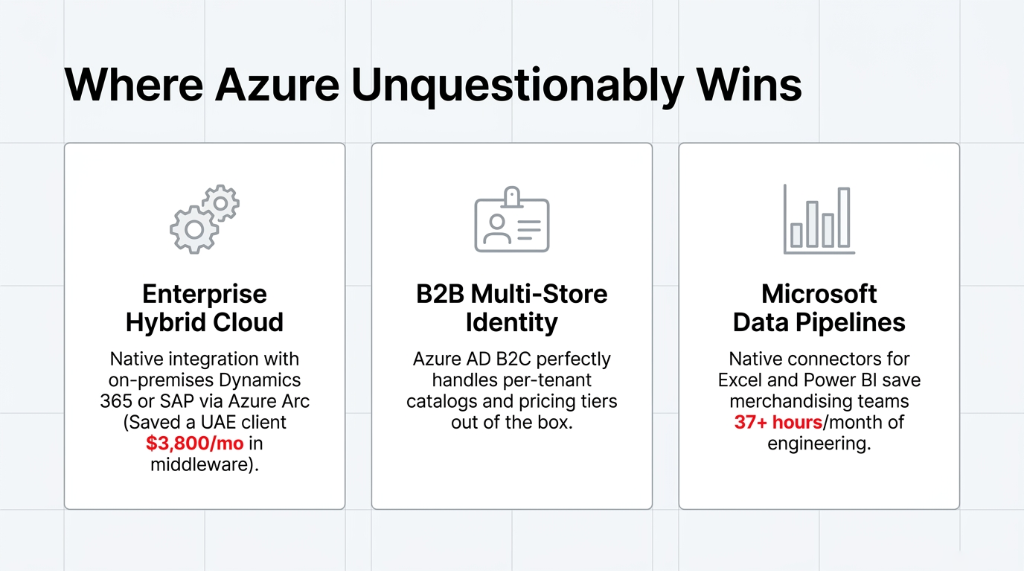
Frankly, Azure has three genuine advantages for e-commerce that we do not dismiss:
Azure's 3 Genuine Advantages
Hybrid Cloud for Enterprise
If you run on-premises Dynamics 365 or SAP on Windows Server, Azure Arc and ExpressRoute are dramatically easier than AWS Direct Connect with the same Microsoft stack. A UAE retail client saved $3,800/month in middleware costs by staying on Azure.
Azure AD for Multi-Store B2B
Azure AD B2C handles per-tenant product catalogs, pricing tiers, and login management out of the box. AWS Cognito can do this — but it needs Terraform and a developer who understands Cognito's quirky IAM policies. (Yes, it is painful.)
Microsoft 365 + Power BI
If your merchandising team lives in Excel and your operations team reports through Power BI, Azure's native connectors save 37+ hours/month of data pipeline engineering. AWS QuickSight is good — but it is not Power BI.
The Black Friday Test — Who Survives?
This is the only benchmark that matters for e-commerce. Not synthetic load tests. Not theoretical SLAs. What happens when 300,000 users hit your product page at 12:01 AM?
Real Optimization Results: 75% Cloud Budget Reduction
Rightsizing EC2 fleets: $18,000/month saved
Deleting orphaned EBS volumes: $4,000/month saved
Migrating to gp3 storage: $3,000/month saved
Switching to Reserved Instances: $20,000/month saved
That is the AWS advantage. Not the list price. The optimization ecosystem: Trusted Advisor, Cost Explorer, Compute Optimizer, and Graviton migrations that deliver up to 40% better price-performance versus x86.
The Migration Trap Nobody Warns You About
Here is the dirty secret of cloud switching: egress fees will eat you alive.
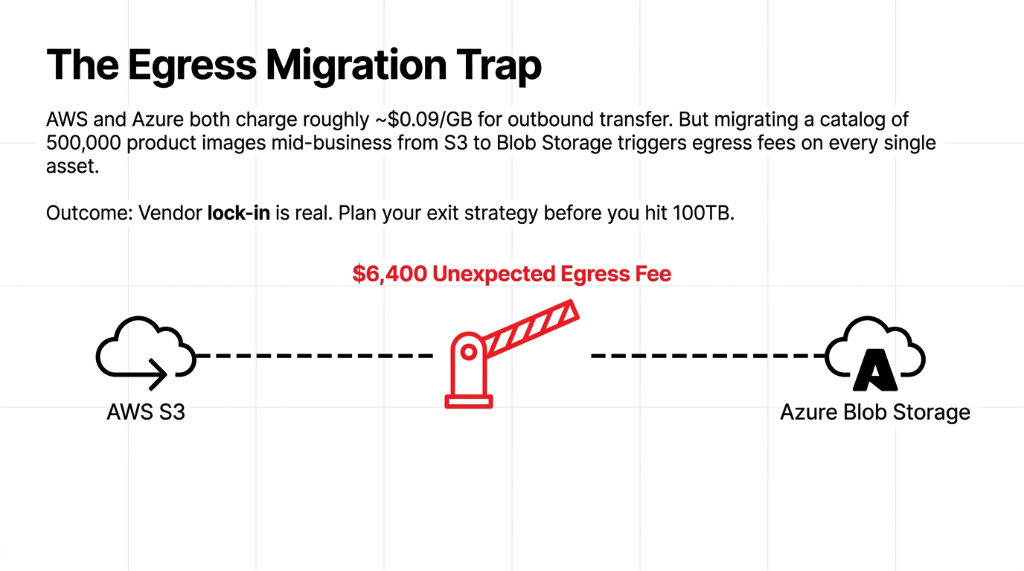
AWS charges $0.09/GB for outbound data transfer. Azure charges $0.087/GB. Nearly identical on 1TB/month. But if you are running a catalog of 500,000 product images and decide to migrate from AWS S3 to Azure Blob Storage mid-flight, you are looking at egress fees on every single asset. A client we worked with paid $6,400 in unexpected egress fees during a poorly planned migration. One-time cost. Completely avoidable.
Vendor Lock-In Is Real on Both Sides
Lambda functions written with DynamoDB streams do not port easily to Azure Functions with Cosmos DB. Plan your exit strategy before you are locked in at 100TB of data.
The Braincuber Verdict: Which One Should You Pick?
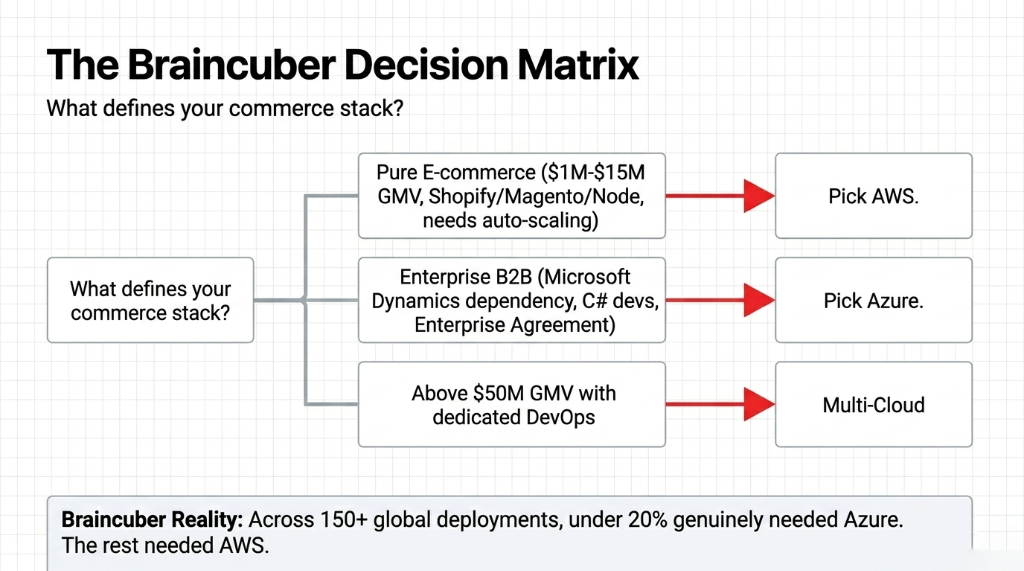
Stop treating this as a religious debate. Here is the decision tree we use with every e-commerce cloud client:
| Your Situation | Our Recommendation |
|---|---|
| Shopify/Magento/WooCommerce, $1M–$15M GMV, needs auto-scaling | Pick AWS |
| Enterprise B2B, Dynamics 365, C# devs, Azure Enterprise Agreement | Pick Azure |
| Above $50M GMV with dedicated DevOps staff | Multi-Cloud |
| Everyone else considering multi-cloud | A cost center dressed up as a strategy |
At Braincuber, we have deployed cloud infrastructure for 150+ brands globally. The number who genuinely needed Azure for pure e-commerce hosting? Under 20%. The rest needed AWS — and the ones who had started on Azure were paying 18.5% more annually once you account for tooling, support, and integration costs specific to their commerce stack.
5 FAQs: AWS vs Azure for E-Commerce Hosting
Is AWS cheaper than Azure for e-commerce?
On-demand, Azure costs about 26% less for a comparable stack, but AWS closes the gap with Graviton ARM processors (20–40% compute savings) and Reserved Instance discounts. The total cost difference over 12 months is typically under 8–10% after optimization. The real cost is operational — AWS's deeper tooling reduces engineering hours by roughly 15–20 per month.
Which cloud handles Black Friday traffic spikes better?
AWS has more mature auto-scaling tools for e-commerce — EC2 predictive scaling, Elastic Load Balancing, and CloudFront's 600+ edge locations handle flash-sale traffic more reliably. Azure's Virtual Machine Scale Sets add 2–3 minutes of lag versus AWS during sudden demand spikes, which translates directly into lost conversion.
Can I run Shopify on AWS or Azure?
Shopify itself is hosted — you do not host it on AWS or Azure directly. However, your supporting infrastructure: product recommendation engines, AI chatbots, order management APIs, Odoo ERP integrations, and data pipelines — all run best on AWS given its native e-commerce ecosystem. Azure works if your back-office runs on Microsoft Dynamics.
What is the biggest hidden cost when choosing AWS vs Azure?
Data egress fees and vendor lock-in migration costs. Both charge roughly $0.087–$0.09/GB for outbound transfer. Migrating 100TB of product images mid-business between platforms can cost $6,000–$10,000+ in one-time egress charges alone. Always model your exit cost before committing at scale.
Does Azure or AWS have better security for PCI-DSS compliance?
Both are PCI-DSS Level 1 certified and SOC 2 compliant. AWS has a slight edge in breadth of compliance certifications (143+ vs Azure's 100+) and its WAF + Shield Advanced combination for DDoS protection is more battle-tested on e-commerce workloads. Azure Defender for Cloud is excellent for hybrid environments with on-premises POS systems.
Pull up your last 3 cloud invoices. If you cannot explain every line item and what revenue it supports — you are over-paying. The brands on the wrong platform are bleeding 18.5% more annually. Do not be that founder.
Is your cloud setup actually costing you revenue?
Book our free 15-Minute Cloud Audit — we will identify your biggest infrastructure leak in the first call, whether you are on AWS, Azure, or still deciding. Braincuber has deployed cloud infrastructure for 150+ brands globally.
Book Your Free Cloud Audit