
The Attack Anatomy Nobody Warns You About
Here is what a flash sale DDoS attack actually looks like in practice.
Your marketing team fires the email campaign at 11:59 PM. CloudFront starts serving the surge. At 12:03 AM, an attacker — already watching your social media countdown — fires a UDP reflection attack at 6.1 Gbps toward your origin server. Your CDN edge absorbs some of it, but the origin gets overwhelmed. Your checkout API stops responding. The ALB health checks start failing. Route 53 routes traffic into a dead zone.
The Brutal Math: Attacks Are Timed, Not Random
DDoS attacks against e-commerce providers spike over 70% on Black Friday and 109% on Cyber Monday. These are not random spray-and-pray attacks. Competitors know your sale windows. Former employees know your infrastructure. And botnet-as-a-service tools cost less than $50/hour on Telegram.
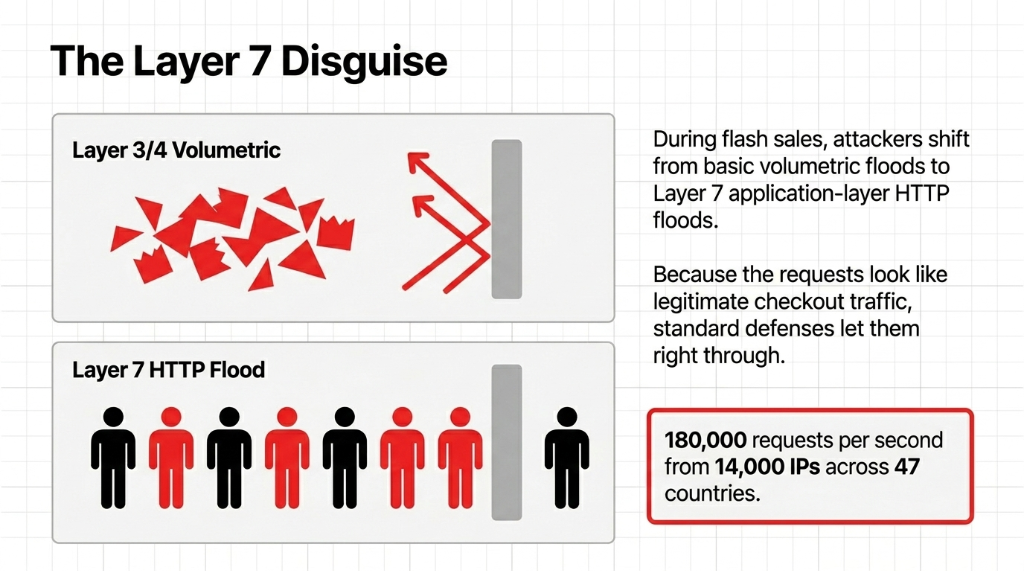
What most teams do not realize: the attack vector shifts during a flash sale. Normal days, you get Layer 3/4 volumetric floods — easy to detect, easy to block. During a flash sale, sophisticated attackers mix in Layer 7 application-layer attacks: HTTP floods that look exactly like real customer traffic because they ARE real HTTP requests — just generated at 180,000 requests per second from 14,000 IP addresses across 47 countries.
AWS Shield Standard — which every AWS customer gets for free — stops 96% of common DDoS attacks including SYN floods, ACK floods, and reflection attacks. It works transparently on ELB, CloudFront, and Route 53 with zero configuration. But here is the ugly truth: Standard does not touch Layer 7. And Layer 7 attacks are exactly what hits during flash sales.
This is the gap we close first during our AWS consulting services engagements — because the brands that discover it during a live attack pay 100x more than the brands that discover it during an architecture review.
Why Your Current Setup Will Fail at 12:03 AM
We constantly see brands make the same three mistakes during flash sale prep:
Mistake 1: Assuming CloudFront Alone Is Enough
CloudFront absorbs edge traffic. It does NOT intelligently distinguish between 40,000 legitimate buyers and 40,000 bot requests that look identical. Without AWS WAF rule groups tuned to your traffic patterns, CloudFront will dutifully serve error pages to your real customers at $11,000/minute in lost GMV.
Mistake 2: Enabling Shield Advanced the Day Before the Sale
Shield Advanced's automatic application layer DDoS mitigation learns your baseline traffic patterns. It needs at least 7-14 days of normal traffic to establish what "legitimate" looks like for your application. Turn it on 48 hours before your sale and the system is flying blind. We have seen brands do exactly this and wonder why Advanced did not catch the attack.
Mistake 3: Not Setting Up DDoS Cost Protection Before the Attack
Without Shield Advanced active before the event, a DDoS attack that forces CloudFront to scale to handle 9 Gbps of junk traffic can cost you $14,200+ in data transfer fees — for traffic that never converted a single order. Shield Advanced includes DDoS cost protection that issues service credits for scale-up charges caused by attacks. But it only covers you if you are already subscribed and the resources are already protected.
How AWS Shield Advanced Actually Works (The Technical Reality)
Shield Advanced is not a firewall. Stop thinking about it that way. It is a managed DDoS response system with three distinct engines running simultaneously during your flash sale:
The 3 Engines Running During Your Flash Sale
Engine 1: Network Flow Analysis
Monitors EC2, ELBs, CloudFront, Global Accelerator, Route 53 in real time. Baselines your traffic and fires automated mitigations in under 1 second for known attack signatures. No human in the loop.
Engine 2: Auto Layer 7 Mitigation
Adds managed WAF rules trained on petabytes of attack traffic across all AWS customers globally. Detects HTTP floods against your /checkout endpoint and auto-deploys rate-based rules without touching legitimate buyers.
Engine 3: 24/7 DDoS Response Team
Network engineers who manually craft custom mitigations, adjust ACL rules, and coordinate with upstream providers to null-route attack traffic. Requires Business or Enterprise Support to engage.
Running a $500K Flash Sale Without Enterprise Support?
If you are running a $500K flash sale without Enterprise Support, fix that first. The DRT — the people who save your sale when Engines 1 and 2 are not enough against a coordinated, multi-vector attack — cannot be engaged without Business or Enterprise Support plans.
The Exact Architecture Stack You Need
Here is what we configure for e-commerce clients running high-GMV flash sales on AWS:
The 5-Layer Flash Sale Defense Stack
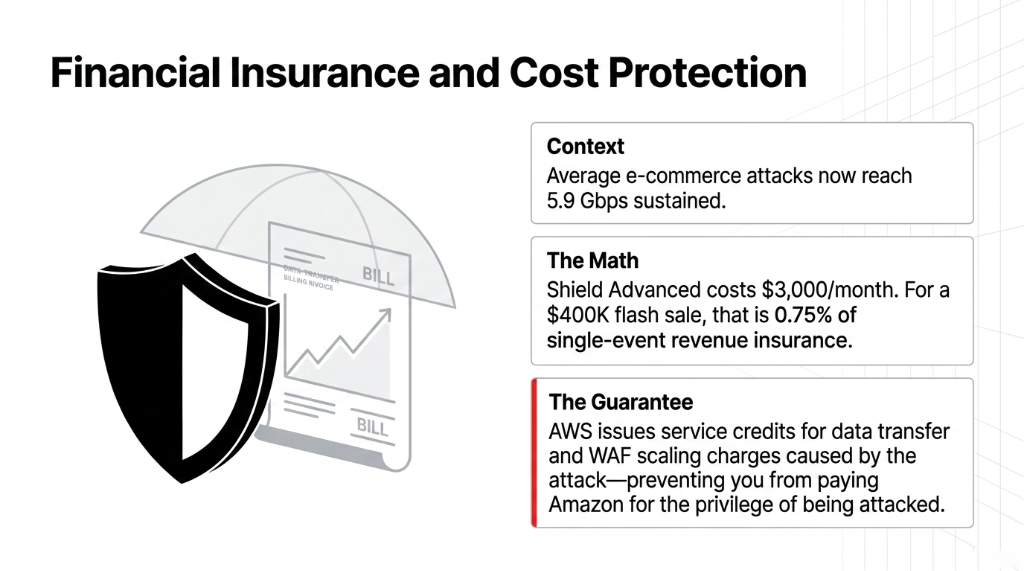
▸ Layer 1 — Shield Advanced on every protected resource. EC2 instances with Elastic IPs, ALBs, CloudFront distributions, Route 53 hosted zones, and Global Accelerator endpoints. At $3,000/month (1-year commitment), this covers all accounts under your consolidated billing family — not per resource. For a brand running a $400K flash sale, $3,000/month is 0.75% of single-event revenue insurance.
▸ Layer 2 — AWS WAF with custom rate-based rules. Shield Advanced includes AWS WAF at no extra cost for protected resources, up to 50 billion requests/month. Pre-configure rate-based rules that cap requests per IP to 500/5-minutes for your checkout API. Normal customers never hit 500 requests in 5 minutes. Bots do.
▸ Layer 3 — CloudFront in front of everything. Not optional. CloudFront's 600+ edge nodes absorb volumetric attacks at the edge, nowhere near your origin. Enable origin shield. Set your origin server's security group to accept traffic ONLY from CloudFront IP ranges.
▸ Layer 4 — Route 53 health checks and DNS failover. Configure health checks on your primary checkout endpoints with a 10-second failure threshold. If your origin goes down, Route 53 fails over to a static error page on S3 that collects email sign-ups. We have seen brands capture 3,100 emails during a 9-minute outage, converting 22% during a re-sale the following week.
▸ Layer 5 — DRT pre-authorization. Before your sale, file a proactive engagement request with the DDoS Response Team through the Shield console. Give them your architecture diagram, expected traffic baselines, sale windows, and emergency contacts. This 45-minute exercise has been the difference between a 9-minute outage and zero downtime for clients we have managed.
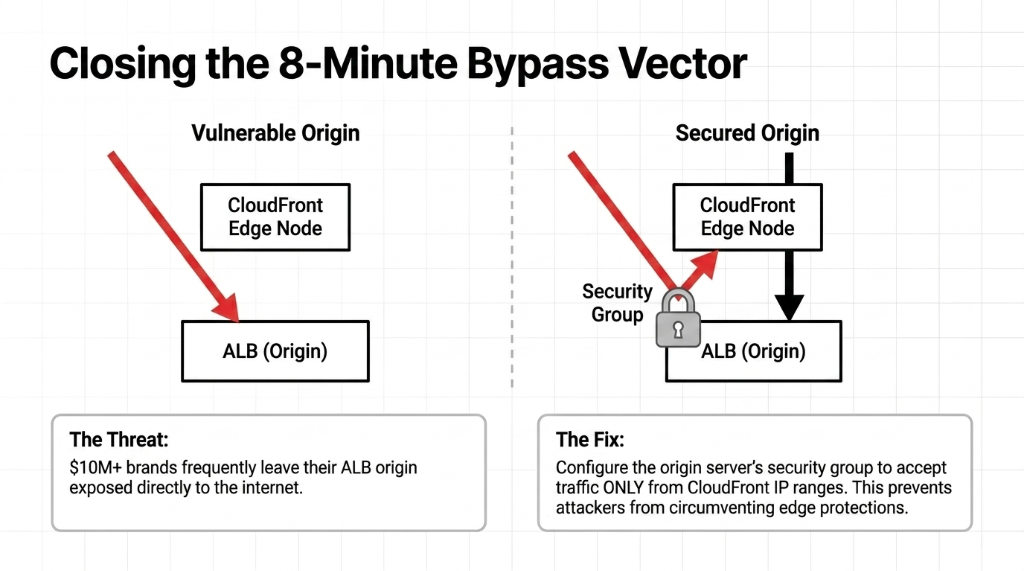
The CloudFront origin lockdown is part of the broader security architecture we build during our cloud consulting services engagements — because surprisingly many $10M+ brands have their ALB origin exposed directly to the internet. An 8-minute configuration that closes the most common bypass vector we see.
13 Days Before Your Flash Sale: The Exact Prep Timeline
This is what "ready" actually looks like — not just "Shield is turned on":
| Day | Action | Why It Matters |
|---|---|---|
| Day -13 | Enable Shield Advanced, enroll all resources, confirm DRT proactive engagement | System needs 7-14 days to baseline normal traffic |
| Day -13 to -7 | Let system baseline your normal traffic patterns | Auto Layer 7 mitigation flies blind without baseline data |
| Day -7 | Simulate load test (50,000 concurrent users), review Shield event logs | Identifies false positives before real customers arrive |
| Day -5 | Review and tighten WAF rules based on load test data; add IP reputation lists | Fine-tuned rules reduce false positive rate during surge |
| Day -3 | Pre-authorize DRT engagement; share sale timing, expected peak RPS, architecture | DRT can pre-stage mitigations for anticipated vectors |
| Day -1 | Confirm CloudWatch alarms firing; verify DDoS cost protection active | Last chance to catch configuration gaps |
| Sale Day | Monitor Shield console and CloudWatch in real time; DRT on speed dial | Response time is everything during a live attack |
The Brands That Skip Days -13 to -7
They are the ones calling us during the attack. Shield Advanced's automatic application layer mitigation needs baseline data to distinguish your 40,000 real buyers from 40,000 bot requests. Without that baseline, every request looks the same to the engine.
The Numbers That Should Keep You Up at Night
Application-layer DDoS attacks increased 93% year-over-year. The average attack against an e-commerce site during a peak sale period now runs at 5.9 Gbps sustained — which exceeds the raw capacity of most unprotected ALBs within 3 minutes.
The Cost of Downtime During a Flash Sale
$1,056/Minute
Lost revenue for a brand doing $380,000 in a 6-hour flash sale window during downtime
$9,500 in 9 Minutes
Direct GMV loss from a single outage — plus 67% cart abandonment spike that does not fully recover
$3,000/Month Insurance
Shield Advanced cost — 0.75% of a $400K flash sale. Includes DDoS cost protection credits for attack-caused scaling charges
Shield Advanced's cost protection means AWS issues service credits for the data transfer and WAF scaling charges caused by the attack. You lose the GMV. You do not also pay Amazon for the privilege of being attacked.
What Shield Advanced Does NOT Cover (Read This Carefully)
Frankly, the documentation buries this and it costs people money.
Shield Advanced does not protect resources you have not explicitly enrolled. If your checkout API sits on an EC2 instance with an Elastic IP that you forgot to add to Shield Advanced protections, that instance is on its own. We have seen a single unenrolled EC2 node become the kill shot in an otherwise well-protected architecture.
The Coverage Gaps That Cost Money
Advanced WAF features like Bot Control, CAPTCHA rules, or WebACLs exceeding 1,500 WCUs have separate charges — not included in Shield Advanced
Resources in non-subscribed accounts — even within the same organization, unless explicitly added to the Shield Advanced subscription
Non-AWS infrastructure — if your origin is partially on-premises or on another cloud provider, Shield stops at the AWS boundary
Retroactive enrollment — DDoS cost protection only applies to resources enrolled before the attack begins. Signing up during the attack does not qualify for credits on that event.
New Region Coverage: Asia Pacific and Latin America
AWS Shield Advanced is now available in the Asia Pacific (Thailand) and Mexico (Central) regions as of May 2025, bringing coverage to all major commercial regions — relevant if you are running multi-region flash sales for Southeast Asian or Latin American audiences.
For brands layering AI-driven recommendation engines and dynamic pricing on their flash sale infrastructure, the DDoS protection layer is non-negotiable — our AI e-commerce solutions always deploy behind Shield Advanced because a compromised personalization endpoint during a sale event is a direct path to $0 revenue.
Frequently Asked Questions
Does AWS Shield Standard protect my flash sale for free?
AWS Shield Standard is automatically enabled for all AWS customers at no cost and blocks 96% of common Layer 3 and Layer 4 attacks like SYN floods and UDP reflection. It does not protect against Layer 7 application-layer attacks — the type most commonly used during flash sales — so high-GMV events require Shield Advanced.
How much does AWS Shield Advanced cost?
Shield Advanced costs $3,000/month on a 1-year subscription commitment, plus data transfer out fees (approximately $0.025-$0.050/GB depending on the service and region). It covers all accounts under a consolidated billing family under one subscription fee, and includes AWS WAF at no extra charge up to 50 billion requests/month.
How quickly does AWS Shield Advanced stop a DDoS attack?
For known attack signatures at Layer 3/4, automatic mitigations fire in under 1 second. For application-layer attacks, the automatic mitigation engine detects and deploys WAF rules within seconds to minutes depending on attack pattern complexity. For sophisticated multi-vector attacks, the 24/7 DDoS Response Team typically achieves full mitigation within 15-40 minutes.
Can AWS Shield Advanced protect my origin server if I am using CloudFront?
Yes — but you must configure your origin server's security group to accept traffic ONLY from CloudFront IP ranges. If your ALB or EC2 origin is exposed directly to the internet, attackers can bypass CloudFront entirely and hit your origin directly, circumventing Shield protections at the edge. This is a 10-minute configuration fix that most teams overlook.
Does Shield Advanced prevent all DDoS-related AWS billing spikes?
Shield Advanced includes DDoS cost protection, meaning AWS issues service credits for scaling charges on ELB, CloudFront, EC2, and Route 53 caused by a DDoS attack. This coverage only applies to resources already enrolled in Shield Advanced before the attack begins — retroactive enrollment does not qualify for cost protection on past events.
The Insider Takeaway
Stop leaving your highest-revenue events unprotected. Shield Standard blocks 96% of Layer 3/4 attacks for free — but Layer 7 HTTP floods are exactly what hits during flash sales, and Standard does not touch them. Shield Advanced at $3,000/month gives you automatic Layer 7 mitigation trained on petabytes of attack data, 24/7 DDoS Response Team access, and cost protection credits so you do not pay Amazon for the privilege of being attacked. But it needs 13 days of baseline data before your sale. The DRT cannot help you if you call them after the attack starts. Call us before.
Your Next Flash Sale Is Already on Someone's Target List
Competitors know your sale windows. Botnet-as-a-service tools cost less than $50/hour. And the attack vector shifts to Layer 7 HTTP floods that look exactly like real customer traffic during peak events.
Book our free 15-Minute Cloud Security Audit. We will review your current AWS architecture, identify unprotected resources, and give you a pre-sale hardening checklist on the first call. No prep required. No sales deck.
Book Your Free Flash Sale Security Audit