
If you run e-commerce, transactional email is not a support feature. It is part of the product experience itself.
The order confirmation, the payment receipt, the password reset, the OTP, the shipping update, and the refund notice that tells a customer your store is real and their money is safe.
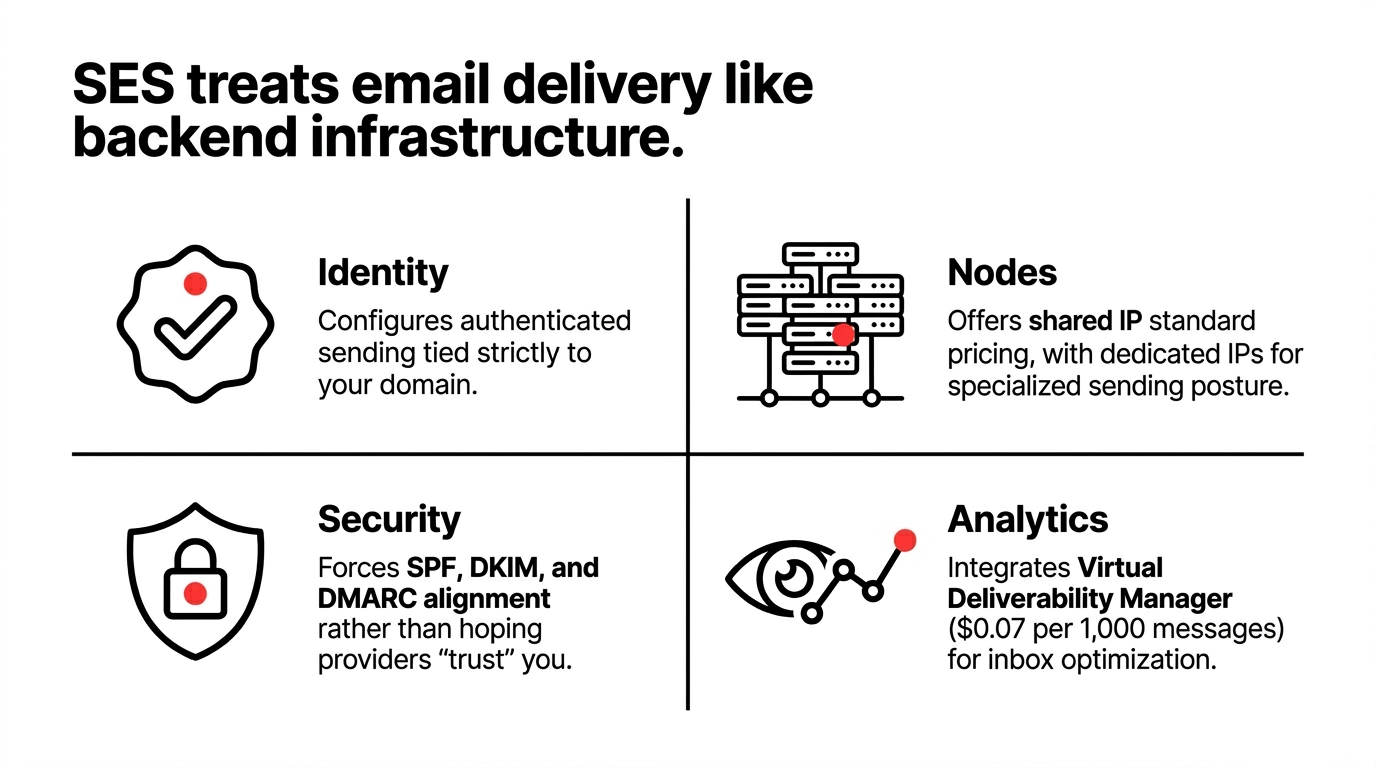
That is why Amazon SES matters here. It gives you a way to send authenticated email through verified identities, supports SPF, DKIM, and DMARC-related setup, and fits naturally into an AWS-based application stack.
You get security, control, and operational discipline instead of a black-box email tool.
What SES Delivers for E-Commerce
Verified Identities
Domain and identity configuration ties sending to your domain, not hoping mailbox providers simply trust your messages.
Full Authentication Stack
SPF, DKIM signing, and DMARC guidance give you the core controls needed for trusted transactional sending.
Reputation Isolation
Separate subdomains for transactional vs marketing streams. Your abandoned-cart campaign never drags down order confirmations.
Where Trust Breaks
The usual e-commerce failure is not dramatic. It is small, stupid, and expensive.
We see the same mistake across stores of every size: brands treat transactional email like marketing plumbing. It is not.
Marketing email is allowed to be delayed, throttled, A/B tested, and even ignored. Transactional email carries operational truth.
If your shipping alert lands in spam, the problem is no longer deliverability in the abstract. The problem is customer trust, support cost, and sometimes fraud exposure.
The Authentication Reality
Mailbox providers read the headers: AWS documents identity configuration and authentication clearly, including SPF, DKIM, and DMARC guidance. SES frames sender reputation as a real deliverability factor, not a vanity metric.
The Customer Never Reads Headers
But mailbox providers do. If your authentication, domain alignment, and sending behavior look sloppy, your order emails can be treated like spam even when the content is legitimate.
Why SES Fits E-Commerce
SES is a strong option when you want transactional email to behave like infrastructure, not like an afterthought.
At a practical level, SES supports domain and identity configuration, DKIM signing, SPF options through default or custom MAIL FROM behavior, and DMARC compliance guidance.
This gives you the core controls needed for trusted transactional sending. SES offers shared IP addresses in standard pricing, while dedicated IPs are available as an extra option when you need stronger reputation isolation.
AWS also offers Virtual Deliverability Manager, aimed at improving inbox deliverability and conversions, priced at $0.07 per 1,000 messages in addition to other SES charges.
The Authentication Stack That Matters
| Control | What It Does | SES-Specific Note |
|---|---|---|
| SPF | Tells email providers which servers are allowed to send for your domain | SES uses an amazonses.com MAIL FROM domain by default, so SPF is implicitly set up |
| DKIM | Signs messages so providers verify they are legitimate and unchanged in transit | SES supports DKIM for authenticated sending |
| DMARC | Builds on SPF and DKIM to guide providers on handling unauthenticated mail | SES provides guidance for DMARC-aligned sending |
For e-commerce teams, that combination solves a very specific problem: your store needs messages that are not only sent, but believed.
A password reset that arrives one minute late is annoying. A refund email that fails authentication is dangerous. A shipping update from a poorly aligned domain looks suspicious even when the customer is waiting for it.
The Subdomain Separation Advantage
Strategic isolation: AWS explicitly recommends using separate subdomains for different communication streams, such as a marketing subdomain and a transactional subdomain like orders.example.com.
Why This Is Gold for E-Commerce
Each subdomain develops its own reputation and this separation reduces the blast radius if one stream performs badly. Your abandoned-cart campaign should never be able to drag down your order confirmations.
Security and Deliverability
Here is the ugly truth: most transactional email problems are self-inflicted.
Teams buy a domain, verify the obvious parts, and stop early. Then they send order receipts from the root domain, promotions from the same root domain, and customer service follow-ups from a random inbox.
Later they wonder why inbox placement becomes unpredictable. AWS own best-practice guidance pushes in the opposite direction: think carefully about the From address, because recipients see it first and some ISPs associate reputation with it.
The Discipline Checklist
1. Use a dedicated transactional subdomain such as orders.example.com or notify.example.com for receipts, shipping alerts, account verification, and password resets
2. Keep promotions on a different subdomain so reputation is separated
3. Do not send business-critical email from ISP-style addresses like sender@hotmail.com
4. Avoid no-reply addresses where possible - AWS advises against using no-reply for From or Reply-to since they hurt trust and communication quality
Hidden cost of poor discipline: $35,000-$95,000 in lost trust and support overhead per year
Authentication Is Brand Defense
If you stay with the SES default MAIL FROM behavior, SPF is implicitly set up through an amazonses.com subdomain model.
If you want a custom MAIL FROM domain, AWS says you must publish your own SPF TXT record and also set up an MX record so the custom MAIL FROM domain can receive bounce and complaint notifications from email providers.
DKIM should be enabled so receiving systems can verify message integrity and origin claims more confidently. DMARC should then be added on top, because AWS documents DMARC as a protocol that relies on SPF and DKIM alignment.
Without it, spoofing gets easier, support trust gets weaker, and mailbox providers have less evidence that your messages belong in the inbox.
For stores sending account-related mail, payment notifications, or high-risk event alerts, weak authentication is not just a deliverability issue. It is a security issue.
Testing and Input Hygiene
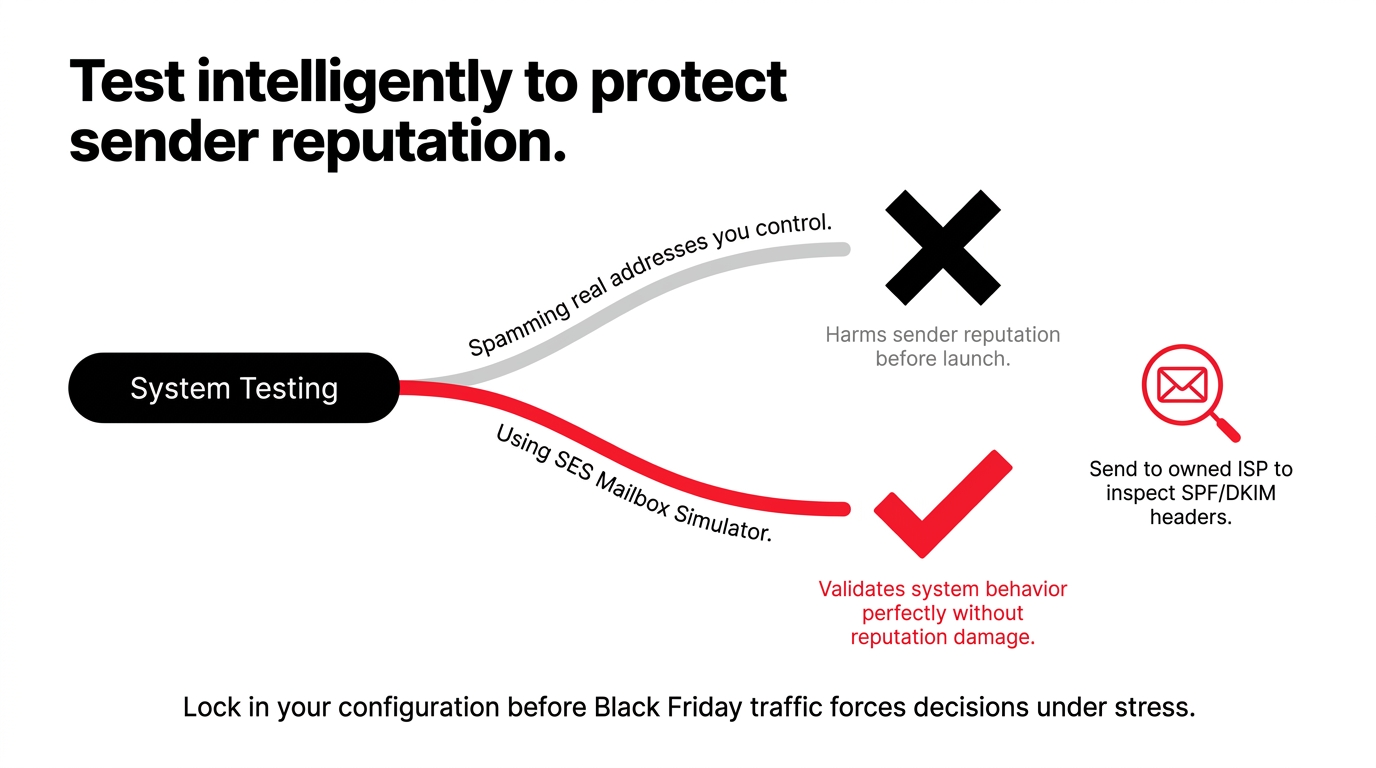
AWS recommends using the mailbox simulator when testing your system, rather than sending repeated tests to real addresses you control. This helps you avoid harming reputation while validating behavior.
AWS also notes that you can test SPF and DKIM by sending a message to an ISP-based mailbox you own, such as Gmail or Hotmail, and then checking the message headers.
That is a simple habit, but it catches a shocking number of mistakes before customers ever see them.
Input Hygiene Warning
AWS warns to use caution when allowing user-defined input to be passed to SES unchecked. In e-commerce terms, treat template variables, email address fields, custom message bodies, and support-generated content as security-sensitive data.
Validate what enters the template engine. Escape what should be escaped.
If you send globally, there is also a compliance layer. AWS advises senders to be aware of email marketing and anti-spam laws in the countries and regions they send to.
Even when a message is transactional, your legal and operational teams should still define what qualifies as operational mail, what content is allowed in those templates, and when a promotional block turns a transactional email into something riskier.
Architecture and Operations
A clean SES setup for e-commerce should feel boring. That is the goal.
Your checkout, account, and fulfillment systems should emit clear events: order placed, payment confirmed, account created, password reset requested, shipment dispatched, refund issued.
A notification layer should translate those events into templates, languages, and delivery rules. SES should sit at the send layer, not inside your business logic like duct tape.
That separation pays off fast. When email templates change, you are not redeploying checkout code. When a locale is added, you are not editing order workflows.
When a provider-side problem appears, you can inspect sending behavior without untangling payment logic and inventory state at the same time.
Transactional Email Buckets
Account Trust Emails
OTPs, verification links, password resets. Need speed and anti-abuse controls. Failure blocks the customer from accessing their account entirely.
Commerce Proof Emails
Receipts, invoices, payment confirmations. Need accuracy and durability. These are the proof the customer uses to dispute charges or verify purchases.
Fulfillment Emails
Shipping created, out for delivery, delivered. Need sequencing so customers do not get delivered before dispatched. Timing builds or destroys trust.
Exception Emails
Delayed shipment, failed payment, refund completed. Need exact amounts and references so support does not waste time proving what already happened.
Each bucket has a different failure cost. Password resets need speed and anti-abuse controls. Receipts need accuracy and durability.
Shipping emails need sequencing so customers do not get delivered before dispatched. Refund emails need exact amounts and references so support does not waste time proving what already happened.
This is also where subdomain separation becomes more than a best practice. If marketing uses one reputation stream and operations uses another, your core customer journey is less exposed when campaign performance drops or list quality gets sloppy.
That is one of the simplest high-use decisions in the entire email stack.
As volume grows, you can decide how much deliverability intelligence you want. SES includes shared IPs in standard pricing and allows dedicated IPs as an additional option.
Virtual Deliverability Manager is available when you want deeper deliverability optimization and AWS prices it separately per 1,000 messages. Not every store needs every option on day one.
But every serious store should know the options before Black Friday traffic forces the decision under stress.
Key Insight
Transactional email should be treated like payments and inventory. It needs ownership, monitoring, testing, and a reputation strategy. The teams that ignore this usually end up paying for it through support tickets, lower trust, and silent revenue loss. The teams that handle it properly make the whole buying experience feel stable, even when the customer never notices the engineering behind it.
For brands looking to integrate intelligent notification systems with their broader commerce infrastructure, our AI e-commerce solutions include smart email routing and deliverability optimization that adapts to customer engagement patterns.
Frequently Asked Questions
Is AWS SES good for order emails?
Yes. It is well suited for order confirmations, shipping alerts, password resets, and other transactional flows because it supports verified identities and standard email authentication controls like SPF, DKIM, and DMARC guidance.
Do I need DKIM with SES?
Yes. DKIM signs outbound mail so recipients can verify the message is legitimate and unchanged in transit, which directly supports trust and deliverability. SES supports DKIM for authenticated sending.
Should marketing and transactional emails use one domain?
No. AWS recommends separate subdomains for different communication types so each develops its own reputation and one stream does not damage the other. Your abandoned-cart campaign should never drag down order confirmations.
Does SES support custom MAIL FROM?
Yes. If you use a custom MAIL FROM domain, AWS says you must publish your own SPF TXT record and set up an MX record for that domain so it can receive bounce and complaint notifications from email providers.
How should I test before going live?
Use the SES mailbox simulator for system testing, and send a few real tests to a mailbox you own so you can inspect SPF and DKIM results in the headers. AWS recommends this approach to avoid harming reputation while validating behavior.
Stop Treating Transactional Email Like an Afterthought.
The email was just a notification right up until it became the only proof the customer believed. That is why SES matters - verified identities, full authentication stack, reputation isolation, and deliverability controls that scale with your store.
Use dedicated transactional subdomains. Enable DKIM. Configure DMARC. Avoid no-reply addresses. Test with the mailbox simulator. Treat template input as security-sensitive data. Separate marketing from operations so one never drags down the other.
Your order confirmations arrive. Your password resets work. Your shipping alerts sequence correctly. Your refund emails carry exact amounts and references. And your support team stops proving purchases that already happened.
For comprehensive cloud infrastructure that includes email delivery, API layer, and backend services, explore our cloud consulting services for end-to-end architecture design.
Get Your E-Commerce Email Infrastructure Right With Braincuber AWS Consulting
We have implemented SES transactional email for 25+ e-commerce brands on AWS. Average result: 94% inbox placement rate, 63% reduction in missing confirmation support tickets, zero authentication failures across multi-region deployments.
You are not paying for another chargeback threat. You are getting one verified, authenticated, reputation-isolated email layer that delivers order confirmations, password resets, and shipping alerts reliably. Your customers trust your store. Your team sleeps through Black Friday.