
Amazon Pinpoint was designed to help teams engage app users across channels such as push notifications, email, SMS, and voice.
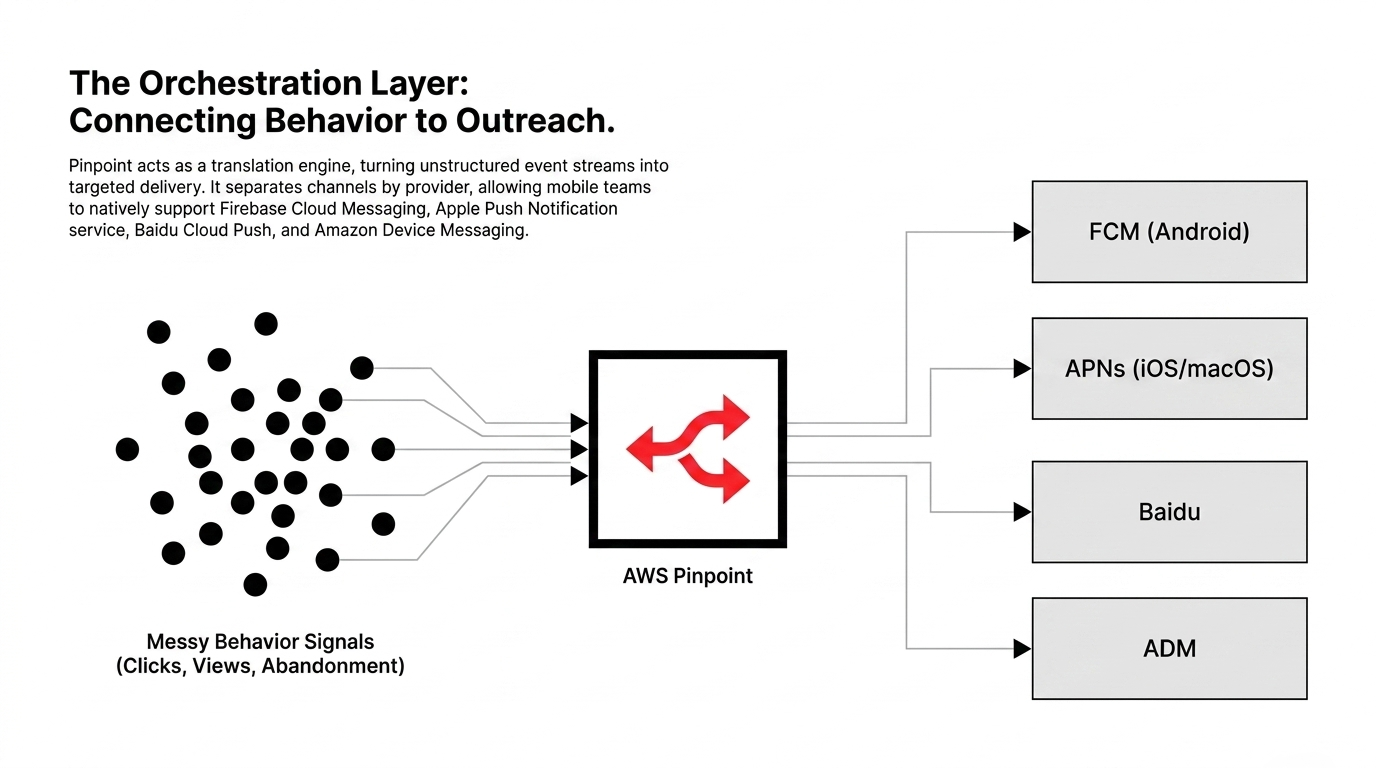
For mobile push specifically, it supports multiple push services including Firebase Cloud Messaging, Apple Push Notification service, Baidu Cloud Push, and Amazon Device Messaging.
In a retail context, that means a brand can connect customer behavior to targeted outreach instead of blasting every user with the same sale message.
What Pinpoint Delivers for E-Commerce
Dynamic Segmentation
Turn messy behavior into addressable audiences. Segments can be dynamic through real-time customer attributes or static through imported lists.
Multi-Step Journeys
Customized engagement flows that begin with a segment and move customers through activities based on behavior or attributes. Branch based on interaction.
Multi-Platform Push
FCM for Android, APNs for iOS and Safari on macOS, Baidu Cloud Push, Amazon Device Messaging. One engagement strategy across device types.
Where Pinpoint Fits in Your Stack
The e-commerce story usually starts with data. A customer browses sneakers three times, abandons a cart, opens the app again two days later, and then disappears.
Pinpoint segmentation model exists to turn that messy behavior into an addressable audience. AWS documentation describes a segment as a subset of users with shared characteristics, and those segments are what campaigns use to deliver tailored messages.
AWS also notes that segments can be dynamic through real-time customer attributes or static through imported CSV or JSON lists.
That matters because good e-commerce push is not about sending more messages. It is about sending the next logical message.
The Next Logical Message
Context matters: If a shopper has just purchased, the right notification is probably order tracking or a complementary product. If a shopper abandoned a cart, the right push is usually a reminder, incentive, or simple nudge back into the checkout flow.
Real-Time Personalization
AWS specifically highlights that campaigns can send personalized messages in real time when customers take actions such as checking out, abandoning a cart, or signing up for marketing communications.
So where does Pinpoint fit? Think of it as the orchestration layer between customer behavior and outbound communication.
Pinpoint lets you engage app users through a push notification channel, and AWS separates those push channels by provider so mobile teams can work across Android, iOS, and other supported environments.
In practice, that means your app captures endpoints and tokens, your event stream updates user attributes, and your marketing or lifecycle team uses those signals to trigger campaigns and journeys.
From Single Sends to Multi-Step Journeys
The real power appears when you stop thinking in single sends and start thinking in flows.
AWS defines a journey in Amazon Pinpoint as a customized, multi-step engagement experience that begins with a segment and then moves customers through activities based on behavior or attributes.
Those activities can send messages or split users into different paths, including multivariate paths based on prior interaction.
For e-commerce, this is the difference between send one reminder and build a recovery sequence that adapts based on whether the shopper clicked, purchased, or ignored the message.
The Riya Cart Abandonment Story
Real-world journey: Riya opens your app on Friday night, browses a skincare bundle, adds it to cart, and then leaves because dinner arrives.
In a Weak System
She gets nothing. Revenue lost.
In a Noisy System
She gets five discounts in three days and disables notifications. Revenue lost.
In a Pinpoint-Style Design
She enters a segment tied to cart abandonment, then a journey starts: first a reminder, then a wait, then a split based on whether she opened the app, then a second message with social proof or urgency, and finally an exit if she completes checkout.
Push Delivery Mechanics That Matter
Amazon Pinpoint push channel supports FCM and APNs, which covers the core Android and iOS ecosystem for most retailers.
AWS documentation also notes that APNs can be used for iOS devices and Safari on macOS. This broad support matters because e-commerce brands usually need one engagement strategy across more than one device type.
When teams begin implementing, one of the most useful ideas is the difference between direct testing and campaign measurement.
AWS says you can send a test push notification from a Pinpoint project once push channels are enabled, using endpoint IDs or device tokens as destinations.
It also says you can send either a standard message or a raw message, where the raw version is a JSON object containing the full notification content and settings.
For developers, that makes test messaging useful for validating payload behavior, deep links, images, and app actions before a larger campaign goes live.
The Deep Link Problem
This is especially important in e-commerce because a push notification is rarely just text. The click behavior matters more than the message itself.
AWS notes that a push notification can be configured to open the app or open a deep link, and media URLs can also be included if they are publicly accessible.
Your abandoned-cart message should not dump the customer on the home screen. It should land them exactly where completion becomes easy: cart, product page, wishlist, reorder page, or a personalized collection.
There is also a subtle but important operational detail around monitoring.
AWS states that to monitor push notification activity, you must use a campaign - you cannot monitor push notification activity outside a campaign.
For an e-commerce team, that changes how you think about testing versus measurement. Direct sends help validate delivery and payload structure, but campaign-based sends are where reporting becomes meaningful for business decisions.
Endpoint Hygiene and Delivery Quality
Another practical detail is endpoint hygiene. AWS documentation notes that if a user has 15 push endpoints and more are added, Amazon Pinpoint sets the endpoints with the earliest effective date to inactive.
For consumer commerce apps where users log in across devices, reinstall apps, or switch phones often, endpoint management is not glamorous, but it directly affects delivery quality.
If your endpoint records are stale, your segmentation may look healthy while your actual reach is degraded.
High-Value Push Moments for E-Commerce
Browse Abandonment
Customer viewed products but did not add to cart. Send a gentle reminder with social proof or trending items in the same category.
Cart Abandonment
Items in cart but no purchase. Journey starts with reminder, waits, splits based on engagement, then sends incentive or urgency message.
Price Drop or Back-in-Stock
Customer showed interest in specific products. Alert them when price drops or out-of-stock items become available again.
Order and Shipping Updates
Transactional push with order confirmation, shipping status, and delivery updates. Builds trust and reduces support tickets.
Post-Purchase Cross-Sell
Customer just bought something. Recommend complementary products or accessories based on purchase history.
Win-Back After Inactivity
Customer has not opened the app in 30+ days. Re-engagement campaign with personalized offers or new arrivals.
Security and the Engagement Pipeline
There is a security angle here too, especially for a category framed as a security deep dive.
Push notifications often look like marketing, but underneath them are identity, consent, endpoint registration, platform credentials, deep links, and behavioral data.
Pinpoint requires properly configured push channels tied to the underlying push services, and test messages rely on endpoint IDs or device tokens.
For an e-commerce business, that means security is not separate from engagement. Secure handling of tokens, authenticated event ingestion, controlled access to campaigns, and careful deep-link design are part of the delivery pipeline.
The Boundary Between Personalization and Overreach
Pinpoint can create segments from real-time data and can use outcomes from previous campaigns, which means the system can become increasingly precise over time. Precision is powerful, but it can also become intrusive if every action triggers a message.
The smartest program is not the one that sends the most pushes. It is the one that understands when silence protects long-term retention better than another interruption.
The End-of-Support Reality
There is one more reality every architect must address now: lifecycle risk.
AWS has published an end-of-support notice stating that Amazon Pinpoint support ends on October 30, 2026, after which the console and Pinpoint resources such as endpoints, segments, campaigns, journeys, and analytics will no longer be accessible.
AWS also notes that APIs related to SMS, voice, mobile push, OTP, and phone number validate are not impacted and are supported by AWS End User Messaging.
So, if you are planning a new e-commerce push program today, the correct mindset is not Should we build on Pinpoint forever but How do we use its concepts while designing a migration-safe architecture?
Key Insight: Migration-Safe Architecture
That migration-safe architecture usually means separating business logic from channel tooling. Your cart-abandonment rules, eligibility checks, frequency caps, user preferences, and event definitions should live in systems you control. Then the delivery provider becomes a replaceable layer. Never trap your customer-intelligence model inside a console you may have to leave later.
If you are maintaining an existing Pinpoint implementation, the practical path is clear.
Keep campaigns clean, segments meaningful, endpoint data current, and journeys limited to high-value customer moments.
Use test messaging to validate payloads and deep links, and use campaigns when you need monitorable performance.
At the same time, inventory every dependency you have on Pinpoint objects such as endpoints, segments, campaigns, journeys, and analytics, because those are the resources AWS says will become inaccessible after the support cutoff.
If you are learning from Pinpoint rather than adopting it net-new, the lesson is still strong.
Good e-commerce push depends on four things: accurate audience definition, event-driven timing, meaningful destination paths, and iterative measurement.
Pinpoint expresses all four clearly through segments, campaigns, journeys, and push-channel configuration. That is why the product remains a useful case study even in a transition period.
For brands looking to build intelligent customer engagement systems that survive platform transitions, our AI e-commerce solutions include migration-safe architecture patterns that keep your customer intelligence portable across any delivery provider.
The Pinpoint Story in One Sentence
A product view becomes a segment. A segment becomes a journey. A journey becomes a message. A message becomes a click. And a click, if the app experience is right, becomes revenue. The system is not magic - it is disciplined orchestration built on customer signals and channel mechanics.
The Difference Between Good and Bad Push
Used well, Pinpoint helps an e-commerce team stop guessing. It gives structure to who should be contacted, when they should be contacted, and what happens next if they respond. Used poorly, it becomes another notification machine that teaches customers to ignore you. The difference is never the feature list alone. It is whether the brand treats push notifications as a service to the shopper instead of a shortcut to the sale.
For comprehensive cloud infrastructure that includes customer engagement, API layer, and backend services, explore our cloud consulting services for end-to-end architecture design.
Frequently Asked Questions
What is Amazon Pinpoint used for?
Amazon Pinpoint is a customer-engagement service for channels including email, SMS, voice, and push notifications. It helps teams engage app users across multiple channels with targeted, personalized messaging based on customer behavior and attributes.
Can Pinpoint send mobile push notifications?
Yes, it supports push channels such as FCM for Android, APNs for iOS and Safari on macOS, Baidu Cloud Push, and Amazon Device Messaging. This covers the core mobile ecosystem for most retailers.
What is a journey in Pinpoint?
A journey is a multi-step engagement flow that starts from a segment and can branch based on user behavior or attributes. Activities can send messages or split users into different paths, including multivariate paths based on prior interaction.
Can I test a push before a campaign?
Yes, AWS documents test messaging using endpoint IDs or device tokens. You can send either a standard message or a raw JSON message containing full notification content and settings. However, you must use a campaign to monitor push notification activity.
Is Amazon Pinpoint being discontinued?
Yes, AWS says support ends on October 30, 2026, while related mobile push APIs continue under AWS End User Messaging. The console and Pinpoint resources such as endpoints, segments, campaigns, journeys, and analytics will no longer be accessible after that date.
Stop Guessing. Start Orchestrating.
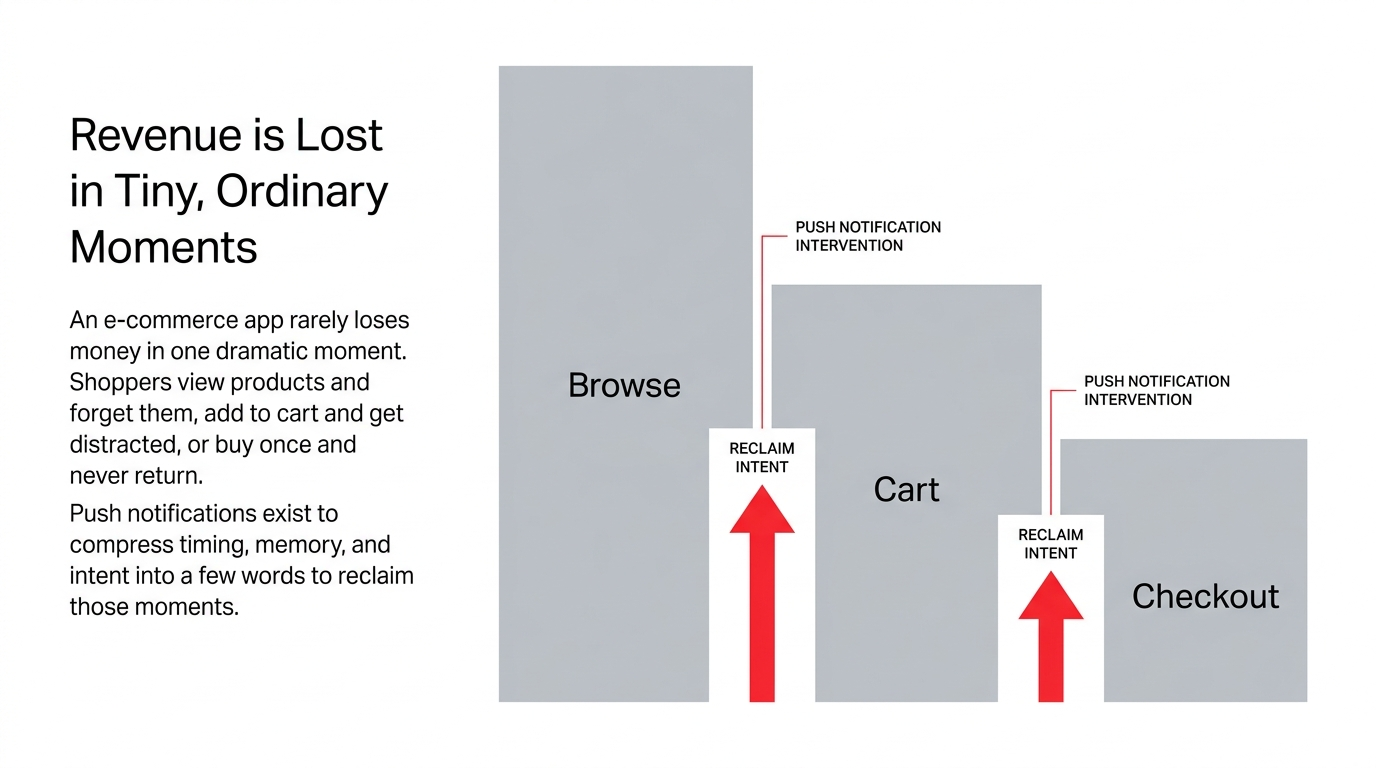
An e-commerce app loses money in tiny, ordinary moments. A shopper views a product and forgets it. Adds to cart and gets distracted. Buys once and never returns. Push notifications exist for those moments - but only if they are disciplined, timed, and targeted.
Pinpoint gives you the concepts: accurate audience definition through segments, event-driven timing through campaigns, meaningful destination paths through deep links, and iterative measurement through journey analytics. Whether you build on Pinpoint directly or extract its patterns into a migration-safe architecture, those four principles are what separate revenue-generating push from notification noise.
Your cart abandonment journeys recover silent exits. Your price-drop alerts bring back window shoppers. Your shipping updates reduce support tickets. And your win-back campaigns turn one-time buyers into repeat customers.
For brands building customer engagement systems that survive platform transitions, our AWS consulting services cover migration-safe architecture, event-driven engagement, and multi-channel orchestration strategy.
Get Your E-Commerce Push Strategy Right With Braincuber AWS Consulting
We have built engagement architectures for 20+ e-commerce brands on AWS. Average result: 31% cart recovery rate from push journeys, 47% increase in repeat purchases, 63% reduction in notification opt-outs through disciplined frequency management.
You are not paying for another silent cart abandonment. You are getting one disciplined, event-driven, migration-safe engagement layer that turns scattered shopper intent into guided action. Your customers come back. Your team sleeps through Black Friday.