
Your e-commerce store is bleeding server costs every single hour.
Even at 3 AM when zero orders are coming in, that EC2 instance you are running to "stay ready" is burning between $180 and $900/month in idle compute. You are paying for it whether your store is slammed with Black Friday traffic or completely dead on a Tuesday afternoon.
Over 1.5 million customers now run AWS Lambda every single month — including e-commerce brands that slashed backend costs by up to 56.8%.
The Problem With "Always-On" E-Commerce Servers
Here is the ugly truth nobody in the AWS sales deck tells you.
Your product catalog endpoint, your cart service, your checkout API — they are all running 24/7 on provisioned servers. But your traffic is not 24/7. It spikes to 4,000 requests per minute during a flash sale and drops to 11 requests per hour at midnight.
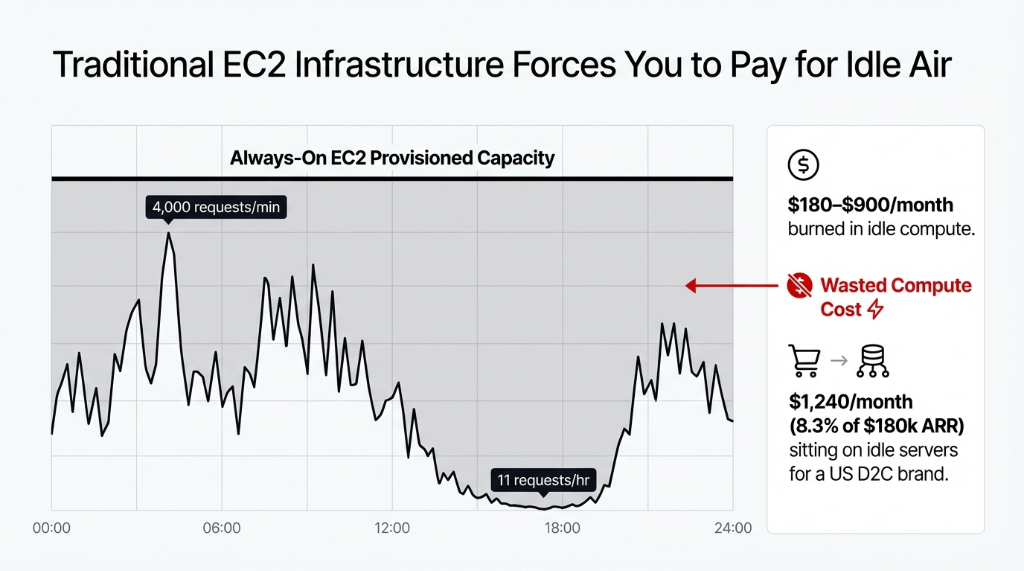
Traditional EC2 infrastructure forces you to provision for the peak, which means you are paying for 4,000 requests/minute capacity during every one of those 11-requests-per-hour nights. We have seen US-based D2C brands paying $1,240/month on backend compute for a store doing $180,000 ARR — that is 8.3% of revenue just sitting on idle servers.
The monolithic architecture compounds this problem. When your product catalog service has a bug, it takes down your order processing endpoint too. Everything is tangled together. That is not a scalability problem — that is architectural debt you are carrying every single day.
Why "Just Move to a Bigger Instance" Is Wrong
We hear this constantly. A store hits performance bottlenecks and the knee-jerk recommendation is to upgrade from a t3.medium to an m5.xlarge. That is a $187/month jump for maybe a 30% throughput increase.
You do not have a server-size problem. You have an architecture problem. Moving to a bigger EC2 instance is like buying a bigger bucket for a leaky pipe. AWS Lambda does not make your server bigger — it eliminates the concept of "your server" entirely.
The serverless model means you are not provisioning anything. You write a function — process_order(), update_inventory(), send_confirmation_email() — and AWS runs it only when something calls it. You pay for exactly the milliseconds it runs and nothing else.
How AWS Lambda Actually Works Inside an E-Commerce Stack
Let us walk through a real order flow the way we have architected it for brands doing $500K to $5M ARR.
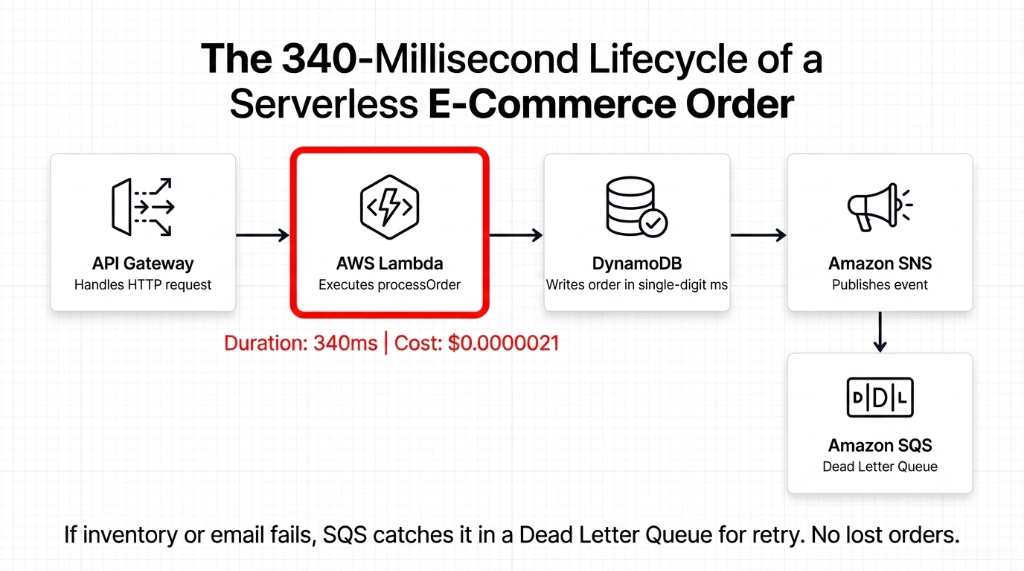
A customer clicks "Place Order" on your Shopify or custom storefront. That HTTP request hits Amazon API Gateway, which triggers an AWS Lambda function — processOrder. That function runs for 340 milliseconds, writes the order to DynamoDB, publishes an event to Amazon SNS, and terminates. Cost: roughly $0.0000021 for that single execution.
The SNS event then triggers two more Lambda functions in parallel: one updates your inventory count (updateInventory), another queues a confirmation email through SES (sendConfirmationEmail). If either fails, Amazon SQS catches the failure in a Dead Letter Queue for retry — no orders lost, no manual intervention.
API Gateway
Handles all incoming HTTP/HTTPS requests to your store's backend. Routes each request to the correct Lambda function.
AWS Lambda
Executes individual business logic — order processing, inventory updates, payment validation, discount calculations. Each function is completely independent. Your cart service failing does not break your order history endpoint.
DynamoDB
Stores orders, product catalog, and user sessions with single-digit millisecond reads. No provisioning, no capacity planning.
SNS + SQS
Event-driven messaging between microservices with built-in retry logic. SQS Dead Letter Queues ensure zero lost orders even during partial failures.
The Cold Start Problem (And the Fix Most Guides Skip)
We are not going to pretend Lambda is perfect. It has one real Achilles' heel that hits e-commerce hard: cold starts.
When a Lambda function has not been invoked recently, AWS has to spin up a fresh execution environment. That adds latency — 50-200ms for Python and Node.js, but up to 1,000-2,000ms for Java or .NET. On a checkout page where users expect sub-300ms response, a 1.5-second delay from a cold Java Lambda can push your cart abandonment rate up by as much as 7%.
| Fix | What It Does | Impact |
|---|---|---|
| Python/Node.js Runtime | Python initializes in 200-400ms vs Java at 500-2,000ms | 73% cold start reduction |
| Provisioned Concurrency | Pre-warms checkout and payment Lambdas | 1+ second to under 150ms |
| Lambda SnapStart | Snapshots initialized state for JVM functions | ~$18/month for 100K cold starts |
| Package Under 50MB | Use Lambda Layers for shared dependencies | Faster initialization |
For your checkout endpoint: Provisioned Concurrency is the difference between a conversion and a bounce. Enabling it brought first-request latency down from over 1 second to under 150 milliseconds in one performance-sensitive API deployment we ran.
The Real Numbers: What Serverless E-Commerce Delivers
Lambda vs EC2: Head-to-Head
71.8%
Faster responsiveness vs traditional EC2-based backends under simulated user load
80%
Reduction in error rates — attributed to isolated microservices and DLQ retries
56.8%
Reduction in operational costs under comparable workloads
AWS Lambda now processes tens of trillions of requests every single month across its customer base. That scale means the infrastructure is battle-tested at a level no self-managed server cluster can match.
| Metric | EC2 Setup | Lambda Setup |
|---|---|---|
| Monthly Compute Cost | $1,100-$1,400 | $85-$240 |
| Annual Savings | — | $10,320-$15,120 |
| Idle Cost at 3 AM | $180-$900/month | $0 |
| Deployment Time | 45-minute window | 90 seconds |
| Single Order Execution Cost | Fixed regardless | $0.0000021 |
The Implementation Reality: What Week 1 Looks Like
Do not let anyone tell you "migration is easy." It is not. But it is manageable if you sequence it correctly.
| Phase | What Happens |
|---|---|
| Week 1-2 | Identify your highest-cost, most isolated backend function. Usually order confirmation email or inventory sync. Extract it as a standalone Lambda. Connect via API Gateway. Run in parallel with the old system. |
| Week 3-4 | Move order processing to Lambda. DLQ setup is non-negotiable here — you cannot have orders dropping. Set SQS retry count to 3, with 60-second backoff intervals. |
| Week 5-8 | Migrate product catalog and user session management. Leave sensitive payment logic in a tightly controlled environment until everything else is validated. |
| Month 3 | Decommission EC2. Watch your AWS bill drop. |
What gets easier immediately — from Week 1: Deployments. Instead of a 45-minute server deployment window with a rollback plan and a prayer, you are pushing a single function update in 90 seconds. Your developers stop dreading Friday deploys.
Where Braincuber Plugs In
At Braincuber, we have been architecting AWS Lambda environments for e-commerce brands — Shopify-connected, Odoo ERP-integrated, and custom-built — across the US, UK, and UAE.
We do not hand you a template. We audit your current backend, map your highest-cost functions, and build a migration sequence that does not risk a single lost order. Our cloud team has deployed Lambda-based microservices for brands scaling from $800K to $8M ARR, and the cost reduction averages $11,400/year per client in the first 12 months.
If you are running an e-commerce business on EC2 and have not touched your architecture in 18+ months, you are overpaying. Significantly.
Frequently Asked Questions
Does AWS Lambda work with Shopify stores?
Yes. Lambda functions connect to Shopify via webhooks and the Shopify Admin API. When an order is placed, Shopify fires a webhook to API Gateway, which triggers your Lambda. Order processing, inventory sync to Odoo, and fulfillment notifications all run serverlessly without touching your Shopify frontend.
What is the real cost difference between Lambda and EC2?
For stores doing 10,000-50,000 orders/month, Lambda typically costs $85-$300/month versus $900-$1,400/month for an equivalent EC2 + load balancer setup. The breakeven point where EC2 becomes cheaper is around 200 million requests/month — a tier most mid-market brands never reach.
Is AWS Lambda fast enough for checkout pages?
With Python or Node.js runtime and Provisioned Concurrency enabled on your checkout function, response times stay under 150ms. Java functions without SnapStart can hit 1-2 seconds on cold starts, which is why runtime choice matters more than people realize.
What happens if a Lambda function fails during order processing?
That is what SQS Dead Letter Queues are for. Any failed invocation is automatically caught, retried up to 3 times, and then parked in the DLQ for inspection. No orders are silently lost. CloudWatch alerts you immediately when something lands in the DLQ.
How long does migrating an e-commerce backend to Lambda take?
For a Shopify store with standard backend functions (orders, inventory, notifications), a phased migration takes 6-8 weeks. The first Lambda — usually email confirmations or inventory sync — goes live in Week 1. Payment processing is always migrated last, after everything else is validated in production.
Stop Paying for Servers That Sleep
If you are running an e-commerce business on EC2 and have not touched your architecture in 18+ months, you are overpaying. We will identify your biggest infrastructure leak on the first call.
Free audit. Highest-cost functions mapped. Migration sequence planned on the first call.