
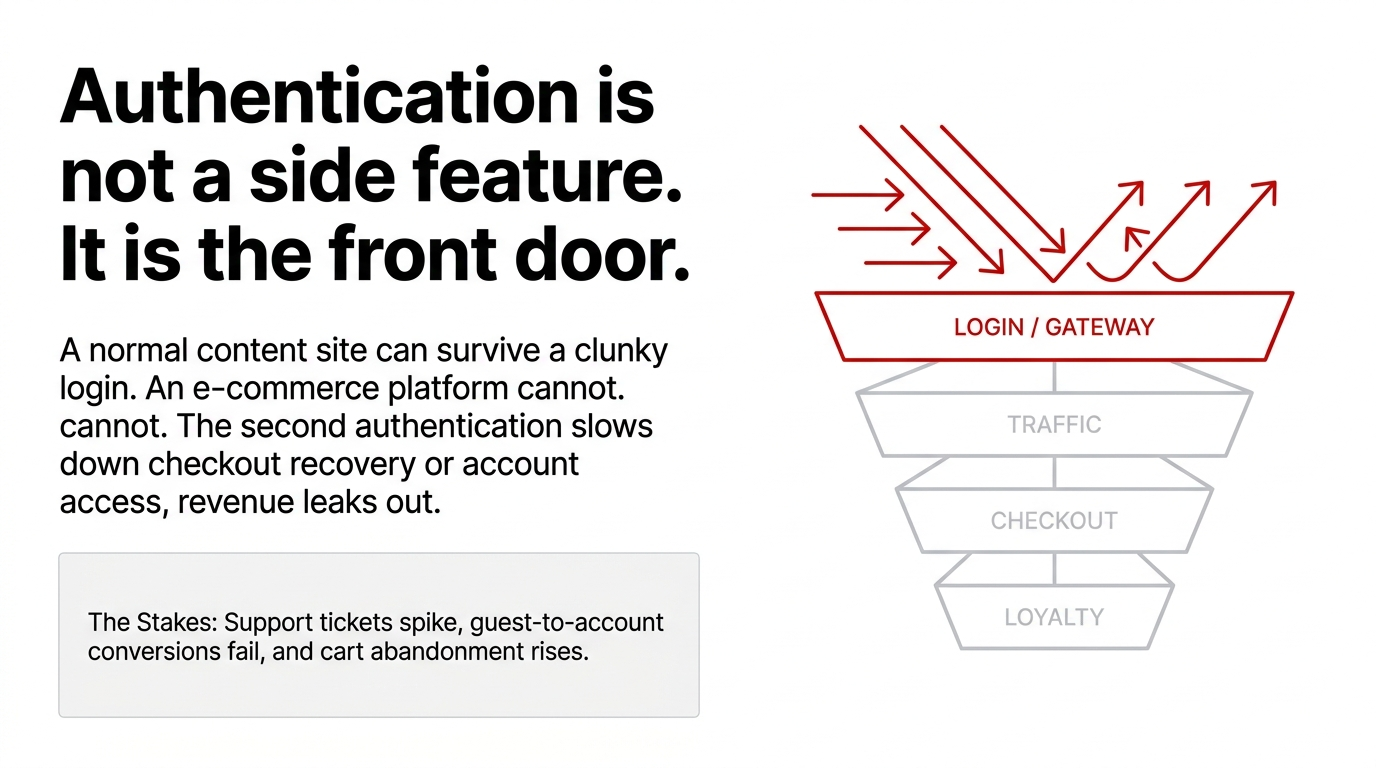
Amazon Cognito is built for exactly this job. It provides a user directory, sign-up and sign-in flows, managed login pages, MFA, passkeys, passwordless options, federation, JWT token issuance, and customization hooks through Lambda.
All of it fits cleanly into the AWS stack. Cognito helps solve commerce authentication problems with user pools, app clients, managed login, adaptive authentication, device trust, and federation patterns designed for production workloads rather than hobby apps.
What Cognito Delivers for E-Commerce
User Pools as OIDC Provider
A user directory and OpenID Connect identity provider handling authentication, tokens, security controls, and app integration in one place.
Adaptive Authentication
Conditionally require MFA or block sign-in when activity appears risky. Compromised credential monitoring and IP geo-velocity tracking built in.
Lambda Triggers
Modify sign-up, sign-in, and profile behavior. Block disposable emails, enrich tokens with loyalty tier, gate wholesale accounts behind approval logic.
Why E-Commerce Breaks at Authentication
A normal content site can survive a clunky login. An e-commerce platform cannot.
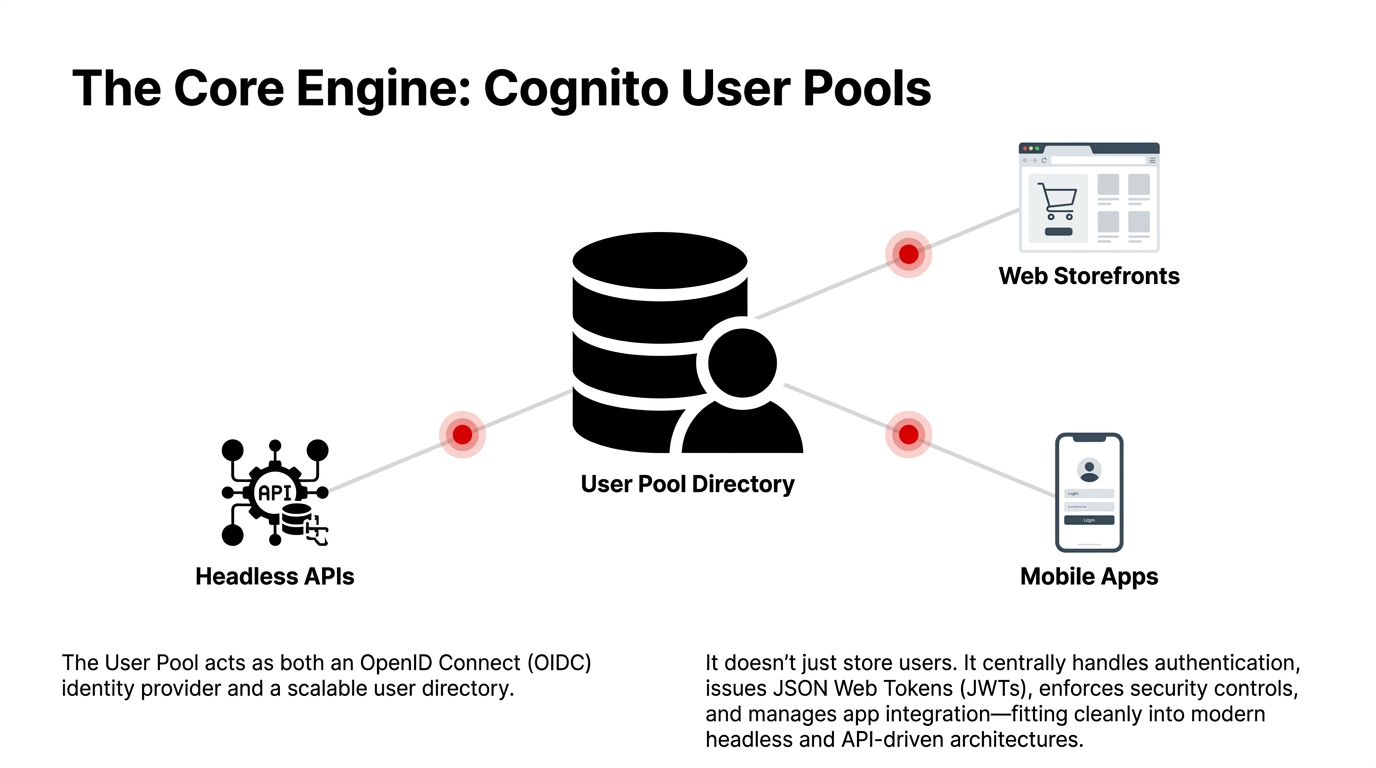
Amazon Cognito user pools act as an OpenID Connect identity provider and user directory for web and mobile apps. They are not just storing users - they are handling authentication, tokens, security controls, and app integration in one place.
Cognito also supports self-service sign-up, administrator-created users, imported users, and just-in-time population through Lambda-backed workflows. This matters when stores migrate from older systems or merge multiple customer databases.
Self-Service Sign-Up Warning
Choose deliberately: AWS explicitly notes that enabling self-service sign-up opens registration to anyone on the internet. This setting should be chosen deliberately, not left on because it looked convenient during setup.
B2B vs B2C Strategy
One brand might want open self-registration for faster account creation, while another wants admin-only account creation for B2B buyers and wholesale portals. The right choice depends on your buyer model.
For commerce teams, that flexibility matters more than people admit. The difference between a smooth migration and a customer service nightmare often comes down to how identities are handled during the transition.
The Cognito Pieces That Matter
The heart of the setup is the user pool. That is where customer identities live, where sign-up and sign-in rules are enforced, and where Cognito issues ID, access, and refresh tokens after successful authentication.
AWS describes the user pool as both a user directory and an OIDC identity provider, which is why it fits neatly into modern storefronts, mobile apps, headless commerce front ends, and API-driven architectures.
Managed Login vs Custom UI
Cognito lets you use managed login pages hosted by AWS or build your own custom front end against the user pools API and AWS SDKs.
Managed login is useful when you want secure sign-up, sign-in, MFA, and password reset pages without building every screen yourself. Custom UI makes sense when brand control, embedded checkout experiences, or highly tailored account journeys are non-negotiable.
The Wrong Call Many Teams Make
They assume custom UI is automatically better because it looks more polished. In practice, managed login can dramatically reduce implementation complexity for stores that care more about getting secure authentication live fast.
Hidden cost: $45,000-$120,000 in custom auth maintenance per year
AWS also notes that managed login supports more authentication options than the classic hosted UI, including passwordless and passkey flows.
Authentication Methods Customers Actually Use
Cognito supports username-password sign-in, passkeys through WebAuthn, and one-time passwords sent by email or SMS. It can also trigger MFA after sign-in and support trusted devices.
That mix is powerful for e-commerce because customer behavior is messy. Some shoppers are happy with passwords. Some prefer Google or Apple login. Some buy once every four months and never remember their credentials.
Some are returning from a loyalty email on a phone they barely use. Cognito gives you room to support those realities instead of forcing every customer into one brittle path.
Authentication Method Coverage
Password + MFA
Traditional username-password with software token, SMS, or email OTP. Trusted device support reduces repeated friction for recognized shoppers.
Passkeys via WebAuthn
Passwordless authentication using device biometrics or security keys. Managed login supports passkey flows out of the box.
Social Federation
Google, Facebook, Amazon, and Apple sign-in. Third-party IdP sign-in requires managed login or classic hosted UI, not SDK-only flows.
SAML/OIDC Federation
Corporate identity for B2B portals. Linked user profiles connect federated sign-in to native profiles with your own access model.
There is an important implementation detail here. AWS states that third-party IdP sign-in cannot be handled through SDK-only authentication flows.
You must use managed login or the classic hosted UI and then process the authentication object with OIDC libraries. That limitation matters when planning architecture, especially for headless storefronts.
Where Security Gets Real
E-commerce authentication is not just about letting good users in. It is about keeping bad actors from abusing checkout, testing stolen credentials, hijacking accounts with saved addresses, or draining loyalty balances.
Cognito includes MFA options, trusted device support, adaptive authentication, and the ability to associate AWS WAF web ACLs with a user pool to monitor and respond to potentially malicious traffic.
Adaptive Authentication in Action
AWS says Cognito can conditionally require MFA or block sign-in when it detects potentially malicious activity. The public Cognito service page highlights risk-based adaptive authentication, compromised credential monitoring, IP geo-velocity tracking, and security metrics for threat detection.
During holiday traffic or credential stuffing attacks: lower friction for normal sessions, tighter checks when behavior looks wrong
That makes a major difference during high-risk moments. Think holiday traffic, coupon abuse waves, or bot-driven credential stuffing.
A blanket MFA policy can hurt conversion, but no MFA at all is reckless when stored payment methods, order data, and personal information sit behind the account page.
Risk-based controls give you a middle path. AWS also documents lockout behavior for failed password attempts. After five failed sign-in attempts, the user is locked out for one second, and the duration doubles with each additional failed attempt up to about 15 minutes.
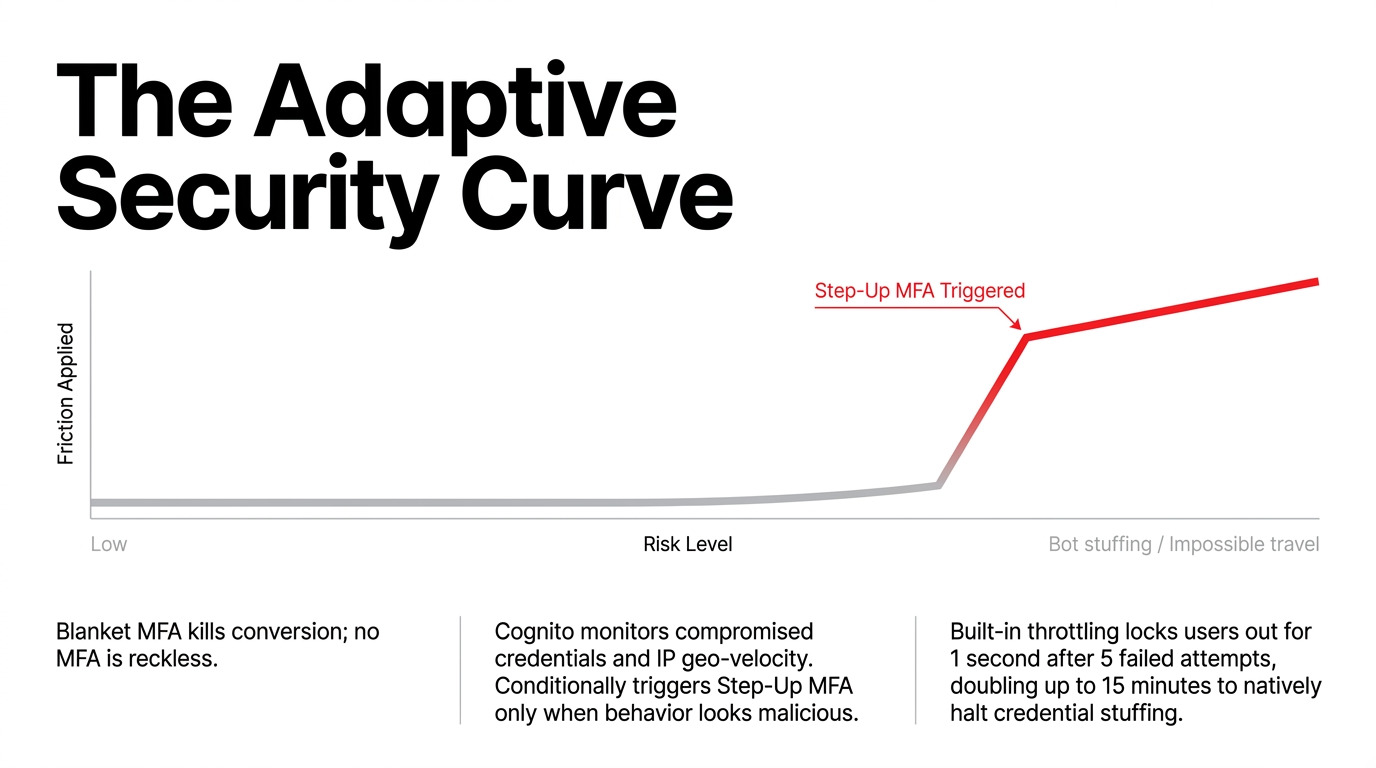
That type of built-in throttling is not glamorous, but it is exactly the kind of baseline protection many custom-built authentication systems forget until they are already under attack.
How a Real Customer Journey Flows
A shopper lands on your site, chooses sign-in, and your application asks Cognito which authentication methods are available. Cognito can respond with options such as password, email OTP, or WebAuthn, and your front end can then present the appropriate method to the customer.
If the shopper enters a password and your policy requires another factor, Cognito returns an MFA challenge such as software token MFA. Once the challenge is completed, Cognito issues ID, access, and refresh JWTs.
Your application stores them to authorize account pages, retrieve profile data, and refresh sessions when tokens expire. That matters in e-commerce because authentication is not a one-time event.
The Full Session Lifecycle
Authentication is continuous: The customer signs in, browses, leaves, comes back, opens order history, checks subscriptions, updates an address, and maybe resumes a session after the original token expired.
Token Refresh Best Practice
AWS authentication flow example explicitly includes token refresh using a saved refresh token. AWS suggests refreshing around 75% of token lifetime as a best practice to keep account experiences smooth without forcing repeated logins.
Lambda Triggers and Commerce Logic
This is where Cognito becomes more than a login tool. AWS states that Lambda triggers can modify default behavior across sign-up, sign-in, and profile updates, and they can also support custom authentication flows.
In e-commerce, that opens practical use cases:
1. Block registration from disposable email patterns
2. Enrich tokens with loyalty tier or region
3. Route high-risk logins into stronger checks
4. Auto-link migrated customer records
5. Gate wholesale accounts behind approval logic
Those are not theoretical enhancements. They are the small controls that stop identity chaos from spilling into support, fraud, and messy customer data.
Because Cognito issues JWTs after successful authentication, your commerce APIs and services can use those claims for downstream authorization decisions across storefront, OMS, loyalty, or customer-service tools.
Federation, Migration, and Identity Sprawl
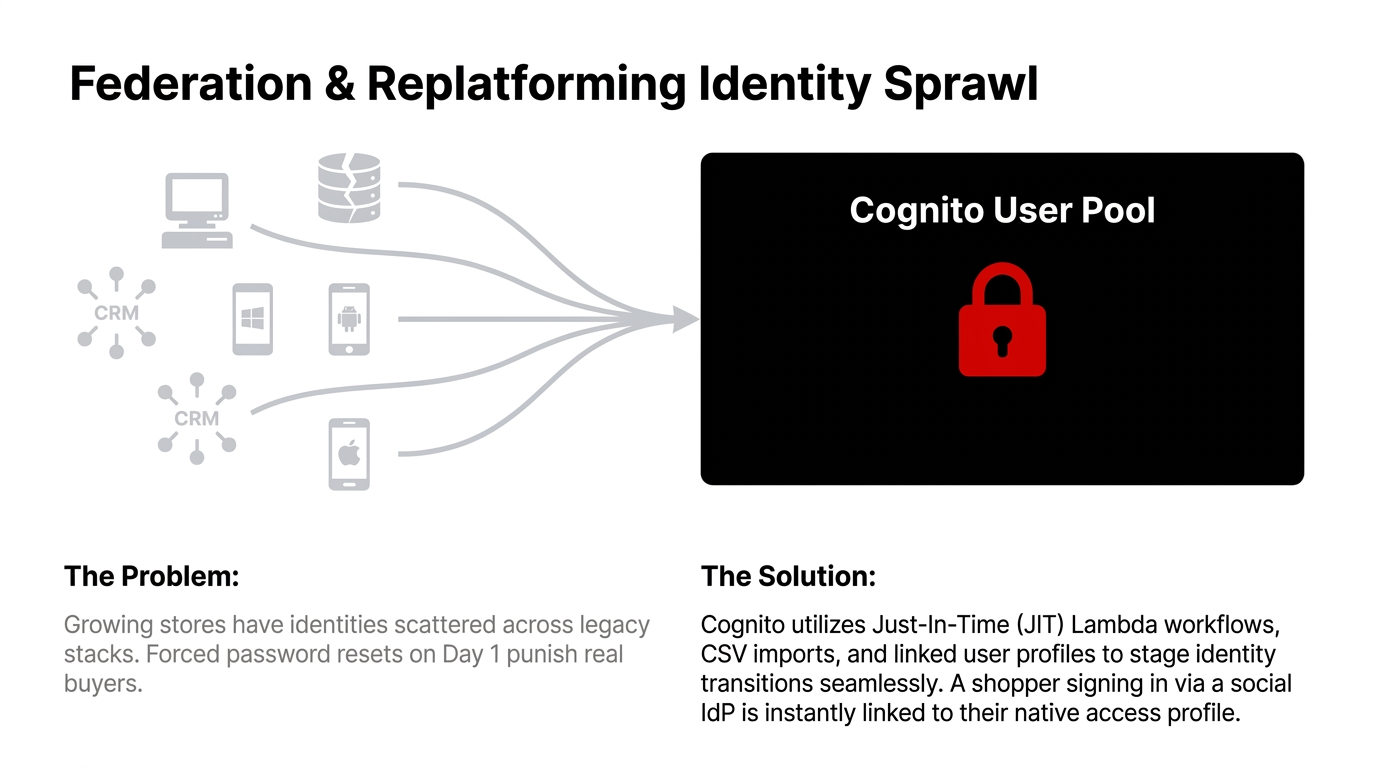
Most growing stores already have customer identities scattered across old platforms, CRMs, mobile apps, or social providers. Cognito supports importing users from CSV, administrator-created users, external IdP sign-in, and linked profiles between federated and native identities.
AWS also notes that just-in-time Lambda workflows can populate user profiles from an existing directory. This is especially useful during replatforming.
A brand moving from a legacy commerce stack does not want every customer forced through a painful reset on day one. Cognito migration-friendly patterns give teams options for staged identity transitions instead of an all-at-once cutover that punishes real buyers for an internal architecture decision.
User Pools vs Identity Pools
Important distinction: User pools handle authentication and token issuance, while identity pools provide AWS credentials for access to AWS services such as S3 or DynamoDB.
When You Need Both
If your customer-facing app needs direct, controlled access to AWS resources after login, identity pool integration becomes part of the design. Most e-commerce setups need user pools; identity pools depend on your architecture.
Cost and Scaling Without Surprises
Cognito pricing is usage-based, and AWS says billing can include user pool monthly active users, federated users, machine-to-machine authorization request volume, and purchased usage above default API quotas.
AWS also warns that dependent services such as email, SMS, and Lambda triggers can add cost on top of Cognito itself. For e-commerce teams, this means authentication cost is not just users times a number.
Product launches, new market expansion, and federated sign-in choices can change cost patterns. AWS specifically advises that high-volume events can increase MAU counts, and that user counts, feature plan choices, and token-request volume should all be watched closely.
Cost Control Checklist
Inactive Users Free
Inactive users are not counted toward the bill. Clean up dormant accounts to reduce MAU counts without losing data.
Use ListUsers Not AdminGetUser
AdminGetUser can mark a user active for the month. AWS recommends ListUsers when possible for attribute queries to avoid accidental billing.
Refresh at 75% Token Lifetime
Token caching and refresh timing should be designed carefully. Bad token handling quietly inflates request volume and creates latency you did not need.
That last point matters for commerce microservices, mobile apps, and serverless functions. Bad token handling quietly inflates request volume and creates latency you did not need.
A Practical Architecture for Stores
A solid Cognito setup for e-commerce usually looks like this: user pool for customer identities, app client configured for the right authentication methods, managed login or custom UI depending on brand needs, MFA or adaptive authentication for risk control, Lambda triggers for business rules, and token-aware APIs for account and checkout services.
For teams looking to integrate intelligent identity management with their broader commerce stack, our AI e-commerce solutions include adaptive authentication patterns that learn from customer behavior to reduce friction while maintaining security.
1. User Pool for Customer Identities
Central directory for all customer accounts. Configure sign-up rules, password policies, and MFA requirements based on your risk tolerance and buyer model.
2. App Client with Right Auth Methods
Configure the authentication methods your customers actually use. Password, passkeys, email OTP, social federation - enable what fits your audience, not every option available.
3. Managed Login or Custom UI
Use managed login when speed, security coverage, and lower maintenance matter more than absolute visual control. Custom UI when your storefront experience is tightly choreographed.
4. MFA or Adaptive Authentication
Risk-based controls give you a middle path: lower friction for normal sessions, tighter checks when behavior looks wrong. Associate WAF web ACLs for additional threat monitoring.
5. Lambda Triggers for Business Rules
Block disposable emails, enrich tokens with loyalty tier, route high-risk logins into stronger checks, auto-link migrated records, gate wholesale accounts behind approval logic.
6. Token-Aware APIs
Your commerce APIs and services use JWT claims for downstream authorization decisions across storefront, OMS, loyalty, or customer-service tools. Design refresh timing carefully.
Then layer in federation only where it improves conversion or buyer convenience, not because every sign-in option looks impressive on a product roadmap.
Social login is useful. Corporate SAML can be essential for B2B. But each new provider adds account-linking, data-mapping, and support complexity, so the right approach is deliberate expansion, not checkbox collecting.
Key Insight
The smartest e-commerce authentication systems are boring in the best possible way. Customers get in quickly. Suspicious sessions hit extra checks. Tokens refresh quietly. Account records stay unified. Fraud pressure is visible. And your engineering team is not reinventing identity every quarter.
Here is the ugly truth: many commerce teams overestimate their appetite for maintaining custom authentication. Building the first version is easy.
Maintaining passkeys, MFA edge cases, reset flows, risk checks, session timing, token handling, and migration logic a year later is where projects start bleeding time. Cognito gives you a way to customize where it matters without rebuilding the identity layer from scratch.
For comprehensive AWS identity and access management strategy across your entire commerce infrastructure, our AWS consulting services cover authentication architecture, security best practices, and cost optimization.
Frequently Asked Questions
Is AWS Cognito good for e-commerce authentication?
Yes. Cognito is well-suited for e-commerce because it supports customer sign-up, sign-in, passwordless methods, passkeys, MFA, federation, JWT token issuance, and customization through Lambda, all of which map directly to real storefront and account-management needs.
Can Cognito support social login?
Yes. Cognito supports social sign-in with Google, Facebook, Amazon, and Apple, and it also supports SAML and OIDC federation for external identity providers. Third-party IdP sign-in requires managed login or the classic hosted UI rather than SDK-only custom authentication.
Does Cognito support MFA and adaptive security?
Yes. Cognito supports MFA with SMS, email, and authenticator-app factors, and AWS says adaptive authentication can conditionally require MFA or block sign-in when activity appears risky. AWS also highlights threat signals such as compromised credential monitoring and IP geo-velocity tracking.
What is the difference between user pools and identity pools?
User pools handle authentication and act as a user directory and OIDC identity provider. Identity pools provide AWS credentials so authenticated users can access AWS services like S3 or DynamoDB under controlled permissions. Most e-commerce setups need user pools; identity pools depend on your architecture.
What should teams watch in Cognito pricing?
Teams should watch MAUs, federated-user usage, machine-to-machine token requests, and costs from dependent services such as SMS, email, and Lambda triggers. AWS also recommends avoiding unnecessary user-activation operations and designing token refresh carefully to control cost. Inactive users are not counted toward the bill.
Stop Reinventing Identity Every Quarter. Start Shipping.
Building the first version of custom authentication is easy. Maintaining passkeys, MFA edge cases, reset flows, risk checks, session timing, token handling, and migration logic a year later is where projects start bleeding time and money.
Cognito gives you user pools for customer identities, managed login with passkey support, adaptive authentication that responds to real threats, Lambda triggers for commerce-specific logic, and clean JWT issuance for your downstream services. Layer in federation deliberately, not as checkbox collecting.
Your customers get in quickly. Suspicious sessions hit extra checks. Tokens refresh quietly. Account records stay unified. Fraud pressure is visible. And your engineering team focuses on commerce, not identity plumbing.
For end-to-end cloud architecture that includes identity, API layer, and backend services, explore our cloud consulting services for comprehensive infrastructure design.
Get Your E-Commerce Authentication Right With Braincuber AWS Consulting
We have implemented Cognito authentication for 35+ e-commerce brands on AWS. Average result: 71% reduction in password-reset support tickets, 43% faster checkout recovery, zero account takeover incidents across multi-tenant platforms.
You are not paying for another custom auth rebuild. You are getting one secure, adaptable, production-ready identity layer that handles passwords, passkeys, MFA, and federation. Your customers stay logged in. Your team sleeps through Black Friday.