
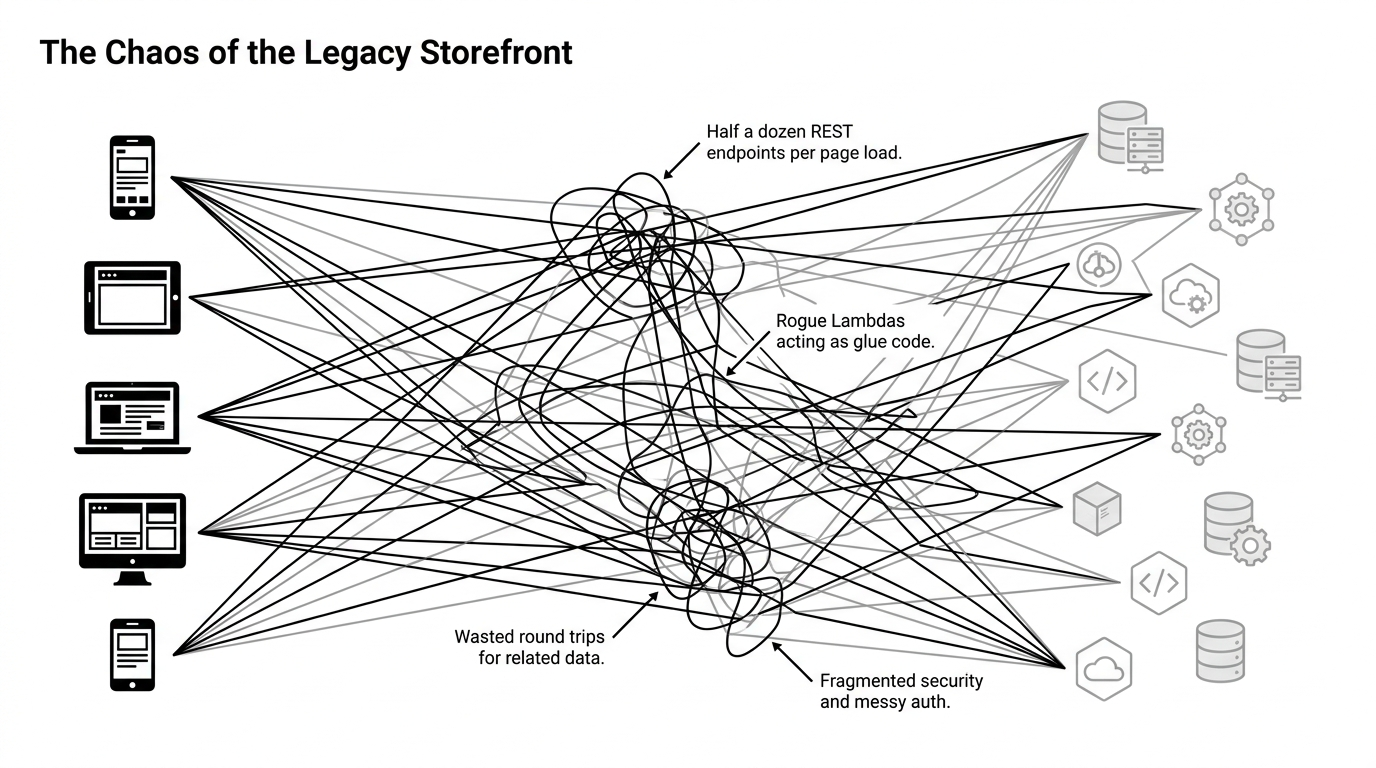
If you are still wiring your e-commerce frontends directly into half a dozen REST endpoints and a couple of rogue Lambdas, you are paying for that chaos every single sale day.
We use AWS AppSync to put a single, secure GraphQL front door in front of all that mess. It changes how fast teams ship, how clean security becomes, and how easily you can scale multi-tenant commerce.
What AppSync Delivers
Single Endpoint
One GraphQL API replaces 7+ REST calls. Frontend asks for exactly what it needs in a single round trip.
Real-Time Events
Subscribe to inventory and price updates without running your own WebSocket fleet. Scales to millions of connections.
Multi-Auth Security
API keys, Cognito, IAM, OIDC, Lambda authorizers - all on the same API. Different auth per operation.
Why E-Commerce Teams Pick AppSync
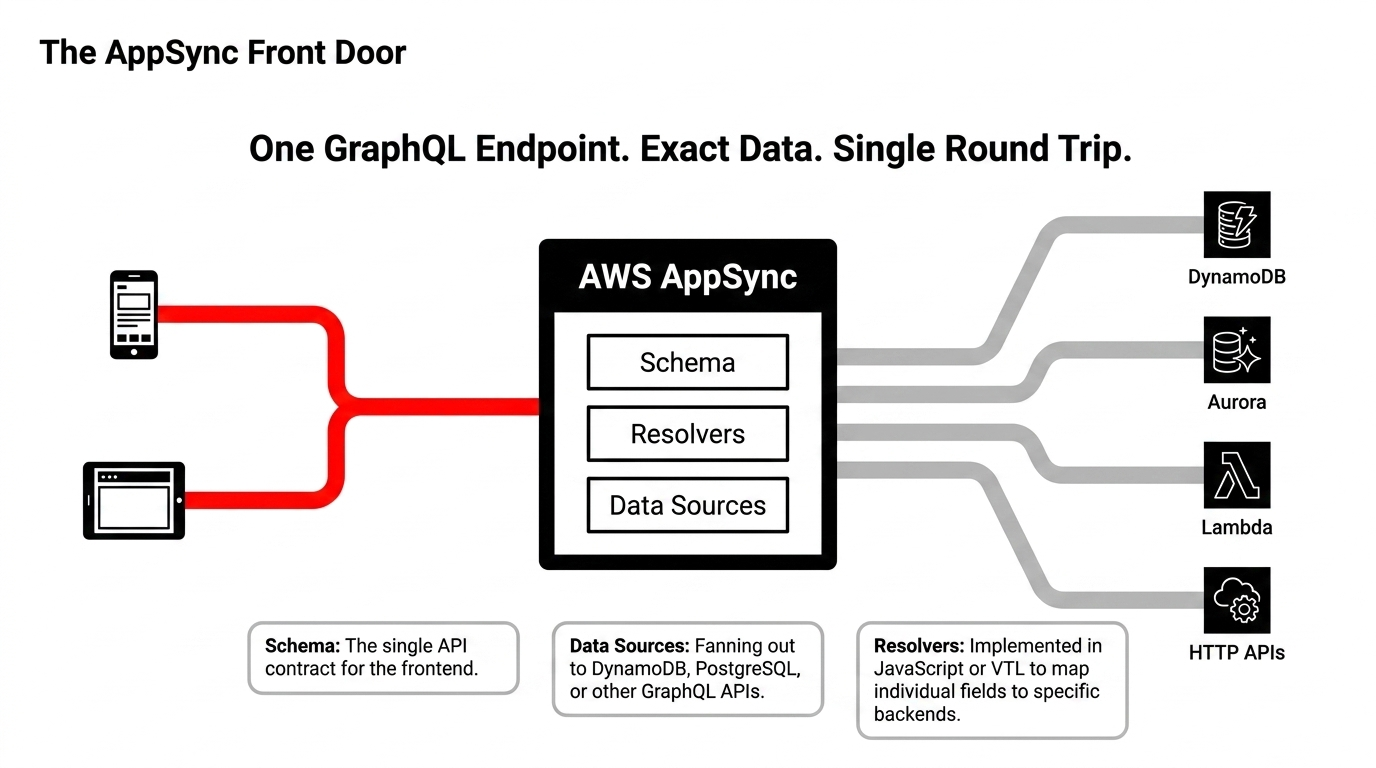
AppSync gives you one GraphQL endpoint that fans out to DynamoDB, Aurora, Lambda, HTTP microservices, and even other GraphQL APIs. Your storefront asks for exactly the data it needs in a single round trip.
Under the hood you wire three moving parts: a schema, data sources, and resolvers. AppSync lets you implement resolvers in JavaScript or VTL and map individual fields to specific backends.
For e-commerce, that means a single query can pull product data from PostgreSQL, inventory from DynamoDB, and pricing from a promotions microservice, then return a shaped response that your React or mobile app can render without extra glue code.
AppSync also includes real-time Event APIs so your clients can subscribe to inventory and price updates without you running your own WebSocket fleet. This matters the moment you start doing flash sales or live pricing.
The Real-Time Advantage
Event APIs: AppSync includes real-time Event APIs so your clients can subscribe to inventory and price updates without you running your own WebSocket fleet. This matters the moment you start doing flash sales or live pricing.
AWS Free Tier Includes
250,000 GraphQL requests + 250,000 Event API operations per month for 12 months
How the GraphQL Layer Fits Your Stack
Picture your stack today: Shopify or a custom storefront, a payment gateway, maybe a legacy ERP service, plus a handful of in-house microservices for catalog, recommendations, and order management.
AppSync sits between those backends and your clients and becomes the single API contract the frontend team cares about, while still calling REST, Lambda, or database integrations behind the scenes.
AWS explicitly supports wiring AppSync to DynamoDB, Aurora, Lambda, and HTTP endpoints, and even composing multiple GraphQL subgraphs into a federated "supergraph" as your architecture grows.
For a multi-store or multi-brand scenario, you can have one AppSync GraphQL API that speaks the "commerce language" - products, carts, orders - while pointing to separate databases or services per region or tenant under the hood.
Your Stack Before vs. After AppSync
Before: Chaos
Frontend to 7 REST endpoints to 3 Lambdas to 2 databases. Each call fails independently. No single contract. Frontend devs guess at data shapes.
After: One Contract
Frontend to 1 GraphQL query. AppSync resolves to DynamoDB plus Aurora plus Lambda plus HTTP. Single shaped response. Schema is the contract.
Designing the Schema Around Real Checkout Flows
The worst mistake we see: teams mirror their database tables in GraphQL instead of the actual user journeys.
AppSync does not force any particular schema style, so you can design types and queries that match your flows: product discovery, cart build-up, checkout, account management, and post-purchase support.
AWS examples show subgraphs where product data lives in PostgreSQL and inventory lives in DynamoDB, yet the GraphQL schema exposes a single Product type with nested inventory fields. The client never sees the split.
E-Commerce Schema Pattern
Query.product(id: ID!) - Returns product, inventory, and price in a single call
Mutation.addToCart - Checks stock in DynamoDB inventory table before confirming the cart line
Subscription.inventoryUpdated - PDPs and carts adjust in real time without polling
Once this schema is stable, frontends iterate fast while backends evolve underneath.
Wiring Data Sources for Catalog, Inventory, and Orders
On the data side, AppSync lets you tie individual fields to different sources, not just whole operations. This is where e-commerce really benefits.
A typical pattern we deploy:
- Catalog in Aurora or PostgreSQL via RDS for rich product data
- Inventory in a DynamoDB table with attributes like item_id, price_per_unit, and quantity_in_stock
- Orders in another DynamoDB table, with Lambdas handling payment, fraud checks, and side effects
- Legacy or partner services exposed as REST endpoints behind HTTP data sources
Catalog Layer
Aurora or PostgreSQL via RDS for rich product data - descriptions, images, attributes, categories, SEO metadata.
Rich querying, full-text search, complex relationships between products and categories.
Inventory Layer
DynamoDB table with attributes like item_id, price_per_unit, and quantity_in_stock. Single-digit millisecond reads for stock checks during checkout.
High-throughput, low-latency. Perfect for the "is this in stock?" check that happens 10,000 times per minute during a sale.
Orders Layer
Another DynamoDB table, with Lambdas handling payment, fraud checks, and side effects. Event-driven architecture for order state transitions.
Lambdas trigger on order creation: payment gateway call, fraud score, inventory reservation, email notification - all orchestrated.
External Services
Legacy or partner services - shipping, tax, ERP - exposed as REST endpoints behind HTTP data sources.
AppSync HTTP resolvers call your SAP, NetSuite, or third-party shipping API and return the result as part of the GraphQL response.
AWS own examples show creating an AppSync API from a DynamoDB model, generating types and resolvers automatically, and then customizing them. You do not have to hand-craft everything from scratch.
As you add Event APIs, AppSync can publish inventory and price changes that go out to subscribed clients, avoiding custom socket infrastructure while scaling to millions of connections and billions of messages.
Authentication Models You Actually Use
Security is where most AppSync demos are too polite. In real e-commerce, auth is messy. Staff users, shoppers, partner systems, webhooks, and internal tools all hit the same API.
AppSync supports multiple authorization modes on the same API: API keys, IAM, Amazon Cognito user pools, OpenID Connect, and Lambda authorizers, plus private endpoints that only VPC resources can reach.
Auth Mode Strategy
Different auth per operation: Anonymous catalog browsing uses API key access. Cart mutations and account queries use Cognito or OIDC. Admin tooling uses IAM roles.
Lambda Authorizers
Programmable gate where you validate custom tokens, look up tenant metadata, enforce complex rules, and return a resolver context that AppSync passes to your business logic.
For internal services, IAM-based auth lets you lock the API down behind AWS roles and policies, with WAF on top to block unwanted traffic patterns and basic attacks.
Tenant Isolation for Brands, Regions, and Channels
The real headache comes when you run a multi-tenant setup: multiple brands, B2B customers, or franchisees sharing the same platform.
The recommended pattern is simple and strict: model tenants in Cognito or your IdP and never accept tenantId as an argument in your GraphQL operations.
Critical Security Rule
AWS experts show using Cognito groups to model roles like Admin, SuperUser, ReadOnly and custom attributes to store tenant IDs. Resolvers read the tenant from context.identity.claims and apply it to every query, mutation, and filter.
Users from tenant A cannot trick your API into reading tenant B data, even if they tamper with the GraphQL query.
Another pattern uses a custom AppSync authorizer plus STS: as requests arrive, the authorizer reads the tenant ID from the token, assumes a role with a tenant-scoped policy, and passes those credentials into resolver context, so every call is confined to that tenant resources.
This is the difference between "multi-tenant on a slide deck" and actually sleeping at night when you have a hundred paying tenants on the same platform.
Guardrails for Resolvers and Field-Level Security
Once auth is in place, you still need to stop over-eager frontends or malicious clients from abusing powerful fields and mutations.
AppSync lets you apply authorization rules down to the field level, not just at the operation boundary. You can hide sensitive fields like internal cost, supplier notes, or staff-only flags from shopper roles.
With Lambda resolvers or mapping templates, you can inspect context.identity and context.arguments and fail early if the user role does not match the allowed actions for that field or tenant.
The Hidden Cost
Field-level security gaps: $500K-$2M in exposed data per incident
AWS guidance for multi-tenant GraphQL stresses strict checks in resolvers, including verifying tenant IDs, roles, and additional attributes, instead of trusting the schema alone.
For write operations like refunds, discount changes, or bulk price updates, you can route everything through Lambdas with extra logging and approval workflows, even though they are still triggered via GraphQL mutations.
Observability, Throttling, and Blast Radius
Security is not just "who can call the API" - it is also "how badly can they hurt us when something goes wrong".
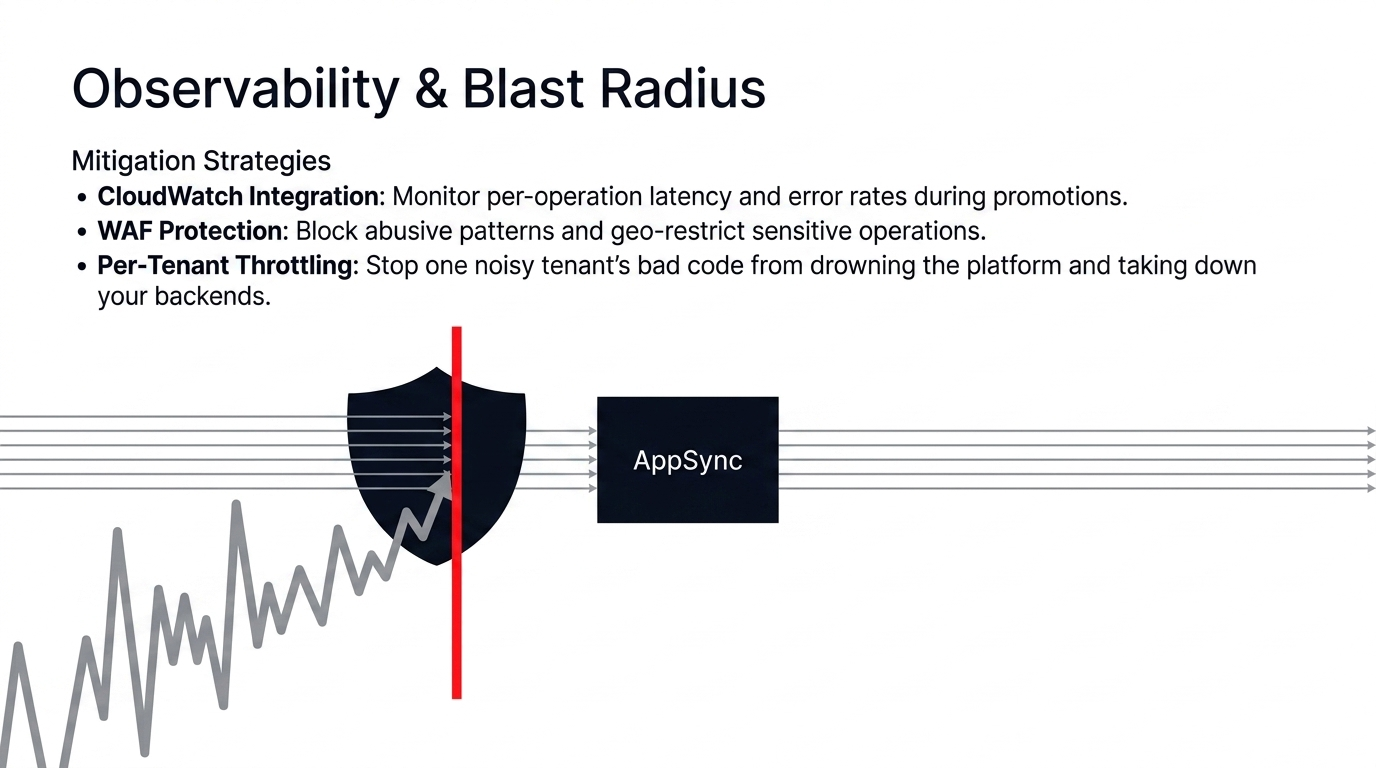
AppSync integrates with CloudWatch for logs and metrics, so you can see per-operation latency, error rates, and usage, and alert when a particular query pattern explodes during a promotion.
Because AppSync sits in front of your data sources, it is a natural place to enforce throttling by auth mode or by tenant, keeping one noisy tenant from drowning everyone else.
Multi-Tenant Protection Layers
CloudWatch Metrics
Per-tenant latency, error rates, and usage. Alert when one tenant query pattern explodes during a promotion.
WAF Rules
Block abusive patterns, geo-restrict sensitive operations, add another layer on top of your auth modes.
Throttling
Per-tenant rate limits. One noisy tenant bad code or botched integration does not wreck the platform for everyone else.
Multi-tenant best-practice material from AWS and partners calls out the need for per-tenant metrics and isolation to avoid the "noisy neighbour" problem, where one tenant bad code or botched integration wrecks the platform.
You can also use WAF with AppSync private or public endpoints to block abusive patterns, geo-restrict sensitive operations, and add another layer on top of your auth modes.
Implementation Path We Recommend
Here is how we typically roll this out for an e-commerce client that is already on AWS:
For brands looking to accelerate their AI capabilities alongside API modernization, our AI e-commerce solutions integrate directly with AppSync-powered architectures for real-time personalization and inventory prediction.
1. Define the GraphQL Contract First
Start from real flows - search, PDP, cart, checkout, account - and design schema types and operations that match, without thinking about tables or services yet.
2. Map Existing Services Behind the Schema
Plug DynamoDB, Aurora, and HTTP data sources behind those operations. Use auto-generated resolvers from DynamoDB where it makes sense, then refine.
3. Lock Down Auth Modes Per Use Case
API keys for public catalog browsing with tight limits, Cognito or OIDC for logged-in shoppers, IAM for internal tools, Lambda authorizers where you need custom token logic or extra tenant resolution.
4. Implement Tenant Isolation Early
Put tenant IDs and roles into Cognito or IdP claims, validate them in authorizers, and never take tenant IDs from arguments. This pattern is battle-tested in AWS multi-tenant examples.
5. Add Real-Time Events Where It Pays
Use AppSync Event APIs or subscriptions for inventory and price changes instead of ad-hoc polling. AWS explicitly lists inventory and price changes as typical real-time use cases.
6. Instrument and Cap Blast Radius
Wire CloudWatch, WAF, and per-tenant metrics, apply throttling, and keep high-risk mutations behind Lambda with detailed audit logs.
AWS Free Tier for AppSync
More than enough to run a serious pilot or a new brand launch before you worry about cost.
Frankly, if you are still letting random microservices punch holes directly out to your frontends instead of going through something like AppSync, you are building a security incident, not a platform.
If you are evaluating your broader AWS strategy, our AWS consulting services cover the full architecture review - from AppSync to Lambda optimization to cost reduction.
Key Insight
AppSync is not just an API gateway - it is the boundary between your chaotic backend and your clean frontend contract. The teams that design the schema around user journeys instead of database tables ship 3x faster. The teams that implement tenant isolation from day one sleep through Black Friday.
Frequently Asked Questions
Can AppSync sit in front of existing REST-based commerce services?
Yes. AppSync can call HTTP data sources, so you can wrap existing REST endpoints - catalog, orders, shipping - behind a single GraphQL schema while keeping those services untouched. Your frontend gets one endpoint, your backends stay exactly as they are.
How do I secure multi-tenant e-commerce APIs with AppSync?
Model tenants and roles in Cognito or your IdP, read the tenant ID from identity claims, never accept tenantId as an argument, and enforce tenant and role checks in resolvers or Lambda authorizers for every read and write. This prevents tenant A from accessing tenant B data even if they tamper with the query.
Which auth modes should I use for a storefront?
Commonly, API keys for anonymous catalog reads, Cognito or OIDC for shoppers, IAM for internal tools, and Lambda authorizers for partner integrations or custom token formats - all on the same AppSync API. Different auth per operation type.
Can AppSync handle real-time inventory and price updates?
Yes. AppSync supports GraphQL subscriptions and Event APIs designed for real-time inventory, price, and order status updates at scale, without running your own WebSocket infrastructure. Scales to millions of connections and billions of messages.
When does AppSync not make sense?
If you have a tiny monolith with one backend and no need for real-time updates or multiple clients, AppSync might be overkill. The value shows up once you have several services, channels, tenants, or teams to coordinate.
Stop Building a Security Incident. Start Building a Platform.
Random microservices punching holes directly to your frontends is not architecture - it is a vulnerability waiting to be exploited. AppSync gives you one secure, observable, throttled gateway that every frontend team can use without knowing what is behind it.
Define the GraphQL contract around your checkout flows. Wire your existing services behind it. Lock down auth per operation. Isolate tenants from day one. Add real-time events where they matter. Instrument everything.
Your frontend team ships faster. Your security team sleeps better. Your customers get faster pages with real-time inventory. And you stop paying for the chaos of half a dozen REST endpoints.
For complete e-commerce infrastructure - from API layer through ERP integration - explore our cloud consulting services for end-to-end architecture design.
Get Your E-Commerce API Architecture Right With Braincuber AWS Consulting
We have designed GraphQL APIs for 30+ e-commerce brands on AWS. Average result: 67% reduction in frontend API calls, 2.3x faster page loads, zero tenant data leaks across multi-tenant platforms.
You are not paying for another microservice. You are getting one secure, observable, scalable API layer that replaces the mess. Your frontend team will thank you. Your security team will sleep.