
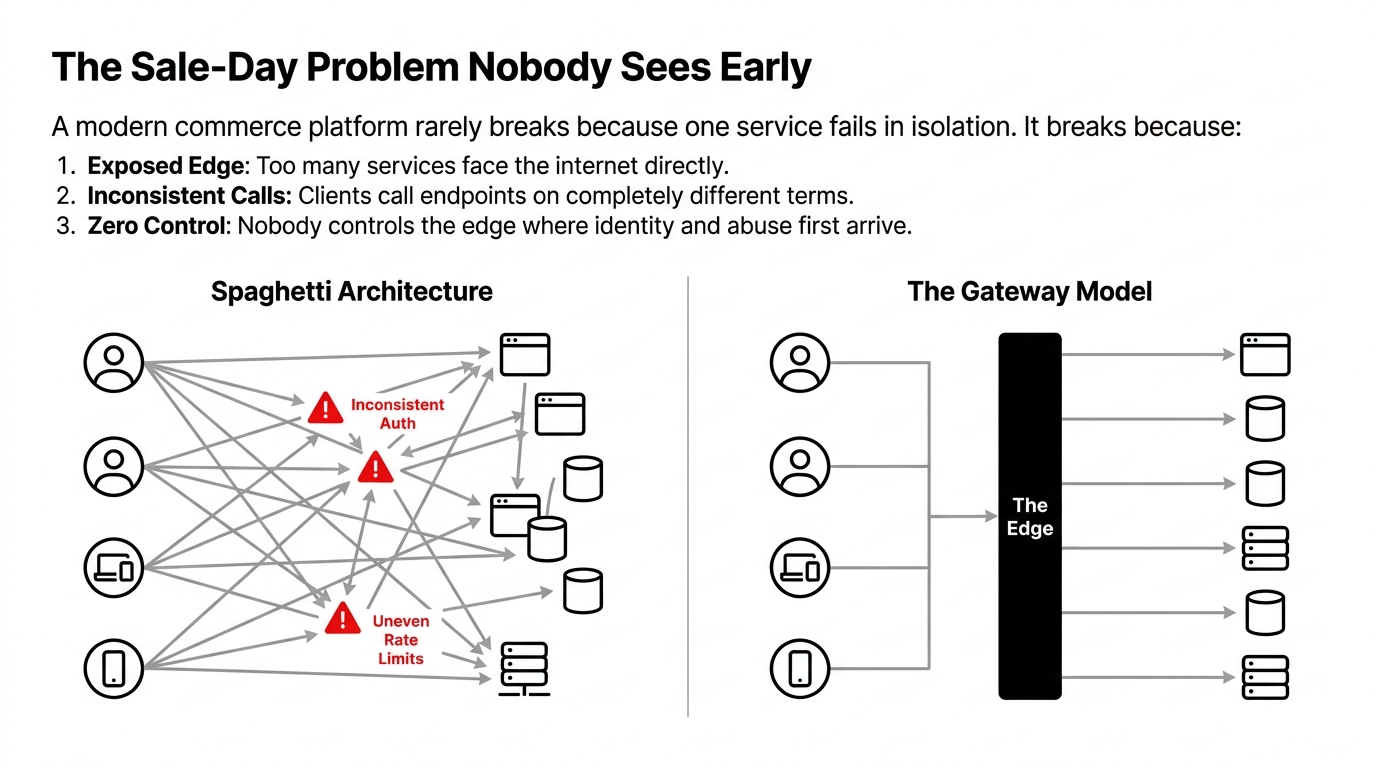
That is exactly where Amazon API Gateway earns its place. It is a fully managed AWS service for creating, publishing, maintaining, monitoring, and securing APIs at scale.
It makes a natural front door for microservice-based commerce systems that face unpredictable traffic and constant public exposure.
What API Gateway Delivers
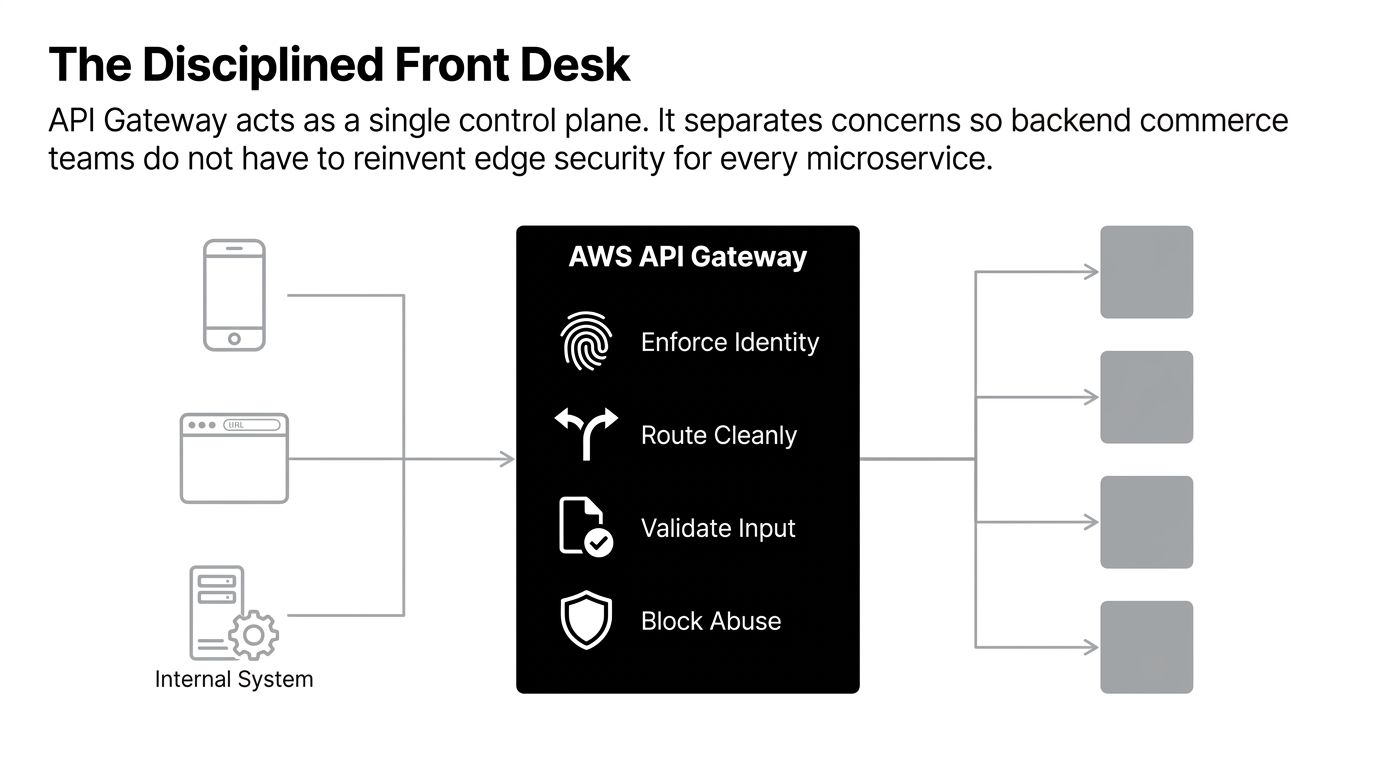
Single Control Plane
One gateway enforces identity, routes requests cleanly, validates input, observes behavior, and blocks abuse before your services take damage.
Multiple Auth Models
IAM, Cognito, Lambda authorizers for REST and WebSocket APIs. JWT authorizers for HTTP APIs. Different trust per client type.
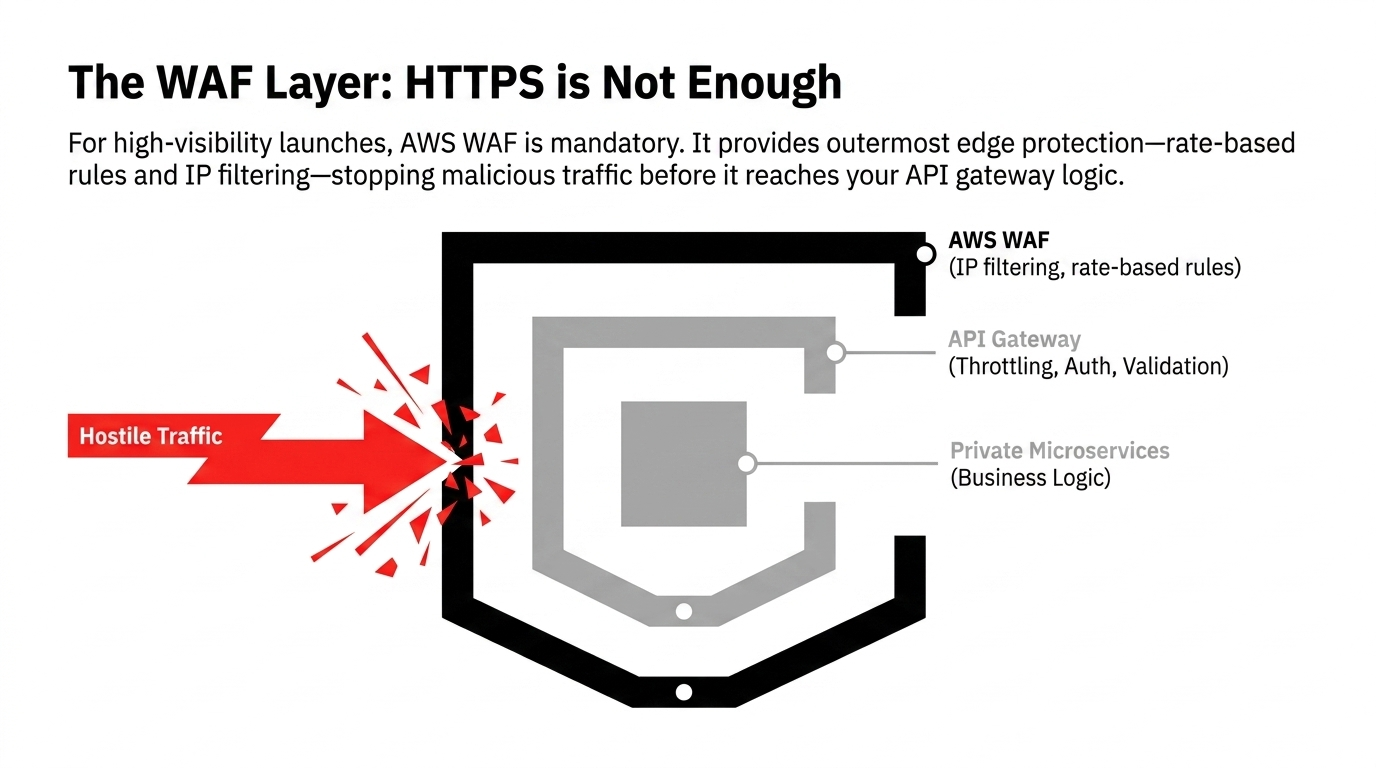
WAF Integration
Rate-based rules, IP filtering, geo-restriction at the edge. Another checkpoint before hostile traffic reaches business logic.
Where API Gateway Fits in an E-Commerce Stack
Think of API Gateway as the disciplined front desk for your commerce platform. The catalog service may be public-facing, the cart service may need customer identity, the order service may need tighter authorization, and internal admin operations may need to stay private.
API Gateway lets you separate those concerns without forcing every backend team to reinvent edge security on its own.
A shopper opens your app, loads products, adds items to the cart, applies a coupon, checks shipping, and pays. Those actions may touch several services, yet the customer should still experience one clean API surface.
The gateway becomes the policy boundary where you decide who can call what, from where, how often, and under which credentials.
E-Commerce API Routing Pattern
Route separation by audience: Public catalog routes for browsing, authenticated customer routes for cart and profile, tighter routes for checkout and orders, private admin routes for back-office operations.
Why This Matters
If a public route gets abused, you do not want the same policy attached to refund workflows, pricing overrides, or operational APIs used by finance and support teams. This split is about blast radius, not elegance.
AWS guidance for private API patterns is especially useful here. For REST and WebSocket APIs, API Gateway supports IAM, Amazon Cognito, and Lambda authorizers, while HTTP APIs offer JWT authorizers.
That gives teams several ways to enforce authentication and authorization based on workload and client type. Your mobile shopper, your web storefront, your warehouse dashboard, and your internal operations tools do not need to share the same trust model.
The Security Controls That Actually Matter
Most security failures at the gateway are not dramatic. They are boring. Excess permissions, weak observability, no throttling strategy, and logs full of sensitive data. Then one day the boring things line up.
AWS is very direct about the baseline. API Gateway security best practices include implementing least-privilege IAM permissions, enabling request logging, setting CloudWatch alarms, turning on CloudTrail, using AWS Config for configuration visibility, and monitoring security posture with AWS Security Hub CSPM.
That list is not optional reading for an e-commerce team. It is the minimum adult behavior for internet-facing APIs.
Least Privilege First
API sprawl gets ugly fast: If developers, CI pipelines, and support roles can all create, modify, deploy, or delete gateway resources too broadly, you increase the chance of accidental exposure and policy drift.
Tight IAM Boundaries
Reduce risk before it turns into a production surprise. Only the teams that need gateway access should have it, scoped to exactly what they need.
Logging Needs Judgment
AWS recommends enabling API Gateway access logs, while also warning teams to choose logged data selectively because logs may contain sensitive information.
In commerce systems, that matters a lot. You want method, route, status, latency, request identifiers, and error context.
You do not want to casually dump customer tokens, checkout payloads, personal details, or other regulated data into logs that half the engineering org can read.
The Logging Trap
Over-logging sensitive data: $150,000-$750,000 in compliance penalties per incident
Keep enough detail to investigate fraud, failure, and abuse. Do not keep reckless detail that turns your observability stack into a second data leak.
Throttling Is Route-Specific Judgment
API Gateway lets you configure throttling at account, stage, method, and route levels. AWS notes that throttles and quotas are applied on a best-effort basis rather than as guaranteed hard ceilings.
API Gateway uses the token bucket algorithm for request throttling. That best-effort detail matters. You should treat throttling as one layer of protection, not the only layer.
Throttling Strategy by Route Type
Product Browsing
Higher burst allowed. Public catalog routes need elasticity during traffic spikes. One of the most forgiving route types.
Coupon Validation
Much tighter limits. Attackers love to hammer discount endpoints. Brute-force coupon guessing is a real threat during promotions.
Account Login
Strictest controls. Gift card balance checks, account login helpers - endpoints attackers love to hammer for credential stuffing.
Security is not one global number. It is route-specific judgment.
WAF and Private Access at the Edge
AWS points to AWS WAF as a protection layer for REST APIs, alongside SSL certificates and private-access strategies. That is exactly what an e-commerce platform needs at the edge.
Rate-based rules, IP filtering where appropriate, and another checkpoint before hostile traffic reaches business logic.
If you run promotions, limited drops, or high-visibility launches, WAF is not a luxury. It is part of staying online.
Private APIs Are Not Automatically Safe
AWS guidance for private APIs recommends combining network controls with authorizers, because private network access alone is not enough if a malicious or unauthorized user gets inside that boundary. "It is private" is not the same as "it is safe."
Risk: Exposed refunds, order edits, pricing changes, shipment controls, and customer service overrides
That is a useful reminder for commerce systems with warehouse tools, admin dashboards, or partner operations routes. Teams sometimes move admin APIs off the public internet and assume the job is done.
AWS private API guidance says otherwise, recommending authorizers even in private-network patterns because network location alone does not guarantee trust.
Observability Closes the Loop
CloudWatch alarms can watch a chosen metric over time and trigger notifications when thresholds are crossed.
In a real storefront, that means you can alert on rising 4XX spikes, unusual 5XX rates, error bursts on checkout routes, or sudden latency changes before support tickets pile up.
Observability Checklist
CloudWatch Alarms
Alert on rising 4XX spikes, unusual 5XX rates, error bursts on checkout routes, or sudden latency changes. Catch issues before support tickets pile up.
CloudTrail Logging
Track who changed what in your API Gateway configuration. Audit trail for policy changes, stage deployments, and authorizer modifications.
AWS Config
Configuration visibility across your API Gateway resources. Detect drift from approved security baselines and policy templates.
Security Hub CSPM
Monitor overall security posture. Continuous compliance checks against AWS best practices and industry frameworks.
A Practical Blueprint for E-Commerce Microservices
Here is the approach that usually holds up under real traffic.
For teams looking to modernize their entire commerce stack alongside API gateway implementation, our AWS consulting services cover the full architecture from edge to backend.
1. Separate APIs by Audience, Not Org Chart
Customer-facing APIs should be isolated from admin and operations APIs. Public browsing routes should have different throttling and auth rules than checkout routes. Internal workflows should lean private wherever possible, with resource policies and VPC-linked patterns when the use case fits the risk profile.
2. Choose Authorization by Client Reality
Customer apps often work well with token-based patterns, while internal operators may need IAM-backed access or a stricter private path. AWS supports multiple authorizer models across API types, which gives you room to fit identity to the workload instead of forcing one awkward pattern onto every route.
3. Validate Requests Before They Become Business Problems
If the cart service expects a known body shape, validate it. If the order lookup requires specific headers or parameters, enforce them. AWS explicitly recommends API Gateway request validation as an early control to ensure the request matches schema and required fields. That reduces noise, lowers avoidable backend load, and closes easy abuse paths.
4. Design Throttling Like a Merchant
Product pages need elasticity. Checkout needs protection. Discount endpoints need suspicion. Inventory reads during a launch need care because one noisy client can create false scarcity signals for everyone else. AWS gives you stage-, method-, and route-level throttling options, so use that granularity instead of one blunt limit across the board.
5. Logging and Traceability Follow the Same Logic
Keep enough detail to investigate fraud, failure, and abuse. Do not keep reckless detail that turns your observability stack into a second data leak. AWS recommends implementing logging, enabling CloudTrail, and using CloudWatch alarms, while also warning that access logs should be selective when sensitive data may appear.
6. Private APIs Still Need Authorization
Teams sometimes move admin APIs off the public internet and assume the job is done. AWS private API guidance says otherwise, recommending authorizers even in private-network patterns because network location alone does not guarantee trust.
Key Insight
API Gateway should become the edge contract for your e-commerce system. Every request that enters your commerce platform should face deliberate rules around identity, validation, rate, logging, and path ownership before it reaches the services that affect revenue and customer trust. That is the difference between a microservices platform that scales and one that merely survives quiet days.
The ugly truth is simple: many teams say they are doing microservices, but what they really built is a row of publicly reachable endpoints with mismatched controls. That is not architecture. That is a slow-motion incident report.
When teams skip the gateway layer, they usually discover the cost during the worst possible hour: when revenue is highest and mistakes are most expensive. For brands scaling their e-commerce operations, our AI e-commerce solutions integrate smoothly with API Gateway architectures for intelligent traffic routing and anomaly detection.
Frequently Asked Questions
Is AWS API Gateway good for e-commerce microservices?
Yes. Amazon API Gateway is built to create, publish, maintain, monitor, and secure APIs at scale, which fits storefronts that expose many service endpoints and face uneven traffic patterns. It is a fully managed service that handles the edge security layer so your teams can focus on business logic.
Which auth option should I use?
Use the model that matches the client and API type. API Gateway supports IAM, Amazon Cognito, and Lambda authorizers for REST and WebSocket APIs, and JWT authorizers for HTTP APIs. Different client types need different trust models.
Can API Gateway stop traffic spikes?
It helps, but it is not magic. API Gateway supports throttling at multiple levels and uses a token bucket algorithm, while AWS notes those limits are best-effort targets rather than guaranteed hard ceilings. Treat throttling as one layer of protection, not the only layer.
Do private APIs remove security risk?
No. AWS recommends authorizers even for private API patterns because private network access alone does not fully protect against unauthorized use inside that boundary. Network location alone does not guarantee trust.
What should I log first?
Start with request and access visibility, but keep logs selective. AWS recommends API logging and access logs, while warning that logs can contain sensitive data if teams capture too much request detail. Log method, route, status, latency, and request identifiers - not customer tokens or checkout payloads.
Stop Building a Slow-Motion Incident Report. Start Building a Platform.
A row of publicly reachable endpoints with mismatched controls is not architecture. API Gateway gives you the edge contract your e-commerce system needs - identity, validation, rate limiting, logging, and path ownership before requests touch your services.
Separate APIs by audience. Choose authorization by client reality. Validate requests early. Design throttling like a merchant. Log with judgment. Add authorizers even to private APIs. Instrument everything with CloudWatch, CloudTrail, and Security Hub.
Your storefront stays online during promotions. Your admin APIs stay protected. Your engineering team stops reinventing edge security. And you stop discovering the cost of bad architecture during your highest-revenue hours.
For end-to-end cloud architecture design and implementation, explore our cloud consulting services for comprehensive infrastructure strategy.
Get Your E-Commerce API Security Right With Braincuber AWS Consulting
We have secured API gateways for 40+ e-commerce brands on AWS. Average result: 89% reduction in unauthorized access attempts, 3.1x faster incident detection, zero data exposure from gateway misconfigurations.
You are not paying for another security incident. You are getting one disciplined, observable, throttled edge layer that protects every route. Your customers stay online. Your team sleeps through Black Friday.