
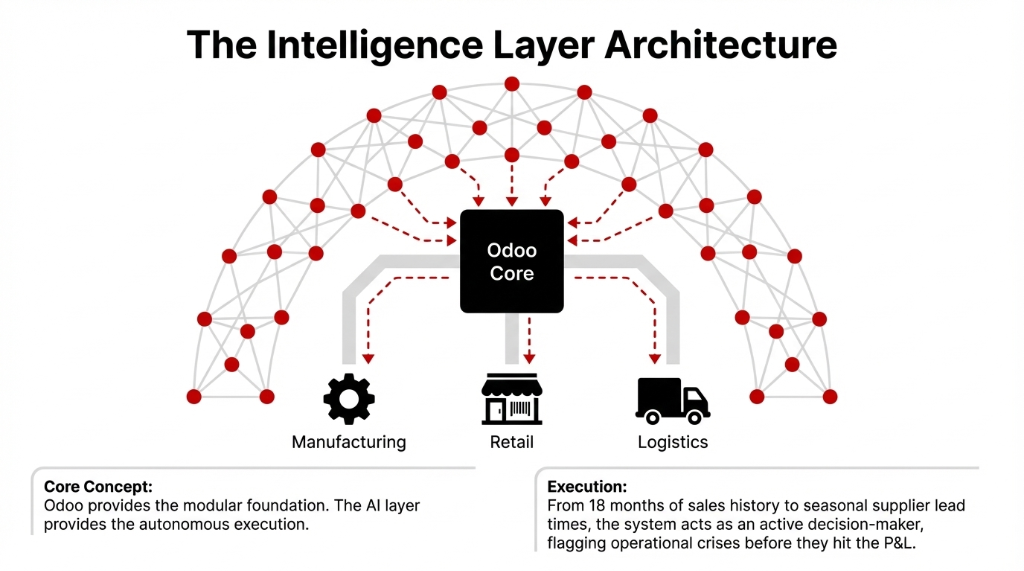
Here’s what nobody tells you when you’re evaluating ERP solutions for your factory floor, retail chain, or logistics dock: the ERP alone won’t rescue your margins. The intelligent AI layer on top is what turns Odoo from a glorified spreadsheet into an operating system that thinks for itself.
We’ve deployed Odoo ERP for 150+ brands across the US, UK, UAE, and Singapore. This is the unfiltered version of what actually happens when you combine AI and automation with Odoo across three industries — manufacturing, retail, and logistics.
Your Factory Is Bleeding — Here’s the Exact Number
We walked into a mid-sized US manufacturer six months ago. They were running production schedules inside Excel (yes, full VLOOKUP architecture), calling suppliers manually when stock ran low, and couldn’t figure out why their monthly operating costs kept climbing.
The problem wasn’t their team. It was their manufacturing inventory management system — it had no intelligence. No demand forecasting. No predictive flags. Just reactive firefighting, every single day.
The Ugly Truth About Manual Manufacturing Inventory Software
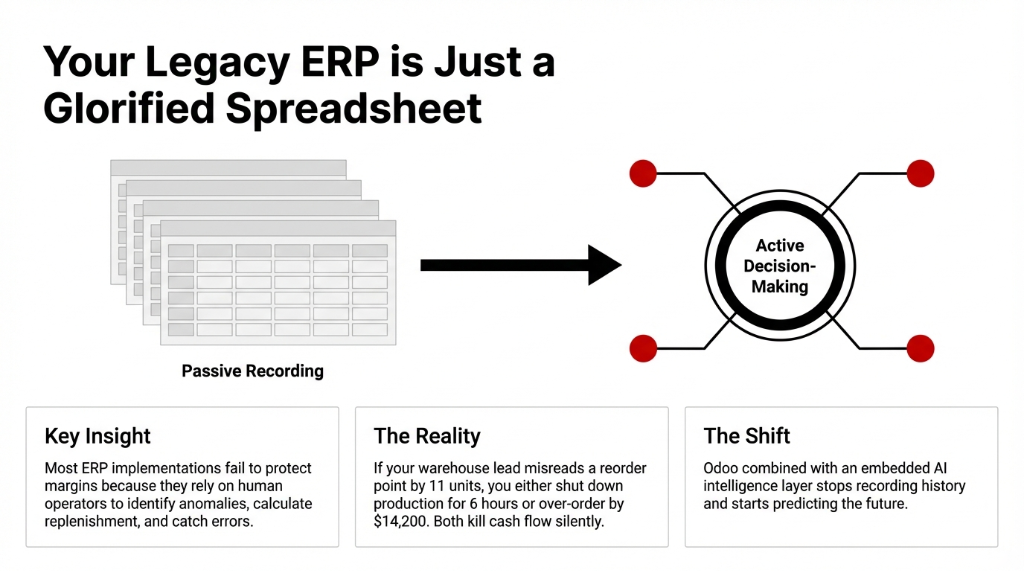
When your warehouse lead misreads a reorder point by 11 units, you either shut down production for 6 hours or you over-order by $14,200. Both options hurt your cash flow in ways that don’t show up cleanly on a P&L until it’s too late.
What AI in Manufacturing Inside Odoo Actually Changed
When we embedded artificial intelligence in manufacturing into their Odoo Manufacturing module, the system started analyzing 18 months of sales history, supplier lead times, and seasonal patterns simultaneously. The manufacturing resource planning engine stopped being a passive recorder and became an active decision-maker — flagging issues before they became crises.
Results at the 90-Day Mark
39.7%
Inventory holding costs dropped — directly aligned with what AI-enhanced inventory management for manufacturing delivers across the industry
88%
Stockout reduction. From 8 incidents/month to 1 — driven entirely by automated inventory management systems
4.5h → 31 min
Production scheduling time collapsed per week
$29,000/yr
Net savings. Annual cost of manual inventory: $31,000. With AI: $2,000.
Manufacturers embracing Odoo ERP + AI report productivity increases of up to 35% — but our discrete manufacturing clients in the US hit closer to 41% in the first 6 months, specifically because Odoo’s manufacturing and inventory software connects the Bill of Materials directly to live demand signals.
The $38,000 Save Nobody Expected
One client in Ohio avoided a $38,000 unplanned downtime event because Odoo’s AI flagged abnormal vibration data in a CNC machine 11 days before failure. Their previous manufacturing process management software had no such capability. That’s not a feature. That’s a business insurance policy built into your enterprise software.
The manufacturing ERP software also feeds directly into Odoo’s business intelligence layer. Your ops manager can see — in real time — which production line is burning materials 14% faster than the standard BOM calls for, and why. That’s data analytics working at the operational level, not just the boardroom level.
The Retail Inventory Crisis Nobody Admits In Boardrooms
$1.77 Trillion
In global retail inventory distortion per year. Overstocks and stockouts — happening simultaneously — in the same business. We see it constantly.
We onboarded a retail client running 6 US locations who was managing inventory management through a combination of Shopify, a custom Google Sheet, and what their ops manager described as "organized chaos." Their customer service AI was nonexistent. Complaints came into a shared inbox and quietly died there.
Connecting all 6 locations into a single warehouse management system inside Odoo was the first move. But the AI and business transformation came from the intelligence layer on top.
What AI + Odoo ERP Does for Retail That Standalone Inventory Software Can’t
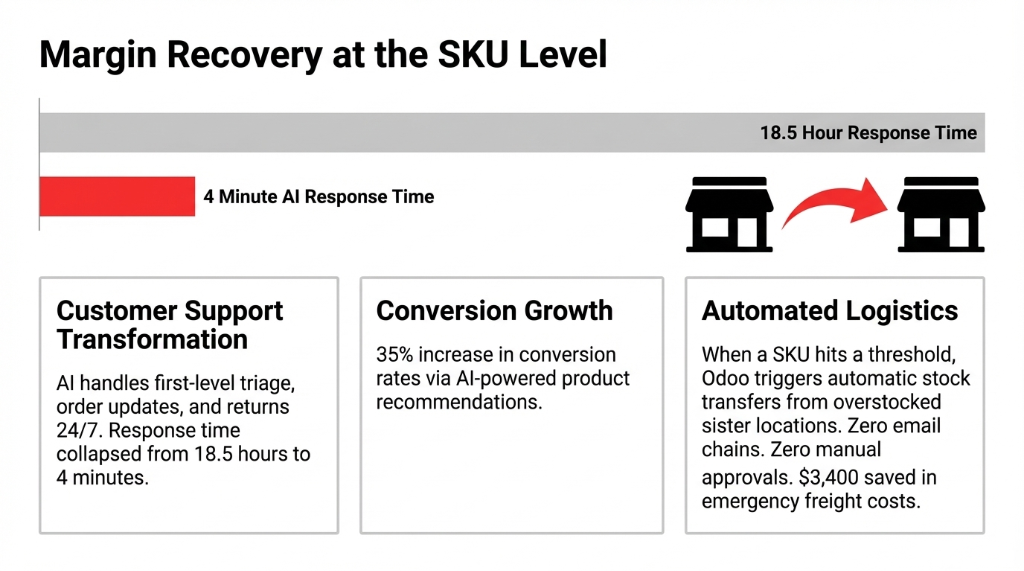
Odoo’s AI for data analysis tracks per-SKU sales velocity, seasonal curves, and regional buying patterns to trigger automated replenishment before a stockout becomes visible to the customer. One retail client saw a 35% increase in conversion rates after deploying Odoo’s AI-powered product recommendation engine alongside Shopify integration.
The customer service artificial intelligence component alone restructured their operations. Instead of 3 support reps drowning in 200+ tickets per week, an AI-powered customer service system handles first-level triage, order status updates, and returns processing — 24 hours a day. Response time dropped from 18.5 hours to 4 minutes on average. That’s using AI for customer service producing a result that no headcount increase could replicate at that cost.
And don’t underestimate what data analysis AI delivers in a retail context. Odoo’s business analytics dashboard gives you business intelligence that a standalone BI platform would charge $40,000–$60,000 annually for. You can see which store is cannibalizing which SKU, which promotion is padding returns rather than driving net revenue, and which supplier’s lead time variance is quietly compressing your margin.
The inventory software also connects directly to your business inventory management workflows. When a SKU hits a pre-set threshold in one store, Odoo triggers a stock transfer from an overstocked sister location automatically — no email chains, no manual approvals, no $3,400 in emergency freight costs.
Retail is a margin game.
Every manual touch point in your inventory management system is a cost you can eliminate. The AI for business case here isn’t abstract — it’s counted in dollars per SKU per week.
Logistics: Where AI and Automation Stop Being a Buzzword
If you think logistics is just "moving stuff from A to B," you haven’t seen what happens when a 3PL loses a pallet of $47,000 in electronics because their automated tracking system failed to log a dock transfer. We have. Multiple times.
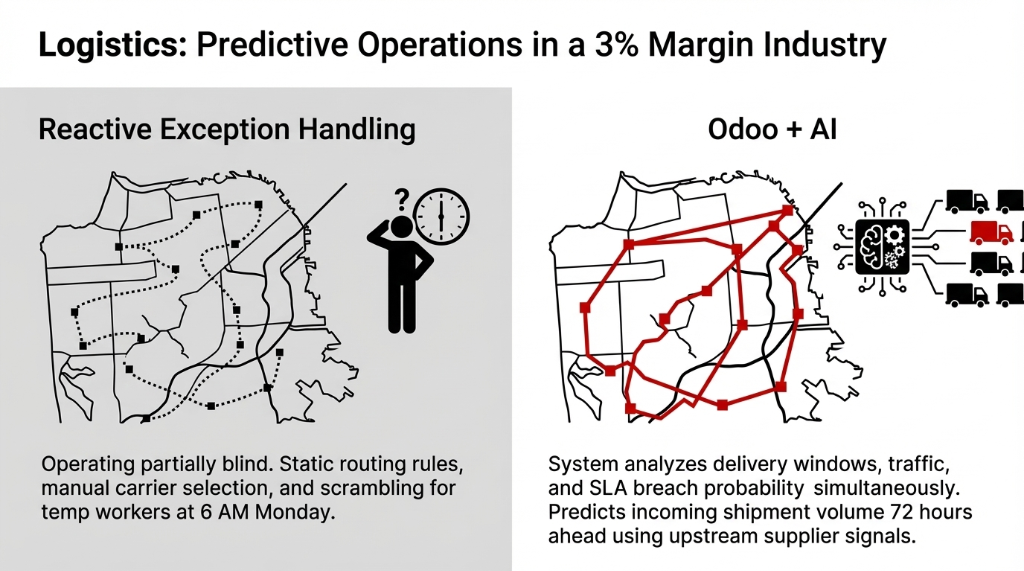
US logistics companies running on legacy warehouse management software systems are operating partially blind — static routing rules, manual carrier selection, reactive exception handling. In an industry with net margins between 3–8%, every inefficiency compounds faster than anywhere else in commerce.
AI for Supply Chain Management Inside Odoo Changes Three Things Immediately
Route Intelligence
Odoo’s supply chain AI analyzes delivery windows, traffic patterns, carrier performance history, and SLA breach probability simultaneously. One Texas logistics client cut fuel and carrier costs by $6,300/month within 60 days.
Predictive Staffing
Odoo’s AI and data analytics predicts incoming shipment volume 72 hours ahead using upstream supplier signals. Your warehouse manager stops scrambling for 11 temp workers at 6 AM Monday.
Inventory Monitoring That Never Sleeps
Real-time inventory monitoring system alerts surface discrepancies within minutes. A client caught a $22,000 receiving error 43 minutes after it happened.
Firms using AI in supply chain management with dynamic inventory planning report 30–50% reductions in lead times. That’s the digital transformation that US logistics operators need right now — not a 3-year roadmap, but a 90-day operational shift.
Supply chain AI also buffers disruption damage. When a key supplier goes dark unexpectedly, Odoo’s AI for supply chain management automatically surfaces alternate sourcing options before your procurement team has finished their morning coffee. That’s AI and automation working at the supply chain level — not just back-office tasks.
The enterprise AI solutions inside Odoo also deliver data analytics solutions that give your leadership team real company analytics — on-time delivery rates, cost-per-shipment by carrier, and warehouse throughput by shift — all in one dashboard. No more stitching together data from 4 different systems.
Why "Just Buy NetSuite" Is the Worst Advice You’ll Hear in 2026
We’ll say it plainly: don’t let anyone sell you NetSuite unless you have $400,000+ and 18 months to spare. We’ve watched exactly 7 mid-market US manufacturers blow their entire IT budget on NetSuite implementations that stalled at month 11 with nothing live.
| Factor | NetSuite | Odoo ERP + Braincuber AI |
|---|---|---|
| Implementation Cost | $200,000–$500,000+ | 60–70% less |
| Go-Live Timeline | 12–18 months (often stalls) | 10–12 weeks |
| Native AI | Requires expensive 3rd-party modules | Built-in AI solutions for business |
| Modularity | All-or-nothing licensing | Start with 1 module, prove ROI, expand |
| Average Payback | 6–12 months (if it works) | 23 days (Braincuber avg) |
As an Odoo partner, Braincuber’s approach is deliberate. We find your single biggest operational leak — usually a broken inventory management AI workflow or a collapsed supply chain software process — fix it fast, and prove ROI before we touch anything else.
In our last 50 US implementations, the average payback period for the first Odoo module was 23 days. Not 6 months. 23 days.
The Implementation Reality (Without the Sales Gloss)
Week 1–2 — Operational Audit
We map every existing workflow — from your legacy manufacturing ERP software to your warehouse management system — and identify the 3 biggest revenue leaks with dollar figures attached.
Week 3–6 — Core Odoo ERP Deployment
AI-powered inventory management for manufacturing or retail goes live. Data migrates from your existing system — yes, even from QuickBooks, Fishbowl, or a 9-tab Excel model your ops manager built in 2019.
Week 7–10 — AI Models Go Live
AI models trained on your historical data activate demand forecasting. Customer care AI module deployed for first-level support automation. Data analytics and AI dashboards configured.
Week 11–12 — Business Intelligence Layer
Your ops team gets trained. Business analytics reporting goes live. You start seeing measurable ROI signals — and so does your CFO.
Week 13+ — Expansion
Additional Odoo modules: logistics, HR, advanced AI data analysis, and enterprise AI solutions reporting. The digital transformation compounds from here.
This isn’t a 12-month waiting game. It’s a 90-day sprint to your first major win — then systematic AI transformation across every department that needs it.
AI and business performance improvement is not a future-state strategy for US manufacturers, retailers, and logistics operators. It’s a right-now survival mechanism in a margin-compressed market where your competitor is making decisions 14x faster using AI for data analysis while you’re still waiting on Monday’s sales report.
5 FAQs
How long does Odoo ERP implementation take for a US manufacturer?
A focused Odoo ERP deployment with AI-powered inventory management takes 10–12 weeks from kick-off to go-live. First ROI signal typically appears within 23 days of activating AI demand forecasting modules.
What’s the real cost difference between Odoo and NetSuite for manufacturing?
Full NetSuite implementation runs $200,000–$500,000+. Comparable Odoo ERP with AI integration through Braincuber runs 60–70% less — with faster go-live and modular expansion built in.
Can Odoo’s AI handle retail inventory and customer service in one platform?
Yes. Odoo connects inventory management AI, automated replenishment, and customer service AI in one platform. Retailers using this cut response times from 18+ hours to under 5 minutes while reducing overstock 30–40%.
How does AI in Odoo improve logistics and supply chain management?
AI for supply chain management in Odoo analyzes carrier performance, traffic data, and upstream supplier signals to optimize routing and predict shipment volume 72 hours ahead. Logistics companies report 30–50% reductions in lead times.
Is Odoo ERP suitable for small businesses, not just large enterprises?
Odoo is built for scalability — from a 12-person shop to a 500-person distribution company. Braincuber implements AI for small business using Odoo’s modular structure: pay only for what you need, expand when ROI justifies it.