
Your HR team just spent 42 days filling a role, paid $4,800 in recruitment costs, and the new hire is already underperforming. That’s not a bad luck story. That’s a broken human resource management system doing what broken systems do—costing you money quietly, every single quarter.
Here’s the math nobody puts in a sales brochure: SHRM reports a bad hire can cost up to $240,000 when you factor in lost productivity, team disruption, onboarding waste, and damage to client relationships. And Gallup found that actively disengaged employees cost U.S. businesses between $450 billion and $550 billion annually in lost productivity alone.
Your HR Department Isn’t a Cost Center. It’s a Revenue Leak With a Logo on the Door.
42 days to fill one role. $4,800 in recruiter fees. A new hire who underperforms from week two. Multiply that across 7–9 hires per year and you are looking at a $67,400 annual leak that never hits a dashboard.
Impact: $240,000 per bad hire. And you made three last year.
Your HR Stack Is the Problem, Not the People
We’ve implemented human resource management software for 150+ companies across the US, UK, and UAE. The pattern is always the same.
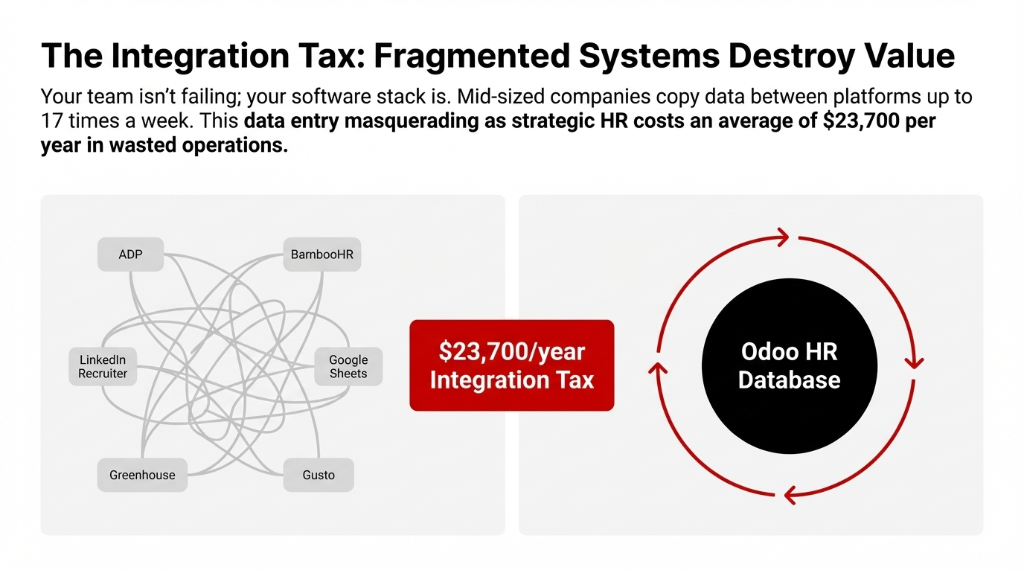
A mid-sized US company running ADP for payroll, BambooHR for employee records, LinkedIn Recruiter for sourcing, and Google Sheets to track everything in between. The human resources professionals on the team are copying data between four platforms at least 17 times per week. (Yes, we’ve counted.)
That’s not strategic human resource management. That’s data entry with a job title.
The dirty truth about most hr software tools on the market: they are built to store data, not to act on it. Workday will show you a headcount report. It will not tell you that your top software engineer is 73% likely to resign within 90 days based on recent behavioral patterns. Neither will BambooHR. Neither will Excel with its beloved VLOOKUPs.
Human resources services teams in the US are drowning in dashboards that describe yesterday, while the real problem is tomorrow.
The Hire That Cost One Client $67,400
One of our US-based manufacturing clients spent $67,400 on a failed senior operations hire—that number includes recruiter fees ($18,200), onboarding costs, 11 weeks of below-target output, and the ripple cost of the two team members who quietly started job hunting after the new manager’s arrival.
Real Client: $4.7M US Manufacturing Brand
Root Cause: Their hr management software had zero predictive capability. It processed applications. It didn’t screen them. Their recruiter manually read 214 resumes over 6 working days. By the time they made an offer, their first-choice candidate had already accepted a competing offer.
The Verdict
Total Damage: $67,400 on a single hire
AI changes this calculus entirely—but only if it lives inside your human resource management system, not bolted on top of it as a third-party plugin that breaks every time you update your core platform.
What AI Actually Does Inside Odoo HR
Odoo 19 doesn’t add AI as a checkbox feature. It embeds AI directly into every stage of the HR workflow. Here’s what that looks like in practice for hr management systems running Odoo:
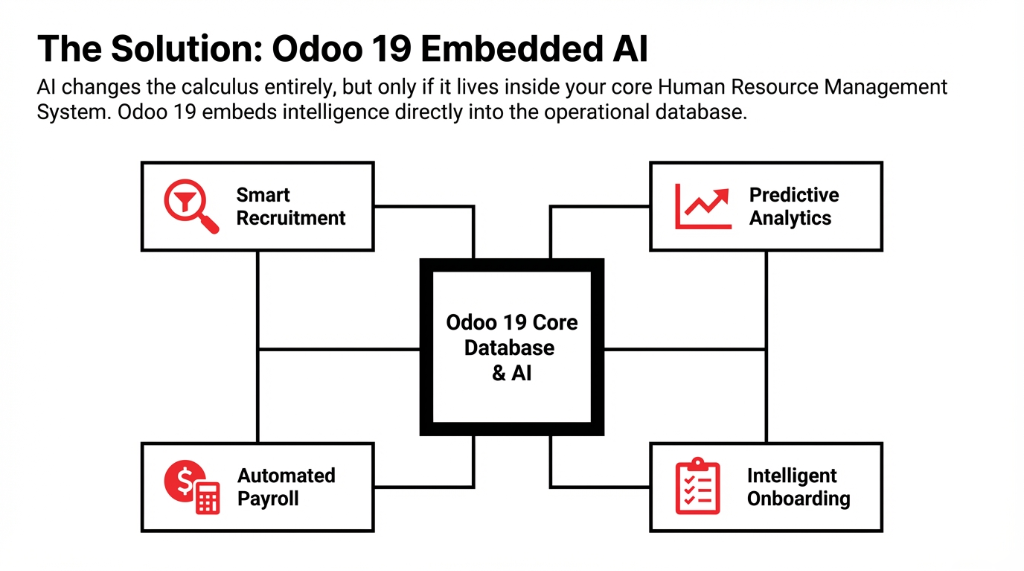
How Odoo 19 AI Transforms Every HR Workflow
▸ Resume Screening at Scale
AI reads CVs, compares against stored job profiles in your HRIS system
Assigns 0–100 match score, auto-routes qualified candidates
Saves 6 hours of screening per hire
▸ Bias Reduction (Measurable)
Early-stage AI screening reduces recruitment bias by 41%
PwC: 58% of North American enterprises use predictive DEI analytics
Auditable results, not talking points
▸ Automated Payroll + Salary Sim
Odoo 19 Salary Estimation Simulator: net pay, tax, total cost—real time
Kills the software for hr and payroll fragmentation problem
Saves $3,200/year per HR staff member
▸ Onboarding Task Intelligence
AI generates step-by-step instructions for new hires
Allocates tasks based on skills and responsibilities
From "here’s your laptop" to a tracked workflow
Recruiters dealing with 150–250 applications per role—a common volume for specialist hiring in the US—stop wasting 6 hours reading resumes that should have been auto-filtered. The AI in your employee management software does it in minutes. Not "AI-assisted." Fully automated first-pass screening.
Employee Analytics: Stop Managing Feelings, Start Managing Data
Frankly, most hr management decisions in US companies are still made on gut instinct dressed up as experience.
AI-powered hr analytics in Odoo transforms human resource management from reactive to predictive. Here’s what the numbers look like when it’s done right:
| AI-Driven HR Metric | Impact | Source |
|---|---|---|
| Predictive analytics on turnover | 18–25% reduction in turnover rates | Deloitte |
| AI-powered engagement surveys | 45% boost in response rates | Hirebee |
| AI-driven performance reviews | 50% reduction in review bias | Hirebee |
| AI HR dashboards on decision speed | 60% faster decision-making | Hirebee |
| AI-driven coaching programs | 35% improvement in productivity | BetterUp |
These aren’t forecasts. These are outcomes from companies that stopped using hr software tools as glorified filing cabinets and started using them as decision engines.
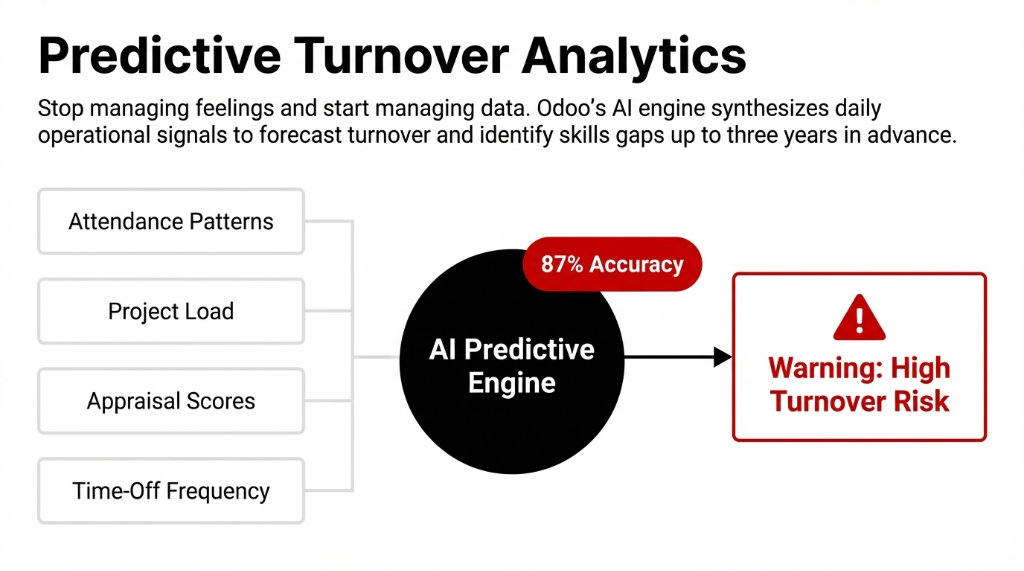
One insight that most hr management systems completely miss: AI can forecast skills gaps three years in advance. For US companies doing strategic hr management, that means you’re not scrambling to upskill your team six months before a technology shift. You’re ahead of it.
Why Odoo Beats a Stack of "Best HR Software" Point Solutions
Everyone in the hr software companies space will sell you a "best-in-breed" point solution. Best ATS. Best payroll. Best performance management tool. Best human resources app.
Here’s the ugly truth: five best-in-breed tools that don’t talk to each other are worse than one integrated platform that does everything at 80%. The integration tax—the time and money spent syncing data between disconnected hr systems—destroys the value of every "best" tool in the stack.
The $23,700/Year Integration Tax
We’ve watched companies running a human resources management system software frankenstein setup (Greenhouse + Gusto + Lattice + 15Five + Slack bots) spend $23,700/year more on HR operations than comparable companies running a single hr management software platform like Odoo.
The Breakdown Nobody Shows You
▸ Data sync failures: 4.3 hours/week fixing broken API connections
▸ Duplicate data entry: 17 cross-platform copies per week
▸ License overlap: paying for the same feature in 3 different tools
Total: $23,700/year in pure waste
Odoo’s hr systems software connects Recruitment, Employees, Attendance, Time Off, Expenses, and Payroll in one database. Your hr analytics pull from actual operational data—not from an API sync that ran 6 hours ago and missed three payroll corrections. That’s hr connectivity that actually works.
For small business hr software buyers specifically: Odoo’s human resource management software for small business tier starts at a fraction of what enterprise platforms like Workday or SAP SuccessFactors charge. And unlike most hr software free tools that hit hard paywalls at 25 employees, Odoo scales without forcing you to switch platforms. That makes it the AI-powered solution that actually fits your budget.
What 90 Days Looks Like After Braincuber Implements Odoo AI-HR
We don’t drop software and disappear. Here’s the honest implementation timeline we give every US client:
Core HR Setup + Data Migration
Days 1–14
Employee records migrated, organizational structure mapped, payroll rules configured for US tax compliance. Your existing ADP data comes with you. Nothing gets lost.
What happens: Full human resource system software goes live with clean, validated employee data from your old stack.
AI Recruitment Workflows Activated
Days 15–30
The scoring model gets trained on your historical hiring data (or on industry benchmarks if you’re starting fresh). Job posting templates go live across LinkedIn, Indeed, and your careers page—all feeding directly into Odoo.
Result: Your hr application starts screening candidates autonomously. Zero manual resume reading.
Analytics Dashboards + First Payroll Run
Days 31–60
Your hr management tools start surfacing data on turnover risk, performance trends, and skills gaps. The first automated payroll run happens in this window. Hr and payroll finally live in one system.
Independent Operations
Days 61–90
Human resources professionals on your team are running independently. Average time-to-hire drops by 22 days. Recruiter screening time drops by 6 hours per hire. Payroll errors drop to near-zero because AI flags discrepancies before they hit the pay run.
By Day 90: Your team runs the entire employee management system without calling us. That’s the goal.
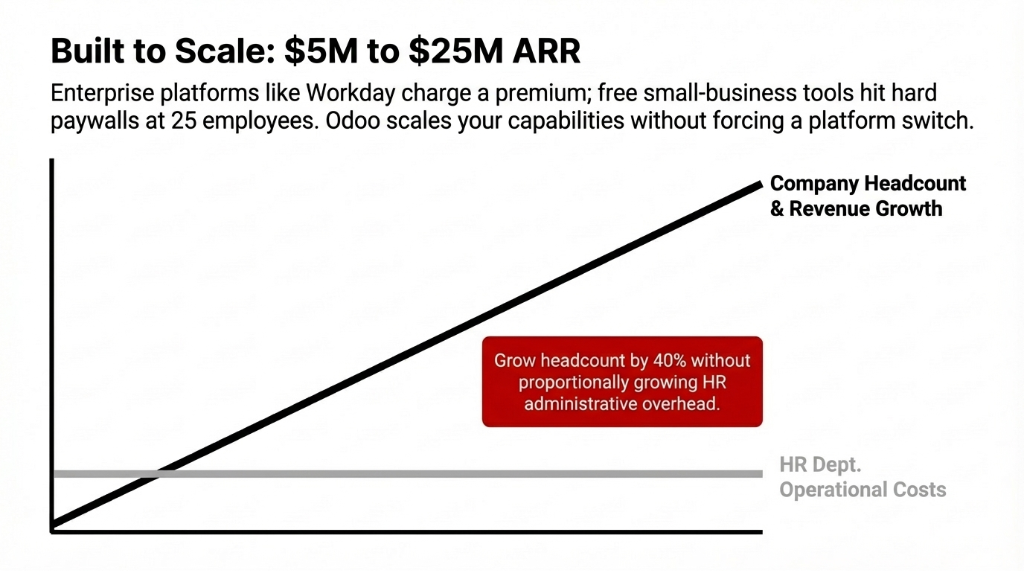
Clients scaling from $5M to $25M ARR see the clearest ROI here—they can grow headcount by 40% without proportionally growing their hr department operational cost. That is managed hr done right. Your Odoo implementation partner should be delivering this kind of measurable outcome—not a login and a PDF manual.
The Controversial Take: Stop Buying "Best HR Software" Lists
Everyone says buy the "best" ATS. The "best" payroll. The "best" performance tool. Five "best" hr software programs that don’t share a single database.
Hidden cost: $23,700/year in integration tax. Every year. Forever.
One insight most hr solutions providers won’t tell you: the hr portals they sell you are designed to maximize their per-seat licensing revenue, not your operational efficiency. Odoo’s human resource management tools are priced per app, not per employee—which means your cost doesn’t triple when your headcount does. That is hr for small businesses and hr for small companies that actually makes financial sense.
And if you’re wondering whether full ERP integration can extend these AI capabilities beyond HR—into accounting, inventory, and CRM—the answer is yes. But fix the hr functions first. Walk before you run.
The Insight: Your HR Team Should Be Strategists, Not Data Entry Clerks
The goal is not to fire your human resources professionals. It is to stop wasting them. When your hr software solutions handle resume screening, payroll automation, and turnover prediction—your team handles the judgment calls. Retention strategy. Culture. Comp negotiations. Hr strategy that actually moves numbers.
That’s the correct ratio. Anything else is burning $67,400 per bad hire.
Frequently Asked Questions
How does AI in Odoo HR reduce recruitment time?
Odoo’s AI reads and scores CVs against the job profile automatically, then routes qualified candidates to the next stage. Recruiters handling 150+ applications save up to 6 hours per hire, and time-to-hire drops by an average of 22 days.
Can Odoo HR predict employee turnover?
Yes. Predictive AI monitors attendance, appraisal scores, project load, and time-off patterns to flag at-risk employees with up to 87% accuracy—before they submit a resignation letter.
Is Odoo HR good for small businesses in the US?
Odoo scales from 10-person teams to 10,000+ employees without a platform switch. It covers payroll, recruitment, attendance, and analytics—making it one of the most cost-effective small business HR software options available.
How long does Odoo HR implementation take?
A standard Odoo HR implementation with AI features takes 60–90 days. Core HR management functions go live in the first 30 days. AI-powered recruitment and analytics are fully operational by day 60.
Does Odoo replace existing payroll software?
Yes. Odoo’s HRM payroll software handles US-specific tax rules, automates batch pay runs, and syncs directly with employee records. No more exporting from BambooHR and importing into Gusto.
Stop Losing $67,000 Per Bad Hire
Braincuber has implemented Odoo HR for 150+ companies across the US, UK, and UAE. We know exactly where the leaks are in your current hr management system software. Pull up your last 3 hires. Count the days-to-fill. Multiply by $4,800. That’s the number we’re cutting.
Book Your Free 15-Minute HR Operations AuditCheck your last 3 hires. If any one of them took more than 30 days to fill, call us.