
Here is the ugly truth: 73% of your Shopify customers will not buy from you again next year. Not because your product failed. Because your loyalty program is static, your customer interaction management is reactive, and you are only finding out someone churned after they already left.
That $14,200/month leaking out of your Shopify store? It is not a pricing problem. It is a customer churn problem you chose to solve with a points card that nobody checks.
Your Loyalty Program Is Lying to You
We work with Shopify brands scaling from $1M to $10M ARR, and we constantly see the same mistake: they launch a customer loyalty rewards program, hand out points for purchases, and assume customers feel "rewarded." They do not.
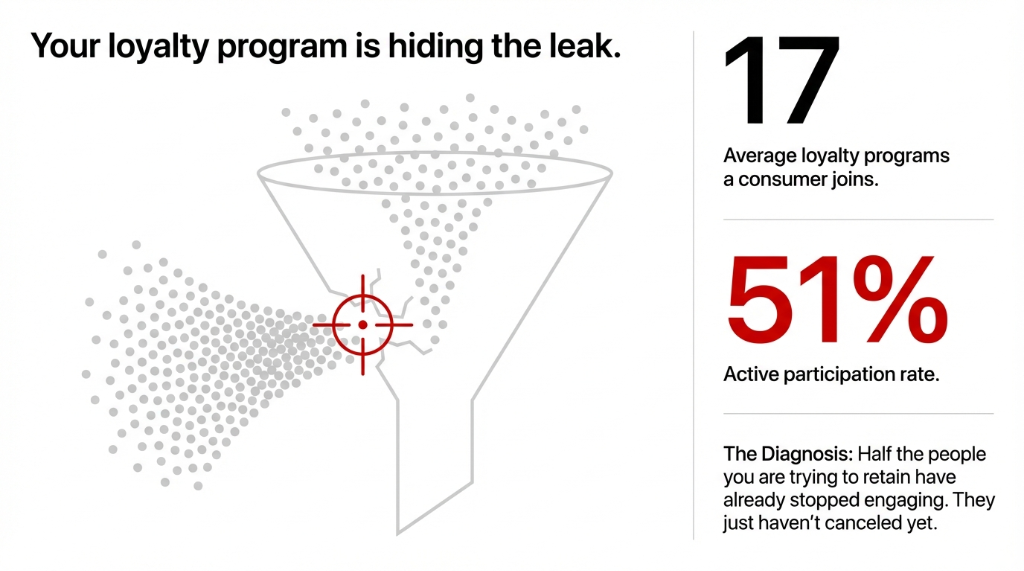
The average American consumer is enrolled in 17 loyalty programs. Their active participation rate across all of them is just 51%. Read that again. Half the people you are trying to retain through your customer loyalty schemes already stopped engaging — they just have not cancelled yet.
That is passive churn. It is the worst kind because it looks like retention until your repeat purchase rate tanks in Q4. One of our Shopify clients — a skincare brand in Austin doing $2.3M annually — had 4,100 "active" loyalty members. When we ran cohort analysis on their customer data, only 1,190 had purchased in the last 90 days. The other 2,910 were ghosts. Their customer retention rate was sitting at 28%, not the 67% their loyalty platform was reporting.
The platform was counting enrolled customers, not engaged ones. Big difference.
Why Standard Customer Retention Strategies Fail
Everyone tells you to run more email campaigns, add more rewards tiers, and improve your customer experience. That advice is not wrong. It is just dangerously incomplete.
Traditional customer retention management systems like LoyaltyLion, Smile.io, and Yotpo are built on a simple model: customer buys → earns points → (hopefully) redeems → buys again. The problem? That model treats every customer the same. Your $380/year repeat buyer and the one-time $28 impulse purchaser get the same "Earn 10X points this weekend!" email.
That is not a customer engagement strategy. That is spray-and-pray with a rewards badge slapped on it.
Here is the insider secret most agencies will not tell you: a customer's likelihood to churn can be calculated 37 to 45 days before they actually leave. Their session frequency drops, their average order value shrinks, their email open rate slides below 8%, and their time-between-purchases extends past their normal cycle. Every one of those signals is sitting in your Shopify backend right now. Standard loyalty platforms are not reading them.
How AI Predicts Churn — And Stops It
AI-powered customer retention management systems do not wait for a customer to lapse. They monitor behavioral signals in real time: browse frequency, dwell time on product pages, cart abandonment patterns, discount sensitivity, and purchase velocity.
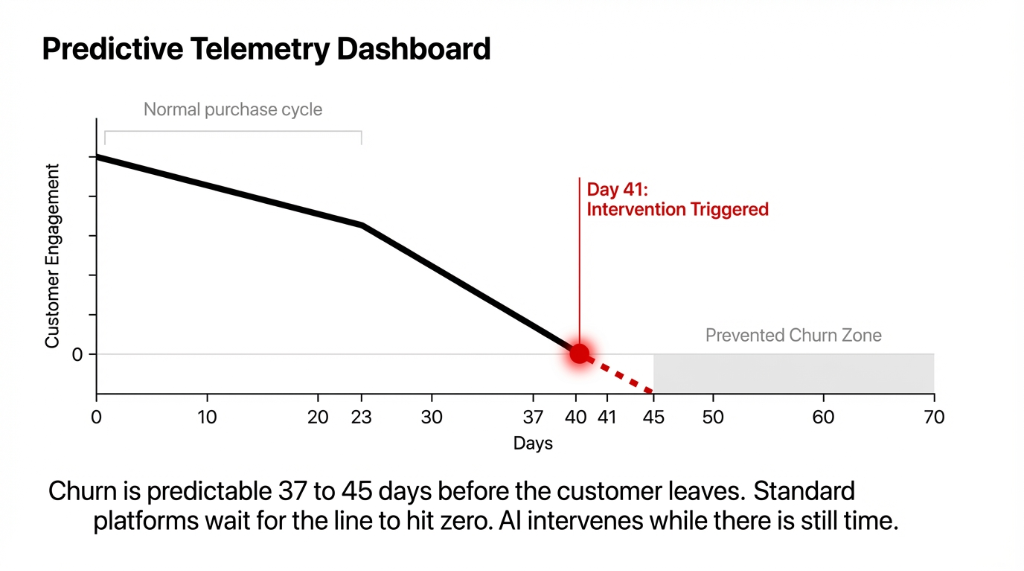
When a customer who used to buy every 23 days suddenly goes 41 days without a visit, the AI does not send them the same generic newsletter. It triggers a personalized intervention — the specific product they viewed 3x without buying, paired with a time-sensitive offer calibrated to their exact discount sensitivity threshold.
That is customer interaction management built for 2026, not 2014.
At Braincuber, we implement AI-driven churn prediction models on Shopify stores using a combination of Shopify's native customer segmentation API, Klaviyo behavioral flows, and custom ML models built on AWS SageMaker. Here is what the signal stack looks like in practice:
Dynamic RFM Scoring
Recency, Frequency, Monetary Value updated daily, so your segments are never stale.
Churn Probability Score
0–100 risk score assigned to every customer, recalculated every 48 hours based on behavior decay.
Session Intent Signals
Monitors searches, ignores, and time on the returns page—the primary "ghosting" signal.
Cross-sell Triggers
Automatically fires when a customer’s primary category drops but adjacent interests rise.
One US-based D2C apparel brand we worked with reduced their monthly churn rate from 6.8% down to 3.1% in 91 days after implementing this stack. That translated to $19,400/month in recovered net revenue retention that was previously walking out the door silently.
The AI Loyalty Stack That Actually Works on Shopify
Building a real customer loyalty program that predicts and prevents churn requires three layers that most Shopify brands are missing:
Layer 1 — The Data Foundation
Your customer data needs to be unified. Right now, your purchase history is in Shopify, email in Klaviyo, and tickets in Gorgias. They don't talk. We unify every touchpoint, return, and abandoned cart into one customer interaction management profile via Shopify-Odoo pipelines.
Layer 2 — The Prediction Engine
Once unified, AI calculates customer lifetime value individually. No more manual snapshots. The AI calculates dynamic CLV addressing engagement decay, affinity, and seasonality. This makes your client retention strategies bulletproof.
Layer 3 — The Automated Intervention
When the churn probability crosses 68%, your loyalty rewards program stops being a ledger and becomes an engine, firing precision interventions at the exact moment risk probability peaks.
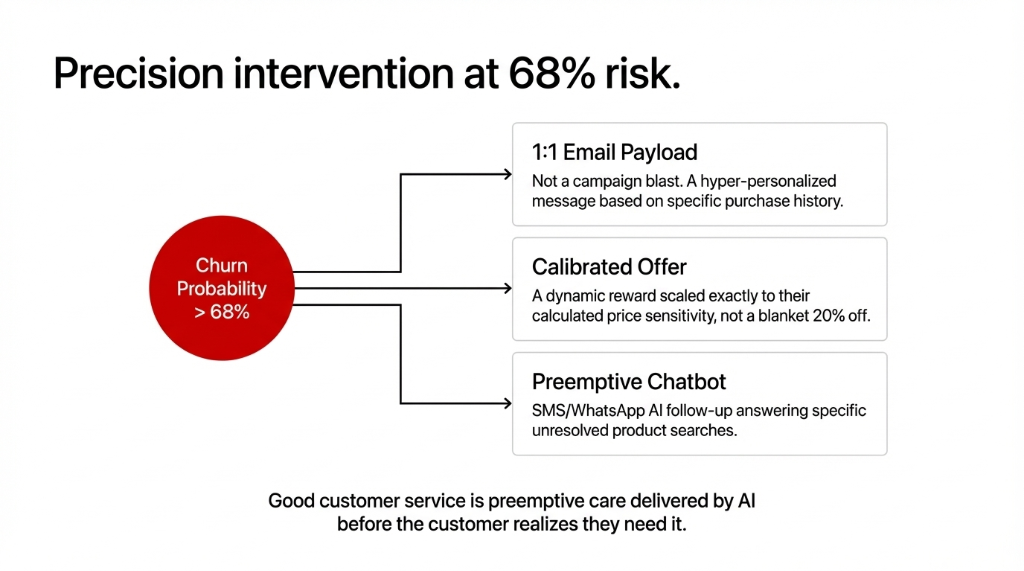
Good customer service is no longer just reactive support — it is preemptive care delivered by AI before the customer realizes they need it.
What Real Client Retention Looks Like
Let us talk numbers, because vague promises about "improved customer satisfaction" are useless.
Jewelry brand Olive & Piper used AI personalization tools on their Shopify store and increased conversions by 35%. That is not magic — that is what happens when you replace broad product recommendations with AI-driven ones that reflect individual customer needs.
The global loyalty management market was valued at $13.31 billion in 2024 and is projected to reach $41.21 billion by 2032. That growth is not coming from more punch cards. It is coming from AI-powered loyalty platforms that turn behavioral data into revenue.
Here is what an AI-powered client retention model changes for a $3M Shopify brand:
| Metric | Before AI Loyalty | After 90 Days |
|---|---|---|
| Monthly Churn Rate | 6.8% | 3.1% |
| Repeat Purchase Rate | 28% | 41% |
| Customer Lifetime Value | $187 avg | $263 avg |
| Email Campaign Open Rate | 11.2% | 23.7% |
| Monthly Revenue from Retention | $61K | $88K |
The difference between those two columns is not a bigger marketing budget. It is a smarter customer engagement system that knows who is about to leave before they do.
The One Mistake That Kills Every Loyalty Campaign
Frankly, the biggest error we see in loyalty program examples across Shopify stores is this: brands invest in customer acquisition strategy and treat retention as an afterthought.
Customer acquisition costs 5x to 7x more than retention. Yet US D2C brands on Shopify spend 73% of their marketing budget on acquiring new customers and under 18% on keeping the ones they already have. That is a math problem disguised as a growth strategy.
Repeat customers represent only 21% of an average ecommerce base — but generate 44% of total revenue.
If your client engagement strategy is not built around protecting and growing that 21%, you are running a business that leaks money every single month. Customer advocacy — the point where a retained customer becomes a referral engine — only happens when your customer experience management is consistent, personal, and proactive. AI makes that possible at scale.
Stop Watching Best Customers Disappear.
We don't sell you an app. We build the full stack: Custom AI churn models, Shopify-Klaviyo-Odoo integration, and automated precision follow-ups. Book a free 15-Minute Shopify Retention Audit to find your leakage.
Book Your Free AI AuditFrequently Asked Questions
How does AI predict customer churn on a Shopify store?
AI monitors behavioral signals — declining purchase frequency, dropping email open rates, reduced session time, and shrinking basket sizes. When these signals hit a defined threshold, the system triggers automated, personalized retention interventions before they actually leave.
What is a healthy customer retention rate for a Shopify store?
For non-subscription ecommerce, a retention rate above 35–40% is considered strong. The industry average sits around 27–30%. If your calculated retention rate is below 25%, your customer churn problem is costing you more than your ad spend.
Do AI loyalty programs work for small Shopify stores under $500K/year?
Yes, but the ROI math works best at $500K+ ARR. Below that, a smart Klaviyo flow with basic RFM segmentation is more cost-effective. The full AI churn prediction stack becomes worth the investment when you have enough transaction volume to train a reliable model.
How is this different from apps like LoyaltyLion or Smile.io?
Those are traditional loyalty point programs — they manage static rewards. AI churn prediction is a behavioral intelligence layer that sits above your loyalty program and tells it who to reward, when, and with what. Most apps track points; AI tracks intent.
How long does it take to implement an AI loyalty system on Shopify?
A basic churn prediction model with automated triggers typically goes live in 3–4 weeks. A full-stack build with custom ML models, Shopify-Odoo integration, and AI customer support takes 6–10 weeks depending on data availability.