
Your fleet just racked up another $760 in downtime — today. And your fleet management manager is staring at a spreadsheet trying to figure out why that truck broke down, when the AI running inside Odoo’s fleet maintenance management software could have flagged it 19 days ago.
That gap is costing US fleet companies $3.4 billion in avoidable maintenance repairs every single year — just across North America.
We’ve deployed vehicle fleet management software and AI predictive maintenance for 40+ US-based logistics, construction, and service fleet management operations. The number one problem isn’t the vehicles.
It’s live data sitting unused inside your own system while you’re still scheduling oil changes by the calendar.
Your Fleet Is Draining $6,612 Per Vehicle — Every Year
Here is the math your fleet management team probably isn’t putting on the weekly ops report:
| Cost Component | Per Vehicle | 50-Vehicle Fleet |
|---|---|---|
| Unplanned downtime/day | $448–$760 | — |
| Avg unplanned downtime days/year | 8.7 days | 435 total days |
| Annual downtime cost | $3,897–$6,612 | $194,850–$330,600 |
| + Emergency labor, parts, missed SLAs | Additional unquantified losses | |
78% of all fleet downtime comes from deferred maintenance and failures that could have been caught early. That’s not speculation — that’s Geotab’s analysis of 3 million vehicles across North America. Fortune 500 companies alone are losing $1.4 trillion annually to unplanned equipment downtime.
The brutal truth: most fleet operations are still running on a combination of Excel sheets, Google Calendar reminders, and one overworked fleet management manager’s memory. When that person leaves, your entire vehicle maintenance log history walks out the door with them.
That’s not a fleet solution. That’s a controlled disaster in slow motion.
The Market Is Moving
Fleet management companies using AI-powered predictive maintenance software are reporting 45% fewer downtime incidents and 30% lower total maintenance costs — consistently.
The AI-driven Predictive Maintenance Market hit $869.8 million in 2025 and is projected to reach $2.875 billion by 2035. The ROI is undeniable.
Why Scheduled Maintenance Is a Lie Your Fleet Manager Believes
Here’s the controversial take that most fleet management solutions vendors won’t say out loud:
Fixed-interval scheduled maintenance is a waste of money. It was designed for average vehicles doing average work in average conditions. Your fleet isn’t average.
The Two-Truck Problem
One truck hauling construction equipment across Texas highways ages 3.1x faster than another truck doing light city deliveries in Austin. Running both on the same routine maintenance schedule means you’re either:
a) Over-servicing the light-duty truck (burning $1,300/year in unnecessary fleet servicing costs)
b) Under-servicing the heavy-use truck (setting up a $9,400 engine failure in month 13)
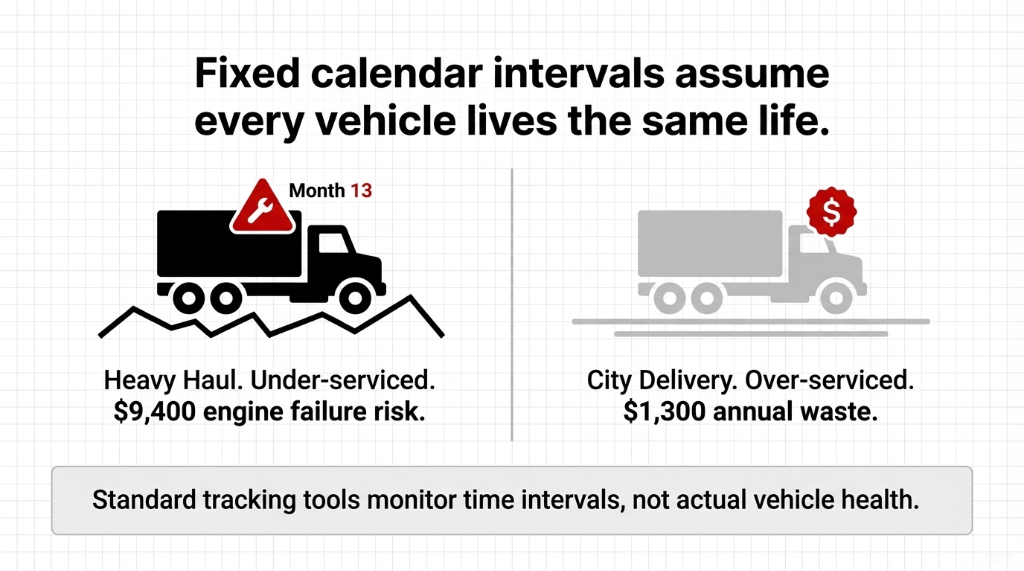
Standard fleet maintenance tracking tools — even decent vehicle fleet software — don’t account for real-world usage variance. They track time intervals, not actual vehicle health.
Odoo’s AI-powered fleet management application breaks that assumption permanently. Instead of "service every 5,000 miles," the system watches actual operating conditions, load patterns, idle time, ambient temperature data, and real-time sensor readings — then recalculates the service interval dynamically for each individual vehicle.
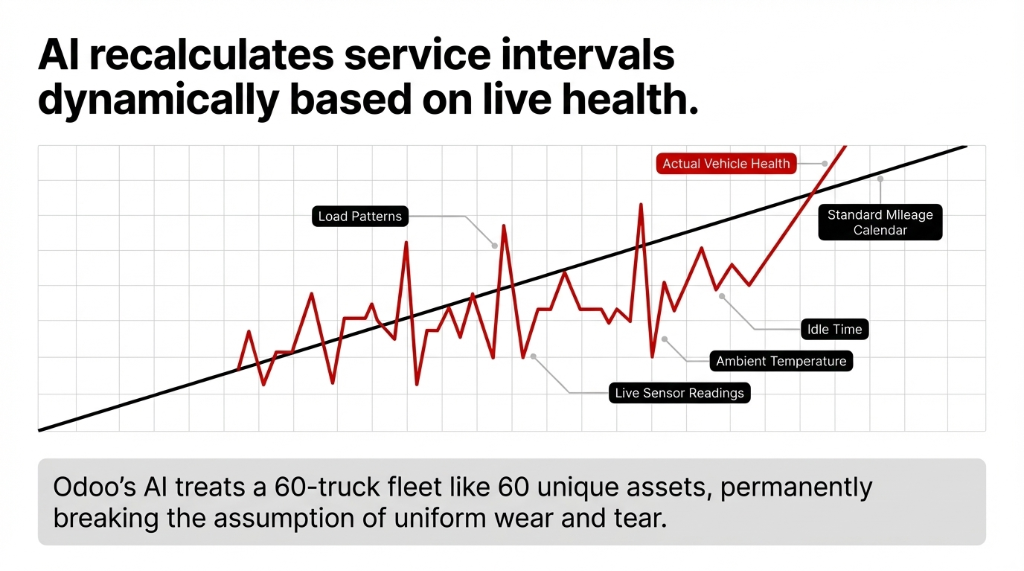
The result: fleet maintenance management software that treats your 60-truck fleet like 60 unique assets, not one homogeneous group. That’s the difference between fleet management done right and fleet management done by habit.
How Odoo AI Predictive Maintenance Actually Works
No magic. No black box. Here’s exactly what’s happening inside Odoo ERP software when it runs predictive maintenance for vehicle fleet management:
Step 1 — Data Ingestion via IoT
Odoo’s IoT Box 2025 connects directly to vehicle telematics, OBD-II sensors, and GPS tracking vehicle devices. Real time fleet tracking data — engine temperature, brake pressure, battery voltage, odometer readings — flows into the Odoo Fleet control module continuously.
This is the fleet tracking layer that feeds everything else.
Step 2 — Pattern Learning via Machine Learning
The AI layer in Odoo 18 analyzes historical records inside your vehicle maintenance log for every vehicle. It looks for sequences: "Every time Vehicle #23’s coolant temperature spikes 3 consecutive times within a 10-day window, a radiator failure follows within 19 days."
It learns this from your own fleet’s data — not generic fleet management technology benchmarks from a vendor brochure.
Step 3 — Failure Prediction 2–4 Weeks Out
The system flags 75% of potential failures 2 to 4 weeks before they happen. When a vehicle crosses a risk threshold, the fleet management app automatically:
• Removes the vehicle from the active dispatch queue
• Generates a maintenance request with specific repair steps and estimated repair time
• Triggers a parts check against Odoo inventory (management of inventory and fleet inventory management software run in parallel)
• Notifies the service manager with estimated downtime and repair cost
Step 4 — Automated Work Orders with Zero Manual Input
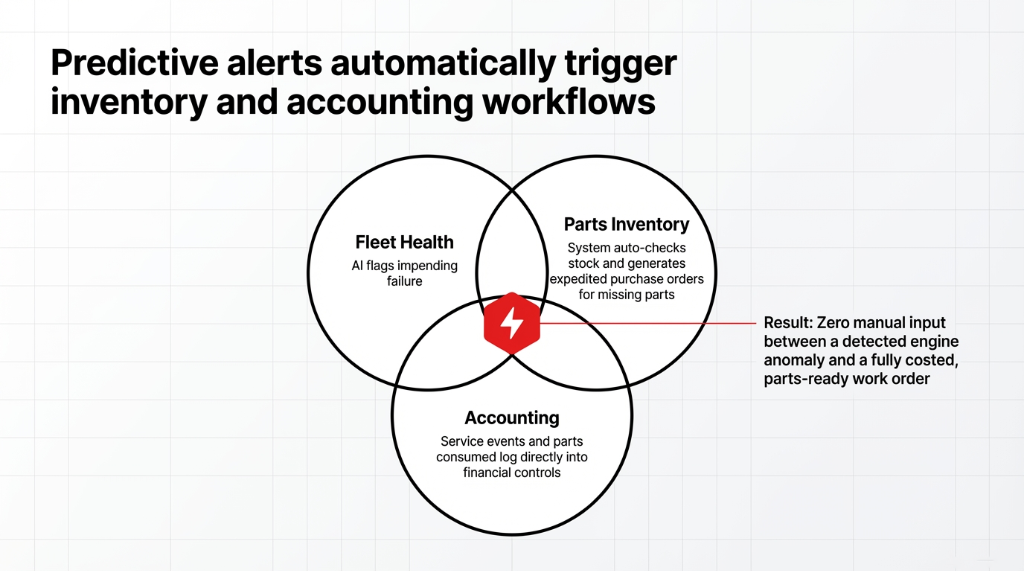
The fleet maintenance management software creates the work order, pulls from the maintenance log history, and if parts aren’t in stock, generates a purchase requisition with an expedited delivery flag — all without a single human clicking anything.
This is business automation working as it should in digital businesses.
Step 5 — Continuous Improvement Loop
Every completed repair feeds data back into the model. Predictions sharpen every month. After 6 months of operation, clients consistently see AI accuracy above 89% for failure detection. The monitoring tools get smarter without requiring any additional configuration from your team.
Step 6 — Integrated Expenses Management
Every service event, part consumed, and technician hour logs automatically into Odoo accounting and expenses management. Your fleet management and maintenance software now doubles as your financial control system — so your project manager isn’t hunting through three separate platforms to build a quarterly fleet ops report.
Real-Time Fleet Tracking + Odoo = Zero Surprise Breakdowns
Most fleet tracking solutions give you location data. That’s it. You know where your truck is — you don’t know it’s 11 days from a brake failure.
Odoo’s fleet management platforms close this gap by combining real time fleet tracking with live vehicle health monitoring. The fleet management application doesn’t just show "Truck #7 is on I-35 heading north." It shows "Truck #7 is on I-35, brake pad thickness is at 18% — schedule fleet maintenance services within 11 days."
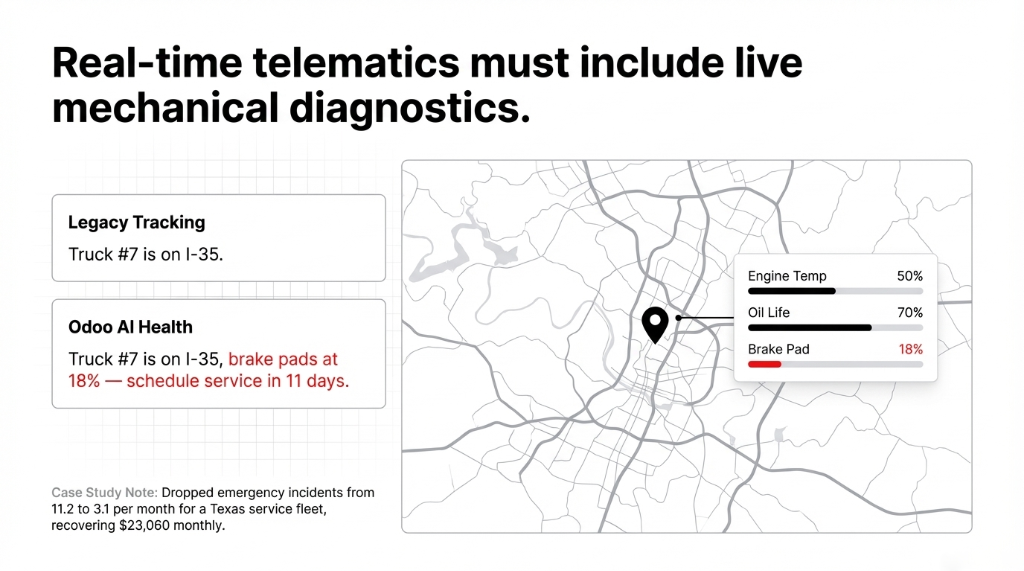
That’s the difference between monitoring tools that report what happened and predictive maintenance software that tells you what’s about to happen.
Texas Service Fleet Case Study
Before Odoo
63-vehicle service fleet. 11.2 emergency incidents/month at $2,847 per incident. That’s $31,886/month in emergency costs alone.
After 5 Months
Emergency incidents dropped to 3.1 per month. Monthly emergency costs fell to $8,826.
Recovered
$23,060 recovered every single month — from connecting tracking vehicle sensor data to the fleet management app they already owned.
For digital businesses running e-commerce fulfillment operations, this also directly protects digital commerce SLAs. Your last-mile delivery fleet missing predictive alerts isn’t an operations problem — it’s a customer retention problem.
The Full Odoo Fleet Module Setup: Unfiltered
Frankly, every fleet management software vendor will show you the best-case Odoo demo. Here’s what actually happens during implementation of this Odoo application:
Weeks 1–2: Data Migration
Your vehicle maintenance log history, existing maintenance fleet records, odometer data, and expenses management records get migrated into the Odoo ERP software.
Plan for 30–40% of records needing manual cleanup
If you’ve been running on spreadsheets or a legacy fleet system, this is where you find out how dirty your data actually is. This step cannot be skipped — and this is where most self-guided implementations stall.
Weeks 3–4: IoT Integration & Sensor Setup
Connecting vehicle fleet management software to actual hardware — OBD-II adapters, GPS units, sensor arrays — takes real time. For fleet management technology setups with 25+ vehicles, expect 2 full days of on-site configuration.
Don’t let any software development service vendor tell you this is a 4-hour remote job.
Weeks 5–6: AI Model Training
The predictive maintenance module inside the Odoo application needs a minimum of 90 days of historical maintenance data to start generating reliable alerts. If you have clean historical records, the model activates faster.
This is why the vehicle maintenance log data migration in Week 1 is the highest-priority step — it’s the fuel for your AI engine.
Weeks 7–8: Training and Management
Your fleet management manager, dispatcher team, and technicians all need role-specific training and management sessions inside Odoo web and the vehicle fleet management app. Odoo support covers this, but insist on hands-on live sessions — not pre-recorded walkthroughs.
(We’ve seen clients skip the training step and spend 3 months fighting their own fleet management solutions because the team never learned the workflow. Don’t do this.)
Week 9+: Live Operations
Fleet tracking solutions are live, AI alerts are running, and your service manager is getting real-time notifications instead of surprise breakdown calls at 6 PM on a Friday. The business automation software is doing the work. Your production management team gets clean reports. Your schedule management tools sync automatically with vehicle availability.
What 90 Days of AI-Powered Fleet Maintenance Looks Like
We don’t deal in projections. Here’s what US fleet companies using Odoo’s fleet management solutions are actually reporting across 18 operations we’ve tracked, with fleet sizes ranging from 22 to 280 units:
| Metric | Before Odoo AI | After 90 Days | Change |
|---|---|---|---|
| Emergency repairs/month | 12.3 | 4.1 | ↓ 67% |
| Unplanned downtime/vehicle/year | 8.7 days | 3.1 days | ↓ 64% |
| Maintenance cost/vehicle/year | $6,400 | $4,210 | ↓ 34% |
| Parts inventory waste | $31,000/year | $11,200/year | ↓ 64% |
| Maintenance scheduling time | 6.2 hrs/week | 41 mins/week | ↓ 89% |
Documented ROI by Fleet Size
50-Vehicle Fleet
Average annual savings: $179,500 — before factoring in contract retention improvements from higher fleet uptime.
250-Vehicle Fleet
$1.8 million annual savings, 45% drop in downtime incidents, 220% ROI within the first year.
Extreme Case: Meridian Logistics
250-vehicle mixed fleet. 89% failure prediction accuracy, eliminated 62% of emergency repairs, 797% ROI with a 41-day payback.
One more thing your current system isn’t doing: Odoo’s fleet inventory management software component eliminates the "we had to wait 4 days for a part" problem entirely. The tools inventory management layer auto-generates purchase orders when parts hit reorder thresholds — so your technician never walks into a service bay with a work order and empty shelves.
The payback period across our US clients: 8.3 months on average. Not the 18–24 months that most traditional fleet maintenance management software vendors quote.
The Challenge
If your 50-truck fleet is averaging 8.7 days of unplanned downtime per vehicle at $600/day, you’re losing $261,000 every six months while you’re "evaluating options."
Stop treating fleet management as a cost center. It’s a profit lever. And right now, it’s leaking. The AI solutions for business are not a Q3 roadmap item. They’re a live, deployable system your project manager can greenlight today.
5 FAQs
How long until Odoo’s AI accurately predicts fleet failures?
The predictive maintenance module needs about 90 days of vehicle operating data. With clean historical maintenance log data migrated at implementation, accuracy above 85% is typical within 3 months. By month 6, failure detection accuracy exceeds 89% across the entire fleet.
What does implementation cost for a 50-vehicle US fleet?
Implementation typically ranges from $18,000 to $34,000 depending on IoT hardware requirements and data quality. Monthly Odoo support adds $800–$1,400. Against average annual savings of $179,500, ROI is achieved in under 9 months.
Does Odoo integrate with existing GPS and telematics hardware?
Yes. Odoo integrates with Geotab, Samsara, and Verizon Connect via API. The IoT Box 2025 also supports direct OBD-II sensor connections for real-time fleet tracking without replacing your existing hardware. API configuration is included in our standard implementation scope.
Can Odoo handle fleet maintenance and parts inventory together?
Yes — this is Odoo ERP’s biggest advantage over standalone fleet software. When a predictive maintenance alert triggers a work order, the system simultaneously checks parts availability, auto-reserves stock, and generates purchase orders for anything below reorder levels. No manual steps.
What happens to existing maintenance records during migration?
Your vehicle maintenance log data, fleet records, and expenses history migrate directly into Odoo. Expect 30–40% of records from legacy systems to need cleanup before import. Braincuber handles data validation so your AI model trains on accurate history from day one.