
Your ERP is running AI — and you probably haven't done a single ai check on whether it's compliant with GDPR, India's DPDP Act, or the EU AI Act. That's not a hypothetical risk. Non-compliance with the EU AI Act alone carries fines of up to €35 million or 7% of your global annual turnover — whichever is higher.
We've done 150+ enterprise AI implementations across the US, UK, UAE, and India. Here's the ugly truth: most companies using ai inside Odoo ERP have zero documentation for their ai models, no ai governance framework, and couldn't pass an ai audit if their survival depended on it. This post changes that.
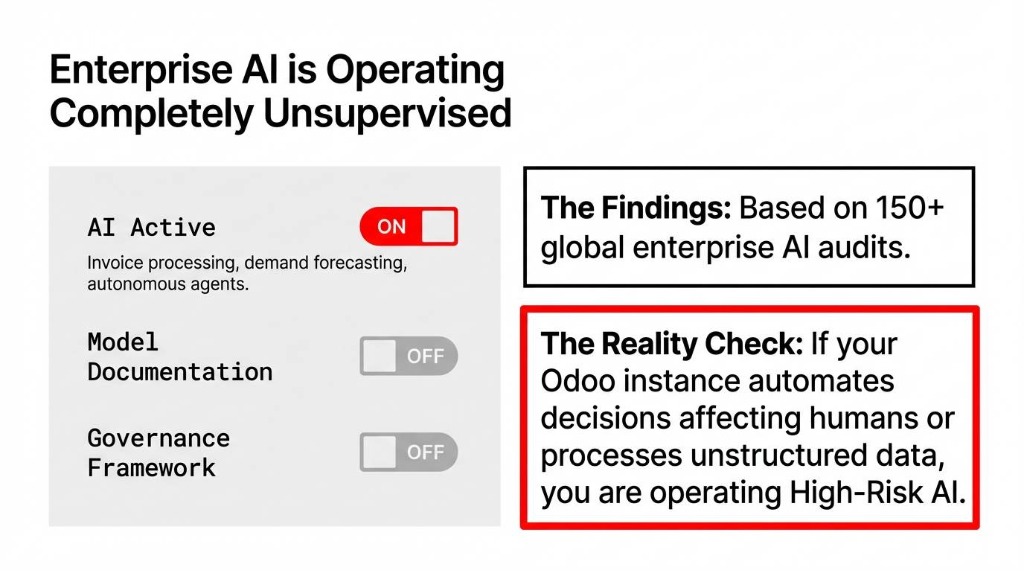
The $35M Trap Hiding Inside Your ERP
If your Odoo instance has AI-powered invoice processing, demand forecasting, or any agent ai automating decisions — congratulations, you are operating a high-risk AI system under the EU AI Act.
The Liability Timeline Right Now
EU AI Act became effective.
First mandatory provisions entered into force.
GPAI model rules enforcement begins.
High-risk AI system registration in EU database becomes mandatory.
Full compliance across all provisions required.
If you're a US company selling to EU customers and your ERP's ai systems process personal data or make automated decisions, you're in scope. Period. The EU AI Act has extraterritorial reach — just like GDPR did. Ignore it and you're not just non-compliant; you're a $14.3 million fine waiting to happen.
And if you're also processing data for Indian users? India's Digital Personal Data Protection (DPDP) Act 2023 adds another layer of ai regulation that most enterprise ai teams are treating like an optional footnote.
What the EU AI Act Actually Demands From Your ERP
Let's talk about ai governance specifics — because "check for ai compliance" means nothing without knowing what you're checking for.
Under the EU AI Act, if your ERP runs high-risk AI (which includes automated credit scoring, HR decisions, supply chain risk profiling), you need all of the following in place:
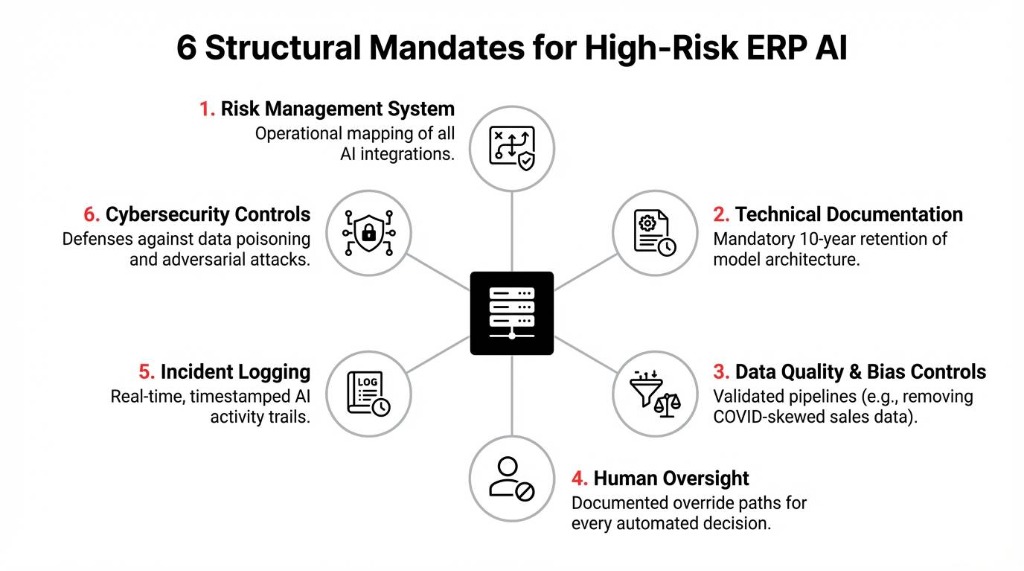
1. Comprehensive AI Risk Management System
Not a PDF policy. An active, documented process that maps every ai integration in your ERP to a risk category. This is ai risk management at the operational level — not a box-ticking exercise.
2. Technical Documentation (Minimum 10 Years)
Every ai model you use in production — whether it's a custom-built LangChain agent or an out-of-the-box Odoo module — must have documented architecture, training data lineage, and performance benchmarks. If you build ai in-house, this documentation is your responsibility, not your vendor's.
3. Data Quality and Bias Controls
Bias in ai systems isn't just an ethical problem — under the EU AI Act, it's a legal one. Your ai data pipelines must be validated for accuracy, representativeness, and freedom from ai bias. If your demand forecasting model was trained on 18 months of COVID-skewed sales data, that's a compliance failure.
4. Human Oversight Mechanisms
Every decision your ERP's AI makes that affects a person — an employee, a vendor, a customer — must have a documented human override path. Responsible ai isn't a marketing slogan anymore; it's an enforceable obligation.
5. Incident Reporting and Activity Logging
Real-time AI activity logs are mandatory. If your ai for enterprise can't produce a timestamped audit trail of every automated decision it made last Tuesday, you're not compliant.
6. Cybersecurity Controls
Security ai isn't optional. The Act requires strict measures to prevent adversarial attacks, data poisoning, and model manipulation. Ai and security go together — your security in ai controls need to be tested, documented, and updated at least quarterly.
GDPR and AI in ERP: The 7 Checkpoints You're Skipping
GDPR has been law ai since 2018 — but most ai in compliance teams still miss these seven specific checkpoints when they create ai workflows inside Odoo:
The Privacy Checkpoint List
Checkpoint 1 — Data Source Ledger
Every piece of personal data feeding your ai llm or predictive model needs a documented origin. We've audited clients where 34% of their AI training data had no documented legal basis.
Checkpoint 2 — Data Protection Impact Assessments (DPIAs)
If your ERP's AI processes sensitive data at scale or uses personal data for ai generation tasks — a DPIA is mandatory before deployment. Before.
Checkpoint 3 — Consent Management
Using AI to ai generate personalized pricing or credit decisions? Your users must have given specific, revocable consent.
Checkpoint 4 — Third-Party AI Vendor Contracts
If you're running ai platforms like OpenAI APIs or custom ai app integrations, you need Article 28 GDPR Data Processing Agreements with every vendor. One missing DPA = full controller liability.
Checkpoint 5 — Cross-Border Data Transfer Safeguards
Ai and data flows across borders require SCCs or adequacy decisions. Highly critical for ai in financial services where data for ai crosses 3-4 jurisdictions.
Checkpoint 6 — Right to Explanation
Any automated decision your ERP makes that affects a person must be explainable in plain language. This is where ai ethics becomes enforceability.
Checkpoint 7 — Algorithmic Audit Trail
Your ai audit log must show not just what the model decided, but why. If you're running real time ai and can't explain a decision, that's an Article 22 violation.
India's DPDP Act: A Different Beast for Enterprise AI
Most US-based ai company teams dismiss the DPDP Act because India is "not their primary market." That's a mistake if you have Indian employees, vendors, or B2B customers. With the rise of ai in india and uae ai initiatives, geographic boundaries are irrelevant to cloud databases.
Under the DPDP Act 2023, any business acting as a Data Fiduciary (the entity that determines why and how personal data is processed) carries full accountability — even if the actual ai development or processing is outsourced.
What DPDP Means Practically for Your Odoo ERP:
- ▸Map your AI data flows — identify every touchpoint where personal data from Indian nationals enters your ai systems.
- ▸Appoint an India-based DPO if you're classified as a Significant Data Fiduciary.
- ▸Conduct Data Protection Impact Assessments with India-specific reporting obligations.
- ▸Segregate Indian user data from global pools before it feeds into ai models.
- ▸Vendor compliance verification — pass DPDP obligations to your third-party ai platforms down the chain.
Building an AI Governance Framework Inside Odoo
Here's where ai governance platform thinking meets actual ERP implementation of ai. The goal isn't to create a compliance binder that sits on a shelf — it's to build ai governance into your Odoo instance so compliance runs automatically.
Step 1 & 2 — Inventory & Risk Classification
Before you can define ai compliance, you need to know every ai app active in your ERP. We've found clients running 7–12 undocumented AI-adjacent automations they'd forgotten about. Using the EU AI Act's tiered model, classify each system. Ai and risk management decisions made here determine your compliance overhead.
Step 3 & 4 — Policy Layer & Ongoing Management
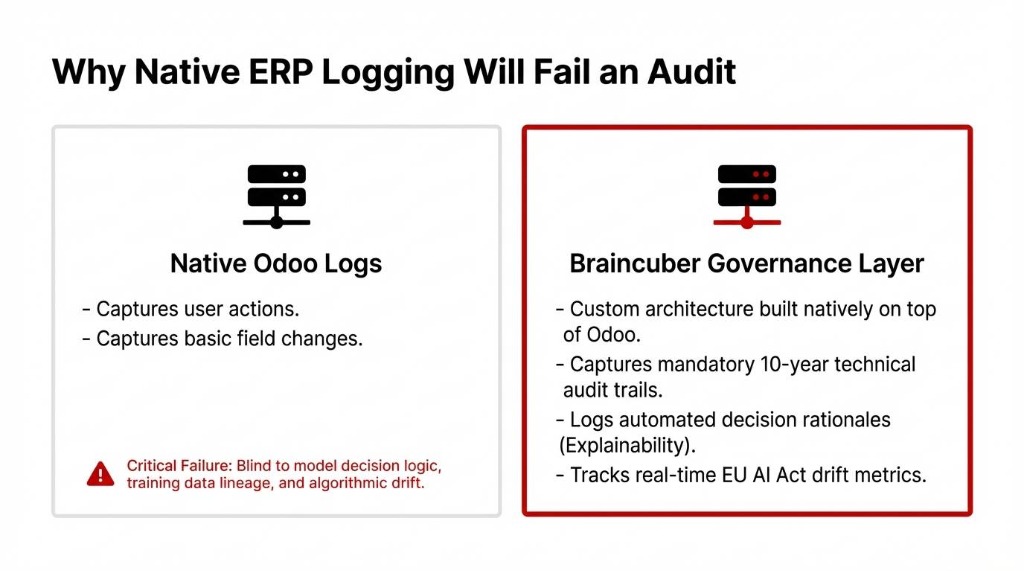
Write your ai policy documents while implementation is still fresh. Ai manage is not a one-time event. Build quarterly ai audit cycles into Odoo's project management module. Use custom Odoo data layers to maintain the 10-year documentation trail the EU AI Act requires — native ERP logging is not enough.
Step 5 & 6 — Drift Monitoring & Security Response
Implement automated model drift detection. Ai and security protocols must include a documented response plan for adversarial attacks and data poisoning. Security and ai is a compliance obligation under both GDPR and the EU AI Act.
The Real Cost of Getting This Wrong
The $83,000 Wake-Up Call
We worked with a $4.7M ARR US-based B2B SaaS company last year that had been running an AI-powered contract risk scoring module inside their Odoo instance for 23 months — completely undocumented, no DPIA, no human override mechanism, feeding off European client data.
The Exposure: €2.1M in potential GDPR fines and zero EU AI Act documentation.
The fix took 11 weeks and cost $83,000 in remediation. The alternative was a fine that would have wiped out their 2025 operating margin.
The Non-Negotiable Compliance Checklist
Print this. Paste it in your Confluence. Email it to your CTO today.
| Checkpoint | GDPR | EU AI Act | DPDP Act (India) |
|---|---|---|---|
| AI system inventory documented | Required | Required | Required |
| DPIA completed before deployment | Mandatory | Mandatory | Mandatory |
| Data Source Ledger maintained | Required | Required | Required |
| Bias audit on training data | Article 22 | High-risk | Fairness |
| Human oversight mechanism | Article 22 | Mandatory | Required |
| 10-year documentation retention | — | Mandatory | — |
| Vendor DPAs in place | Art. 28 | Required | Required |
| Cross-border data safeguards | Art. 44-49 | Required | Required |
| India-based DPO appointed | — | — | If SDF |
| EU AI database registration | — | High-risk | — |
| Incident reporting protocol | 72-hour | Required | Required |
| AI model drift monitoring | Recommended | Mandatory | Required |
Frequently Asked Questions
Does the EU AI Act apply to US companies using Odoo ERP?
Yes. If your Odoo ERP's AI systems process data of EU residents or make automated decisions affecting EU-based users, customers, or employees — regardless of where your company is incorporated — the EU AI Act applies. The extraterritorial scope mirrors GDPR's reach.
What qualifies as a "high-risk" AI system in an ERP?
ERP AI that automates employment decisions, vendor creditworthiness scoring, supply chain risk flagging, or financial forecasting typically qualifies as high-risk under the EU AI Act.
How does India's DPDP Act differ from GDPR for AI compliance?
DPDP mandates India-based DPOs for Significant Data Fiduciaries, stricter consent management than GDPR's legitimate interest, and full accountability for outsourced AI processing.
Can Odoo's built-in logging satisfy EU AI Act audit trails?
No. Odoo's native audit log covers user actions and field changes, but it doesn't capture model decision logic or training data lineage. You need a custom ai governance layer built on top.
What's the fastest way to check if our ERP's AI is compliant today?
Start with an ai check inventory: list every automated decision your ERP makes, trace each to a legal basis under GDPR/DPDP, and check whether documentation exists. If that takes more than 2 hours, you have a gap.
Stop Letting Your ERP's AI Run Unsupervised
The mid-2026 EU AI Act full compliance deadline is closer than your next product roadmap cycle — and the regulators don't care about your growth stage.
Use the enterprise ai platform compliance guidelines above, or let Odoo implementation experts from Braincuber fix it for you before the fines generate a massive liability.
Book Your Free 15-Minute AI Compliance Audit
We'll map your Odoo AI risk exposure, identify your top 3 compliance gaps, and give you a remediation timeline. No sales pitch. Just numbers.
Free audit ▸ No obligation ▸ AI compliance roadmap