
We have seen this exact scenario 43 times in the last 18 months across AI projects in the US, UAE, and UK. Teams deep in the amazon web aws ecosystem building smart applications with aws lambda function, Amazon Bedrock, and amazon aws s3 believe that a few connected Lambda functions equals a "workflow." It does not. AWS Step Functions gives you the coordination you are missing.
The Real Cost of Unorchestrated AI Pipelines
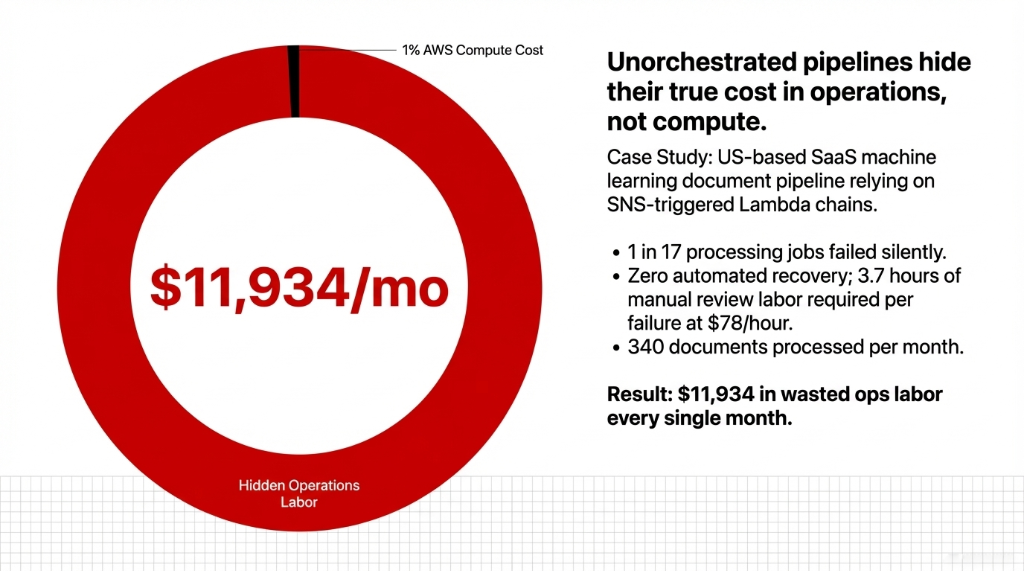
Let us talk numbers before anything else. One of our clients — a US-based SaaS company — was running an aws for machine learning pipeline using chained SNS triggers and Lambda functions. No aws step functions orchestrating it. No retry logic.
One in 17 document processing jobs failed silently because amazon cloudwatch alerts were ignored or unstructured. Each failure demanded 3.7 hours of manual review labor at $78/hour. Across 340 documents per month, that was $11,934 in wasted ops labor every single month. The aws cost wasn't the execution fees. The cost was the absence of orchestration.
What AWS Step Functions Actually Does (No Fluff)
AWS Step Functions is a fully managed service inside the amazon web services console that coordinates multiple AWS services into serverless workflows using a visual state machine defined in Amazon States Language. It is the traffic controller for your serverless architecture.
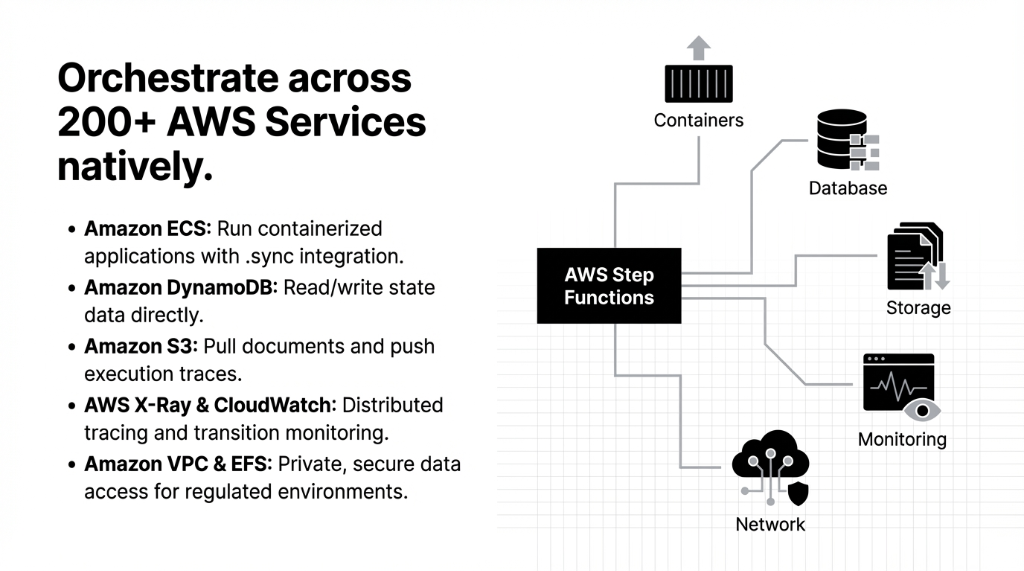
Instead of writing custom retry logic inside every lambda aws function and hoping your triggers fire, you define a state machine. It manages every transition, error, retry, and branch automatically inside the amazon console. It integrates natively with 9,000+ AWS API actions across 200+ services including amazon ec2, amazon redshift, aws dynamodb, aws x ray, amazon cloudfront, amazon vpc, and amazon efs.
Standard vs. Express: Pick Wrong and You'll Pay For It
Using Standard when you need Express — or vice versa — is a direct path to inflated aws charges you will not understand until the bill arrives. Standard Workflows are built for durable processes running for hours or days. Pricing in aws starts at $0.000025 per state transition, with 4,000 free state transitions per month permanently.
Express Workflows are for high-throughput, short-duration tasks (under 5 minutes) handling 100,000 executions per second. Use Express unless your process requires exactly-once execution guarantee for compliance reasons. Running 50,000 daily executions on Standard will burn through budget relentlessly.
Orchestrating AI With AWS Step Functions: The Architecture That Works
This is where aws and ai finally become production-grade. When we built a pipeline using amazon web services lambda and Amazon Bedrock for a US healthcare client, we created a 9-state machine. It retrieves documents natively from S3, invokes Claude directly via Bedrock API (no Lambda middleman), writes to DynamoDB or pushes to an SQS queue based on confidence scoring, and writes audit traces back to S3.
The Cold Math
At 80,000 documents a month, generating 720,000 state transitions, the bill came to exactly $17.90/month after the free tier. Previously, custom logic wrapped in 7 Lambda chains was costing them $3,200/month in continuous developer manual review.
Why Building Without Step Functions Is a Liability
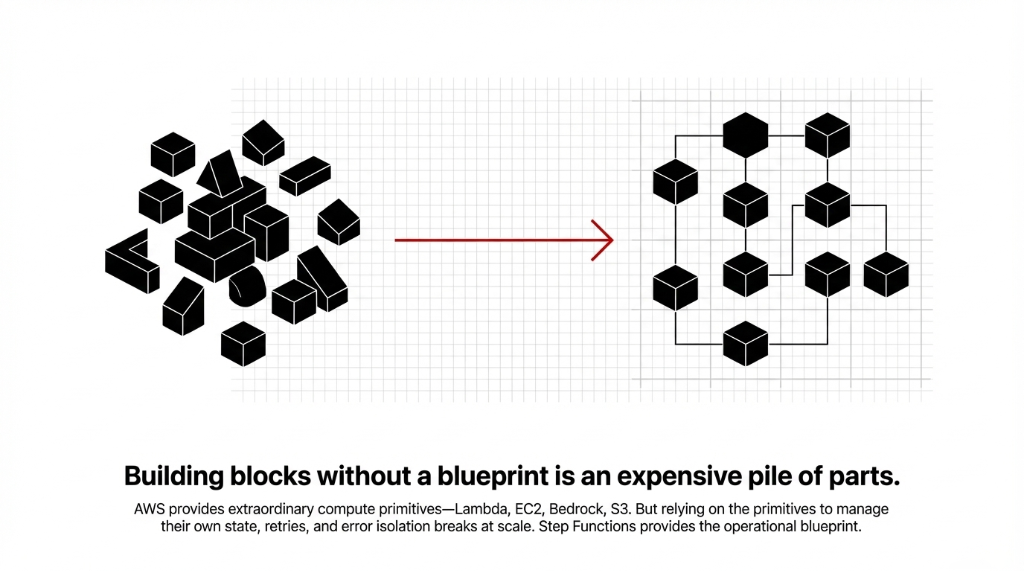
Amazon web cloud services provide exceptional primitives: aws lambda function, amazon aws s3, amazon ec2. However, building blocks without a blueprint is an expensive pile of parts.
We migrated 17 US-based teams from unorchestrated cloud based services to Step Functions. They all lacked retry logic, pipeline visibility, and error isolation. Step Functions combined with iam roles aws, aws key management service, and aws cloudwatch produces proper automated ai in aws deployment — not a software as a service demo built at amazon reinvent.
Advanced AI Patterns: Where Step Functions Shines
The 2025 Capabilities
Distributed Map
Process massive S3 buckets in parallel. One client analyzed 2.3 million tickets in 4.1 hours instead of 37 hours using sequential Lambda chains.
JSONata Integration
Reshape JSON outputs natively inside the state machine. Stop paying for aws software development kit lambda invocations that only reformat data strings.
Agentic AI Loops
Build autonomous decision pipelines holding multi-agent AI systems interacting perfectly with aws kubernetes workloads and third-party tools.
FAQs
What is AWS Step Functions and how does it differ from AWS Lambda?
AWS Step Functions is a fully managed workflow orchestration service that coordinates multiple services into visual state machines. Lambda runs individual code functions. Step Functions calls Lambda (along with 200+ other services) and manages the flow, retries, and state between every step.
What does AWS Step Functions cost per month?
Standard Workflows cost $0.000025 per state transition, with 4,000 free state transitions per month permanently. Running a 9-step workflow 80,000 times/month costs approximately $17.90 in aws charges. Express Workflows are priced per execution and duration.
Can AWS Step Functions orchestrate AI models like Amazon Bedrock?
Yes, directly. Step Functions integrates natively with Amazon Bedrock, letting you invoke models with no Lambda function in between. You can also build full agentic AI workflows using Choice, Parallel, and Distributed Map states.
What is the difference between Standard and Express Workflows in AWS?
Standard Workflows run up to 1 year, guarantee exactly-once execution, cost per state transition, and retain 90 days of execution history. Express Workflows run up to 5 minutes, support 100,000 executions/second, and cost per request plus duration.
Does AWS Step Functions work with existing Amazon EC2 or ECS containerized applications?
Yes. Step Functions integrates with Amazon ECS for containerized applications and with Amazon EC2 via SDK calls or Lambda. You can trigger ECS or Fargate container jobs directly using the .sync integration pattern.
Stop Managing Workflows With Crossed Fingers
Do not let unorchestrated pipelines and silent Lambda failures kill your margins. We can audit your AWS environment and replace expensive, weak chains with rock-solid serverless workflows rapidly.