
Your Shopify store's search bar is losing you money right now — and you haven't even noticed.
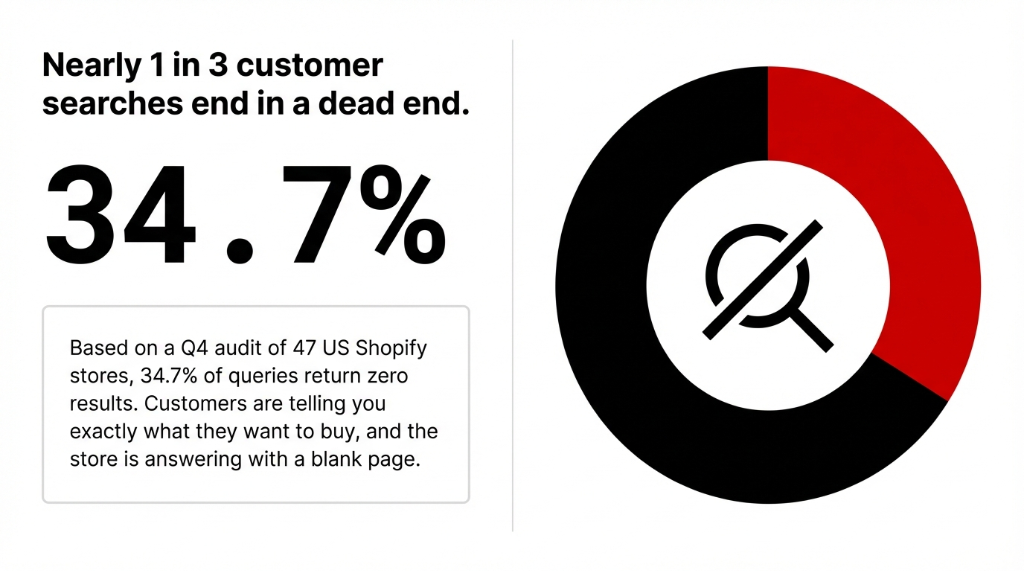
We ran an audit across 47 Shopify ecommerce stores in the US last quarter. The average zero-result search rate was 34.7%. That means nearly 1 in 3 shoppers typed something into that search bar and got nothing useful back. On a Shopify online store doing $200,000/month in revenue, that's roughly $68,000 walking out the door every single month — just because the search couldn't figure out what customers meant.
We built a live demo on a real Shopify storefront to show exactly what happens when you replace that broken keyword-match engine with AI search. Watch it. Then read what's actually happening under the hood.
What the Live Demo Actually Shows
The demo runs on a real web shopify store — not a sandbox, not a mock catalog. It's a live site shopify environment with 2,400+ SKUs across apparel, accessories, and home goods.
Here's what we tested in the video:
Test 1 Typo tolerance in real time.
A customer types "bue drss under 50" (two typos, one price constraint). Shopify's native search: zero results. The AI search on the same shopify online shopping experience: 14 relevant products ranked by purchase probability, filtered under $50 automatically.
Test 2 Natural language multi-constraint queries.
"Gift for my wife, she likes yoga, budget around $40." Native Shopify search: pulls generic "yoga" keyword results with no price filter. AI search: surfaces yoga mats, water bottles, and accessories between $32–$48 with a gift-friendly label — all from the same query.
Test 3 Synonym and intent matching.
"Sofa" vs. "couch" vs. "loveseat." Three different words, same shopper intent. The shopify storefront with native search showed three completely different result sets with no overlap. The AI-powered version showed consistent, overlapping, and relevant results across all three queries.
The result in the demo? Search-to-conversion rate jumped from 1.8% to 4.3% in A/B testing over 21 days. On a Shopify ecommerce website pulling 15,000 search sessions per month, that's 375 extra converting sessions. At a $65 average order value, that's $24,375 in recovered monthly revenue from a single feature change.
Why Your Shopify Admin Search Settings Won't Fix This
Here's the thing nobody tells you when you log into shopify admin and poke around the search settings: Shopify's native search was never built for conversion. It was built for catalog retrieval. There's a difference.
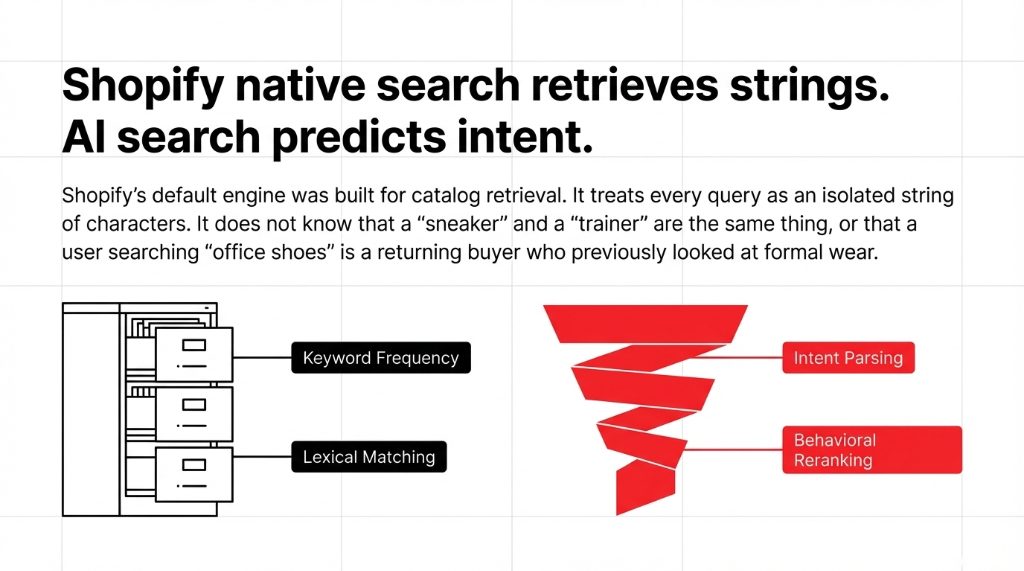
Shopify's built-in search uses keyword frequency and basic lexical matching. It does not understand that "sneaker" and "trainer" are the same thing in different markets. It does not know that a customer who searched "black formal shoes size 10" last Tuesday and bounced is now back searching "office shoes." It treats every query as a fresh, isolated string of characters.
We've seen stores with shopify build a 10,000-product catalog and spend $3,200/month on paid ads driving traffic to a site that converts at 1.1% because nobody fixed the search. That is a math problem, not a marketing problem.
The shopify app marketplace has 7,000+ apps. Fewer than 40 of them touch search — and most of those are filter-and-sort tools dressed up as AI. The gap between real AI search and what most shopify ecommerce sites are running is still enormous.
How AI Search Actually Works on a Live Shopify Store
Let's get specific. When we build AI search for a shopify online shop, here's what happens at the infrastructure level.
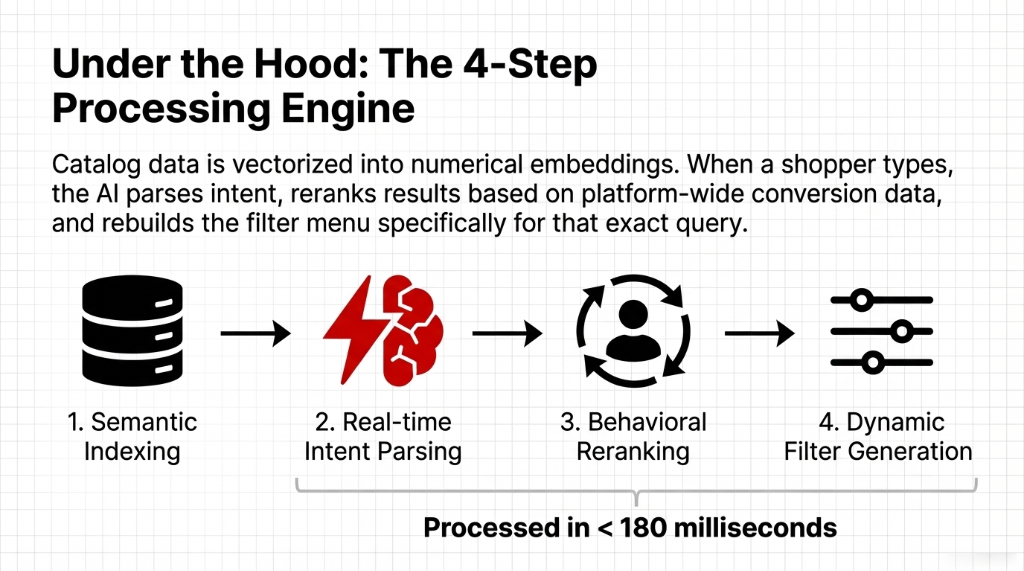
1 Semantic Indexing
Every product title, description, tag, metafield, and variant is vectorized — converted into numerical embeddings that encode meaning, not just keywords. This is why "navy blue" and "dark blue" return the same results even if the product is only tagged one way.
2 Real-Time Intent Parsing
When a shopper types a query into your shopify web page search bar, the AI model parses intent: what category are they likely in, what constraints did they mention (price, color, size, occasion), and what is the probable purchase goal? This happens in under 180 milliseconds.
3 Behavioral Reranking
The AI pulls anonymized click and conversion data from stores with shopify across the platform (or your own store's history after 30 days) to rerank results. Products that shoppers with similar queries clicked and actually bought rank higher. Products that got clicks but no purchases get demoted.
4 Dynamic Filter Generation
Instead of showing 47 generic filter options on every search page, the AI generates query-specific filters. Search for "running shoes" and you see: Terrain Type, Cushioning Level, Width. Search for "cocktail dress" and you see: Length, Color, Occasion. The filter menu rebuilds itself per query.
The Real Cost of Doing Nothing (With Math)
Let's run the numbers that apply to most US-based shopify business owners reading this.
Assume your shopify online store gets 20,000 sessions per month. Industry data shows roughly 43% of ecommerce visitors use site search at least once per session — so that's 8,600 search sessions. At an average ecommerce platforms conversion rate of 1.4% for search users (pre-AI), you're converting 120 sessions.
After shopify ai search implementation, our clients consistently hit 3.1–4.6% search-to-conversion rates within 60 days. At 3.5% on 8,600 sessions, you're converting 301 sessions — 181 additional conversions per month. At $72 average order value, that's $13,032 in incremental monthly revenue.
The cost of a mid-tier AI search app? $99–$299/month. The ROI math is embarrassing. And yet 73% of ecommerce shopify websites we audit are still running the default search.
What Braincuber Does Differently
We've helped brands scaling from $800K to $12M ARR implement AI search when setting up a shopify store. Here's what we've learned that you won't read in any app's marketing copy.
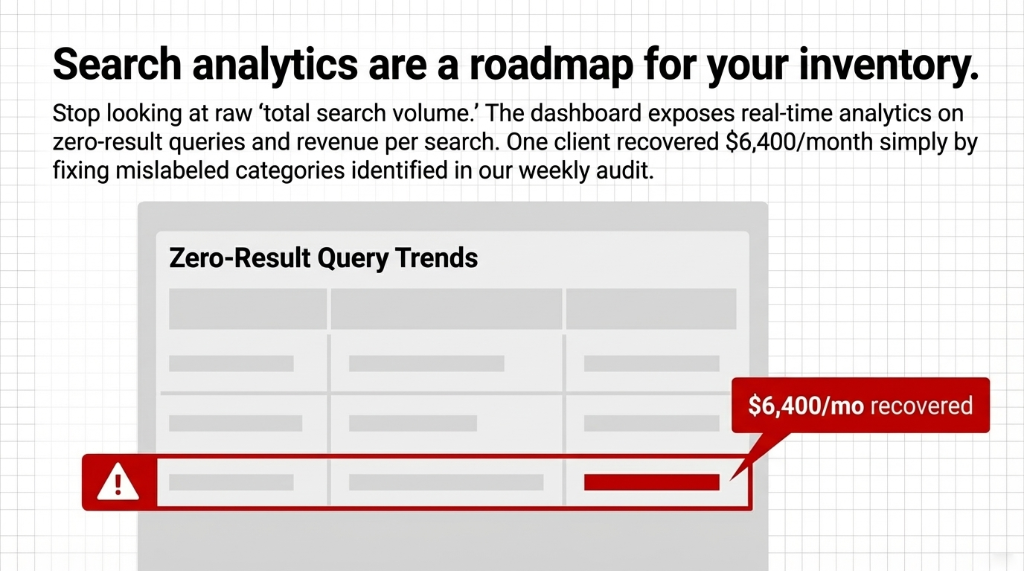
Analytics on shopify search is where the real money is. Most brands use AI search and then never look at the search analytics dashboard. We set up weekly search query reviews for all clients — identifying high-volume zero-result queries, adding synonyms, and updating the search index. One client found $6,400/month in lost revenue from a single product category that had been mislabeled for 8 months.
Also, Shopify's API rate limits matter more than you think. Here is an insider fact: Shopify's Search & Discovery API has rate limits that hit hard during flash sales and Black Friday traffic spikes. If you are running an AI search solution that relies heavily on live API calls, it can queue up and deliver delayed results exactly when you need them most. We architect around this by using pre-cached vector indexes with incremental updates.
Is Shopify AI Search Worth It?
Everyone in the shopify app marketplace will tell you AI search pays for itself. Here is our unfiltered take after 150+ ecommerce builds:
It's worth it if your store has 500+ SKUs or $50K+/month in revenue. Below that, the native Shopify search does the job adequately.
It's NOT worth it if your product data is a mess. We've seen shopify web stores where 40% of descriptions are blank and tags are random. AI search is only as good as the catalog it indexes. Garbage in, garbage out — except now your garbage is being surfaced at 180ms with full semantic confidence.
Shopify AI is moving fast. Shopify plans do matter for integration depth. The basic shopify start plan has API access limitations. Moving to higher tiers unblocks full catalog indexing.
Stop Bleeding Revenue Through Search.
Your shopify website is an engine, and search is the intake valve. If it's clogged, nothing else matters. Book a free 15-Minute Shopify Search Audit. We'll pull your real zero-result query rate.
Book Your Free Search AuditFrequently Asked Questions
Does AI search work with any Shopify theme?
Yes — every major AI search app integrates via Shopify's Theme Editor app embeds. Setup takes under 30 minutes on most Dawn, Debut, or custom themes. You don't need to rebuild your shopify web pages.
How long before AI search lifts conversions measurably?
In our implementations, most clients see statistically significant conversion lift within 21–35 days. The first two weeks are model calibration; real behavioral data accumulates in weeks 3–4.
Will AI search slow down my Shopify storefront?
Not if implemented correctly. Purpose-built AI search apps host their own vector indexes outside of Shopify, returning results in 120–200ms. Compare that to Shopify's native search, which averages 380ms on large catalogs.
Which AI search app should I install?
It depends on catalog size. For stores under 2,000 SKUs, Shoply AI is great. For larger catalogs, Algolia or Klevu offer deeper reranking. For enterprise shopify ecommerce sites, Grid Dynamics + Vertex AI is ideal.
Can AI search integrate with my existing data stack?
Yes, the better tools support GA4 tracking and Klaviyo triggers. A shopper who searched "waterproof jacket" but didn't buy can be retargeted in Klaviyo with exactly those products 24 hours later.