
We have deployed AI workloads on amazon aws cloud for over 500 projects. We can tell you exactly where teams go wrong. The choice between self-managed kubernetes and amazon ecs is not a philosophical debate. It is an immediate financial anchor.
The Real Problem with "Just Pick Kubernetes"
Every DevOps influencer defaults to Kubernetes. It is aggressively bad advice for early teams. aws kubernetes setup on bare amazon ec2 adds 37+ hours of pure SRE maintenance per month. You are spending $6,660–$8,140 a month to literally just keep the lights on.
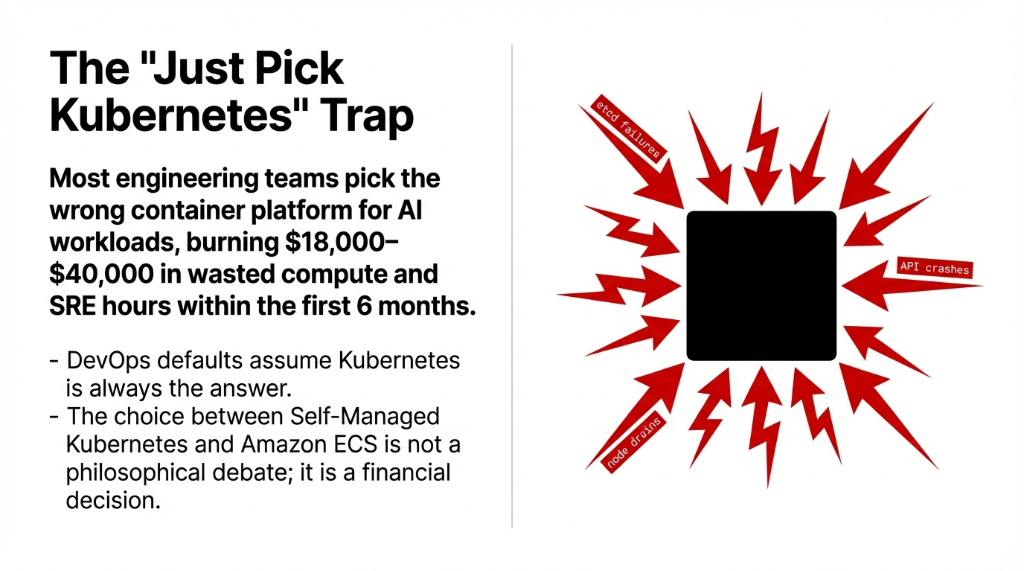
Self-managed Kubernetes means you own the control plane: etcd failures, API crashes, and node drains. Amazon ECS is fully managed. You pay precisely $0 for the orchestration layer. That is exactly what your CFO wants to hear.
AWS ECS vs Self-Managed Kubernetes: What the Numbers Actually Say
Cost Breakdown (100k requests/month)
- Amazon ECS (Fargate): ~$88.08
- AWS EKS (managed K8s): ~$194.96
- Self-Managed K8s (EC2): $270–$350+ (plus human costs)
Self-managed kubernetes orchestration never wins on cost. Not on amazon aws cloud services. Not unless you have an 8-person platform engineering team dealing heavily with distinct air-gapped security configurations.
Why ECS Wins for Smaller AI Teams
Amazon ECS excels if you are running lightweight inference containers with 3–5 engineers. Managed aws services shine heavily here due to native elastic load balancing and pre-configured amazon vpc networking without customized RBAC policies. We migrated a US SaaS company doing document classification on ECS off a brutal bare-K8s setup, slicing their bill from $14,200 to $5,800 monthly.
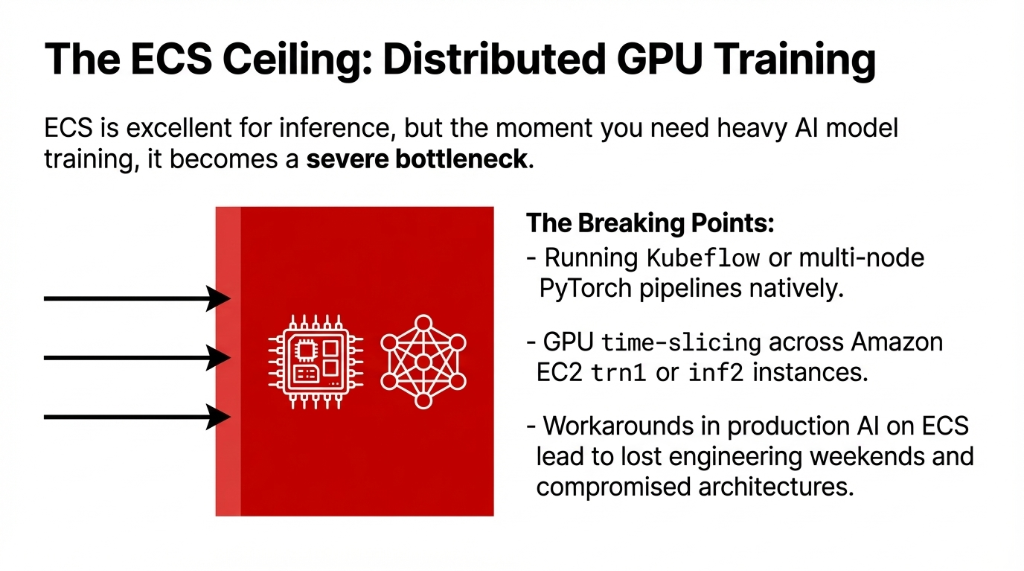
But ECS carries a lethal ceiling: distributed GPU training. Kubeflow or multi-node PyTorch training on ECS forces massive operational workarounds. Doing AI production through workarounds burns entire weekends unnecessarily.
Where Kubernetes (EKS) Is the Only Honest Answer
For aggressive heavy model training, aws eks is the mandatory choice. EKS smoothly slices logical virtual GPUs onto hardware so expensive ec2 instances never sit idle. aws auto scaling via Karpenter provisions exact EC2 instance types against unschedulable pods rapidly.
You pay $0.10/hour (roughly $73/month) for a managed EKS control plane. That removes weeks of it configuration management. Self-managing costs $6,600 in SRE time. Stop negotiating against basic math.
Making the Decision: The Infrastructure Engine
Do not guess. Use the proven infrastructure flowchart rules established by top cloud services teams in action.
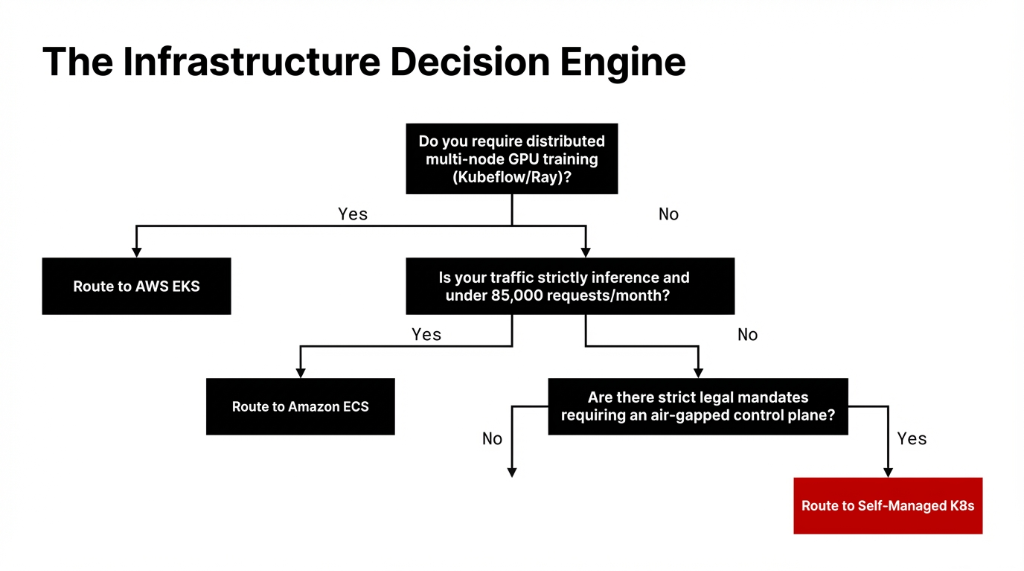
Avoid self-managed setups strictly. Only 3% of organizations legitimately require the kernel-level manipulation that EKS cannot automatically resolve. It is a distraction for the other 97%.
The Hybrid Architecture Nobody Talks About
Here is our elite playbook for AI companies: operate both aggressively. Use amazon ecs spanning aws fargate for hyper-speed stateless API inference. Use aws eks specifically mapped to GPU compute for intensive R&D deep training.
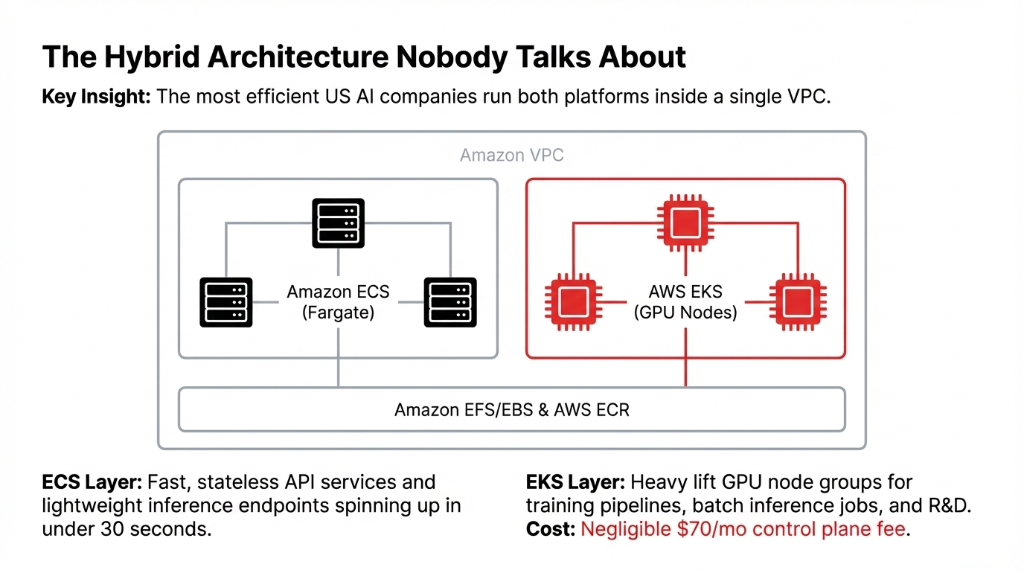
Wire both into a singular amazon vpc pulling from a central aws ecr repository. Back it completely across amazon elastic block store. You extract the ultimate value scale inside amazon aws services with zero performance compromising.
FAQs
Is AWS EKS the same as self-managed Kubernetes?
No. AWS EKS is a managed Kubernetes service where AWS operates the control plane. Self-managed Kubernetes means your team owns and maintains the entire control plane on EC2 instances with no AWS assistance.
Can Amazon ECS run GPU-based AI training workloads?
ECS can run GPU workloads on EC2, but it lacks mature tooling for distributed GPU scheduling. For serious model training, AWS EKS is significantly better equipped.
What does AWS EKS actually cost compared to ECS?
ECS has zero orchestration fee. EKS adds a $0.10/hour control plane fee. At low workload volumes, ECS is cheaper. Above 85,000 requests/month, EKS's better resource utilization makes it more cost-efficient.
Should a startup choose ECS or Kubernetes for their first AI product?
Start with ECS on AWS Fargate. You will ship your first AI inference endpoint in days with zero node management overhead. Migrate to EKS when you need distributed GPU training.
Can Braincuber help migrate from self-managed Kubernetes to EKS or ECS?
Yes. We have executed 30+ container platform migrations for US-based clients, moving self-managed workloads without downtime using blue/green deployment strategies.
Stop Bleeding Cash on DevOps Vanity
Do not burn $8,000 a month feeding idle control planes because someone told you "everyone uses Kubernetes." Our engineers migrate complex bare metal AI architectures to lean, fast ECS/EKS systems rapidly.