
Here's the ugly truth no one is saying out loud: 90% of all AI search engine referral traffic comes from desktop devices — and if you're running a Shopify store in the USA and treating your SEO strategy as one-size-fits-all, you're actively handing your competitors an advantage.
That's not an opinion. That's a Search Engine Journal-verified data point. And it gets worse the moment you look at conversion numbers.
The Device Split Nobody Is Watching
Most Shopify merchants check their Google Analytics dashboard, see 68-75% mobile traffic, and conclude their check site traffic mobile strategy is "working."
It isn't.
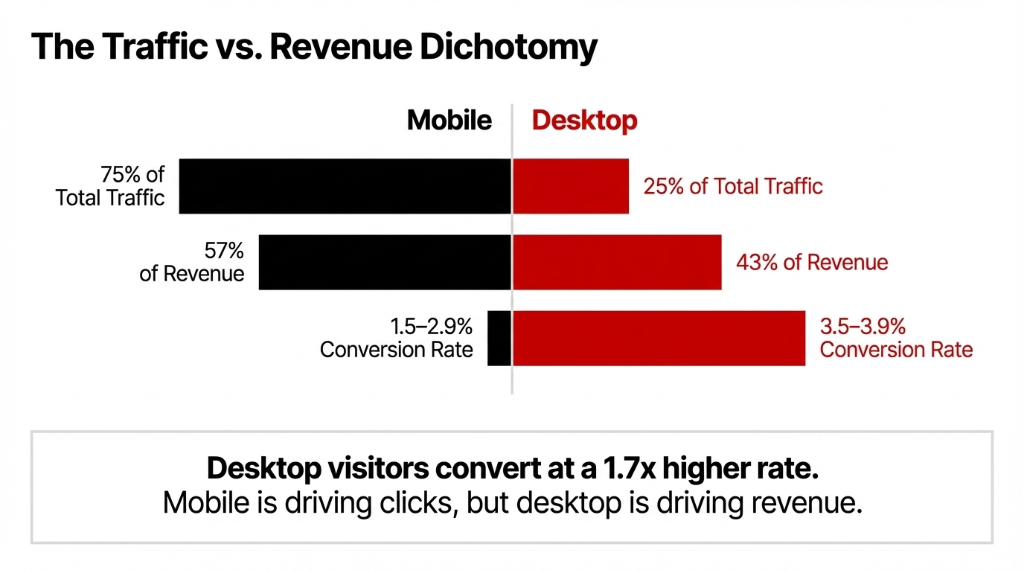
Mobile drives 75% of ecommerce traffic but only delivers 57% of revenue. Desktop, pulling in just 25% of visits, generates 43% of all revenue. Desktop visitors convert at 3.5–3.9%. Mobile converts at 1.5–2.9%. That's a 1.7x performance gap — on the low end.
We work with Shopify brands doing $1M–$10M ARR across the US, and this device gap is the single most underestimated leak in their revenue pipeline. When a client comes to us saying "our website traffic looks great," we immediately pull device-segmented data. Nine times out of ten, the mobile bounce rate is hemorrhaging revenue.
The average desktop visitor stays on-site for 4 minutes and 47 seconds. The average mobile visitor: 3 minutes and 12 seconds. That 95-second difference is the window in which you either win or lose the sale.
How AI Search Engines Are Making This Worse
The rise of google ai search and AI-powered answer engines has introduced a new wrinkle that most site seo strategies aren't accounting for.
Look at the platform-by-platform breakdown of AI search referral traffic:
| AI Platform | Desktop Traffic | Mobile Traffic |
|---|---|---|
| Perplexity.ai | 96.5% | 3.4% |
| ChatGPT | 94% | 6% |
| Bing with Copilot | 94–95% | 4–5% |
| Google Search | 44% | 53% |
Google search engine is the only outlier — and even there, google search engine optimization for AI features behaves differently by device.
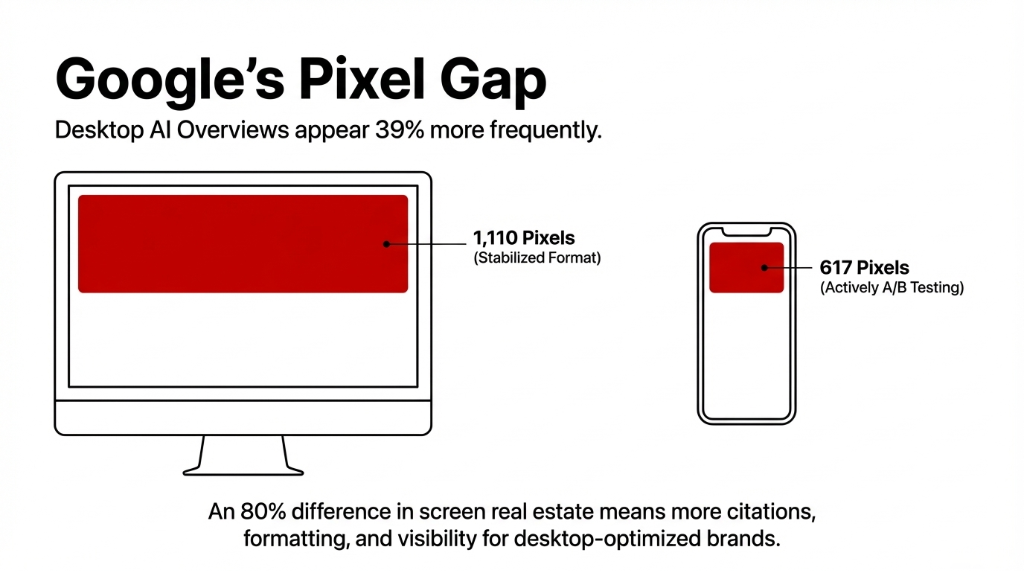
Desktop AI Overviews appear 39% more frequently than mobile versions across tracked keywords. The screen real estate alone tells the story: desktop AI Overviews occupy 1,110 pixels on average vs. 617 pixels on mobile — an 80% difference. That pixel gap means more citations, more formatting, and more visibility for the brands that rank there.
Here's the insider detail most ai seo consultants won't tell you: Google is still actively A/B testing mobile AI Overview formats. The desktop format has stabilized. The mobile format hasn't. Building a keyword research strategy around a moving target is a mistake we've seen cost brands real rankings.
The Ecommerce Exception That Changes Everything
Now, before you write off mobile entirely — stop.
There's one critical finding buried in the data on seo search engine optimization: ecommerce queries trigger mobile AI Overviews 3x more often than desktop (13.5% vs. 4.5%).
Read that again.
When someone searches for a product on Google using their phone — "best running shoes under $100," "Shopify store skincare routine" — the google search ai system is far more likely to surface an AI Overview on mobile than on desktop for that specific intent.
This is where search engine optimization in digital marketing gets device-specific. Shopping-intent queries on mobile = AI Overview territory. Research-intent queries = desktop dominance. If your ecommerce seo strategy doesn't segment by intent AND device, you're operating blind.
What the Conversion Data Actually Means for Your Shopify Store
Desktop sessions referred from AI platforms convert at 4.2x higher rates than mobile in tracked verticals. Desktop visitors from AI sources average 4+ pages per session. Mobile visitors average 1–2 pages before leaving.
This creates a very specific failure mode we see constantly: brands invest heavily in website traffic acquisition via paid search and social media, then wonder why ROAS is declining. The traffic isn't the problem. The post-click mobile experience is the problem.
Mobile cart abandonment sits at 75–85%. Desktop: 65–70%. On a Shopify store doing $500K/month, closing even half that mobile cart gap could recover $37,000–$75,000 per month in lost revenue. (Yes, those numbers hurt. They should.)
Why Your Current SEO Strategy Is Built for One Device and Ignoring the Other
Frankly, most search engine optimization tools report keyword rankings without breaking down device-specific performance. When you check keyword ranking in tools like Ahrefs or SEMrush, you're often seeing blended data.
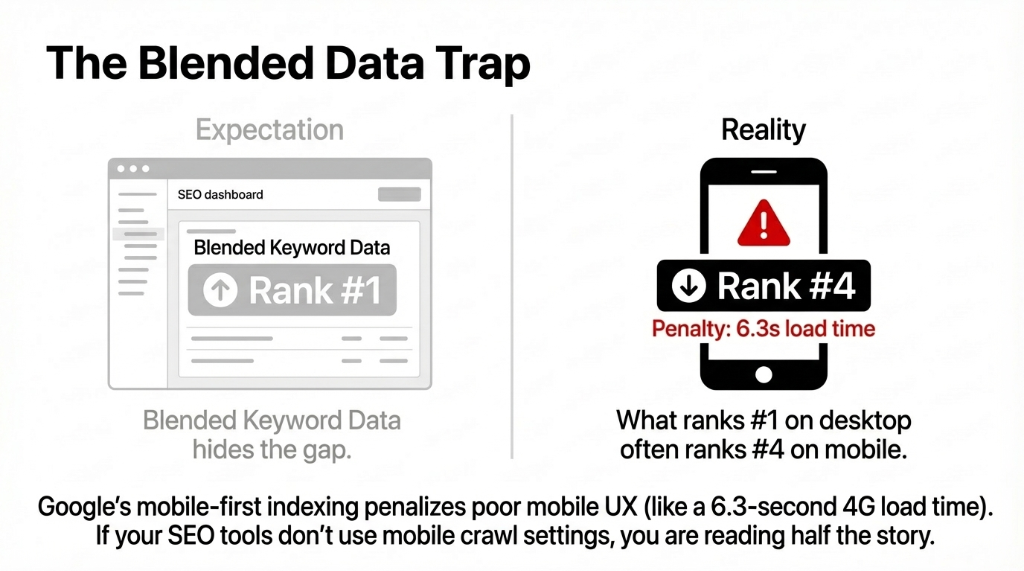
But Google's search engine serves different AI Overviews, different featured snippets, and different local search engine optimization results depending on device type. What ranks #1 on desktop may rank #4 on mobile for the same query.
This is not theoretical. It's been observed in real seo analysis across multiple verticals. We've had clients with perfect desktop seo search engine optimization scores — clean technical SEO, solid backlinks, good structured data — who were invisible in Google mobile AI search results because their page load time on 4G was 6.3 seconds. Google's mobile-first indexing penalizes that. Full stop.
The AI SEO Optimization Playbook for Device-Split Performance
This is how we approach ai seo optimization for Shopify brands targeting USA markets:
Step 1: Segment your traffic data by device immediately.
Pull 90 days of Google Search Console data filtered by mobile vs. desktop. Use a page traffic checker to identify which pages are winning on desktop but losing on mobile.
Step 2: Run a device-specific site seo audit.
Use Google's PageSpeed Insights on mobile simulation — not desktop. A score of 89 on desktop and 54 on mobile is a mobile-first indexing liability.
Step 3: Build device-intent content layers.
For ecommerce seo, treat mobile content as conversion support (fast-loading) and desktop content as research support (detailed, citation-worthy for AI).
Stop Letting the Device Gap Drain Your Shopify Revenue.
We build Shopify stores with device-segmented performance baked into the architecture — not bolted on after launch. Let us identify exactly where your mobile vs. desktop performance split is leaking conversions.
Book Your Free AI SEO AuditFrequently Asked Questions
Does AI search engine optimization require separate strategies for mobile and desktop?
Yes. Desktop AI Overviews appear 39% more frequently and cover 80% more screen space than mobile versions. Content targeting desktop AI needs depth and citations. Mobile AI Overview content for ecommerce should focus on product intent and fast-loading answers.
Why does ChatGPT send 94% of its referral traffic from desktop?
ChatGPT users on desktop are conducting research-intensive sessions — comparing products, reading long-form content, and making considered decisions. Mobile ChatGPT users tend to ask quick questions without clicking through to source sites. Desktop-optimized content earns significantly more AI-platform referral traffic.
How do I check if my site's AI Overview rankings differ by device?
Use SE Ranking or BrightEdge with device-split AI Overview tracking enabled. Running a check site seo audit with mobile simulation in PageSpeed Insights alongside a desktop crawl reveals load-time and rendering discrepancies that affect AI-indexed content differently.
Is local SEO affected by the mobile vs. desktop AI divide?
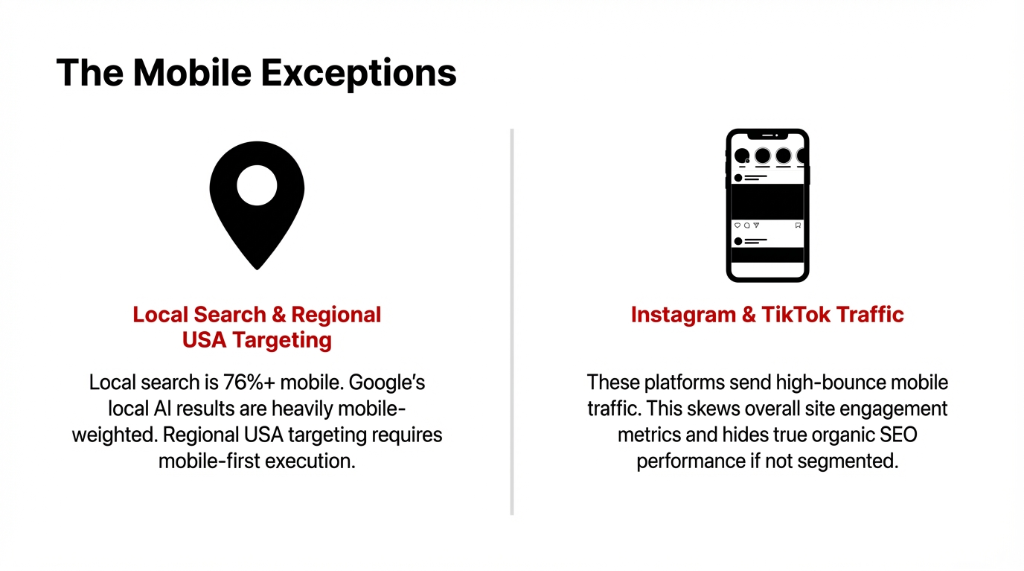
Yes. Local search engine optimization is almost entirely a mobile phenomenon — over 76% of local searches happen on mobile, and Google's local AI results are heavily mobile-weighted. If your Shopify store serves specific US regions, your local seo strategy must be mobile-first in both technical execution and content structure.
Does mobile traffic from social media hurt my SEO performance metrics?
Not directly — but it creates misleading data. Instagram, TikTok, and Facebook send primarily mobile traffic with high bounce rates and low session durations. This skews your overall site traffic engagement metrics. Segment paid social traffic from organic search traffic before drawing SEO conclusions.