
Your Shopify store's prices are wrong right now. Not by a little — by enough to cost you real money.
If you're running a shopify online store in the US and your prices haven't changed since you published your product catalog, you are handing margin directly to your competitors. Amazon adjusts prices 2.5 million times per day. You're updating yours manually, maybe once a week, maybe when you remember.
That gap is not a technology problem. It is a strategy problem — and it's exactly what shopify ai-powered dynamic pricing is built to close.
The Real Cost of Static Pricing on a Shopify Storefront
Here's what we see constantly across US-based shopify stores we audit: a brand doing $40,000/month in shopify store sales leaves between $4,000 and $10,000 per month on the table simply because their prices don't respond to what the market is doing.
McKinsey's research is blunt about this: retailers with a working pricing strategy see margin improvements of 5–10% and sales on shopify grow by 2–5% purely from intelligent repricing. On a $480,000/year store, that's a difference of $24,000 to $48,000 annually — not from a new ad campaign, not from a redesigned shopify website, just from pricing smarter.
The problem with static product pricing is that it assumes the market stands still. It doesn't.
Demand spikes on Friday afternoons. A competitor runs a flash sale. Your top-selling product goes out of stock everywhere else. Every one of those events is a pricing opportunity your shopify storefront is missing completely.
What "AI Dynamic Pricing" Actually Does (Not the Sales Pitch Version)
Most shopify ai pricing apps will tell you they "use machine learning to optimize revenue." That's marketing. Here's what actually happens under the hood.
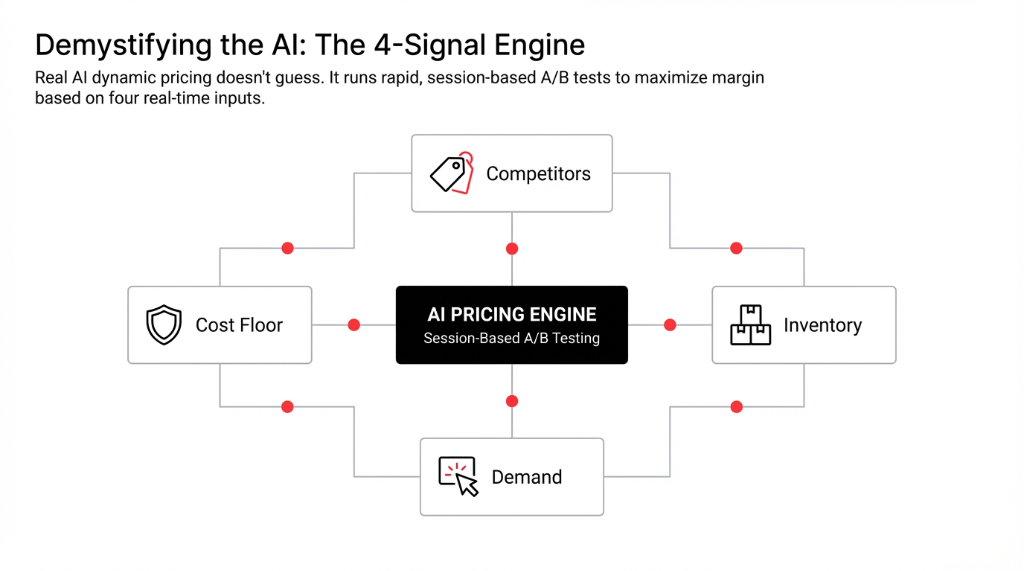
A real AI dynamic pricing engine monitors four data signals simultaneously:
The AI doesn't "guess." It runs rapid price tests — showing different price points to different sessions — measures conversion rate, then locks in the price that maximizes margin, not just volume. This is active pricing and strategy at the product level, running 24/7 without a human touching it.
Why the "Just Copy Amazon Pricing" Approach Destroys Your Margins
We'll give you a controversial take that most shopify guides won't: blindly matching Amazon pricing is one of the fastest ways to kill your Shopify business.
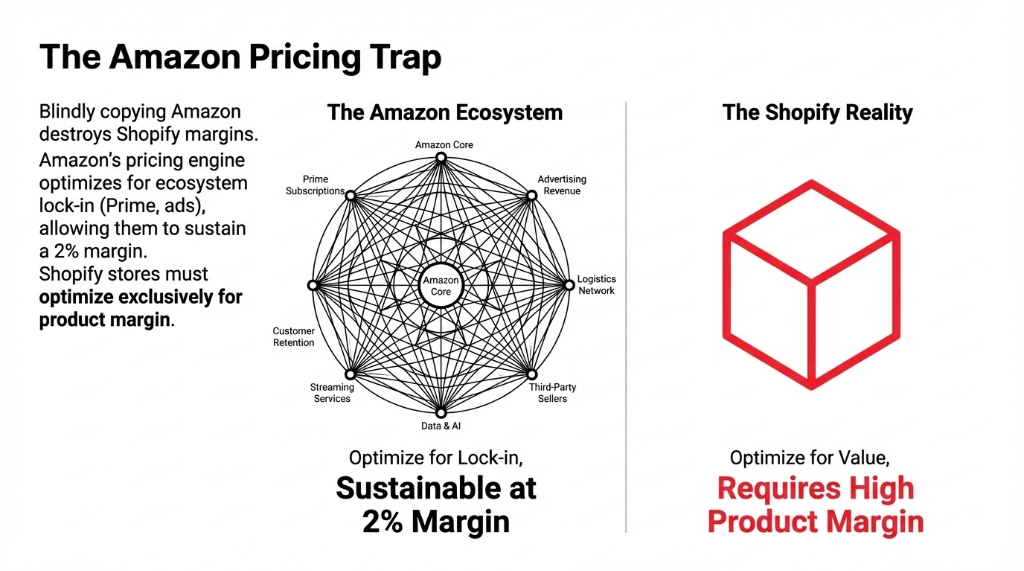
Amazon's pricing engine is optimizing for ecosystem lock-in — Prime subscriptions, repeat purchases, ad revenue from your competitors appearing on your listing. Their amazon pricing model can sustain a 2% margin on a product because they make money everywhere else. You can't.
A US business shopify competing purely on price against Amazon is fighting with a BB gun at a tank battle. Use AI to find the price ceiling your customers will accept — not the lowest price your competitor posted.
The Three Pricing Methods That Actually Work for Shopify Stores
Not all pricing methods in marketing translate to e-commerce. After working with D2C brands scaling from $1M to $10M ARR, we've seen three models consistently outperform.
1. Demand-Based Dynamic Pricing
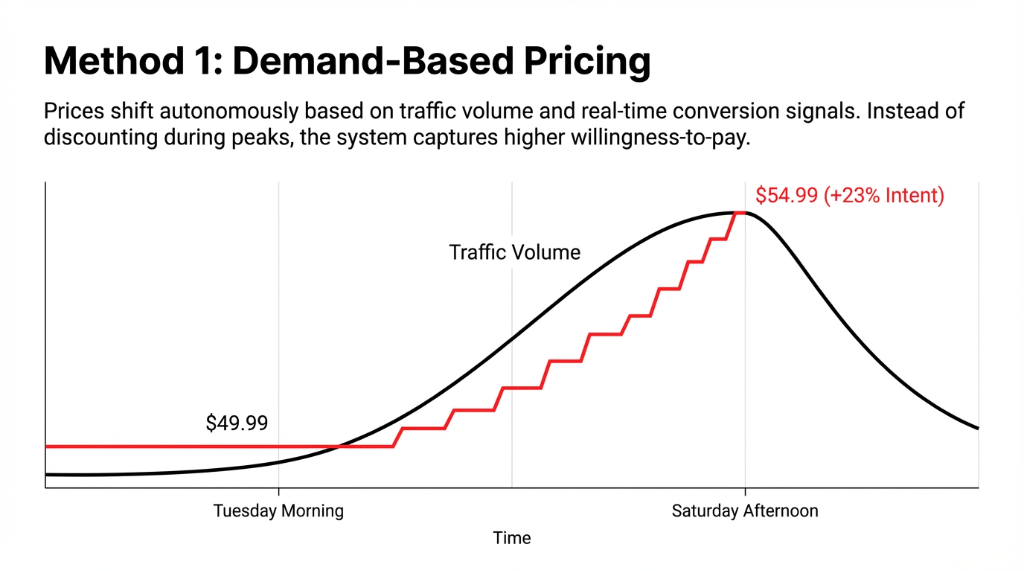
Prices shift autonomously based on traffic volume and conversion signals. A shopify product priced at $49.99 on Tuesday morning might perform best at $54.99 on Saturday when purchase intent is 23% higher. Apps like Pricing.AI run this automatically on your app shopify backend.
2. Competitor-Indexed Pricing
Tools like Prisync AI and Intelis monitor rival online retailers and reposition your prices within a defined band — say, always $2.00 below the top-3 competitors, but never below your cost-plus floor. This is the most common pricing strategy among top shopify stores.
3. Inventory-Urgency Pricing
When stock for a popular product drops below 20 units, the price automatically increases by 8–12%. This isn't manipulation — it's retail pricing reality. Airlines have done it for 40 years. Shopify retail stores that implement this one rule alone often see a $1,200–$3,800/month margin lift on their fast-moving SKUs.
What Results Should a US Shopify Store Actually Expect?
Let's be direct about what realistic outcomes look like, because the app store screenshots show the best-case scenario, not the median.
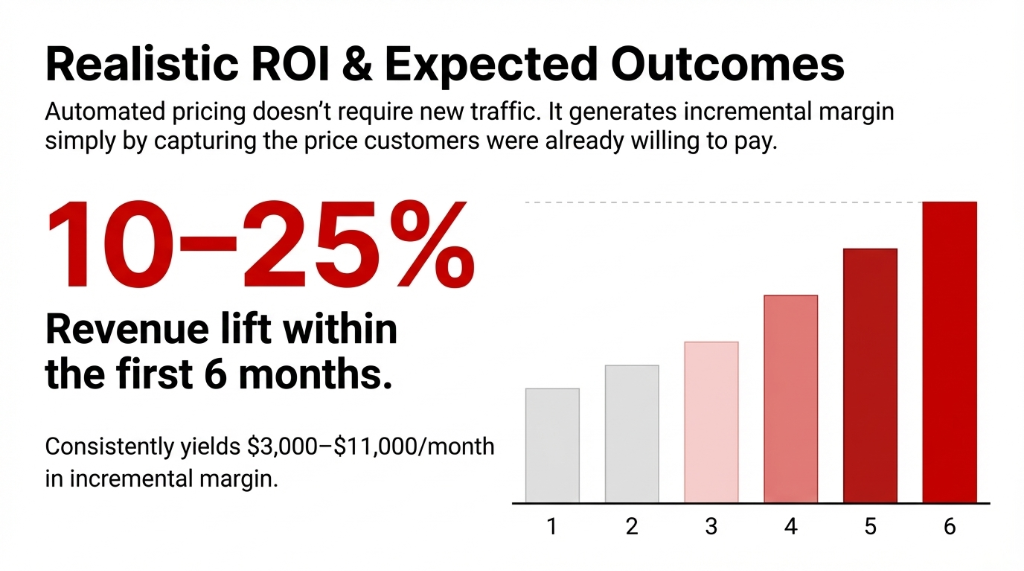
Retailers using structured dynamic pricing see a 10–25% revenue lift within the first six months. That's the range. Stores with thin catalogs or low traffic tend to see 10–13%. Stores with broader catalogs and strong organic traffic hit the 20–25% range.
But shopify store owners we've worked with consistently see $3,000–$11,000/month in incremental margin — not from selling more units, but from capturing the price customers were already willing to pay.
The Window is Closing
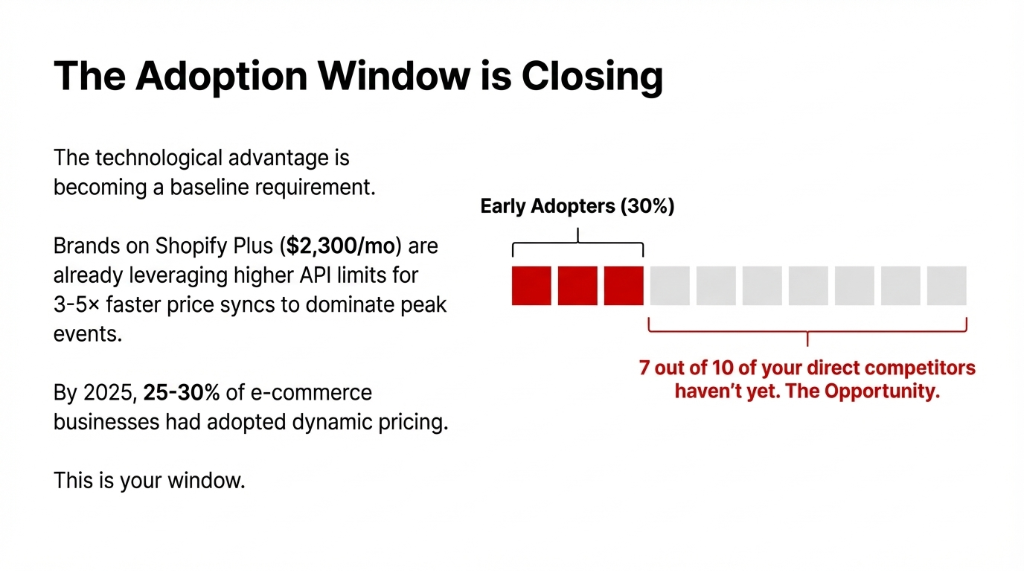
By 2025, 25–30% of e-commerce businesses had adopted dynamic pricing. That means right now, roughly 7 out of 10 of your direct competitors in the US e-commerce retail market have not implemented this. That is your window.
Stop Leaving Money in Your Price Tags.
Your Shopify store is running on static pricing in a market that reprices by the minute. Book a free 15-Minute Operations Audit — we'll show you exactly where your current pricing is costing you margin.
Book Your Free Audit NowFrequently Asked Questions
Does AI dynamic pricing work on the Basic Shopify plan?
Yes. Apps like Pricing.AI and DynamicPricing AI install on any Shopify plan, including Basic at $39/month. However, the Basic plan's API rate limits mean price updates sync slower — typically 15–30 minutes versus near-instant on Advanced or Plus. For stores under $50K/month in revenue, that lag rarely matters.
Will customers notice prices changing and stop trusting my store?
Only if the changes are dramatic and visible side-by-side. A 5–12% price shift between sessions is below the threshold most shoppers notice. What does hurt trust is pricing the same cart at wildly different amounts for the same session — which well-configured guardrails in AI pricing apps prevent by design.
How is AI dynamic pricing different from just running a Shopify discount code?
Discount codes reduce revenue uniformly across all buyers — including those who would have paid full price. Dynamic pricing raises or holds prices for high-intent buyers while adjusting downward only where needed to convert fence-sitters. The net effect is higher product margin overall, not just higher volume.
What Shopify AI apps are best for dynamic pricing in 2026?
The top three in the Shopify marketplace for US stores are: DynamicPricing AI (best for margin-focused optimization), Prisync AI (best for competitor-indexed pricing), and Pricing.AI (best for inventory-urgency rules). All three offer free trials before committing to a monthly Shopify fee structure.
Does Shopify Plus make AI dynamic pricing significantly better?
Yes — specifically during peak traffic events. Shopify Plus pricing at $2,300/month gives you higher API call limits, which means your pricing app can push updates 3–5x faster than on lower plans. During Black Friday or a viral product moment, that speed difference translates directly into captured margin before competitors can react.