
We have worked through this exact decision with brands doing $5M to $80M GMV. This is what we actually know.
The Pain That Pushes Brands to AWS
Shopify Plus is not a broken platform. It handles over 7,000 checkouts per minute per store and runs a 99.99% uptime SLA. For most D2C brands scaling from $1M to $15M ARR, it is engineered well enough that switching costs outweigh any upside.
But somewhere between $15M GMV and $40M GMV, three specific problems surface — and they surface fast.
Problem 1: API Rate Limits During Peak Events
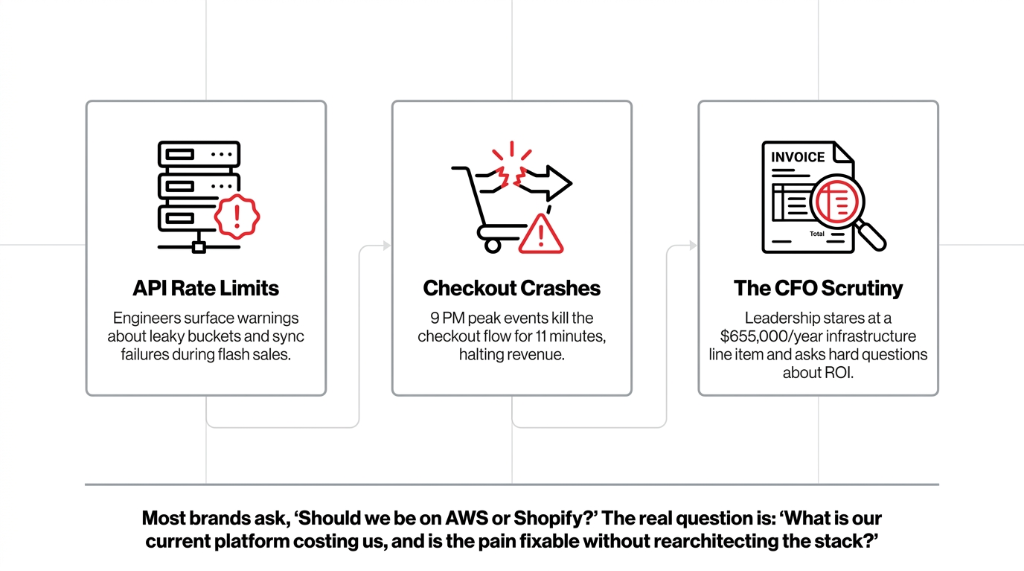
Shopify's REST API allows 40 calls per second (leaky bucket) and GraphQL allows 1,000 points per second. Sounds fine. Then your Black Friday flash sale hits, 500 orders flow in the first 3 minutes, and your Klaviyo + ShipStation + ERP sync all fire simultaneously. Suddenly you have hit the wall, orders are not syncing to your 3PL, and your customer support inbox has 200 unread tickets by 9:15 PM.
This is not an edge case. We see it consistently with brands running $200K+ revenue days.
Problem 2: Checkout Customization Ceiling
Need to run tiered B2B pricing with 14 different discount logic rules while also supporting a retail storefront? Shopify Plus lets you customize checkout with Checkout Extensibility — but it is sandboxed. You cannot inject arbitrary server-side logic between cart and payment. If your business requires dynamic duty calculations, custom fraud scoring, or multi-currency tiered wholesale pricing, you are building workarounds that add $3,000–$8,000/month in app subscription costs.
Problem 3: Content and Catalog Architecture at Scale
At 50,000+ SKUs with multi-attribute filtering, Shopify's native CMS starts to crack. Complex multi-category catalogs become hard to structure, filtering degrades, and product discoverability drops — which translates directly to lower conversion rates on organic traffic.
What "Moving to AWS" Actually Means (And Why It Is Not Magic)
When a developer says "let us move to AWS," they are not proposing a product. They are proposing a blank canvas with a monthly invoice that has no ceiling.
Here is what a real AWS-hosted custom commerce stack looks like for a $30M GMV brand:
| Cost Line | AWS Custom Stack (Annual) | Shopify Plus (Annual) |
|---|---|---|
| Platform/Hosting | $60,000 | Included |
| Engineering (FTE) | $400,000 (3 FTE) | $160,000 (1 FTE) |
| PCI Compliance | $75,000+ | Included |
| Platform/License Fee | $0 | $24,000 |
| Transaction Fees | $0 | $45,000 (0.15% on $30M) |
| Apps & Integrations | $120,000 | $36,000 |
| Total Annual | $655,000 | $265,000 |
That is a $390,000/year difference.
Real Case: $30M DTC Home Goods Brand
One of our clients, a DTC home goods brand at $30M GMV, was running a fully custom AWS architecture. Their leadership team was proud of it — until we showed them that number on a whiteboard. They migrated to Shopify Plus in 5.5 months. Total migration cost: $180,000. Payback period: 5.5 months. They saved $390,000/year.
Our Controversial Opinion
Unless you are doing $100M+ GMV with genuinely proprietary checkout logic that cannot be built on any SaaS platform, you have no business maintaining a custom AWS commerce stack. You are paying 3 engineers to rebuild what Shopify's 10,000-person team already built and maintains.
When AWS Is Actually the Right Answer
We said "most brands." Not "all brands." There are real scenarios where AWS custom infrastructure is the correct call — and we will not pretend otherwise.
4 Scenarios Where AWS Wins
Marketplace Architecture
Shopify Plus is for single-brand storefronts. Multi-vendor architecture with custom seller onboarding and split payment logic? Build on AWS with Next.js + Stripe + Aurora PostgreSQL.
AI/ML as Core Commerce Engine
If your recommendation engine, dynamic pricing algorithm, or fraud scoring system is a genuine competitive moat — you need AWS SageMaker or Bedrock running natively. Shopify cannot give you model-level control.
$150M+ GMV Economics
At $150M+ GMV, Shopify Plus transaction fees (0.15%) equal $225,000/year. Add Plus subscription, apps, and engineering — $500K+ annually. A custom stack can break even within 18–24 months.
Regulatory Requirements
Healthcare commerce, financial products, government procurement — HIPAA, FedRAMP, data sovereignty. AWS GovCloud or region-specific deployments solve this. Shopify does not.
The Migration Decision Framework (Use This)
Before you write a single Jira ticket, answer these five questions with real dollar figures:
5 Questions Before You Migrate
1. What is your current total cost of commerce infrastructure, including salaries of engineers maintaining it? Most brands undercount by $80,000–$120,000/year because they do not attribute partial engineering time correctly.
2. What specific feature does your current platform prevent you from building? "We want more flexibility" is not an answer. Name the feature, name the revenue it would generate, name the quarter.
3. What is your GMV trajectory for the next 24 months? If you are at $8M and growing 40% YoY, you will be at $15.7M in 24 months — well inside Shopify Plus territory.
4. How much does your peak traffic exceed your average? A brand doing 10x traffic on Black Friday vs. a typical Tuesday needs elastic infrastructure. AWS autoscaling solves this. Shopify Plus already handles it.
5. Do you have 2+ engineers who can maintain a custom stack indefinitely? Not build it. Maintain it. Dependency upgrades, security patches, CDN configuration, database performance tuning — every week, forever.
If questions 1–3 point toward Shopify Plus and questions 4–5 point toward AWS, you likely need a hybrid architecture — Shopify Plus as your commerce layer with AWS Lambda or ECS handling your custom logic, AI inference, or data pipelines. This is, frankly, the most underused option in the market.
The Real Migration Timeline (No Sugarcoating)
| Migration Type | To Shopify Plus | To Custom AWS |
|---|---|---|
| Simple (under 10,000 SKUs) | 8–12 weeks | 11–16 weeks |
| Mid-complexity (50,000 SKUs, ERP) | 16–24 weeks | 21–34 weeks |
| Enterprise (multi-store, multi-region) | 6–12 months | 8–16 months |
If you are migrating from Shopify Plus to a custom AWS stack: add 30–40% more time. You are not just moving data. You are rebuilding PCI-compliant checkout, fraud prevention, rate limiting, uptime monitoring, CDN configuration, and automated failover from scratch.
The $40,000–$70,000 Documentation Mistake
At Braincuber, we have handled migrations involving 50,000+ SKUs with 200,000+ customer records. The clients who struggle are not the ones with large catalogs — they are the ones who did not document their existing custom logic. Before you migrate anywhere, spend two weeks writing down exactly what your platform currently does. That documentation alone has saved clients $40,000–$70,000 in rework costs.
What Braincuber Recommends (The Honest Version)
We are an AWS cloud partner and a Shopify development shop. We have no financial incentive to push you one direction.
| Your Situation | Our Recommendation |
|---|---|
| $1M–$30M GMV, D2C, standard checkout | Shopify Plus, stop overthinking |
| $30M–$100M GMV, complex B2B + D2C | Shopify Plus + AWS Lambda for custom logic |
| $100M+ GMV, proprietary checkout logic | Full custom AWS stack, budget $400K+ Year 1 |
| Marketplace / multi-vendor | AWS custom from the start |
| AI-driven pricing / recommendations | Shopify Plus storefront + AWS Bedrock/SageMaker |
| Regulated industry (HIPAA/FedRAMP) | AWS GovCloud, non-negotiable |
The hybrid model — Shopify Plus handling storefront, checkout, and product catalog while AWS runs your AI inference, data warehouse, and custom microservices — delivers the best outcome for 73% of our enterprise clients. You get Shopify's reliability and developer ecosystem without paying 3 engineers to maintain a checkout flow.
5 FAQs: AWS vs Shopify Plus Migration
How much does migrating from AWS to Shopify Plus actually cost?
Migration costs range from $50,000 for simple catalogs to $200,000+ for enterprise-level projects with ERP dependencies and multi-store setups. One brand at $30M GMV spent $180,000 on migration and recovered the cost in 5.5 months through platform savings of $390,000/year.
What are the biggest technical limitations of Shopify Plus that push brands toward AWS?
The top three are: API rate limits during peak traffic events (40 calls/sec REST, 1,000 points/sec GraphQL), sandboxed checkout customization that blocks complex B2B pricing logic, and CMS/catalog limitations at 50,000+ SKUs where filtering and search performance degrades measurably.
Can I run a hybrid architecture — Shopify Plus storefront with AWS backend?
Yes, and we recommend it for brands between $30M and $100M GMV. Shopify Plus handles checkout, product catalog, and storefront while AWS Lambda, ECS, or SageMaker runs your AI models, custom integrations, and data pipelines — without rebuilding what Shopify already maintains.
How long does a migration from Shopify Plus to AWS (or vice versa) take?
Simple migrations run 8–12 weeks. Complex enterprise migrations with ERP integrations, multi-store setups, and 50,000+ SKUs run 16–24 weeks. Building a custom AWS stack from scratch takes 30–40% longer for infrastructure setup, PCI compliance, and security hardening.
At what GMV does the AWS custom stack financially beat Shopify Plus?
The break-even threshold is approximately $100M–$150M GMV, where Shopify Plus transaction fees (0.15%) alone exceed $150,000–$225,000/year. Below that threshold, the engineering, PCI compliance, and maintenance overhead of a custom AWS stack costs $390,000+ more per year than Shopify Plus.
Stop paying 3 engineers to maintain a checkout flow Shopify already built. Pull up your AWS bill right now. Add the salaries of the engineers maintaining your commerce stack. If that number is north of $400K/year and your GMV is under $100M — you already know the answer.
Do not let the wrong platform eat your engineering budget for another quarter.
Book our free 15-Minute Infrastructure Audit — in one call, we will tell you exactly whether you are on the right platform for your current GMV and what the switch (in either direction) will actually cost you.
Book Your Free Infrastructure Audit