
Here is the ugly truth about open ai pricing: it scales aggressively against you. The cost of running heavily tokenized datasets through general API endpoints annihilates cloud budgets within 90 days. We migrate heavily invested clients from OpenAI into aws bedrock constantly, saving them hundreds of thousands yearly.
The OpenAI Bill Nobody Talks About Honestly
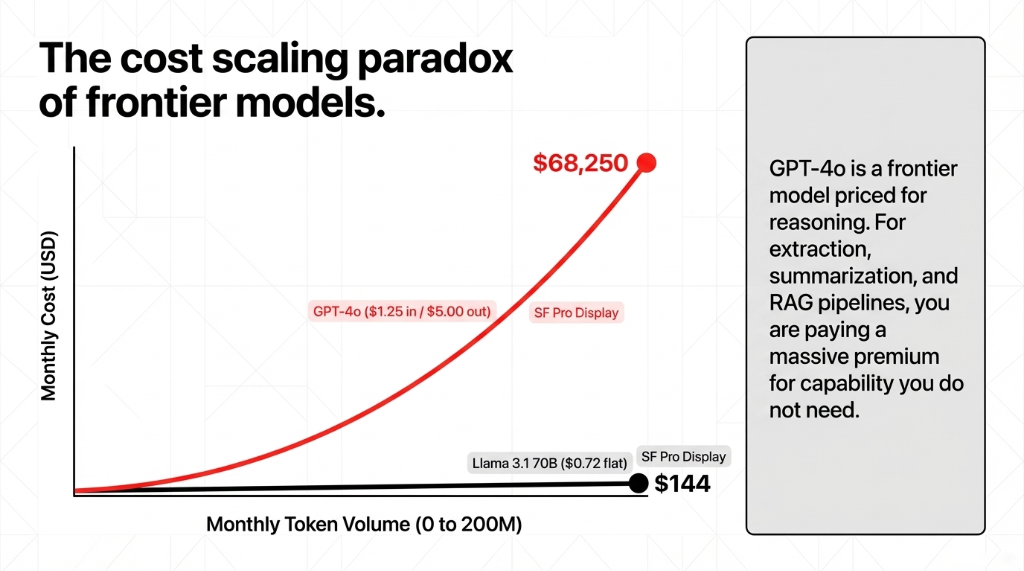
GPT-4o operates heavily parameterized tokens scaling output costs indefinitely. Compare that pipeline directly to running Meta Llama 3.1 70B directly on aws ai inside your VPC. 200 million tokens drops from $68,250 a month to exactly $144.
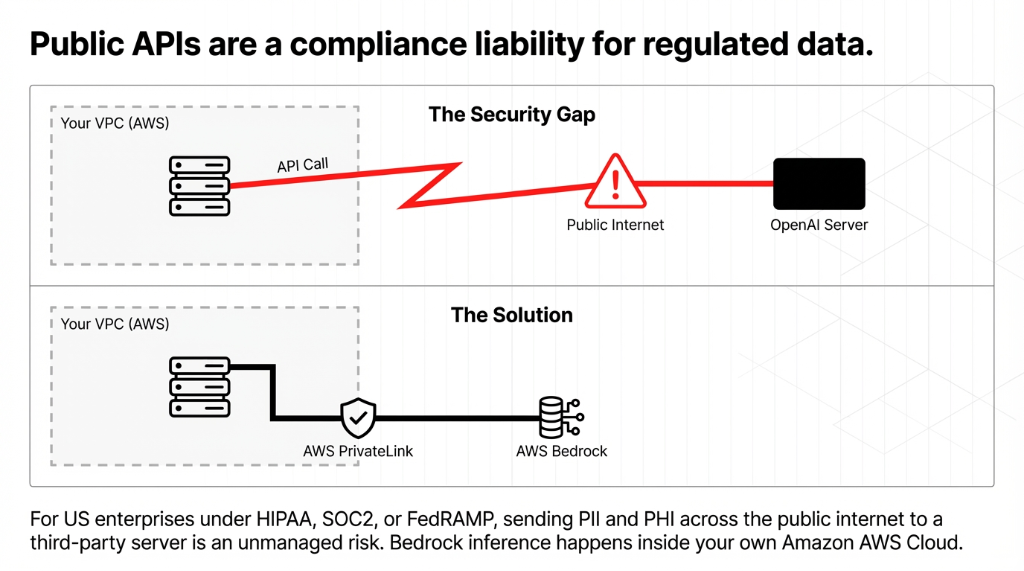
The deeper issue is absolute compliance liability. Data spanning out of your aws applications over the public internet to a third-party server removes architectural security entirely.
Why AWS Bedrock Is Not Just "Another AI Cloud"
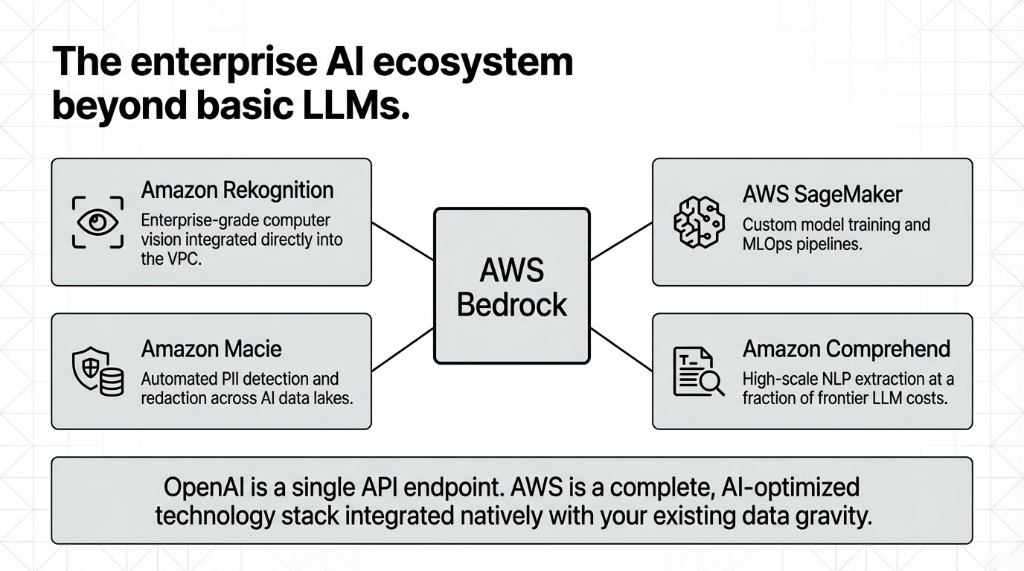
Engineers assume aws bedrock is merely a model wrapper. It is genuinely a fully isolated managed infrastructure layer. It operates locally natively interacting with aws lambda and aws eks without traversing public networks. It is FedRAMP High authorized.
Google's Vertex AI holds value, but the massive vertex ai cost mapping ingress/egress from your amazon aws cloud services architecture eliminates margin aggressively.
The Vendor Lock-In Problem Nobody Wants to Admit
Here is a fiercely controversial stance: moving to Bedrock absolutely does not eliminate vendor lock in. It merely relocates it purposefully.
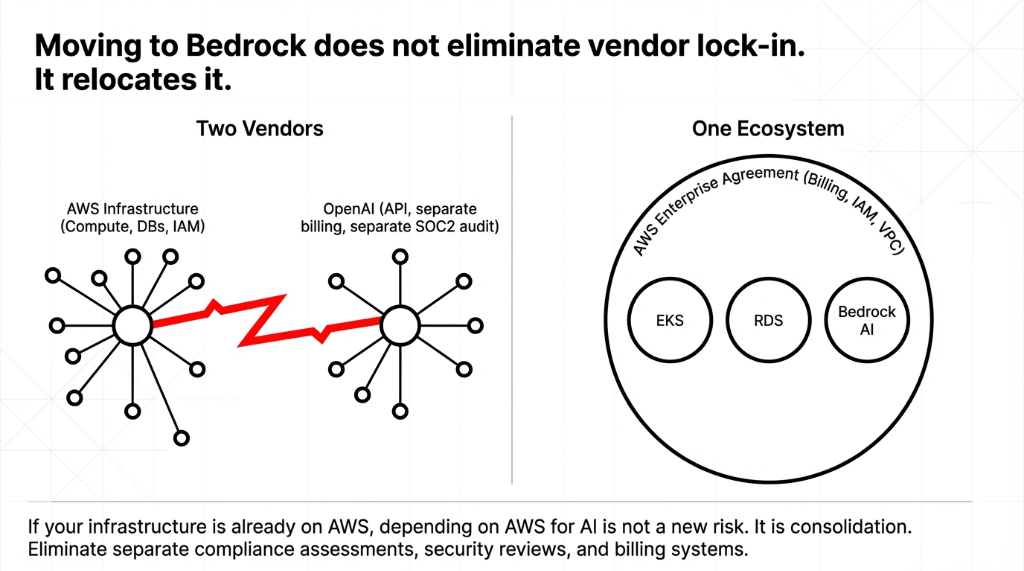
If your cloud services, database, and aws on cloud compute sit inside AWS, migrating your AI strictly centralizes the risk logic into one commercial envelope. Avoiding two massive vendor compliance and SOC audits mathematically generates ROI via time-savings instantly.
Braincuber's Four-Phase Migration Playbook
Our Brutal Standardization Flow
Phase 1: Cost Audit (Week 1–2)
We find your undocumented shadow IT. You have Zapier flows draining OpenAI credits. We secure them.
Phase 2: Prompt Optimization (Week 2–4)
Naive endpoint swaps break quality. We deeply restructure prompts inside shadow-modes against Bedrock aws apis.
Phase 3: Canary Vector Migration (Week 4–8)
We strictly execute database migration vectors against Titan Embeddings. Skipping this breaks your semantic RAG operations instantly.
Phase 4: Optimization (Week 8–12)
Deploying specific Provisioned Throughput scaling via amazon aws services slashing execution variables by further halves.
Do not execute a migration on hope. Our typical US SaaS clients slice operational bleed by $13,503/month merely executing this strict standard. Reinvest that aws hosting cost immediately into product expansion.
FAQs
How long does migrating from OpenAI to AWS Bedrock actually take?
For a company running 3–6 OpenAI-integrated applications, a full production migration takes 8–12 weeks with a dedicated team. Shadow mode testing takes 2–3 weeks. Canary rollout takes 2–4 weeks.
Is AWS Bedrock actually cheaper than OpenAI in every scenario?
No. Claude 3.5 Sonnet on Bedrock costs more than GPT-4o. The cost advantage comes from model selection: using Llama 3.1 70B or Mistral Large 3 for tasks that do not require frontier reasoning.
Will my existing OpenAI prompts work on AWS Bedrock models?
They will run, but they will not perform the same. Each model has different prompt formatting requirements, system instruction syntax, and response tendencies.
How does AWS Bedrock handle data security and compliance for US enterprises?
Bedrock is HIPAA eligible, FedRAMP High authorized (GovCloud US-West), and SOC compliant. Your data never leaves your AWS account, is never used to train base models, and is never shared with model providers.
What is the biggest migration mistake US engineering teams make?
Treating it as a pure API swap. The teams that fail do a find-and-replace on the API endpoint and model name, discover output quality is inconsistent, and roll back.
Stop Bleeding Margins on OpenAI Invoices
Do not burn another quarter's budget subsidizing third-party APIs. We map your current OpenAI layout, pinpoint aggressive reduction variables via Bedrock, and guarantee strict migration validation.