
We do. They're on Standard Shopify. Their competitors are on Plus. And the AI gap between those two tiers is not a feature difference. It's a revenue difference.
In our last 40+ Shopify implementations across the US, we've seen brands on standard plans leaving mass amounts of capital on the table. Not from bad products, not from bad marketing, but from operating a Shopify store without the AI infrastructure that Shopify Plus actually enables.
The Automation Floor Is Not The Same
Let's start with a number most people don't pay attention to.
Standard Shopify gives you 2 API calls per second. Shopify Plus gives you 4.
System Collapse Risk
That sounds technical and boring until your warehouse management system misses 500 orders on Black Friday because the integration hit a wall.
Hidden Danger: Your API rate limit is the foundation every AI automation layer sits on.
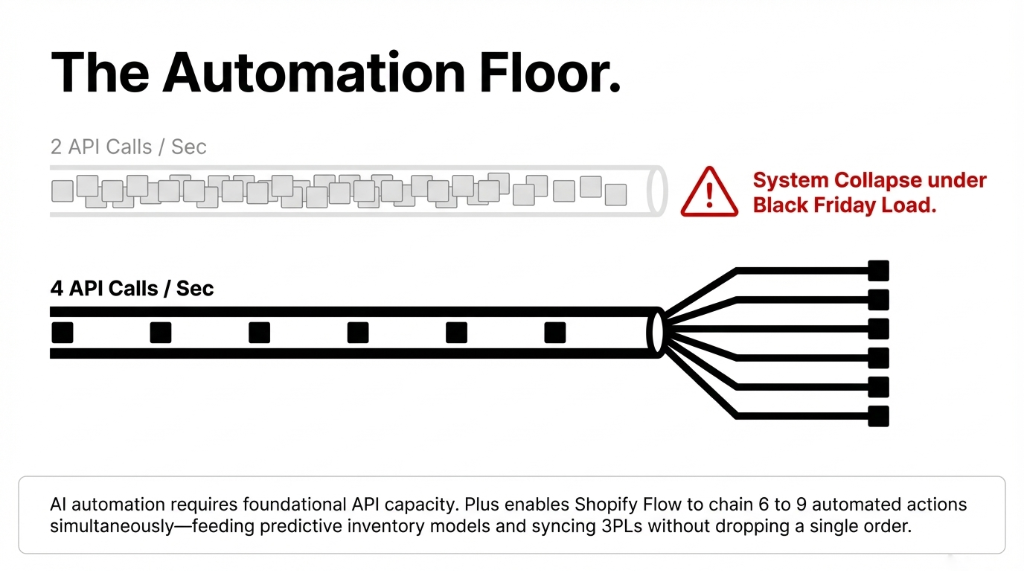
When you're running Shopify Flow to trigger automated reorder alerts, feed predictive inventory models, and sync with your 3PL — all at the same time — 2 calls per second isn't a minor inconvenience. It's the reason your ecommerce inventory management collapses under load.
Shopify Plus brands we work with run Shopify Flow with advanced triggers — chaining 6 to 9 automated actions per workflow. Standard plans run basic Flow. Frankly, calling them the same tool is like calling a Swiss Army knife and a scalpel "both sharp."
What Shopify AI Actually Looks Like at Scale
Standard Shopify merchants get access to Shopify Magic — the AI tool that writes product descriptions, generates email copy, and produces smart replies for Shopify customer support. Useful.
Shopify Plus merchants get that and Shopify Sidekick, which operates more like an embedded operations analyst. It automates workflows, surfaces performance insights, recommends campaign setups, and essentially acts as a 24/7 operational co-pilot inside your dashboards.
The Gap Nobody Talks About
That's not a feature distinction. It's the difference between using AI as a writing assistant versus using AI as a business system.
Businesses using AI-driven automation on Shopify report 20–30% lower operational costs and up to 15% revenue growth within the first year. But those numbers only show up when AI is plugged into systems that can actually act on its output — and that requires the API access, the Flow logic, and the Launchpad automation that only Plus merchants have.
Personalized Product Experience: Night and Day
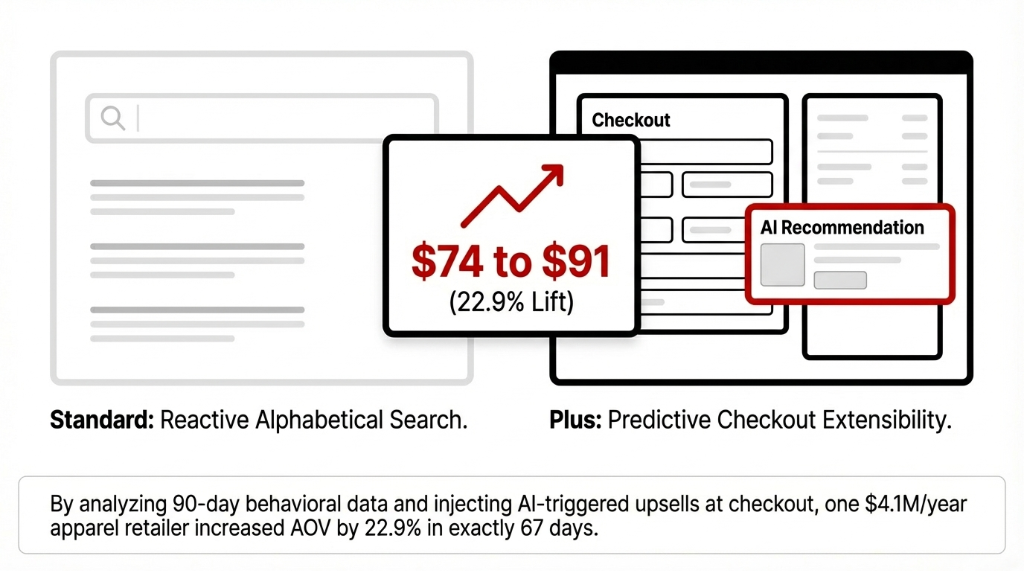
Here's what a standard Shopify site delivers: a homepage, a product grid, and a search bar that returns results alphabetically if the customer doesn't type the exact product name.
Here's what Shopify Plus stores build: AI-powered product recommendation engines that analyze 90-day behavioral data, cart abandonment patterns, and purchase history to surface exactly what each customer is likely to buy — before they search for it.
Extensibility Returns
Insight: We implemented a custom Shopify recommendation engine for a US-based apparel retailer doing $4.1M/year.
Performance Lift
Within 67 days, average order value climbed from $74 to $91 — a 22.9% lift.
Standard Shopify doesn't give you Checkout Extensibility or Shopify Functions, so you can't inject those personalized product moments at the payment step. That's the most valuable conversion moment in the entire purchase journey, and standard plans lock you out of it.
Plus plans also allow Launchpad for pre-scheduled campaign automation — meaning your marketing for a flash sale can arm itself at 11:59 PM with pricing changes, discount logic, and inventory thresholds without a human touching a keyboard.
Shopify Inventory Management: Reactive vs. Predictive
Most standard Shopify merchants manage inventory the same way their grandfather ran a hardware store — they notice they're out of stock after the customer complains.
Shopify Plus integrations allow AI-powered ecommerce inventory management that forecasts demand 30 to 90 days out based on seasonality, traffic spikes, and sell-through velocity. Combined with direct ERP integration (through higher Plus API limits), this becomes a real-time, self-correcting inventory system.
The practical result? One of our clients — selling specialty supplements — eliminated $43,700 in dead stock within one quarter by letting the AI flag slow-moving SKUs and trigger automatic markdown workflows through Flow.
On standard Shopify, that same workflow breaks the moment order volume spikes.
The integration with inventory software like Cin7, Linnworks, or ShipBob starts dropping syncs. And then a warehouse worker ships the wrong product to 200 customers. (We've seen this happen. Twice. Never on Plus.)
Shopify Customer Service: The AI Tier Difference
Standard Shopify merchants plug in a third-party chatbot — Tidio, Gorgias, or Zendesk — and call it customer service. The bot answers basic questions, escalates everything else, and your team handles 300 tickets a week manually.
Shopify Plus merchants build AI customer support pipelines that integrate with the Knowledge Base app, feed curated product and FAQ data directly to AI shopping agents, and monitor what questions customers are actually asking — so the system improves itself.
The Summer '25 Edition pushed this further: Plus merchants now have access to AI shopping agents that operate like a live sales associate inside the shop. These agents don't just answer "where's my order" — they upsell, handle returns, recommend alternatives, and book consultations. AI chatbots are driving up to 15% conversion improvements for Plus stores.
The Real Shopify Plus Cost Calculation
Everyone fixates on the Plus cost — $2,000/month minimum. That sounds expensive until you run the math.
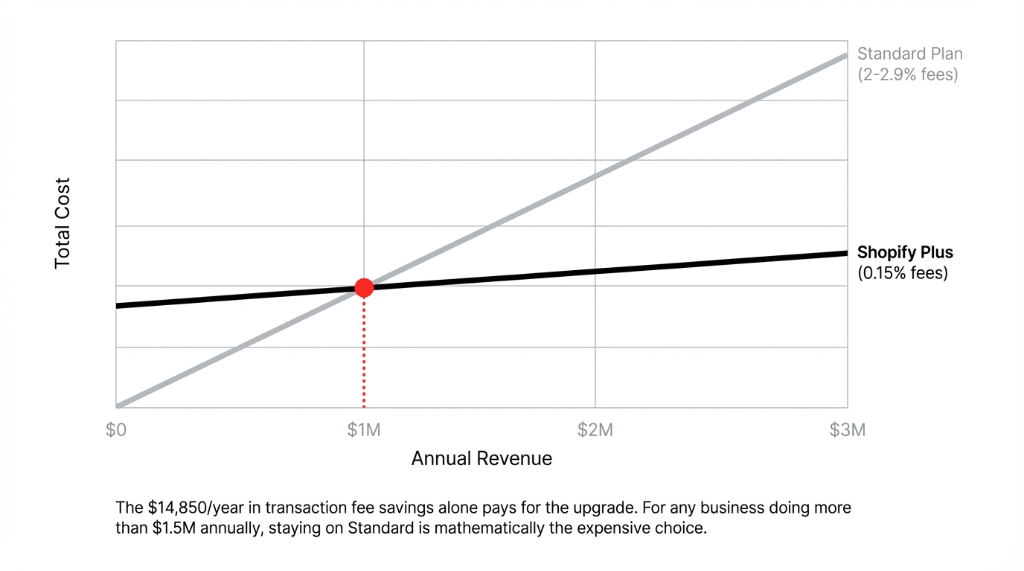
Standard Shopify Advanced plan charges 0.6% per transaction. Standard plans at lower tiers charge between 2% and 2.9%. Shopify Plus charges 0.15%.
The Mathematical Break-Even
At $1M/year Revenue
$14,850/year purely in fee savings.
At $2M/year Revenue
The upgrade pays for itself and yields profit.
For any Shopify business doing more than $1.5M annually in ecommerce stores, staying on standard is mathematically the expensive choice.
Why Most Shopify Retailers Never Make the Jump
We see this constantly with US-based retailers: they know they need more capability, they've hit the ceiling on standard, their competitors are building headless commerce — and they still don't upgrade.
Why? Because nobody walked them through the actual AI capabilities that open up. They see the price tag on Shopify Plus and assume it's just more storage and more staff accounts.
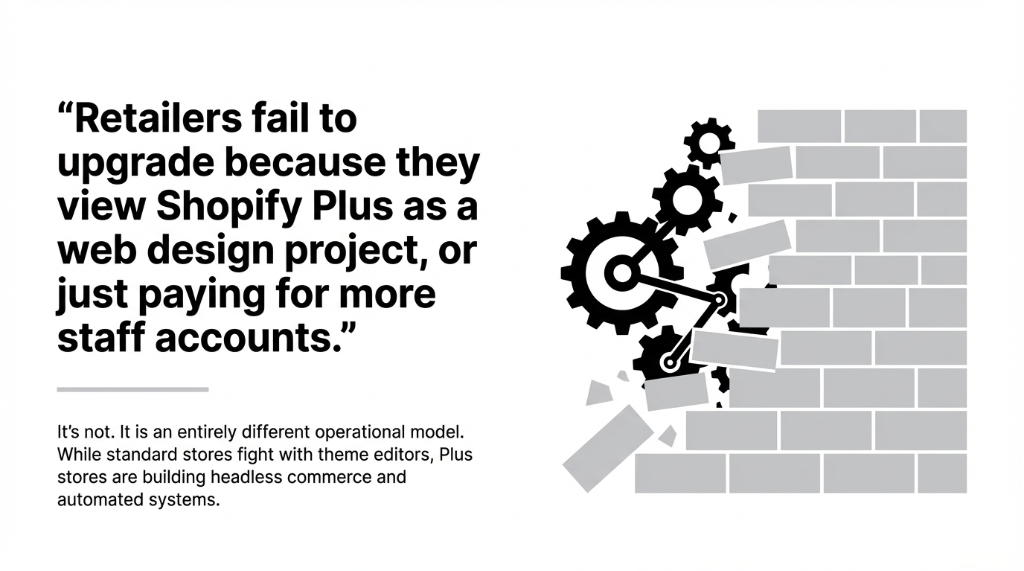
It's not. It's an entirely different operating model.
Braincuber has helped US brands move from standard Shopify to Shopify Plus with full AI integration — custom recommendation engines, Flow-connected inventory systems, Shopify-Odoo ERP integration, and AI customer support pipelines — in an average of 11 weeks.
Stop operating blindly against competitors who automate their edge.
If you're running a Shopify business between $1M and $15M in annual revenue and you're still on a standard plan, you're leaving real money on the table every single month.
Frequently Asked Questions
Does Shopify Plus actually include better AI tools than standard Shopify?
Yes. Shopify Plus merchants get Sidekick (AI operational assistant), Launchpad (automated campaign AI), Shopify Functions for custom checkout logic, and advanced Flow automation. Standard plans get Shopify Magic for content only. The AI capability gap is significant, especially for Shopify inventory management and personalized product experiences.
At what revenue level does Shopify Plus pay for itself?
Shopify Plus becomes financially profitable at roughly $1M in annual revenue, purely from transaction fee savings (0.15% vs. up to 2.9% on standard plans). For a Shopify store doing $2M/year, the fee savings alone cover the $2,000/month Plus subscription cost with $5,400/year left over.
Can standard Shopify stores use AI for ecommerce at all?
Yes, but with hard limits. Standard Shopify stores can use Shopify Magic for content, basic Flow automation, and third-party AI apps like Tidio or Klaviyo. The API rate limit of 2 calls/second, however, means complex AI integrations for ecommerce inventory management or real-time personalization will fail under load.
What is Shopify Sidekick and is it only for Plus merchants?
Shopify Sidekick is an AI assistant built into the Shopify platform that automates workflows, surfaces insights, and helps with campaign setup. It was rolled out broadly in the Summer '25 Edition, with advanced operational capabilities primarily available to Shopify Plus merchants who also have access to Launchpad and advanced Flow.
How long does it take to set up a Shopify Plus store with full AI integration?
A properly built Shopify Plus store with AI recommendation engines, Flow automation, and ERP integration takes between 8 and 14 weeks depending on complexity. Braincuber's implementations average 11 weeks from kickoff to go-live, including Shopify-Odoo integration and custom AI customer support pipelines.