
If you run a US e-commerce brand, you are almost certainly already paying for AI. You just do it indirectly through platforms, apps, and a stack of marketing tools. Most online retailers now use some form of AI in their operations, from chatbots to recommendation engines and marketing automation.
Here is the ugly truth. You are funding AI for Shopify, Meta, Google, and every digital marketing agency you have hired, but you have no clear view of what that intelligence is doing for your brand's profit and loss. You get a marketing report, not a P&L impact.
A Free AI Audit for E-Commerce Brands is our way of flipping that power dynamic. Instead of letting every media agency, social media agency, and ad tech vendor tell their own story, the audit pulls data into a single, blunt narrative: where your AI, marketing, and operations are genuinely creating value and where they are simply burning cash.
The Founder Story This Audit Was Built Around
Picture a US skincare brand doing $4.3 million a year on Shopify. The founder works with a digital marketing company for paid advertising, a separate content marketing agency for blogs and product copy, and a social media agency that handles Instagram, TikTok, and Facebook ads.
Every Month She Gets:
▸ A 32-page online marketing report
▸ Screenshots from a performance marketing agency showing "ROAS 3.2x"
▸ A note from the SEO marketing agency about new keywords ranking
Yet profit has been flat for 18 months.
Discounts keep getting deeper, paid ads budgets keep rising, and the team still reconciles returns and Amazon payouts in Excel. When this brand came to us, they had already spoken to a marketing company promising a new marketing plan, a digital agency selling "full-funnel digital marketing services," a growth marketing agency offering aggressive performance marketing, and an ad agency advertising "brand marketing workshops."
Nobody had looked at how all of this actually flowed through the numbers. That is the gap the free AI audit is designed to close.
Why Your Current Marketing Stack Lies to You
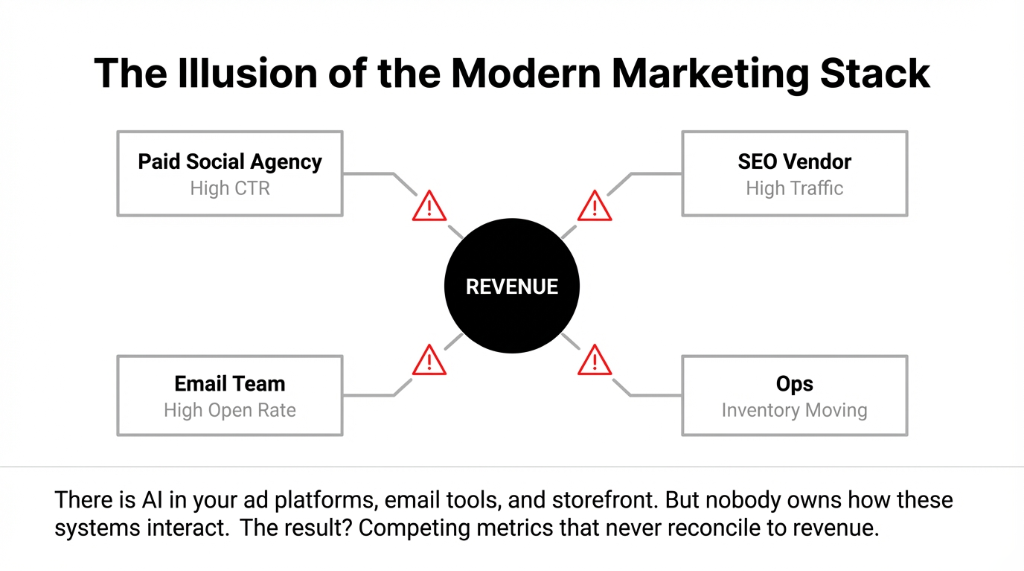
Right now, most US e-commerce brands treat AI as "features" inside tools. There is AI in digital marketing platforms, AI in email tools, AI in social media marketing services, and AI baked into Shopify apps. But nobody owns how these "smart" systems interact with each other.
The Data Is Brutal
AI chat: Retailers using AI chat and assistants see 20-25% conversion uplifts among shoppers who actually engage. Yet most sites barely drive usage.
Recommendations: AI-powered personalization is credited with double-digit conversion and revenue lifts for brands that wire them properly into the funnel.
But in practice? One agency optimizes for CTR, another chases view-through conversions, your SEO vendor focuses on traffic volume, and your internal team stares at blended ROAS and hopes it adds up.
This is how you end up with Facebook ads winning on paper while margins quietly erode. Paid search advertising cannibalizing branded queries you already own. Email, SMS, and content marketing that are never tied to actual cohort-level payback.
The problem is not "digital marketing" versus "traditional marketing." The problem is no single source of truth that connects AI, marketing solutions, and operations.
What Our Free AI Audit Actually Does
A Free AI Audit for E-Commerce Brands is not another marketing website tear-down or generic marketing analysis. It is a structured look at how AI, data, and campaigns interact with your actual customers and cash.
The audit cuts across four layers:
Layer 1: Traffic, Ads, and Media
This is where all the agency jargon lives: marketing ads, digital advertising, SEO, paid ads, and "omni-channel" noise.
What We Check in Layer 1
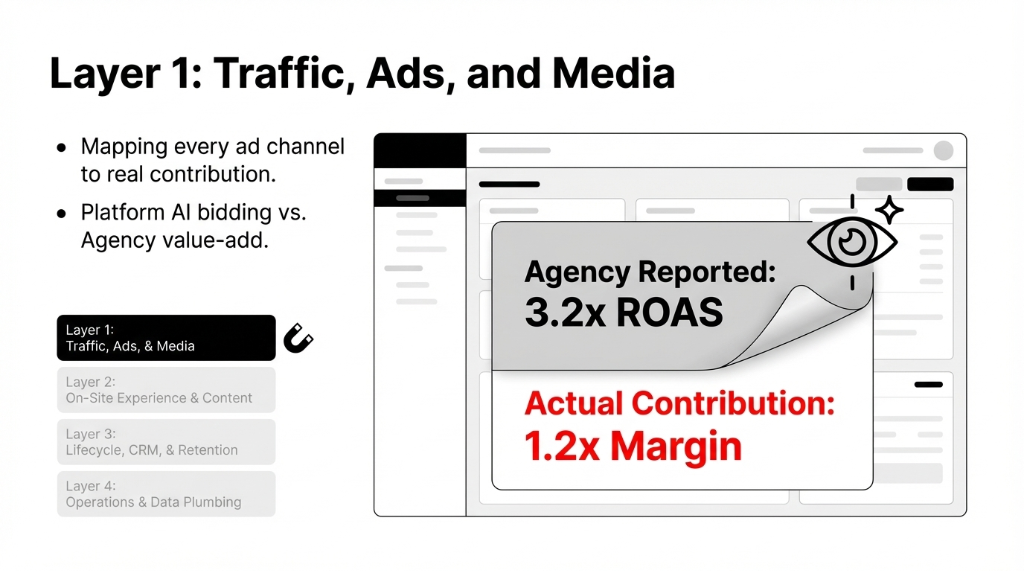
Channel Mapping: Maps every ad channel (Google, Meta, TikTok, programmatic) to real contribution, not vanity ROAS.
AI vs. Rules: Compares AI-driven bidding and targeting to basic rules-based campaigns.
Agency Reality: Breaks out what your digital marketing agency is actually adding beyond what platform AI already does.
Brands are often shocked when a supposedly high-performing advertising agency delivering "AI-powered media buying" delivers the same results as native platform bidding with a clean structure and better creative.
Layer 2: On-Site Experience and Content
AI does not just belong in campaigns. It belongs in your product discovery, content, and merchandising.
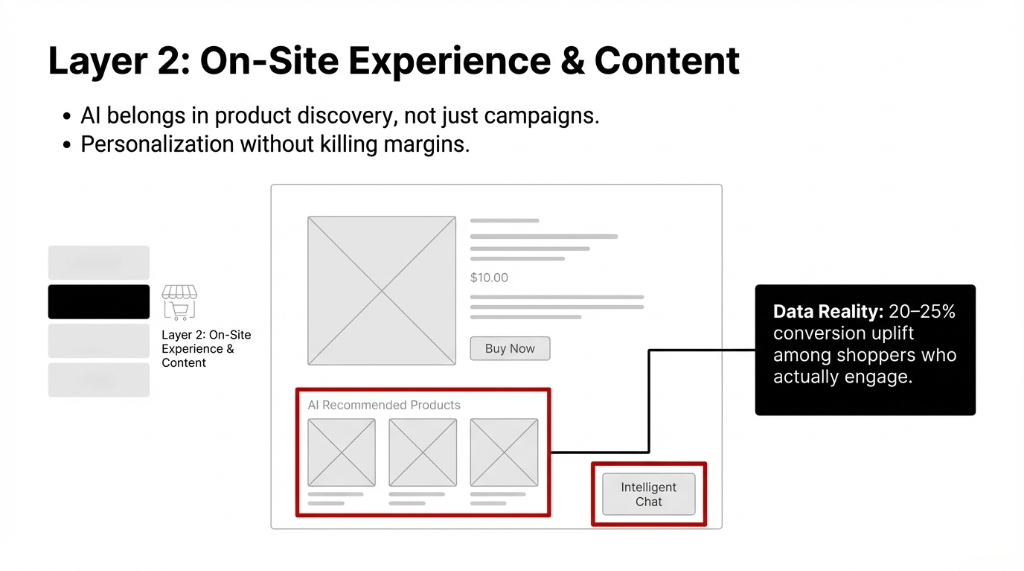
The audit looks at how your search, recommendations, and merchandising logic behave for real users. Where AI for e-commerce merchandising can personalize without killing margins. Whether your content marketing agency is simply churning articles or actually supporting SEO and on-site conversion, and whether AI is being used to test messaging at scale instead of writing endless generic paragraphs.
Layer 3: Lifecycle, CRM, and Retention
Here the focus moves from acquisition to monetization.
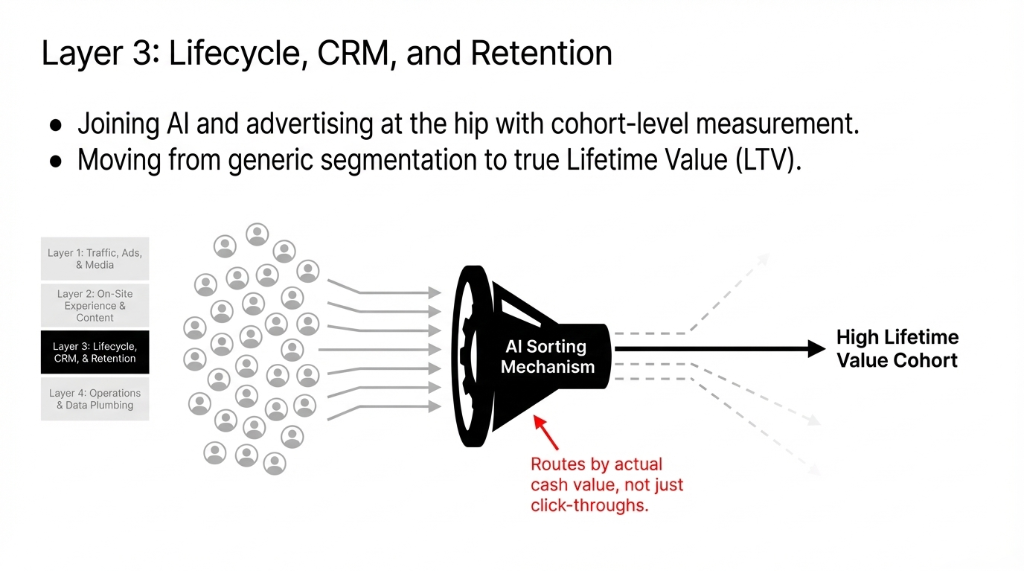
The audit examines how AI marketing tools, recommendation engines, and segmentation logic are used in email, SMS, and remarketing. Whether your marketing AI stack treats everyone the same or truly personalizes offers. How channel-level results from social media agency, online marketing agency, and SEO vendors flow into lifetime value.
Most brands discover they run social media marketing in isolation. Facebook agency teams chase click-through, while lifecycle teams guess at offers. AI and advertising should be joined at the hip with cohort-level measurement, not run as parallel experiments.
Layer 4: Operations, Data Plumbing, and Reality Check
This is the part every marketing agency avoids because it is messy.
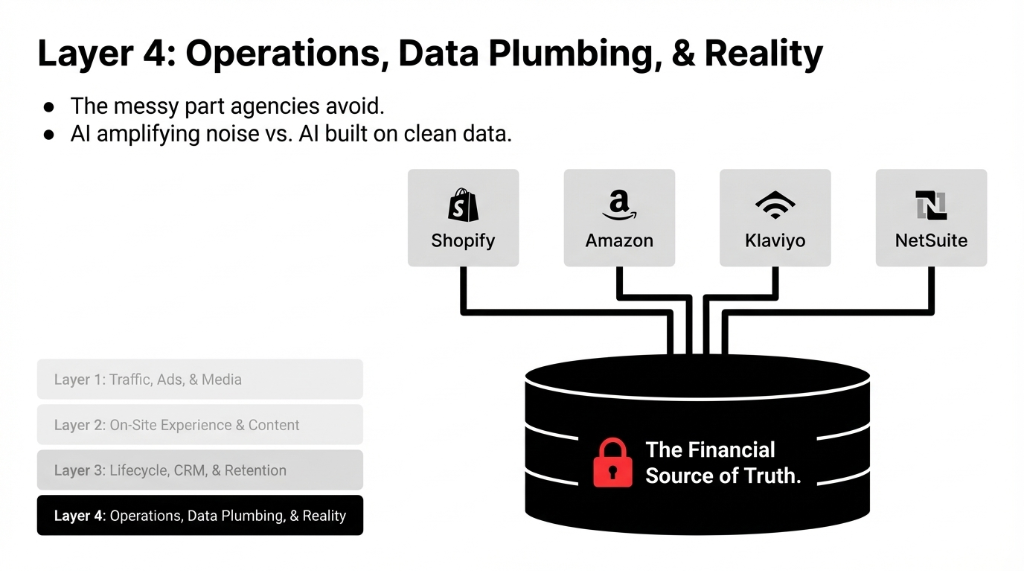
We go through how orders, returns, and inventory flow between Shopify, Amazon, Odoo, QuickBooks, NetSuite, Klaviyo, and your warehouse systems. Where data breaks, duplicates, or lags create false stories in dashboards. How AI tools could automate reconciliation, tagging, and forecasting instead of just writing copy.
Look, if your operations team is still exporting CSVs and pasting into Google Sheets, no amount of marketing and branding will save your margins. AI and digital marketing must sit on top of clean, reliable data or they amplify noise.
Where AI Fits Into This Audit (Without the Buzzwords)
Across those four layers, the audit focuses on very specific AI use cases:
Four AI Focus Areas. Zero Fluff.
AI for Marketing Analysis
Running actual experiments on campaigns, creatives, and audiences instead of gut-feel.
AI for Reporting
Turning raw platform data into a single marketing report the CFO can trust.
AI for Conversion and CX
Chat, guided selling, AI search, and recommendation engines wired to revenue, not clicks.
AI for Forecasting and Inventory
Predicting demand, returns, and cash needs with enough lead time to act.
The point is not to buy three more AI marketing tools. The point is to decide where AI and marketing belong in your stack, where AI in e-commerce is already paying off, and where it is pure theatre. The global market for AI e-commerce tools is growing rapidly, but most retailers still treat it as add-ons instead of core strategy.
How This Plays Out for a US Brand (Real Numbers)
In one recent audit for a US apparel brand doing $9.7 million a year online, the findings were blunt:
The Raw Findings:
▸ Shoppers who used the AI chat converted at 4x the rate of those who did not, but only 6.3% of visitors even saw the widget.
▸ AI-driven recommendations on PDPs generated 31% of revenue for a small segment of returning users, while new visitors barely saw any personalization.
▸ The "hero" Facebook ads campaign looked profitable until returns and discounts were properly attributed, turning a supposed 3.1x ROAS into 1.4x.
By the end of the audit, the brand did not just have a new marketing slide. They had a re-allocation:
The Re-Allocation
$27,400
Cut per month from low-intent paid social and paid ads agency experiments.
$18,900
Reinvested into AI-driven on-site experimentation and lifecycle flows.
4 to 1
Replaced four overlapping dashboards with a single AI marketing analysis tool.
That is the difference between generic digital marketing solutions and a targeted audit that connects AI, media, and operations.
Where All Those Agencies Actually Fit
Most founders are stuck in an agency maze. They bounce between digital marketing agency vendors, media marketing agency models, a branding-focused agency, and a separate performance agency. A local social media agency for local businesses and a separate paid social media agency for national reach.
In the audit, these are not "partners." They are line items. The question is simple: Does this agency, and the AI and digital marketing stack around it, create incremental profit?
If the Answer Is No, Here Are Your Options
Consolidate: Under one agency that can handle SEO, content, and media together.
In-house: Bring key skills in-house while using specialist vendors for narrow tasks.
Automate: Use AI and digital marketing tools to replace low-value, manual reporting and analysis work.
The audit does not start from "How do we keep all these vendors happy?" It starts from "What is the cleanest way to connect marketing activity to profit?"
Why This Audit Is Free (And What the Catch Is)
There is no free advertising. The "free" part of this audit is paid for in two ways:
The Honest Answer
First: By using AI marketing tools internally to cut the manual grunt work of data pulls, matching, and analysis.
Second: By betting that a portion of brands will ask us to implement the fixes we identify.
For your brand, the upside is clear. You get an external, data-driven view of your AI and marketing stack without committing to a long retainer. If the audit shows small, tactical tweaks, you can hand them to your existing partners. If it exposes deeper issues, you know exactly where to press.
Who This Free AI Audit Is For
Built For:
✓ US e-commerce brands on Shopify, BigCommerce, or custom stacks with real volume
✓ Brands spending at least mid-five-figures monthly on online marketing and paid advertising
✓ Teams working with at least one marketing agency, ad agency, or SEO agency today
Not For:
✗ Hobby stores experimenting with free business advertising hacks
✗ Brands not willing to put finance, marketing, and operations in the same room
✗ Teams who want more slides, not more profit
It works best when finance, marketing, and operations are in the same room. Marketing and content decisions only make sense when someone is watching the cash.
What You Walk Away With
Three Deliverables. Not a Deck.
1. A clear, story-level view of how AI and marketing currently work across your funnel.
2. A concrete, prioritized list of changes that tie into margin and cash, not just clicks.
3. A choice: have your existing vendors implement, have our team handle it, or run a hybrid approach.
No more guessing whether AI and digital marketing is "working." You see the exact points where AI, content marketing, SEO, and operations combine to make or lose money. And you get a plan to fix it before the next Black Friday.
FAQs
How long does the free AI audit take?
The initial Free AI Audit for E-Commerce Brands usually takes 7-10 business days once analytics, ad accounts, and key tools are connected. The live walk-through is a 45- to 60-minute session focused on decisions, not dashboards.
What data access is required?
Access is limited to the platforms that actually drive revenue: Shopify or your main storefront, ad platforms like Meta and Google, core email or CRM tools, and high-level finance data. Read-only access is enough for most brands to run the audit.
Will this replace my current marketing agency?
Not automatically. The audit often highlights where a marketing agency relationship is working well and where it is misaligned with your goals. Some brands change scope, some consolidate vendors, and others bring more work in-house.
Is this only about AI tools?
No. AI and marketing are considered together, but the audit is rooted in commercial reality: contribution margin, cohort performance, and operational bottlenecks. If a non-AI tweak beats an AI feature, the recommendation will still favor the better financial outcome.
What does it cost after the free audit?
There is no obligation. If you want help implementing the recommendations, that can involve project work, ongoing support, or advisory retainers. Pricing depends on scope, not on a generic package, and is shared only after the audit findings are clear.
Pull Up Your Last 3 Months of Ad Spend Right Now
If you cannot tie every dollar to contribution margin (not ROAS, not clicks, actual margin), the audit will find money you are leaving on the table. 15-minute slot. No pitch deck. Just your data and a blunt conversation about what is working and what is not.