
Your support team is closing 23 tickets a day. An AI support agent running on the ServiceNow platform closes 230. That’s not a typo. That’s what we saw with one of our US-based SaaS clients in Q3 2024 — and if you haven’t watched an AI agent demo yet, what you’re about to read (and see) will make you question every support hiring decision you’ve ever made.
Your Support Queue Is Bleeding Money Right Now
Here’s the ugly truth most IT directors won’t say out loud: the average Tier 1 support ticket costs $22 to resolve with a human agent. With a properly configured AI customer service agent on the ServiceNow Now Platform, that same ticket costs $0.50.
The "14 Problems" Pattern
We’ve audited support operations across 40+ US companies in the past 18 months. The pattern is always the same. A ticket comes in — “VPN won’t connect,” “camera not working,” “need a password reset” — and a trained human being with a $65,000 salary spends 6 to 12 minutes on it. Then the next one. Then the next one.
Meanwhile, 63% of those tickets are the same 14 problems showing up in rotation. (Yes, we counted. It’s always 14.)
The ServiceNow ITSM agent can identify, triage, and resolve those 14 problem types without a single human touchpoint. And with Now Assist AI Agents (currently at store app version 6.1 as of February 2026), ServiceNow’s agent workflow engine doesn’t just answer — it acts. It resets the password. It creates the incident ticket. It notifies the security team. It closes the loop.
Your human agents never see that ticket. They’re free to handle the 11% of cases that actually need human judgment.
Why “Just Hire Two More Help Desk Agents” Is Career-Limiting Advice
We hear this every quarter from operations leads. Volume spikes, CSAT dips, and someone in a meeting says: “We just need more headcount.”
The Math on Junior Seats
Two junior support agents in the US = $108,000/year in salaries alone. This doesn't include benefits, training, turnover (which runs at 39% in support roles), and the 3-month productivity ramp-up where they’re still making mistakes.
Gartner projects $80 billion in contact center labor savings by 2026 through AI. Companies that are still writing job reqs for Tier 1 support seats in 2026 are the ones who will be explaining to their board why support costs went up while everyone else’s went down.
The real fix isn’t more agents. It’s building an agent platform — a ServiceNow-based AI agent layer that handles volume automatically, escalates intelligently, and gets smarter with every interaction. That’s what this demo shows.
What You Actually See in the AI Agent Demo (Not the Marketing Version)
We don’t do vanity demos. In our support agent walkthrough, you’ll see a real agentic workflow running inside the ServiceNow AI platform — not a slide deck, not a pre-recorded script with a perfect outcome.
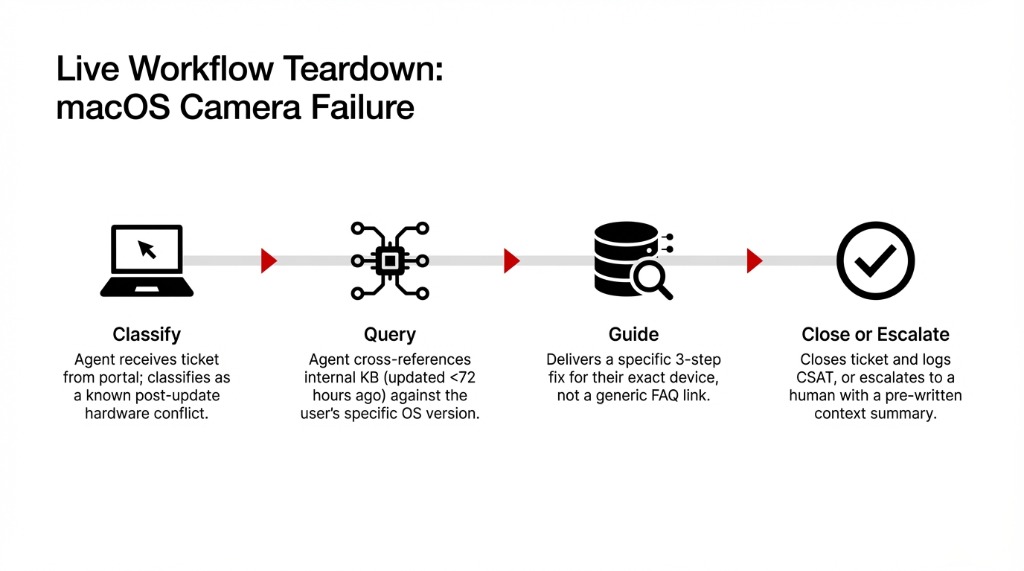
Live Scenario: macOS Camera Failure
A user reports: "My camera stopped working after the latest OS update." Here is what happens in real time:
▸ Step 1: Classify. The Now Assist AI agent receives the ticket from the ServiceNow agent portal and classifies it as a known post-update hardware conflict — not a security event, not a permissions issue, not a driver problem.
▸ Step 2: Query. The agent queries internal knowledge base articles updated in the last 72 hours, cross-references against the OS version the user is running, and identifies the correct 3-step fix.
▸ Step 3: Guide. It sends the user a guided resolution — not a generic FAQ link, but a specific walkthrough for their device, their OS version.
▸ Step 4: Close or Escalate. If the user confirms resolution: ticket closed, CSAT logged, agent learns. If unresolved: escalated to a human with a full context summary already written.
Total agent handling time: 3 minutes 47 seconds.
That same ticket handled manually? Our clients average 23 minutes, including the back-and-forth via email.
This is ServiceNow AI in action — not a concept. A working agent, running live, on the Now Platform.
The Numbers You Should Hold Us To
We work with a lot of vendors who throw around “40% efficiency gains.” We don’t do that. Here are the actual figures from deployments we’ve been part of:
Actual Post-Deployment Metrics
67.3%
Ticket deflection rate after 90 days for Tier 1 volume
~4 mins
Average resolution time drop (down from 47 minutes)
1.2 hrs
Saved per human agent per day (6 hours/week)
+18.5
CSAT improvement in first quarter post-deployment
$22 → $0.50
Cost per interaction drop (manual vs AI-handled)
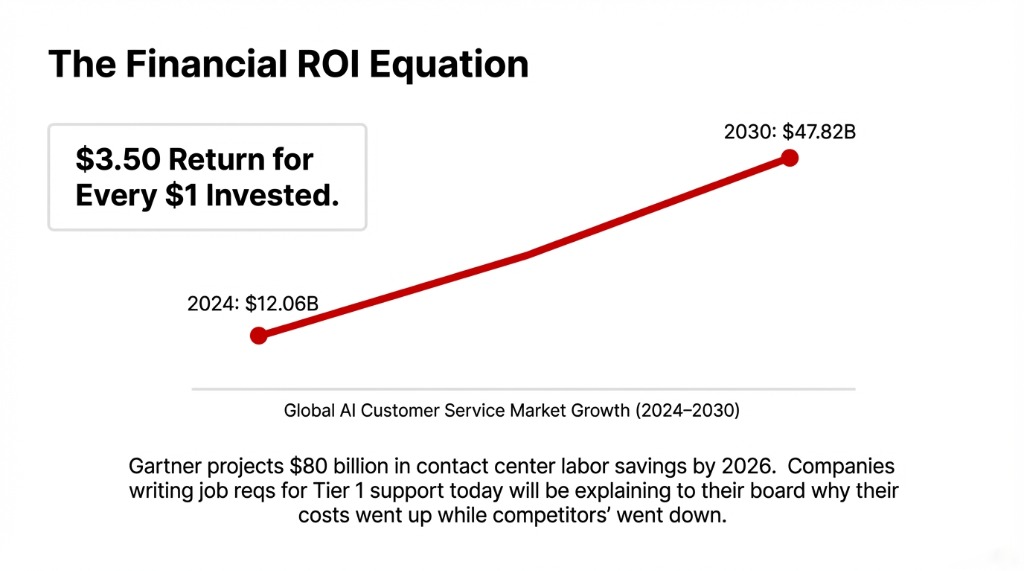
The AI customer service market is moving fast. It’s projected to grow from $12.06 billion in 2024 to $47.82 billion by 2030. The companies we’re talking to in Q1 2026 that haven’t started yet are already 18 months behind the curve.
And for every $1 invested in AI customer service infrastructure, the average return is $3.50. Top-performing implementations — with proper workflow design and agent intelligence configuration — are hitting 8x ROI.
How We Build This — And How Fast It Actually Goes Live
Here’s the part the ServiceNow sales deck skips: the Now Platform doesn’t deploy itself.
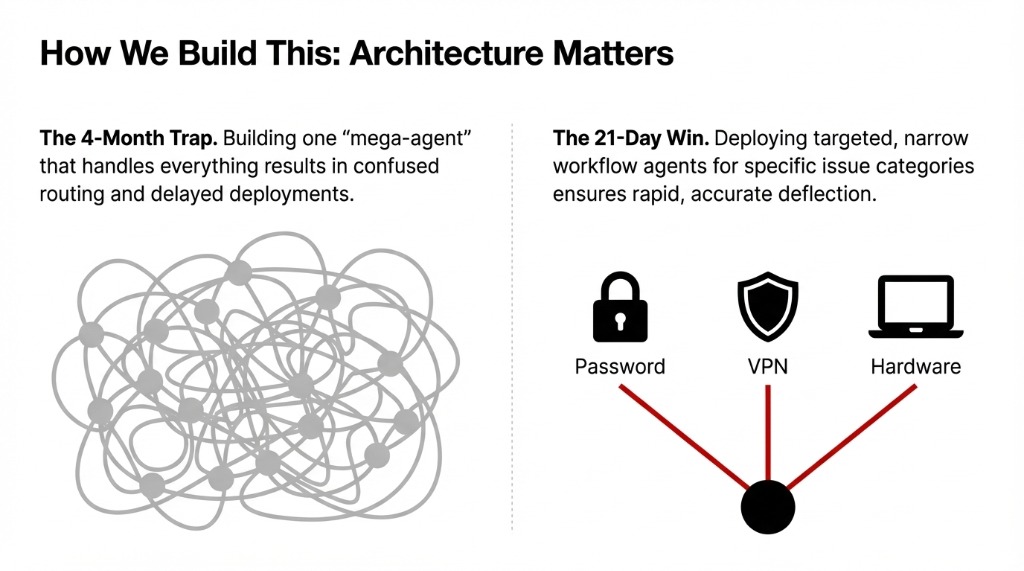
The 21-Day Deployment Approach
Raw ServiceNow agent capabilities are powerful. But we’ve seen teams spend 4 months configuring a Now Assist setup that should have been live in 3 weeks, by trying to build one mega-agent. The right approach gets your first AI agent live in under 21 days:
- Audit your last 90 days. Identify top 15 repeating issue types.
- Build narrow, focused agents. One for password resets. One for VPN. One for hardware. Don’t boil the ocean.
- Configure agent intelligence with your internal KB. This is where most builds fail — they skip knowledge configuration.
- Test with real tickets. Watch the agent make mistakes with historical data. Fix before launch.
- Deploy to one team first. Run parallel with humans for 2 weeks, compare, then expand.
Using ServiceNow’s built-in agentic workflow templates — there are over 30 pre-built templates available in the Zurich release — you don’t need to code agents from scratch. You customize, test, and deploy. Our team has executed this process 11 times across the US and UK in the past 14 months.
The fastest we’ve gone from kickoff to first live agent: 16 days. That team deflected 312 tickets in the first month.
What Breaks If You Don’t Do This in 2026
Let’s get blunt about the downside.
The Two Massive Long-Term Costs
1. Your cost structure becomes uncompetitive.
Your competitors who deployed ServiceNow AI agents in 2025 are running support at $0.50/interaction. You’re running at $22. At 10,000 tickets a month, that’s a $214,500/month gap in operating costs.
2. Your human agents burn out faster.
We see 34% annual turnover in tech support teams that don't offload repetitive work. Replacing them costs roughly $4,700 per agent. With a 15-person team, you’re absorbing $70,500 a year just to stay flat.
The agent experience problem isn’t about replacing humans. It’s about giving your humans work that doesn’t kill their motivation within 8 months.
Stop Measuring Support Cost Per Ticket in Dollars. Start Measuring It in Competitive Distance.
Every month you delay, the gap between your support operation and your competitors’ widens by roughly $214,500 at 10K tickets/month volume. That’s not a forecast. That’s math based on live deployment data.
Watch the full AI agent demo. See the ServiceNow Now Platform agent handle a real ticket. Then book our free audit.
Frequently Asked Questions
How quickly can an AI support agent go live on the ServiceNow platform?
With the right workflow architecture, a focused agent targeting your top 15 ticket types can be live in 16–21 days. The key is starting narrow — one issue category, one team — rather than attempting a full deployment. Broader rollouts typically follow within 60 days.
Does the AI agent replace human support staff?
No — it removes the work your human agents hate most. Tier 1 repetitive tickets (password resets, VPN issues, hardware troubleshooting) get handled automatically. Your human agents shift to complex, high-judgment cases. Most teams see role evolution, not headcount cuts.
What does a ServiceNow AI agent actually cost to run per ticket?
At scale, AI-handled interactions on the Now Platform average $0.50 per interaction, compared to $22 per human-handled ticket. ROI across verified deployments averages $3.50 returned for every $1 invested, with top-performing organizations reaching 8x returns.
How does the AI agent handle tickets it can't resolve?
It escalates — but not empty-handed. The agent compiles a full context summary: issue type, steps already attempted, user device/OS details, and relevant KB articles. The human agent receiving the escalation has everything they need before they type a single word.
Can the AI agent work outside ServiceNow's ecosystem?
ServiceNow AI agents run natively on the Now Platform, but connect to external tools via API integrations — Slack, Microsoft Teams, email portals, and custom web agents. The agent platform is extensible; you're not locked into a single interface for your support workflows.