
Updated June 2026 · Originally published March 16, 2026
The best Shopify store ideas in 2026 are hyper-niched, not generic. Generic dropshipping stores average about $600/month before ad spend; hyper-niched stores pull $10K–$80K/month. Below are 20 validated ideas with real margin ranges and startup costs, the business model behind each, and why your store is invisible to Google by default.
Most people reading this have Googled "best online business to start" at least three times this year. Most of them are still on the sidelines. The best Shopify stores in 2026 are not run by people with more capital. They are run by people who picked the right niche before the market got crowded.
We work with ecommerce founders across the US, and the #1 mistake is chasing niches that are 18 months past their peak. This is about the 20 Shopify business ideas printing real money right now, backed by actual market data.
The $1.3 Trillion Market Where 74% of New Stores Die
US retail e-commerce ran at an annualized pace above $1.2 trillion through 2025 and crossed $326 billion in a single quarter by Q1 2026, according to the US Census Bureau Quarterly Retail E-Commerce report. And yet a widely cited figure holds that roughly 74% of new online storefronts fail in their first year, not because the market is saturated, but because they picked commoditized products with 4% margins and tried to out-advertise Amazon. That is not a business. That is a donation campaign.
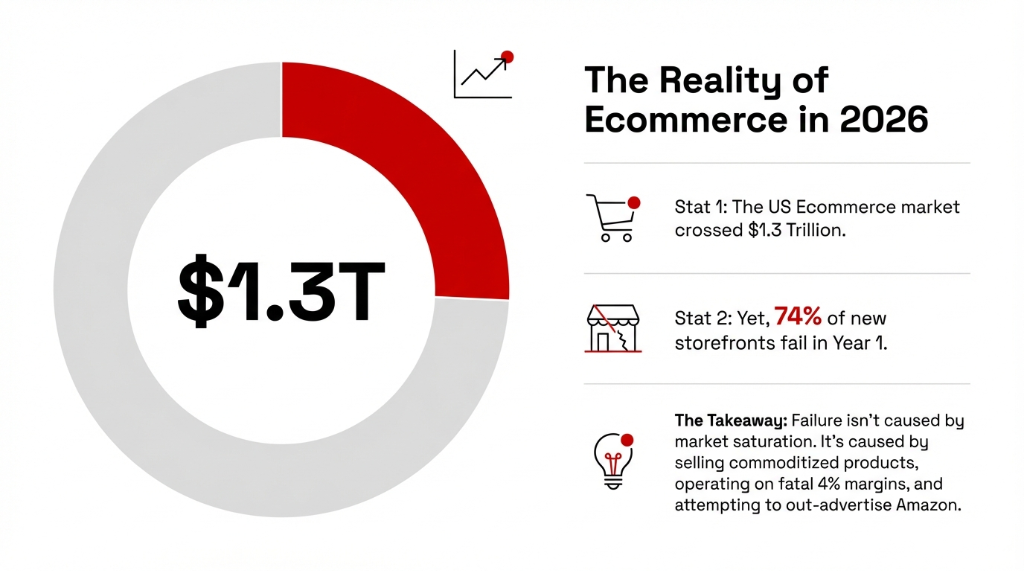
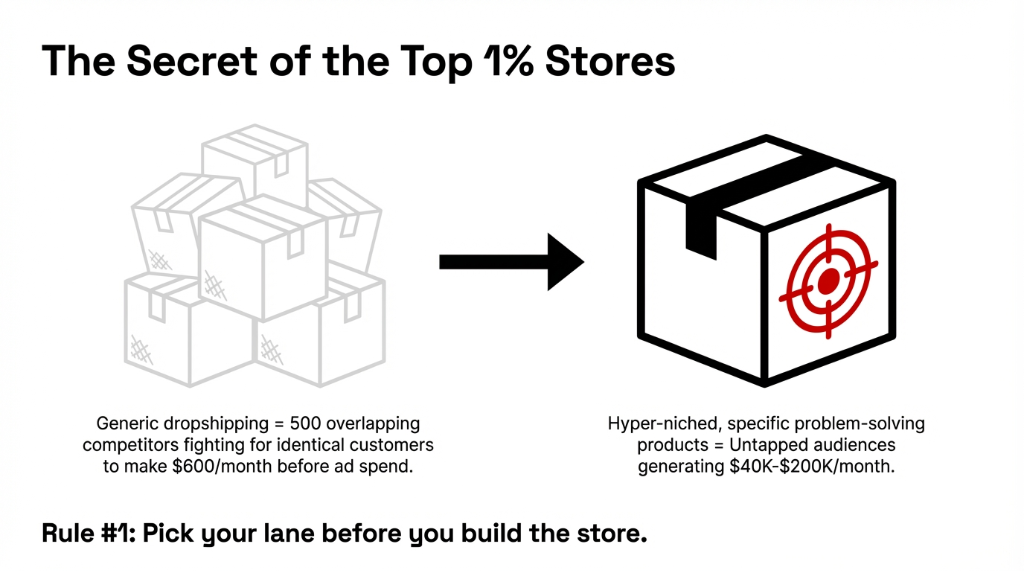
Shopify hosts well over 4.4 million live stores globally, with the US owning the largest share (Shopify store statistics, 2026). But the top-earning stores on the platform are hyper-niched, not general. The founders who built a store around a specific underserved problem are the ones pulling $40K–$200K/month. The ones running generic dropshipping with 500 overlapping competitors make $600/month before ad spend.
20 Shopify Store Ideas That Actually Generate Revenue in 2026
1. Pet Wellness Tech
An estimated 94 million US households (about 71%) own a pet, per the American Pet Products Association (APPA) National Pet Owners Survey. Pet tech, such as smart hydration devices, anxiety-reduction tools, and joint-support gadgets for aging dogs, is still in early-stage growth. Brands selling smart pet health monitors average $23–$47 product margins with 3.1x repeat purchase rates. Start here if you want a home-based business with near-zero competition in the premium tier.
2. Sleep Aid Accessories (Non-Supplement)
The sleep supplement market is crowded. Temperature-regulating pillowcases, weighted eye masks, white-noise machines, and anti-blue-light window films are not. One Sleep Travel Kit store does $14,200/month at a 61% gross margin, with a $38 average order value, run by a single founder with zero employees.
3. Home Office Micro-Upgrades
Hybrid work is now permanent for a majority of US knowledge workers. They are not buying $2,000 desks. They are buying $28 monitor light bars, $19 under-desk footrests, and $34 cable management kits. Supplier costs stay low and perceived value stays high. Built around "desk ergonomics for hybrid workers," you are looking at a $6–$18 cost per acquisition via Pinterest alone.
4. Print-on-Demand Apparel
Print-on-demand carries zero inventory risk: a POD supplier integrated with your store ships directly to the customer. Margins run 35–42%. The winners are niche-specific (nurse humor, dog-breed pride, regional sports fan apparel), not generic quote tees. One of the easiest businesses to start under $500.
5. Digital Products
The best online business to start, period. Profit margins run 85–94% with zero COGS after creation. Notion templates, Canva design kits, Lightroom presets, PDF guides, and mini-courses all qualify. One store selling Notion dashboard templates for real estate agents generates $8,700/month with a team of exactly one and zero fulfillment overhead.
6. Barrier Repair Skincare
Consumers now read ingredient labels the way their parents read nutritional info. The skincare niche around PDRN creams, enzyme masks, and fermented actives is growing fast in the US. Brands with clear, science-backed messaging convert at 4.1%, nearly double the standard ecommerce average of 2.5%. Works beautifully as a small online business with 3–5 hero SKUs.
7. Eco-Friendly & Sustainable Goods
Sustainable goods are one of the fastest-growing Shopify niches. The controversial part: most eco brands fail because they lead with the mission instead of the product. Buyers do not want a lecture; they want a better product that happens to be sustainable. Reusable food wraps, refillable cleaning pods, and bamboo kitchenware sell well when positioned around function first. Margins run 48–65%.
8. Cotton Activewear
The microplastics-in-activewear conversation exploded in 2025. Consumers, especially women 25–40, are ditching polyester leggings. Cotton and organic-cotton activewear is still underrepresented among major brands. A new founder can own a corner of this market in 6–9 months and run a positive ROAS by month 3 targeting female wellness audiences on TikTok and Meta.
9. Specialty & Functional Food
Protein snack bars, adaptogens, mushroom coffee, kombucha kits. The functional food category in the US runs in the tens of billions and is still growing. The trick: do not try to be a full grocery store. Build around one dietary identity (keto, vegan athlete, gut-health-focused) and own that positioning. Subscription models here average 4.3x lifetime value versus one-time buyers.
10. Subscription Box Business
Subscription boxes are not dead; bad ones are. The winners are hyper-curated around a specific identity: quarterly boxes for hobby fishermen, monthly boxes for indoor plant parents, bi-weekly boxes for single-serve cocktail enthusiasts. Upfront investment of $1,200–$2,400 in curated inventory compounds fast past 200 subscribers. We have seen clients hit $18,300/month in recurring revenue within 9 months of launch.
11. At-Home Medical-Grade Skincare Devices
LED therapy panels, microcurrent devices, and portable skin-lifting tools are expensive in clinics ($150–$400/session). Consumers want the same results at home for $89–$189 one-time. Strong before/after content and social proof are required, but once you have them, customer acquisition cost drops to $14–$22 per paid conversion on Meta.
12. Smart Home Gadgets (Dropshipping)
For a dropshipping business that is not plagued by 400 competitors selling the same thing, smart home micro-upgrades are the answer. Smart plugs with energy monitoring, motion-sensor night lights, and compact security cameras are still under-advertised relative to demand. It works best built around a specific use case (security for renters, energy-saving for apartments).
13. Personalized & Custom Products
Personalization commands a 26–38% price premium across almost every category. Custom birthstone jewelry, engraved leather wallets, custom pet portraits on canvas: consumers pay $47–$120 more for something with their name or story on it. Start with a POD or on-demand model, test designs, and only invest in inventory when a SKU proves itself. Use Shopify's built-in customization tools or a $29/month app to handle personalization at checkout.
14. Travel Accessories (Hyper-Niche)
Solo female travel, digital nomad gear, long-haul comfort accessories. The generic "travel gadget" store is dead. A store built entirely around anti-theft accessories for solo female travelers is a $30K/month business waiting to be built. Specific, problem-solving gear converts at 3.7% when paired with content that speaks to the audience's exact fear or frustration.
15. Plant-Based Protein & Supplements
The plant-based protein market is on a strong growth curve, projected to climb from roughly $24 billion in 2025 toward $35 billion by 2030 globally, with North America the largest single region (MarketsandMarkets plant-based protein market report). New flavors, specialized blends for women over 40, and single-serve formats are white space. Margin on white-label supplements runs 55–70%. One of the best businesses to start with little money if you launch with 2–3 SKUs and a strong email strategy via Klaviyo (an email and SMS marketing platform).
16. Upcycled & Vintage Fashion
Reworked denim, deadstock fabric pieces, one-of-one vintage reconstructions. The pre-loved fashion market in the US is growing roughly 21% annually. Scarcity is built into the product: you literally cannot have 500 competitors selling the identical item. Strong visual storytelling on a branded store can reach $9,500/month in 4–6 months, and acquisition cost stays low because exclusivity generates organic word-of-mouth.
17. Baby & Kids Educational Toys
Parents of children under 8 spent an average of $1,340 on educational products in 2024. Screen-free learning toys, Montessori-style wooden sets, and language-development tools all perform in the US. Products are lightweight, margins sit at 52–68%, and the repeat purchase cycle (baby to toddler to preschooler) is extremely predictable. Build around a developmental age range, not a random assortment.
18. Home Improvement & DIY Tools
US home improvement is a roughly $500 billion industry, and Shopify stores pull from it with smart, niche positioning. Hyper-specific kits (tile repair, grout cleaning systems, deck restoration bundles) outperform general hardware assortments by 3x in conversion rate. Margins run 40–60%, suppliers are abundant, and male homeowners 35–55 search for these on Google, making SEO a low-cost acquisition channel.
19. AI Tools & Productivity Templates
The fastest-growing digital product niche of 2026: custom GPT prompt bundles, AI workflow templates, and automated business documents. Pure digital products with zero COGS and massive demand. One creator selling AI Business Starter Kits (a bundle of 43 templates) generates $12,700/month with $0 in inventory cost. This is a low-cost business idea that scales.
20. Kids' Outdoor & Adventure Gear
Screen-time fatigue among parents is real. Compact camping gear for families with young children, kid-friendly hiking accessories, and outdoor adventure starter kits are all growing around 18% year over year in US ecommerce. This works as a dropshipping or small-online-business model because average order value runs $74–$138 and the buying trigger (summer camp, school breaks, national park trips) is predictable and marketable.
How to Start Your Shopify Store Without Wasting $10,000 on the Wrong Idea
First-time founders make the same mistake every time: they skip validation and go straight to a $3,000 inventory order. Then they discover nobody wants what they bought. Here is the right process, not the expensive one:
- Confirm demand is growing, not plateauing. Use Google Trends, TikTok search, and Reddit before committing.
- Start cheap. Use the Shopify Starter plan ($5/month) and a manual order process to test demand before full infrastructure.
- Validate with $200 in paid ads before spending $2,000 on product. If you cannot get a single Add-to-Cart on $200 of spend, the offer is broken, not the budget.
- Build with a professional theme that matches your niche. A generic template loses 14–22% of conversions before a single ad runs.
- Nail your brand name before launch. Rebranding later costs $800–$2,400 in design fees and kills brand equity.
Creating an online store is the easy part. The hard part is picking the right product and talking to the right customer. Once those two things click, the store practically runs itself.
The Business Models Behind These 20 Ideas
Not every ecommerce idea uses the same operating model. Here is what the numbers look like once you strip out the marketing fluff:
| Business Model | Startup Cost | Margin Range | Best For |
|---|---|---|---|
| Dropshipping | $200–$800 | 20–40% | Low-risk testing |
| Print-on-Demand | $100–$500 | 30–45% | Creative entrepreneurs |
| Digital Products | $0–$300 | 80–95% | Solo founders |
| White-Label / Private Label | $2,000–$8,000 | 50–70% | Brand builders |
| Subscription Boxes | $1,200–$3,000 | 35–55% | Community-driven brands |
| Handmade / Artisan | $500–$2,000 | 60–75% | Craft-focused sellers |
Shopify supports all six of these models natively, which is why it remains a top choice for US entrepreneurs. Unlike enterprise platforms that charge enterprise prices from day one, Shopify plans start at $29/month for the Basic tier and scale up as your revenue does.
Your Shopify Site Is Invisible to Google. That's Costing You $2,000/Month.
Your store is invisible to Google by default. That $2,000 you are planning to spend on Meta ads? Cut it in half and invest $1,000 into SEO-optimized product descriptions and blog content first. Stores that rank organically for high-intent terms (like "best sleep travel kit for long flights" or "organic cotton leggings no microplastics") acquire customers at near-zero cost per acquisition, indefinitely. Compared to a perpetual ad-spend treadmill, that is the difference between a business and a donation.
If you want help building an AI-powered store with smart search, product recommendation engines, and Shopify-to-Odoo integration to automate the back office, Braincuber's Shopify development team has built and optimized stores for small-business founders scaling from $0 to $1M+ ARR. Our team handles the parts that break when you grow.
Need your multi-channel inventory synced so Shopify, Amazon, and wholesale do not oversell? That is not a nice-to-have once you pass 200 orders/day. It is survival. And if your inventory management system is a spreadsheet, you are one bad VLOOKUP away from shipping 400 wrong orders in a weekend.
Frequently Asked Questions
What is the cheapest Shopify store idea to start with?
Digital products are the cheapest to launch: startup costs run under $300, margins hit 85–94%, and you need zero inventory. Templates, prompt bundles, and printable guides are proven performers. Pair a Shopify Starter plan with a simple Gumroad-to-Shopify integration and you are live in under 48 hours.
How much can a Shopify store make in Year 1?
A well-niched store run by a single founder can generate $8,000–$40,000 in year one. Dropshipping stores typically see 20–35% gross margins; digital product stores run 80–94%. The range depends on niche selection, ad-spend discipline, and email list growth in months 1–6.
Is dropshipping still profitable in 2026?
Yes, but only if you target margins above 55% and build a brand around a niche, not a product. Generic dropshipping with 20% margins and $30 CPCs on Meta is cash-flow negative by month 3. Niches like pet wellness tech, home office micro-upgrades, and travel accessories support strong margins and lower competition.
What Shopify plan should I start with?
Start with the Basic Shopify plan at $29/month. The Starter plan works if you are selling via social media links only. Move to the $79/month plan when monthly revenue exceeds $3,500: the reduced transaction fees save you $47–$90/month depending on volume.
Do I need a business name before setting up my store?
Yes, and do not underestimate this step. Use Shopify's built-in business name generator or a tool like Namelix to find a name available as a .com domain and a social handle at the same time. Rebranding after launch costs $800–$2,400 minimum and resets your domain authority to zero. Spend 3 hours on this before you spend $1 on ads.
Stop Guessing Niches. Start With the Ones That Work.
The founders who started in early 2024 are sitting on $30K–$80K/month stores right now. The ones who said "I'll wait until I figure it out" are still watching YouTube videos. You now have 20 validated ideas, a validation framework, and the business-model breakdown. The next step is yours. Book a free 15-minute Store Strategy Call with Braincuber Technologies and we will map your niche, your tech stack, and your first 90-day revenue plan. Book your free store strategy call.
Written by Mayur Domadiya — Founder & Odoo Practice Lead, Braincuber Technologies. Founder of Braincuber, he has scoped and shipped 500+ Odoo implementations for US mid-market and global brands, and takes every founder call personally, with no SDR layer between buyers and the people building the system.Founder and CEO of Braincuber. Scopes Odoo, AI, and cloud projects for growing brands in India and abroad. Takes every founder call personally — no SDR layer between buyers and the people building the system.