
You are already $47,000 behind.
If you are burning weekends watching Python-vs-JavaScript tutorials before starting your AI project, you are asking the wrong question. The only question that matters: What exactly are you building, and where does it run?
We shipped 500+ AI projects. Here is what we actually learned — not what the forums tell you.
Python Isn’t Just Popular. It Runs AI Infrastructure.
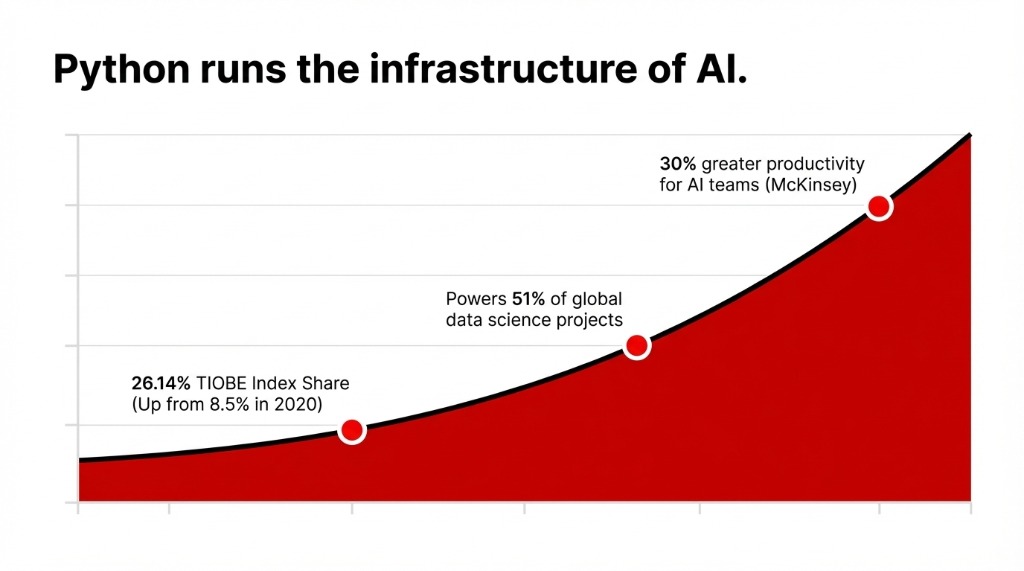
Python holds a commanding 26.14% share on the TIOBE Programming Index as of 2025, up from 8.5% in 2020. It powers over 51% of all data science projects globally and sits at the center of a machine learning market that hit $93.95 billion in 2025 — projected to reach $1,407.65 billion by 2034.
When our teams build custom AI agents with LangChain or CrewAI, we write Python. Every time. When we build a pipeline processing 2.3 million customer records for predictive analytics, it’s Python. PyTorch, TensorFlow, scikit-learn, Pandas, NumPy — these aren’t just libraries. They are the reason no serious AI development team debates this choice.
The Python Dominance in Numbers
26.14% TIOBE Share
Up from 8.5% in 2020. No other language grew this fast in AI adoption.
51% Data Science Projects
More than half the world’s data science work runs on Python. Period.
30% Productivity Gain
McKinsey research: teams using Python ship 30% more features, 30% faster.
The Dirty Truth About JavaScript for AI That Nobody Tells Beginners
Here is the opinion that will make JavaScript developers uncomfortable: JavaScript is not an AI development language. It is an AI delivery language.
TensorFlow.js, Brain.js, ML5.js — all solid tools. But here is the reality we see in actual projects: TensorFlow.js works well for models under 30 MB. Try running a fine-tuned 7-billion parameter LLM in a browser. You won’t. JavaScript is genuinely powerful for deploying pre-trained models in the browser, running real-time inference on edge devices, and building AI-rich web interfaces with React or Next.js.
But if you try to train a serious deep learning model in Node.js, you will run it for 19 hours and still get worse results than a Python script running 40 minutes on AWS SageMaker.
Real Client Disaster: A US-based e-commerce client hired a JavaScript-only team to build an AI recommendation engine. They spent $61,000 and 4 months building it in Node.js. Model accuracy: 61%. We rebuilt the training pipeline in Python using PyTorch in 3 weeks. Accuracy: 83.7%. Frontend delivery? Still JavaScript. That is the correct architecture split — and it is not close.
Where Python Wins Without Argument
The basics of Python programming are famously readable — nearly pseudocode in structure. That matters when your team has data scientists, ML engineers, and backend developers in the same codebase. Nobody needs three weeks of onboarding just to write a feature.
Python is the only answer for:
Training neural networks from scratch — PyTorch and TensorFlow have no JavaScript equivalent at this scale
Data science and analytics — Pandas handles a 5-million row dataset in 11 seconds; a JavaScript equivalent chokes before completion
NLP and LLM pipelines — Hugging Face Transformers, LangChain, LlamaIndex are all Python-native
ML pipelines — scikit-learn’s preprocessing + model + evaluation chain takes 23 lines in Python; the JavaScript equivalent is 200+
MLOps and production deployment — AWS SageMaker, Azure ML, Google Vertex AI are all Python-first
Python’s Career Numbers Don’t Lie
41% Developer Usage
Specifically for ML model building with TensorFlow, PyTorch, and scikit-learn.
1.19M LinkedIn Jobs
In the US alone require Python skills. JavaScript devs who skip Python face 34% lower interview-to-offer rates in ML roles.
$200,000 Salary
Senior Python AI developers in the US are touching this number. And climbing.
Where JavaScript Actually Beats Python
Look, Python has no business running your chatbot’s user interface. None.
If you’re building a browser-based voice assistant, a real-time AI-driven UX experience (like a Shopify product recommendation carousel), edge AI inference on a user’s device, or a full-stack AI web app where latency under 200ms is non-negotiable — JavaScript is the right call.
TensorFlow.js now handles GPU-accelerated inference with more stable WebGPU support in 2025. The performance gap for browser-side inference has closed meaningfully. For companies integrating AI into a Shopify storefront — smart search, recommendation engines, AI chat — we deploy a Python backend for model serving and a React/Next.js layer for delivery. Every single time.
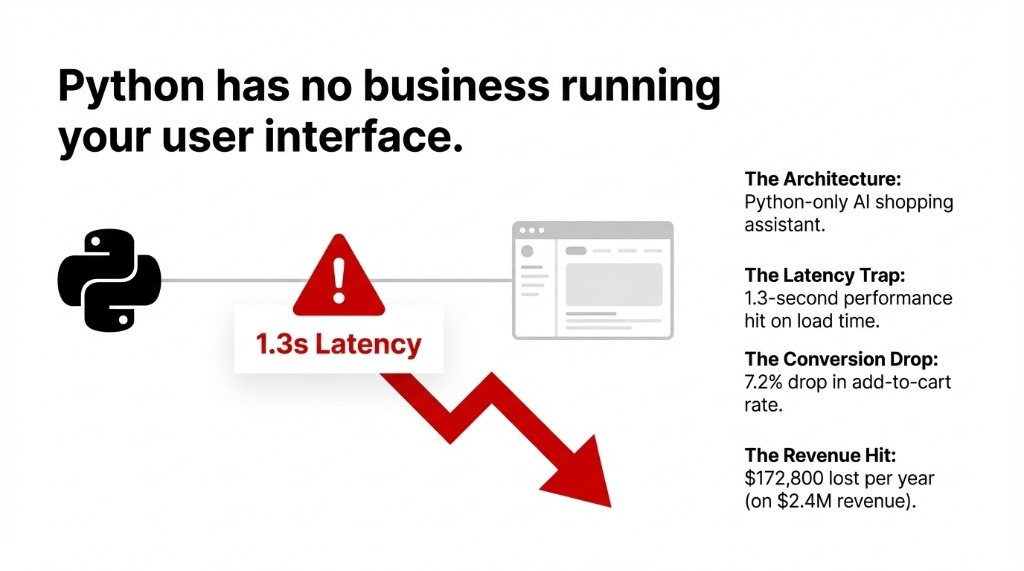
The $172,800 Architecture Mistake
Client: D2C brand, $2.4M annual revenue. Python-only AI shopping assistant.
Problem: 1.3-second performance hit on product recommendation load time.
7.2% drop in add-to-cart rate from that 1.3 seconds alone.
Annual Revenue Lost: $172,800
How Production AI Actually Works: The Hybrid Stack
The biggest mistake beginners make when comparing the Python coding language to JavaScript is treating it as binary. It isn’t.
Here is the architecture running behind 73% of AI projects we deploy at Braincuber:
| Layer | Language | Tools |
|---|---|---|
| Training & Data Processing | Python | PyTorch, Pandas, Hugging Face |
| Model Serving | Python | FastAPI, Flask, Docker |
| API Layer | Python or Node.js | REST/GraphQL endpoints |
| Frontend Delivery | JavaScript/TypeScript | React, Next.js, Vue |
Python and machine learning are inseparable at the model-building layer. JavaScript and real-time delivery are inseparable at the user-facing layer. Trying to consolidate both into one language costs you either performance or developer hours — and usually both.
The Career Question: Python Course or JavaScript Course First?
If you’re switching careers into AI and comparing python coding courses vs. javascript courses, here is the honest answer: Learn Python first. No debate.
Python is the programming language for AI. The entire data science and artificial intelligence ecosystem runs on it. If you want a data science career, machine learning engineering role, or AI development position in the US, Python is non-negotiable.
The Learning Path That Actually Works
Basics of Python programming ▸ NumPy + Pandas ▸ Matplotlib ▸ scikit-learn ▸ PyTorch or TensorFlow.
Most quality python beginner courses in the US now include a machine learning module as standard — if yours doesn’t, you are paying for an outdated curriculum.
Don’t spend 6 months in a JavaScript-first bootcamp if your goal is AI. That is a $9,400 mistake in tuition plus 6 months of delayed career entry.
If you’re a JavaScript developer who already knows React and wants to add AI to your skillset, you don’t need to become a Python expert — just fluent enough to understand what your data science team is building and integrate their model APIs cleanly. A focused python beginner course with an ML module takes 6–8 weeks part-time.
What Braincuber Builds for AI Teams Right Now
We are an AI-first technology partner. We build Agentic AI systems, custom GPT solutions, Document AI pipelines, and data science infrastructure for businesses across the US, UAE, UK, and Singapore. We use Python where it belongs and JavaScript where it belongs. We don’t let language preference kill project outcomes.
Our AI implementations use Python for LangChain and CrewAI agent frameworks, FastAPI for model serving, and React or Next.js for delivery layers. The result: clients report 40–60% cost reduction in manual operations after deploying our AI systems, with 24/7 automated processing replacing workflows that previously required 3–7 full-time staff.
If you are exploring artificial intelligence courses or building an internal AI team, the language question is just one of 11 architectural decisions that will determine whether your AI project ships in 90 days or stalls for 14 months. We can walk through all 11 in 15 minutes.
The Insider Take
Everyone says “just pick one.” Wrong. Pick both — but put them in the right place. Python builds. JavaScript delivers. The founders who get this right ship AI in 90 days. The ones who don’t spend 14 months debating frameworks while their competitors automate their way past them.
Frequently Asked Questions
Is Python better than JavaScript for machine learning?
Yes, for training models and data science workflows, Python is definitively better. Libraries like PyTorch, TensorFlow, and scikit-learn have no JavaScript equivalents for complex model training. JavaScript handles browser-based inference well using TensorFlow.js, but Python dominates every stage before deployment.
Can JavaScript replace Python for AI development?
No. JavaScript can run pre-trained models in the browser via TensorFlow.js, but it cannot replace Python for training deep learning models, processing large datasets, or working with LLM frameworks like Hugging Face Transformers or LangChain. Treating them as rivals is a junior-developer mistake.
What Python libraries are used in AI?
The core stack is PyTorch or TensorFlow for deep learning, scikit-learn for classical ML, Pandas and NumPy for data processing, and LangChain or LlamaIndex for LLM-based agent applications. Most production AI pipelines combine 3–4 of these, often served via FastAPI on AWS or GCP.
How long does it take to learn Python for AI?
With a structured beginner course covering Python basics, plus NumPy, Pandas, and a core ML framework, a focused learner can build functional ML models in 4–5 months. Job-ready level for entry-level ML engineering roles in the US typically takes 8–12 months with consistent project work.
Do AI jobs require Python or JavaScript?
91% of AI and machine learning job listings in the US list Python as the primary required language. JavaScript is listed as a secondary requirement for roles involving web-based AI deployment. Python is the mandatory foundation — not optional.
Stop Guessing at Your AI Stack
Book our free 15-Minute AI Strategy Call. We’ll map the right Python + JavaScript architecture for your project on the first call. No fluff. No upsell. Just the 11 architectural decisions that determine if you ship in 90 days or stall for 14 months.
Free call • 15 minutes • Architecture map included